Kurukshetra a journal on rural development is published by
A
Ministry of Finance
B
Ministry of Information and Broadcastin
C
Ministry of Rural Development
D
Planning Commission
Question 3Single Answer
Devaluation of a currency means
A
Fixing the value of the currency in conjuction with the movement in the value of a basket of predetermined currencies
B
Reduction in the value of a currency vis-à-vis major internationally traded currencies
C
Fixing the value of currency in multilateral consultaion with the IMF the World Bank and major trading partners
D
Permitting the currency to seek its worth in the international market
Question 4Single Answer
In India rural incomes are generally lower than the urban incomes, which of the following reasons account for this
1. a large number of farmers are illiterate and know little about scientific agriculture
2. prices of primary products are lower than those of manufactured products
3. Investments in agriculture has been low when compared to investment in industry
A
1 and 3
B
2 and 3
C
1 and 2
D
1,2 and 3
Question 5Single Answer
Which of the following programmes aims at the promotion of savings among rural women
A
Rashtriya Mahila Kosh
B
Indira Mahila Yojna
C
Jawahar Rozgar Yojna
D
Mahila Samridhi Yojna
Question 6Single Answer
Total number of districts in Andhra Pradesh ?
A
10
B
12
C
13
D
17
Question 7Single Answer
Which one is the largest district by area wise in Andhra Pradesh ?
A
Kurnool
B
Anantapur
C
Kadapa
D
Nellore
Question 8Single Answer
Who is the first sports person to received Rajiv Gandhi Khel Ratna award from Andhra Pradesh ?
A
Pullela Gopichand
B
Karnam Malleswari
C
Saina Nehwal
D
Sania Mirza
Question 9Single Answer
Before Hyderabad was made capital in 1956, which city was the capital of Andhra Pradesh ?
A
Warangal
B
Vijayawada
C
Visakhapatnam
D
Kurnool
Question 10Single Answer
In which district, the TirumalaVenkateswara Temple is located ?
A
Chittoor
B
Krishna
C
Kurnool
D
Vizianagaram
Question 11Single Answer
Which river forms the boundary between Andhra Pradesh and Telangana ?
A
Krishna
B
Godavari
C
Tungabhadra
D
Penna
Question 12Single Answer
What is the highest peak in Andhra Pradesh ?
A
Anaimudi
B
Mahendragiri
C
Arma Konda
D
Kailasagiri
Question 13Single Answer
The Coromandel Coast is located in which part of Andhra Pradesh ?
A
Northern
B
Southern
C
Eastern
D
Western
Question 14Single Answer
Which of the following districts is not part of the Rayalaseema region ?
A
Anantapur
B
Kurnool
C
Kadapa
D
Visakhapatnam
Question 15Single Answer
Which one of the following rivers does not flow through Andhra Pradesh ?
A
Krishna
B
Godavari
C
Tungabhadra
D
Cauvery
Question 16Single Answer
On what date did India celebrate the 9th anniversary of the Goods and Services Tax (GST) implementation?
A
July 1, 2026
B
June 30, 2026
C
July 2, 2026
D
June 29, 2026
Question 17Single Answer
Which global event is India participating in with Sweden as a partner?
A
Venus Orbiter Mission 'Shukrayaan'
B
Chandrayaan-4
C
Gaganyaan crewed mission
D
Mars Orbiter Mission-2
Question 18Single Answer
Who became India's 97th Chess Grandmaster in late June 2026?
A
Gukesh D
B
Praggnanandhaa R
C
Harshavardhan G.B.
D
Arjun Erigaisi
Question 19Single Answer
What major merger was approved by the boards of PFC and REC Limited on June 30, 2026?
A
Merger with SBI
B
Merger into a single power financing entity
C
Merger with NTPC
D
Merger with IREDA
Question 20Single Answer
Which initiative was launched at the Rashtriya Gramin Vikas Sammelan 2026 for rural women SHGs?
A
Lakhpati Didi App
B
Digital India Rural Scheme
C
PM Kisan Drone Yojana
D
SARAS Shakti Collection and Coffee Table Book
Perspectives in Education
Question 21Single Answer
What was the primary mode of education during the Pre-Vedic period in ancient India?
A
Formal schooling in institutions
B
Learning through written texts
C
Informal education within families and communities
D
Vocational training in specialized centers
Question 22Single Answer
What was a significant characteristic of knowledge transmission during the Pre-Vedic era?
A
Emphasis on practical skills for agriculture
B
Reliance on oral tradition and memorization
C
Development of a written script for learning
D
Focus on artistic and creative expression
Question 23Single Answer
In the Pre-Vedic period, who played a crucial role in imparting education?
A
Royal scholars and philosophers
B
Wandering monks and ascetics
C
Elders and gurus within the community
D
Specialized teachers in formal schools
Question 24Single Answer
What type of educational institutions began to emerge during the Post-Vedic period in India?
A
Large universities with diverse faculties
B
Specialized vocational training centers
C
Formal institutions known as Gurukuls
D
Monasteries focused solely on religious studies
Question 25Single Answer
Which of the following scriptures formed a central part of the curriculum in the Gurukuls of the Post-Vedic period?
A
Arthashastra and Natyashastra
B
Vedas and Upanishads
C
Ramayana and Mahabharata
D
Puranas and Smritis
Question 26Single Answer
Besides religious texts, what other subjects were often included in the curriculum of Post-Vedic education?
A
Medicine and engineering
B
Grammar, astronomy, mathematics, and philosophy
C
Fine arts and music
D
Military science and administration
Question 27Single Answer
What was the primary language of instruction in the formal educational institutions of the Post-Vedic period?
A
Pali
B
Sanskrit
C
Prakrit
D
Tamil
Question 28Single Answer
What major cultural influence significantly impacted education during the Medieval period in India?
A
The rise of Buddhism and Jainism
B
The arrival of European traders
C
The influence of Islamic traditions
D
The resurgence of ancient Vedic practices
Question 29Single Answer
What were the primary educational institutions established under Islamic influence during the Medieval period?
A
Agraharas and Ghatikas
B
Maktabs and Madrasas
C
Pathshalas and Tols
D
Universities and Colleges
Question 30Single Answer
What was the main focus of education in Maktabs during the Medieval period?
A
Advanced scientific research
B
Religious teachings and basic literacy
C
Military training and strategy
D
Classical arts and literature
Classroom Implications of Educational Psychology
Question 31Single Answer
Inter-individual differences in a classroom refer to variations?
A
Within a single student across different subjects.
B
Between different students in the class.
C
In a student's performance over time.
D
In the teacher's approach to different students.
Question 32Single Answer
Which of the following is an example of an inter-individual difference among students?
A
A student excels in both math and science but struggles with writing.
B
One student learns best through visual aids, while another learns best through hands-on activities.
C
A student's motivation in history fluctuates throughout the year.
D
A student shows improvement in reading comprehension after focused practice.
Question 33Single Answer
Intra-individual differences refer to variations?
A
Between different teachers in the same school.
B
Within a single student across different abilities or interests.
C
In the overall performance of the class compared to previous years.
D
Between students from different cultural backgrounds.
Question 34Single Answer
Which of the following is an example of an intra-individual difference in a student?
A
A student consistently scores high marks in all subjects.
B
A student is highly skilled in mathematics but has difficulty with reading comprehension.
C
Two students have different learning paces in the same subject.
D
Students in a class show a range of interests in different topics.
Group students homogeneously based on overall performance.
B
Recognize a student's unique profile of strengths and weaknesses.
C
Apply a uniform teaching method to the entire class.
D
Focus solely on a student's areas of difficulty.
Question 36Single Answer
Differentiated instruction primarily aims to?
A
Teach all students the same content at the same pace.
B
Tailor teaching to meet the diverse needs of individual learners.
C
Group students based on their similar learning styles.
D
Focus on the average learner in the classroom.
Question 37Single Answer
In differentiated instruction, teachers might vary the?
A
Classroom rules and expectations for different students.
B
Content, process, product, and learning environment.
C
Amount of homework assigned to different students.
D
Grading criteria for individual students.
Question 38Single Answer
Providing reading materials at different levels of complexity is an example of differentiating the?
A
Process
B
Content
C
Product
D
Learning environment
Question 39Single Answer
Allowing students to choose how they demonstrate their learning (e.g., report, presentation, model) is an example of differentiating the?
A
Content
B
Process
C
Product
D
Learning environment
Question 40Single Answer
Using varied instructional strategies like visual aids, hands-on activities, and discussions caters to differentiation of?
A
Content
B
Process
C
Product
D
Learning environment
Mathematics
Question 41Single Answer
The elements of the set {x : x is an integer, x2 : 4} can be represent as .....Z..... . Here, Z refers to
A
{–2, 2}
B
{–1, 0, 1}
C
{–2, –1, 0, 1, 2}
D
{0, 1, 2}
Question 42Single Answer
A
B
C
D
None of these
Question 43Single Answer
If Y = {x : x is a positive factor of the number 2p – 1(2p – 1), where 2p – 1 is a prime number}, then Y can be represent in roster form as
A
{2}
B
{1, 2}
C
{1, 2, 22, ....., 2p – 1}
D
{1, 2, 22, 23,.... 2p – 1, (2p – 1)}
Question 44Single Answer
The set {x : x is a positive integer less than 6 and 3x – 1 is an even number} in roster form is
A
{1, 2, 3, 4, 5}
B
{1, 2, 3, 4, 5, 6}
C
{2, 4, 6}
D
{1, 3, 5}
Question 45Single Answer
If A B and A B, then
A
A is called a proper subset of B
B
A is called a super set of B
C
A is not a subset of B
D
B is a subset of A
Question 46Single Answer
The number of non-empty subsets of the set{1, 2, 3, 4} is
A
15
B
14
C
16
D
17
Question 47Single Answer
The number of elements of the power set of a set containing m elements is
A
2m – 1
B
m
C
m2
D
2m
Question 48Single Answer
If A = {x : x = n2, n = 1, 2, 3}, then number of proper subsets is
A
3
B
8
C
7
D
None of these
Question 49Single Answer
If A = {x : x = 4n + 1, 2 £ n £ 5},then number of subsets of A is
A
16
B
15
C
4
D
None of these
Question 50Single Answer
Let A and B be two non-empty subsets of a set X such that A is not a subset of B, then
A
A is always a subset of the complement of B
B
B is always a subset of A
C
A and B are always disjoint
D
A and the complement of B are always non-disjoint
Important Questions Package
AP DSC School Assistant Mathematics Exam Online Question Bank Package
Buy AP DSC School Assistant Mathematics Important Questions, MCQ, question answer in Hindi & English. It will help you to score high marks in AP DSC School Assistant Mathematics question bank 2026 in Online, PDF & Print study material.
+ Free Monthly Current Affairs, GK & more PDF Download
Sr.
Package Name
Amount
1.
AP DSC School Assistant (Mathematics) Exam - English
Description : 1000 Question with Answer
₹101[₹500]
2.
AP DSC School Assistant (Mathematics) Exam - English
Description : 2000 Question with Answer
₹151[₹500]
3.
AP DSC School Assistant (Mathematics) Exam - English
Description : 3000 Question with Answer
₹181[₹500]
4.
AP DSC School Assistant (Mathematics) Exam - English
Description : 1000 Question & Answer Download in PDF (Send by Email)
₹151[₹450]
5.
AP DSC School Assistant (Mathematics) Exam Question Bank Book - English
Description : 1000 Question with Answer (Printed Material)
₹390[₹600]
Mathematics
Question 51Single Answer
Which of the following is/are empty set?
A = {x : x2 + x + 1 = 0 and x Î Z} B = {x : x is a prime number and 19 < x < 23}
A
A
B
B
C
Both A and B
D
None of the above
Question 52Single Answer
The set {x : x4 = 1 and x R} is .....X.... set. Here, X refers to
A
empty
B
finite
C
infinite
D
singleton
Question 53Single Answer
The universal set for the sets
A = {x : x2 – 5x + 6 = 0} and
B = {x : x2 – 3x + 2 = 0} having least number of elements is
A
{1, 2}
B
{1, 3}
C
{1, 2, 3}
D
{0, 1, 2, 3}
Question 54Single Answer
If A = {1, 2, 3}, B = {x € R : x2 – 2x + 1 = 0},
C = {1, 2, 2, 3} and
D = {x € R : x3 – 6x2 + 11x – 6 = 0}, then the equal sets are
A
A and B
B
A and C
C
A, B and C
D
A, C and D
Question 55Single Answer
If A = (–3, 5) and B = [–7, 9], then
A
A = B
B
A B
C
B A
D
None of these
Question 56Single Answer
Two finite sets have m and n elements, respectively. The total number of subsets of first set is 56 more than the total number of subsets of the second set. The value of m and n respectively are
A
7, 6
B
5, 1
C
6, 3
D
8, 7
Question 57Single Answer
Combine terms: 12a + 26b - 4b – 16a .
A
4a + 22b
B
-28a + 30b
C
-4a + 22b
D
28a + 30b
Question 58Single Answer
The average of first 50 natural numbers is ………… .
A
25.30
B
25.5
C
25.00
D
12.25
Question 59Single Answer
60 Times of 8 Equals to
A
480
B
300
C
250
D
400
Question 60Single Answer
Consider the sets
A = {x : x is a real number and x2 + 1 = 0}
B = {x : x is a real number and x2 – 16 = 0}
C = {x : x is a real number and x2 = x + 2}
Which of the following is are null set ?
A
A
B
A and B
C
A and C
D
A, B and C
Question 61Single Answer
If X = {4n – 3n – 1: n Î N} and Y = {9(n – 1): n Î N}; where N is the set of natural numbers, then X È Y is equal to
A
N
B
Y – X
C
X
D
Y
Question 62Single Answer
Which of the following is / are correct?
I. {2, 3, 4} {1, 2, 3, 4, 5}
II. {a, b, c} {b, c, d}
III. {x : x is an equilateral triangle in a plane} Ì {x : x is a triangle in the same plane}
IV. {x : x is an even natural number} {x : x is an integer}
A
I and III are correct
B
II and III are correct
C
Only IV is correct
D
All above are correct
Question 63Single Answer
A
B
C
D
Question 64Single Answer
Consider the following statements :
1. The set of all irrational numbers between √2 and √5 is an infinite set .
2. The set of all odd integers less than 100 is a finite set .
Which of the statements given above is/are correct ?
A
1 only
B
2 only
C
Both 1 and 2
D
Neither 1 nor 2
Question 65Single Answer
What is the Next Prime Number after 7 ?
A
13
B
12
C
14
D
11
Question 66Single Answer
If A and B are two given sets, then A (A B)C is equal to
A
A
B
B
C
D
Question 67Single Answer
121 Divided by 11 is
A
11
B
10
C
19
D
18
Question 68Single Answer
Let X be the universal set for sets A and B, if n(A) = 200, n(B) = 300 and n = 100, then n is equal to 300 provided n(X) is equal to
A
600
B
700
C
800
D
900
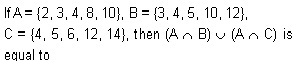
Question 69Single Answer
A
{3, 4, 10}
B
{2, 8, 10}
C
{4, 5, 6}
D
{3, 5, 14}
Question 70Single Answer
Let A = {x : x is a prime factor of 240} B = {x : x is the sum of any two prime factors of 240}, then
A
B
C
D
Question 71Single Answer
Which of the following statements can be proven using mathematical induction?
A
The sum of angles in a triangle is 180°
B
The sum of the first n odd numbers is n^2
C
Every even number is divisible by 3
D
The area of a circle is πr^2
Question 72Single Answer
What is the first step in proving a statement by mathematical induction?
A
Assume the statement is true for n = k
B
Prove the statement for n = 1
C
Prove the statement for n = k + 1
D
Check the statement for n = 0
Question 73Single Answer
The principle of mathematical induction is used to prove statements about:
A
Real numbers
B
Natural numbers
C
Rational numbers
D
Complex numbers
Question 74Single Answer
Which of the following is NOT a part of the induction process?
A
Base case
B
Inductive hypothesis
C
Inductive step
D
Contradiction proof
Question 75Single Answer
To prove that 1 + 2 + 3 + ... + n = n(n+1)/2 for all natural numbers, what is the base case?
A
n = 0
B
n = 1
C
n = 2
D
n = 3
Question 76Single Answer
In the inductive step, we assume the statement is true for n = k. This assumption is called:
A
Base case
B
Inductive hypothesis
C
Inductive step
D
Conclusion
Question 77Single Answer
Which theorem is closely related to the principle of mathematical induction?
A
Binomial Theorem
B
Well-Ordering Principle
C
Pythagorean Theorem
D
Fundamental Theorem of Calculus
Question 78Single Answer
To prove that 2^n > n for all natural numbers n, what is the base case?
A
n = 0
B
n = 1
C
n = 2
D
n = 3
Question 79Single Answer
What is the inductive hypothesis for proving 3^n > 2n for all n ≥ 1?
A
Assume 3^k > 2k
B
Assume 3^(k+1) > 2(k+1)
C
Assume 3^k = 2k
D
Assume 3^k < 2k
Question 80Single Answer
To prove that 5^n - 1 is divisible by 4 for all n ≥ 1, what is the base case?
A
n = 0
B
n = 1
C
n = 2
D
n = 3
Question 81Single Answer
In proving 1 + 3 + 5 + ... + (2n-1) = n^2, what is the inductive step?
A
Show that 1 + 3 + ... + (2k-1) = k^2
B
Show that 1 + 3 + ... + (2k-1) + (2k+1) = (k+1)^2
C
Show that 2n - 1 = n^2
D
Show that (2n-1) = n^2
Question 82Single Answer
To prove that 6^n - 1 is divisible by 5 for all n ≥ 1, what is the inductive hypothesis?
A
Assume 6^k - 1 is divisible by 5
B
Assume 6^(k+1) - 1 is divisible by 5
C
Assume 6^k - 1 = 5
D
Assume 6^k = 5
Question 83Single Answer
What is the base case for proving that n^3 + 2n is divisible by 3 for all n ≥ 1?
A
n = 0
B
n = 1
C
n = 2
D
n = 3
Question 84Single Answer
To prove that 1^2 + 2^2 + ... + n^2 = n(n+1)(2n+1)/6, what is the inductive step?






 B and A
 B, then
 R} is .....X.... set. Here, X refers to
 B
 A





 (A


 = 100, then n
 is equal to 300 provided n(X) is equal to