A B C D E F G H I J K L M N O P Q R S T U V W X Y Z .
Which letter in this alphabet is the eighth letter to the right of the letter and which is tenth letter to the left of the last but one letter of the alphabet ?
A
X
B
W
C
I
D
H
Question 2Single Answer
Passage :
Direction : The following question is based on the five words given below:
AND FOR THE BIG SUM (The new words formed after performing the mentioned operations may or may not necessarily the meaningful English words.)
If the third alphabet of each of the words is changed to the next alphabet in the English alphabetical series, which of the following will form a meaningful English word?
A
SUM
B
BIG
C
Both BIG and THE
D
FOR
E
Both FOR and BIG
Question 3Single Answer
Passage :
Direction : The following question is based on the five words given below:
AND FOR THE BIG SUM (The new words formed after performing the mentioned operations may or may not necessarily the meaningful English words.)
If the given words are arranged in the order as they would appear in a dictionary from left to right, which of the following will be second from the right ?
A
AND
B
FOR
C
THE
D
BIG
E
SUM
Question 4Single Answer
Passage :
Direction: The following question is based on the five words given below:
AND FOR THE BIG SUM (The new words formed after performing the mentioned operations may or may not necessarily the meaningful English words.)
If second alphabet in each of the words is changed to next alphabet in the English alphabetical order, how many words having two vowels (same or different vowels) will be formed ?
A
None
B
One
C
Two
D
Three
E
Four
Question 5Single Answer
Passage :
Direction : The following question is based on the five words given below:
AND FOR THE BIG SUM (The new words formed after performing the mentioned operations may or may not necessarily the meaningful English words.)
How many letters are there in the English alphabetical series between the second letter of the word which is second from the right and the second letter of the word which is second from the left of the given words?
A
Two
B
Five
C
Six
D
Nine
E
Three
Question 6Single Answer
Passage :
Direction: The following question is based on the five words given below:
AND FOR THE BIG SUM (The new words formed after performing the mentioned operations may or may not necessarily the meaningful English words.)
If in each of the given words, each of the consonant is changed to previous letter and each vowel is changed to next letter in the English alphabetical series, in how many words thus formed will no vowels appear?
A
None
B
One
C
Two
D
Three
E
More than three
Question 7Single Answer
Passage :
Direction : Following question is based on five words given below: BRU LEGINKCATOWN
(The new words formed after performing the mentioned operations may or may not necessarily be meaningful English words)
If the third alphabet in each of the words is changed to the next alphabet in the English alphabetical order, how many words having two vowels (same or different vowels) will be formed?
A
None
B
One
C
Two
D
Three
E
Four
Question 8Single Answer
Passage :
Direction : Following question is based on five words given below: BRU LEGINKCATOWN
(The new words formed after performing the mentioned operations may or may not necessarily be meaningful English words)
If the position of the first and the second alphabets of each of the words are interchanged, which of the following will form a meaningful English word?
A
Both CAT and OWN
B
Both BRU and INK
C
Only CAT
D
Only INK
E
Only LEG
Question 9Single Answer
Passage :
Direction: Following question is based on five words given below: BRU LEGINKCATOWN
(The new words formed after performing the mentioned operations may or may not necessarily be meaningful English words)
If the given words are arranged in the order as they would appear in a dictionary from left to right, which of the following will be exactly in the middle of the five words?
A
OWN
B
LEG
C
BRU
D
CAT
E
INK
Question 10Single Answer
Passage :
Direction: Following question is based on five words given below: BRU LEGINKCATOWN
(The new words formed after performing the mentioned operations may or may not necessarily be meaningful English words)
If in each of the given words, each of the consonants is changed to previous letter and each vowel is changed to next letter in the English alphabetical series, in how many words thus formed will the same alphabet appear twice?
A
None
B
One
C
Two
D
Three
E
More than three
Question 11Single Answer
Passage :
Find the missing number in the following series ?
3, 5, 5, 19, 7, 41, 9, ?
A
71
B
61
C
79
D
69
Question 12Single Answer
Passage :
Direction: following question is based on five words given below:
LAP BUT CAR SON HID
(The new words formed after performing the mentioned operations may or may not necessarily be meaningful English words.)
If the positions of the first and the third alphabets of each of the words are interchanged, which of the following would form meaningful words with the new arrangement?
A
HID
B
SON
C
Both LAP and BUT
D
CAR
E
Both CAR and LAP
Question 13Single Answer
Passage :
Direction: following question is based on five words given below:
LAP BUT CAR SON HID
(The new words formed after performing the mentioned operations may or may not necessarily be meaningful English words.)
If the given words are arranged in the order as they would appear in a dictionary from left to right, which of the following will be fourth from the left?
A
LAP
B
BUT
C
CAR
D
SON
E
HID
Question 14Single Answer
Passage :
Direction : following question is based on five words given below:
LAP BUT CAR SON HID
(The new words formed after performing the mentioned operations may or may not necessarily be meaningful English words.)
If in each of given words, each of the consonants is changed to previous letter and each vowel is changed to next letter in the English alphabetical series, in how many words thus formed will at least one vowel appear?
A
None
B
One
C
Two
D
Three
E
More than three
Question 15Single Answer
Passage :
Direction : following question is based on five words given below:
LAP BUT CAR SON HID
(The new words formed after performing the mentioned operations may or may not necessarily be meaningful English words.)
How many letters are there in the English alphabetical series between the third letter of the word which is third from the right and the first letter of the word which is first from the left of the given word?
A
Two
B
Five
C
Six
D
Nine
E
Three
Question 16Single Answer
Passage :
Direction: following question is based on five words given below:
LAP BUT CAR SON HID
(The new words formed after performing the mentioned operations may or may not necessarily be meaningful English words.)
If second alphabet in each of the words is changed to next alphabet in the English alphabetical order, how many words having no vowels will be formed?
A
None
B
One
C
Two
D
Three
E
More than three
Question 17Single Answer
Passage :
Direction: following letter is based on the five three letter words given below:
PIN ROD DEN SAT FUN
(Note: The words formed after performing the given operations may or may not be meaningful English words.)
If all the letters in each of the words are arranged alphabetically (within the word), how many words will remain unchanged?
A
One
B
Two
C
Three
D
More than three
E
None
Question 18Single Answer
Passage :
Direction: following letter is based on the five three letter words given below:
PIN ROD DEN SAT FUN (Note: The words formed after performing the given operations may or may not be meaningful English words.)
According to the English alphabetical series how many letters are there between the first letter of the third word and the first letter of the fifth word?
A
Two
B
One
C
None
D
Three
E
More than three
Question 19Single Answer
Passage :
Direction: following letter is based on the five three letter words given below:
PIN ROD DEN SAT FUN (Note: The words formed after performing the given operations may or may not be meaningful English words.)
If the first letter of all the words is changed to the previous letter of the English alphabetical series, how many words will have more than one vowel?
A
One
B
Two
C
Three
D
More than three
E
None
Question 20Single Answer
Passage :
Direction: following letter is based on the five three letter words given below:
PIN ROD DEN SAT FUN (Note: The words formed after performing the given operations may or may not be meaningful English words.)
If all the vowels (in all the words) are changed to the next letter of the English alphabetical series, how many words will form meaningful English words?
A
One
B
Two
C
Three
D
More than three
E
None
Question 21Single Answer
Passage :
Direction : following letter are based on the five three letter words given below:
PIN ROD DEN SAT FUN (Note: The words formed after performing the given operations may or may not be meaningful English words.)
If the positions of the first and last letters of all of the words are interchanged and then the words thus formed are arranged alphabetically form left to right, which of the following will be second from the left?
A
SAT
B
DEN
C
ROD
D
PIN
E
FUN
Question 22Single Answer
Passage :
Direction: Following question is based on the five three lettered words given below:
SHE AND TWO WIT GUM
(Note: The words formed after performing the given operations may or may not be meaningful English words)
If all the letters in each of the words are arranged in alphabetical order (within the word) how many words will remain unchanged?
A
One
B
Two
C
Three
D
More than three
E
None
Question 23Single Answer
Passage :
Direction: The following question is based on five words given below:
RAT ONE BUT AND SAW
(The new words formed after performing the mentioned operations may or may not necessarily be meaningful English words.)
If in each of the given words each alphabet is changed to the next letter in the English alphabetical series, in how many words thus formed have the consonants changed to vowels?
A
One
B
Two
C
Three
D
Four
E
Five
Question 24Single Answer
Passage :
Direction : The following question is based on five words given below:
RAT ONE BUT AND SAW
(The new words formed after performing the mentioned operations may or may not necessarily be meaningful English words.)
How many such pairs of the letters are there in the word highlighted in bold, each of which has as many letters between them in the word (in both forward and backward directions), as they have between them in the English alphabetical order?
A
None
B
One
C
Two
D
Three
E
Four
Question 25Single Answer
Passage :
Direction: The following question is based on five words given below:
RAT ONE BUT AND SAW
(The new words formed after performing the mentioned operations may or may not necessarily be meaningful English words.)
If the first alphabet of each of the words is changed to the next alphabet in English alphabetical series, how many meaningful English words will be formed?
A
One
B
Two
C
Three
D
Four
E
Five
Question 26Single Answer
Passage :
Direction: The following question is based on five words given below:
RAT ONE BUT AND SAW
(The new words formed after performing the mentioned operations may or may not necessarily be meaningful English words.)
If the given words are arranged in the order as they would appear in the dictionary from left to right, which of the following would be fourth from the left?
A
RAT
B
ONE
C
BUT
D
AND
E
SAW
Question 27Single Answer
Passage :
Direction : The following question is based on five words given below:
RAT ONE BUT AND SAW
(The new words formed after performing the mentioned operations may or may not necessarily be meaningful English words.)
If in each of the given words, only the consonants are changed to the next letter in the English alphabetical series and the vowels are retained, in how many words thus formed will the vowels appear twice or more times? (same or different vowels)
A
None
B
One
C
Two
D
Three
E
Four
Question 28Single Answer
Passage :
Direction : Following question is based on five words given below:
WIT BAR URN ELF TOP
(The new words formed after performing the mentioned operations may or may not necessarily be meaningful English words.)
If in each of the words, all the alphabets are arranged in English alphabetical order within the word, how many words will NOT begin with a vowel?
A
None
B
One
C
Two
D
Three
E
More than three
Question 29Single Answer
Passage :
Direction : Following question is based on five words given below:
WIT BAR URN ELF TOP
(The new words formed after performing the mentioned operations may or may not necessarily be meaningful English words.)
How many letters are there in the English alphabetical series between second letter of the word which is second from the right and the third letter of the word which is third from the left of given words?
A
One
B
Two
C
Three
D
Four
E
Five
Question 30Single Answer
Passage :
Direction : Following question is based on five words given below:
WIT BAR URN ELF TOP
(The new words formed after performing the mentioned operations may or may not necessarily be meaningful English words.)
If in each of the given words, each of the consonants is changed to previous letter and each vowel is changed to next letter in the English alphabetical series, in how many words thus formed will no vowel appear?
A
None
B
One
C
Two
D
Three
E
More than three
Question 31Single Answer
Passage :
Direction : In the following question, the symbols @, $, , # and are used with the followning meaning as illustrated bellow :
'P $ Q' means 'P is not smaller than Q'.
'P @ Q' means 'P is neither smaller than nor equal to Q'.
'P # Q' means 'P is neither greater than nor equal to Q'.
'PQ' menas P is neither greater than nor smaller than Q'.
'PQ' meams 'P is not greater than Q'.
Now in each of the following question assuming the given statements to be true, find which of the four conclusions I, II, III and IV given below them is/are definitely true and give your answer accordingly.
Statements :
H @ T, T # F, F E, E v
Conclusions :
l. V $ F
II. E @ T
III. H @ T
IV. T # V
A
Only I, II and III are true
B
Only I, II and IV are true
C
Only I, III and IV are true
D
All I, II, III and IV are ture
E
All I, II III and IV are true
Question 32Single Answer
Passage :
Direction : In the following question, the symbols @, $, , # and are used with the followning meaning as illustrated bellow :
'P $ Q' means 'P is not smaller than Q'.
'P @ Q' means 'P is neither smaller than nor equal to Q'.
'P # Q' means 'P is neither greater than nor equal to Q'.
'PQ' menas P is neither greater than nor smaller than Q'.
'PQ' meams 'P is not greater than Q'.
Now in each of the following question assuming the given statements to be true, find which of the four conclusions I, II, III and IV given below them is/are definitely true and give your answer accordingly.
Statements :
D # R, R K, K @ F, F S J
Conclusions :
I. J # R
II. J # K
III. R # F
IV. K @ D
A
Only I, II and III are true
B
Only II, III and IV are true
C
Only I, III and IV are true
D
All I, II, III and IV are true
E
None of these
Question 33Single Answer
Passage :
Direction : In the following question, the symbols @, $, , # and are used with the followning meaning as illustrated bellow :
'P $ Q' means 'P is not smaller than Q'.
'P @ Q' means 'P is neither smaller than nor equal to Q'.
'P # Q' means 'P is neither greater than nor equal to Q'.
'PQ' menas P is neither greater than nor smaller than Q'.
'PQ' meams 'P is not greater than Q'.
Now in each of the following question assuming the given statements to be true, find which of the four conclusions I, II, III and IV given below them is/are definitely true and give your answer accordingly.
Statements :
N B, B $ W, W # H, H M
Conclusions :
I. M @ W
II. H @ N
III. W N
IV. W # N
A
Only I is true
B
Only III is true
C
Only IV is true
D
Only either III or IV is true
E
Only either III or IV and I are true
Question 34Single Answer
Passage :
Direction : In the following question, the symbols @, $, , # and are used with the followning meaning as illustrated bellow :
'P $ Q' means 'P is not smaller than Q'.
'P @ Q' means 'P is neither smaller than nor equal to Q'.
'P # Q' means 'P is neither greater than nor equal to Q'.
'PQ' menas P is neither greater than nor smaller than Q'.
'PQ' meams 'P is not greater than Q'.
Now in each of the following question assuming the given statements to be true, find which of the four conclusions I, II, III and IV given below them is/are definitely true and give your answer accordingly.
Statements :
R D, D $ J, J # M, M @ K
Conclusions :
I. K # J
II. D @ M
III, R # M
IV, D @ K
A
None is true
B
Only I is true
C
Only II is true
D
Only III is true
E
Only IV is true
Question 35Single Answer
Passage :
Direction : In the following question, the symbols @, $, , # and are used with the followning meaning as illustrated bellow :
'P $ Q' means 'P is not smaller than Q'.
'P @ Q' means 'P is neither smaller than nor equal to Q'.
'P # Q' means 'P is neither greater than nor equal to Q'.
'PQ' menas P is neither greater than nor smaller than Q'.
'PQ' meams 'P is not greater than Q'.
Now in each of the following question assuming the given statements to be true, find which of the four conclusions I, II, III and IV given below them is/are definitely true and give your answer accordingly.
Statements :
M $ K, K @ N, N R, R # W
Conclusions :
I. W @ K
II. M $ R
III. K @ W
IV. M @ N
A
Only I and II are true
B
Only I, II and III are true
C
Only III and IV are true
D
Only II, III and IV are true
E
None of these
Question 36Single Answer
Passage :
Direction : In the following questions, the , @, , % and * are used with the following meaning as illustrated below :
'P Q' means 'P is not smaller than Q'.
'P % Q' means 'P is neither smaller than nor equal to Q'.
'P * Q' means 'P is neither greater than nor equal to Q'.
'P Q' means 'P is not greater than Q'.
'P @ Q' means 'P is neither greater than nor smaller than Q'.
Now in each of the following questions assuming the given statements to be true, find which of the four conclusion I, II, III and IV given below them is/are definitely true and give your answer accordingly.
Statements :
R * K, K % D, D @ V, V M
Conclusions :
I. R * D
II. V * R
III. D @ M
IV. M % D
A
None is true
B
Only III is true
C
Only IV is true
D
Only either IIl or IV is true
E
Only either III or IV and II are true
Question 37Single Answer
Passage :
Direction : In the following questions, the , @, , % and * are used with the following meaning as illustrated below :
'P Q' means 'P is not smaller than Q'.
'P % Q' means 'P is neither smaller than nor equal to Q'.
'P * Q' means 'P is neither greater than nor equal to Q'.
'P Q' means 'P is not greater than Q'.
'P @ Q' means 'P is neither greater than nor smaller than Q'.
Now in each of the following questions assuming the given statements to be true, find which of the four conclusion I, II, III and IV given below them is/are definitely true and give your answer accordingly.
Statements :
F % N, N W, W Y, Y * T
Conclusions :
I. F % W
II. T % N
III. N % Y
IV. T % W
A
Only I and III are true
B
Only I and IV are true
C
Only II and III are true
D
Only I, II and IV are true
E
None of these
Question 38Single Answer
Passage :
Direction : In the following questions, the , @, , % and * are used with the following meaning as illustrated below :
'P Q' means 'P is not smaller than Q'.
'P % Q' means 'P is neither smaller than nor equal to Q'.
'P * Q' means 'P is neither greater than nor equal to Q'.
'P Q' means 'P is not greater than Q'.
'P @ Q' means 'P is neither greater than nor smaller than Q'.
Now in each of the following questions assuming the given statements to be true, find which of the four conclusion I, II, III and IV given below them is/are definitely true and give your answer accordingly.
Statements :
B T, T * R, R % F, F @ K
Conclusions :
I. B % R
II. F * T
III. R % K
IV. K * T
A
None is true
B
Only I is true
C
Only II is true
D
Only III is true
E
Only IV is true
Question 39Single Answer
Passage :
Direction : In the following questions, the , @, , % and * are used with the following meaning as illustrated below :
'P Q' means 'P is not smaller than Q'.
'P % Q' means 'P is neither smaller than nor equal to Q'.
'P * Q' means 'P is neither greater than nor equal to Q'.
'P Q' means 'P is not greater than Q'.
'P @ Q' means 'P is neither greater than nor smaller than Q'.
Now in each of the following questions assuming the given statements to be true, find which of the four conclusion I, II, III and IV given below them is/are definitely true and give your answer accordingly.
Statements :
J @ F, F N, N % H, H G
Conclusions :
I. G * N
II. N J
III. F * J
IV. J G
A
Only I and II are true
B
Only I, II and III are true
C
Only II, III and IV are true
D
All I, II, III and IV are true
E
None of these
Question 40Single Answer
Passage :
Direction : In the following questions, the , @, , % and * are used with the following meaning as illustrated below :
'P Q' means 'P is not smaller than Q'.
'P % Q' means 'P is neither smaller than nor equal to Q'.
'P * Q' means 'P is neither greater than nor equal to Q'.
'P Q' means 'P is not greater than Q'.
'P @ Q' means 'P is neither greater than nor smaller than Q'.
Now in each of the following questions assuming the given statements to be true, find which of the four conclusion I, II, III and IV given below them is/are definitely true and give your answer accordingly.
Statements :
D T, T @ R, R M, M % K
I. R @ D
II. R % D
III. K * T
IV. M T
A
Only either I or II is true
B
Only III and IV are true
C
Only either I or II and III are true
D
Only either I or II and IV are true
E
Only either I or II and III and IV are true
General/ Financial Awareness
Question 41Single Answer
Who is called as the ‘founding father of modern economics’ ?
A
Adam Smith
B
John Maynard Keynes
C
F. Hayek
D
Samuelson
Question 42Single Answer
Macroeconomics is a study of economics that deals with which 4 major factors :
A
households, firms, government, and demand-supply
B
households, firms, government and external sector
C
firms, government, free-market, and regulations
D
none of the above
Question 43Single Answer
Which of the following is not one of the International Development Targets of the Millennium Development Goals ?
A
Reducing the number of persons living in extreme poverty by one half of 2015
B
Universal primary education by 2015
C
Reduction of infant and child mortality by 2/3rd by 2015
D
Reducing the total population by 1/3rd
Question 44Single Answer
The law of demand states that
A
as the quantity demanded rises, the price rises
B
as the price rises, the quantity demanded rises
C
as the price rises, the quantity demanded falls
D
as supply rises, the demand rises
Question 45Single Answer
Chronic unemployment is measured using :
A
US data
B
CWS data
C
None of the two
D
Both (a) and (b)
Question 46Single Answer
Which of the following is a characteristic of pure monopoly ?
A
one seller of the product
B
low barriers to entry
C
close substitute products
D
perfect information
Question 47Single Answer
Structural Planning refers to :
A
laying down broad goals and strategies
B
centralised planning
C
fixing flexible targets
D
changing existing institutions or creating new ones
Question 48Single Answer
Consider the following statements
1. In a Capitalist economy there is private ownership of means of production
2. In a communist nation, the means of production are owned by the State
3. In a free-market economy there is minimum role of the Government
Which of the above 3 statement is/are true ?
A
Only 1 and 3
B
Only 2 and 3
C
Only 3
D
All are true
Question 49Single Answer
Structural unemployment arises due to :
A
deflationary conditions
B
heavy industry bias
C
shortage of raw materia
D
inadequate prod ive apacity
Question 50Single Answer
Demand is a function of
A
Price
B
Quantity
C
Supply
D
None of these
Important Questions Package
Assistant Accounts Exam Online Question Bank Package
Buy Assistant Accounts Important Questions, MCQ, question answer in Hindi & English. It will help you to score high marks in Assistant Accounts question bank 2026 in Online, PDF & Print study material.
+ Free Monthly Current Affairs, GK & more PDF Download
Sr.
Package Name
Amount
1.
Assistant Accounts Prelims Exam - Hindi
Description : 1000 Question With Answer
₹101[₹500]
2.
Assistant Accounts Prelims Exam - Hindi
Description : 1500 Question With Answer
₹131[₹500]
3.
Assistant Accounts Prelims Exam - English
Description : 1000 Question With Answer
₹101[₹500]
4.
Assistant Accounts Prelims Exam - English
Description : 1500 Question With Answer
₹131[₹500]
5.
Assistant Accounts Main Exam - Hindi
Description : 1000 Question With Answer
₹101[₹500]
6.
Assistant Accounts Main Exam - Hindi
Description : 1500 Question With Answer
₹131[₹500]
7.
Assistant Accounts Main Exam - English
Description : 1000 Question With Answer
₹101[₹500]
8.
Assistant Accounts Main Exam - English
Description : 1600 Question With Answer
₹131[₹500]
9.
Assistant Accounts Prelims Exam - Hindi
Description : 1000 Question & Answer Download in PDF (Send by Email)
₹151[₹450]
10.
Assistant Accounts Prelims Exam - English
Description : 1000 Question & Answer Download in PDF (Send by Email)
₹151[₹450]
11.
Assistant Accounts Main Exam - Hindi
Description : 1000 Question & Answer Download in PDF (Send by Email)
₹151[₹450]
12.
Assistant Accounts Main Exam - English
Description : 1000 Question & Answer Download in PDF (Send by Email)
₹151[₹450]
13.
Assistant Accounts Prelims Exam Question Bank Book - Hindi
Description : 1000 Question with Answer (Printed Material)
₹450[₹800]
14.
Assistant Accounts Prelims Exam Question Bank Book - English
Description : 1000 Question with Answer (Printed Material)
₹390[₹650]
15.
Assistant Accounts Main Exam Question Bank Book - Hindi
Description : 1000 Question with Answer (Printed Material)
₹450[₹800]
16.
Assistant Accounts Main Exam Question Bank Book - English
Description : 1000 Question with Answer (Printed Material)
₹390[₹650]
General/ Financial Awareness
Question 51Single Answer
Aam Admi Bima Yojana provides social security to -
A
All labours in rural areas
B
All landless labours living below poverty line in rural areas
C
All labours in urban areas .
D
All labours in both rural as well as urban areas
Question 52Single Answer
A mixed economy is characterised by the co-existence of
A
Modern and traditional industries
B
Public and private sectors
C
Foreign and domestic investments
D
Commercial and subsistence farming
Question 53Single Answer
Sector wise, maximum employment in the public sector in
A
electricity, gas, and water
B
community, social, and personal services
C
finance, insurance, and
D
transport, storage, and communication
Question 54Single Answer
Microeconomics deals with the
A
Allocation of resources of the economy as between production of different goods and services
B
Determination of prices of goods and services
C
Behaviour of industrial decision makers
D
All of the above
Question 55Single Answer
Which Indian plan ensured high growth rate as compared with targeted growth rate ?
A
Fifth Plan
B
Fourth Plan
C
Second Plan
D
Eighth Plan
Question 56Single Answer
Equilibrium in the market for good A obtains
A
when there is no surplus or shortage prevailing in the market
B
where the demand and supply curves for A intersect
C
when all of what is produced of A is consumed
D
all of the above
Question 57Single Answer
What was the aim of Antyodaya Programme ?
A
Elimination of Urban Poverty of scheduled
B
Improving the standards castes
C
Uplifting minorities
D
Helping the poorest among poor
Question 58Single Answer
Which one of the following activities can be included in the primary sector ?
A
Giving lans to the farmer
B
Making Sugar from sugar cane
C
Cultivating Sugar cane
D
Providing storage facility for the grains
Question 59Single Answer
The Employment Assurance Scheme envisages financial assistance to rural areas for guaranteeing employment to at least
A
50 per cent of the men and women seeking jobs in rural areas
B
50 per cent of the men seeking jobs in the rural areas
C
one man and one women in a rural family living below the poverty line
D
one person in a rural landless house hold living below the poverty line
Question 60Single Answer
Point where market demands will be same to market supply
A
equilibrium in perfect competition
B
equilibrium in imperfect competition
C
equilibrium competition
D
all of answers are correct
Question 61Single Answer
The tribe relied on hunting and farming for food. The boy knew he would be a farmer just like his dad had been. What kind of economic system does this describe ?
A
command economy
B
traditional economy
C
free market economy
D
mixed economy
Question 62Single Answer
Among the following who are eligible to benefit from the "Mahatma Gandhi National Rural Employment Guarantee Act" ?
A
Adult members of only the scheduled caste and scheduled tribe households
B
Adult members of below poverty line (BPL) households
C
Adult members of households of all backward communities
D
Adult members of any household
Question 63Single Answer
There is little or no government control in a ______ economy .
A
mixed
B
free market
C
command
D
traditional
Question 64Single Answer
_____sector was the largest contributor to GDP during the Ninth Plan ?
A
Manufacturing
B
Trade
C
Information technology
D
Financial services
Question 65Single Answer
In the former Soviet Union consumers had to wait in long lines to buy everyday items like bread. They did not have many choices and the government controlled factories. What type of economy did they live in ?
A
traditional economy
B
free market economy
C
command economy
D
mixed economy
Question 66Single Answer
Which of the following is not a millennium development goal ?
A
The eradication of extreme poverty and hunger
B
Universal primary and secondary education
C
Gender equality and empowerment of women
D
Reducing the child mortality rate
Question 67Single Answer
Which of the following is NOT a type of economic system ?
A
command economy
B
free market economy
C
public market economy
D
traditional economy
Question 68Single Answer
An underdeveloped characterized by economy 18
A
High per capita real income
B
Large proportion of labor force in the tertiary sector
C
State of deprivation of large proportion of population
D
All the above
Question 69Single Answer
Which one of the following statements is not correct ?
A
Under the Targeted Public Distribution System, the families below Poverty Line are provided 50 kg of food grains per month per family at subsidized price
B
Under Annapurna Scheme, indigent senior citizens of 65 years of age or above eligible for National Old Age Pension but not getting pension can get 10 kg of food grains per person per month free of cost
C
Ministry of social justice and empowerment has a scheme in which indigent people living in welfare institutions like orphanages are given 15 kg of foodgrains per person per month of BPL rates
D
Ministry of Human Resource Development gives financial support to mid-day meal scheme for the benefit of Class I to V students in government or government aided school
Question 70Single Answer
Utility means -
A
Power to satisfy a want
B
Usefulness
C
Willingness of a person
D
Harmfulness
Question 71Single Answer
Joha rice, which was seen in the news, is from which state/UT ?
A
West Bengal
B
Assam
C
Odisha
D
Bihar
Question 72Single Answer
Which Union Ministry announced changes in UAV Export Policy to make it simpler and liberalized ?
A
Ministry of Commerce and Industry
B
Ministry of MSME
C
Ministry of External Affairs
D
Ministry of Home Affairs
Question 73Single Answer
Archaeologists have unearthed a 4,000-year-old sanctuary in which country ?
A
Netherlands
B
Greece
C
Japan
D
China
Question 74Single Answer
Heliopolis Memorial, which was seen in the news, is located in which country ?
A
Japan
B
USA
C
Egypt
D
Germany
Question 75Single Answer
Which country leads the ‘Minerals Security Partnership (MSP)’ ?
A
USA
B
India
C
Germany
D
Italy
Question 76Single Answer
‘Arkadag’, a US$5 billion ‘smart’ city, was unveiled in which of the following countries to honor its former leader Gurbanguly Berdymukhamedov ?
A
Iran
B
Russia
C
Oman
D
Turkmenistan
Question 77Single Answer
Who among the following has been appointed as a special Director of the Central Bureau of Investigation (CBI) ?
A
Manoj Sashidhar
B
Ajay Bhatnagar
C
Sharad Agarwal
D
Anurag Joshi
Question 78Single Answer
In June 2023, which country will be collaborating with India in the defence sector, with a particular focus on the maritime domain ?
A
Thailand
B
Indonesia
C
The Philippines
D
Nepal
Question 79Single Answer
Who among the following would take over Markus Duesmann as the CEO & Chairman of Audi ?
A
Gernot Dollner
B
Oliver Hoffmann
C
Xavier Ros
D
Renate Vachenauer
Question 80Single Answer
How much amount has been approved by the World Bank to accelerate the development of India’s low-carbon energy sector ?
A
$2.4 billion
B
$3.1 billion
C
2 billion
D
1.5 billion
Quantitative Aptitude
Question 81Single Answer
Passage :
information given below and answer the question that follow.
The result of an exam is given below. Out of 1000 students who appeared
(i) 658 failed in Physics
(ii) 166 failed in Physics and Chemistry
(iii) 372 failed in Chemistry, 434 failed in Physics and Maths
(iv) 590 failed in Maths, 126 failed in Maths & Chemistry
Find the number of people who failed in (assuming that none is passed in all subjects.
We have the following equations:
a+ b + c + d + e + f + g = 1000
a + b + d + e = 658, b + d = 166
b + d + c + f = 372
d + e = 434 as in the figure.
d + e + f + g = 590, d + f = 126. Find the values
Chemistry but not in Physics.
A
318
B
198
C
213
D
206
Question 82Single Answer
Passage :
Direction: information given below and answer the question that follow.
The result of an exam is given below. Out of 1000 students who appeared
(i) 658 failed in Physics
(ii) 166 failed in Physics and Chemistry
(iii) 372 failed in Chemistry, 434 failed in Physics and Maths
(iv) 590 failed in Maths, 126 failed in Maths & Chemistry
Find the number of people who failed in (assuming that none is passed in all subjects.
We have the following equations:
a+ b + c + d + e + f + g = 1000
a + b + d + e = 658, b + d = 166
b + d + c + f = 372
d + e = 434 as in the figure.
d + e + f + g = 590, d + f = 126. Find the values
Physics or Maths but not in Chemistry.
A
558
B
718
C
628
D
None of these
Question 83Single Answer
Passage :
For the next four question that follow:
In a city, three daily newspapers A, B, C are published, 42% read A; 51% read B; 68% read C; 30% read A and B; 28% read B and C; 36% read A and C; 8% do not read any of the three newspapers.
Let x% people read all the three newspapers.
Since 8% people do not read any newspapers.
(x – 24) + (x – 7) + (x + 4) + (30 – x) + (36 – x) + (28 – x) + x = 92
→ x + 98 – 31 = 92
→ x = 92 – 67 = 25
What is the percentage of persons who read all the three papers ?
A
20%
B
25%
C
30%
D
40%
Question 84Single Answer
Passage :
For the next four : question that follow :
In a city, three daily newspapers A, B, C are published, 42% read A; 51% read B; 68% read C; 30% read A and B; 28% read B and C; 36% read A and C; 8% do not read any of the three newspapers.
Let x% people read all the three newspapers.
Since 8% people do not read any newspapers.
(x – 24) + (x – 7) + (x + 4) + (30 – x) + (36 – x) + (28 – x) + x = 92
→ x + 98 – 31 = 92
→ x = 92 – 67 = 25
What is the percentage of persons who read only two papers?
A
19%
B
31%
C
44%
D
None of these
Question 85Single Answer
Passage :
For the next four : question that follow :
In a city, three daily newspapers A, B, C are published, 42% read A; 51% read B; 68% read C; 30% read A and B; 28% read B and C; 36% read A and C; 8% do not read any of the three newspapers.
Let x% people read all the three newspapers.
Since 8% people do not read any newspapers.
(x – 24) + (x – 7) + (x + 4) + (30 – x) + (36 – x) + (28 – x) + x = 92
→ x + 98 – 31 = 92
→ x = 92 – 67 = 25
What is the percentage of persons who read only one paper ?
A
38%
B
48%
C
51%
D
None of these
Question 86Single Answer
Passage :
For the next four : question that follow:
In a city, three daily newspapers A, B, C are published, 42% read A; 51% read B; 68% read C; 30% read A and B; 28% read B and C; 36% read A and C; 8% do not read any of the three newspapers.
Let x% people read all the three newspapers.
Since 8% people do not read any newspapers.
(x – 24) + (x – 7) + (x + 4) + (30 – x) + (36 – x) + (28 – x) + x = 92
→ x + 98 – 31 = 92
→ x = 92 – 67 = 25
What is the percentage of persons who read only A but neither B nor C ?
A
4%
B
3%
C
1%
D
None of these
Question 87Single Answer
Passage :
For the next four : question that follow:
In a city, three daily newspapers A, B, C are published, 42% read A; 51% read B; 68% read C; 30% read A and B; 28% read B and C; 36% read A and C; 8% do not read any of the three newspapers.
Let x% people read all the three newspapers.
Since 8% people do not read any newspapers.
(x – 24) + (x – 7) + (x + 4) + (30 – x) + (36 – x) + (28 – x) + x = 92
→ x + 98 – 31 = 92
→ x = 92 – 67 = 25
If A and B are any two sets, then what is A ᴖ (A ᴗ B) equal to ?
A
Complement of A
B
Complement of B
C
B
D
A
Question 88Single Answer
Passage :
For the next four : question that follow:
In a city, three daily newspapers A, B, C are published, 42% read A; 51% read B; 68% read C; 30% read A and B; 28% read B and C; 36% read A and C; 8% do not read any of the three newspapers.
Let x% people read all the three newspapers.
Since 8% people do not read any newspapers.
(x – 24) + (x – 7) + (x + 4) + (30 – x) + (36 – x) + (28 – x) + x = 92
→ x + 98 – 31 = 92
→ x = 92 – 67 = 25
40% of the people read newspaper X, 50% read newspaper Y and 10% read both the papers. What percentage of the people read neither newspaper ?
A
10%
B
15%
C
20%
D
25%
Question 89Single Answer
Passage :
Read the passage below and solve the question based on it.
5% of the passengers do not like coffee, tea and lassi and 10% like all the three, 20% like coffee and tea, 25% like lassi and coffee and 25% like lassi and tea. 55% like coffee, 50% like tea, and 50% like lassi.
Where C = Coffee, T = Tea and L =Lassi
The passengers who like only coffee is greater than the passengers who like only lassi by
A
25%
B
100%
C
75%
D
0%
Question 90Single Answer
Passage :
Read the passage below and solve the question based on it.
5% of the passengers do not like coffee, tea and lassi and 10% like all the three, 20% like coffee and tea, 25% like lassi and coffee and 25% like lassi and tea. 55% like coffee, 50% like tea, and 50% like lassi.
Where C = Coffee, T = Tea and L =Lassi
The percentage of passengers who like both tea and lassi but not coffee, is
A
15
B
25
C
40
D
75
Question 91Single Answer
Passage :
Read the passage below and solve the question based on it.
5% of the passengers do not like coffee, tea and lassi and 10% like all the three, 20% like coffee and tea, 25% like lassi and coffee and 25% like lassi and tea. 55% like coffee, 50% like tea, and 50% like lassi.
Where C = Coffee, T = Tea and L =Lassi
The percentage passengers who like at least 2 of the coffee, tea and lassi, is
A
30
B
45
C
50
D
60
Question 92Single Answer
Passage :
Read the passage below and solve the question based on it.
5% of the passengers do not like coffee, tea and lassi and 10% like all the three, 20% like coffee and tea, 25% like lassi and coffee and 25% like lassi and tea. 55% like coffee, 50% like tea, and 50% like lassi.
Where C = Coffee, T = Tea and L =Lassi
If the number of passengers is 180, then the number of passengers who like lassi only, is
A
10
B
18
C
27
D
36
Question 93Single Answer
Passage :
Read the passage below and solve the question based on it.
5% of the passengers do not like coffee, tea and lassi and 10% like all the three, 20% like coffee and tea, 25% like lassi and coffee and 25% like lassi and tea. 55% like coffee, 50% like tea, and 50% like lassi.
Where C = Coffee, T = Tea and L =Lassi
In a town three newspapers A, B and C are published. 42% of the people in that town read A, 68% read B, 51% read C, 30% read A and B, 28% read B and C, 36% A and C and 18% do not read any paper. Find the % of the population of town that reads all the three.
A
15%
B
25%
C
20%
D
35%
Question 94Single Answer
Passage :
In the adjoining figure, I and II are circles with ceners P and Q respectively. The two circle touch each other and have a common tangent that touches them at points R and S respectively. This common tangent meets the line joining P and Q at O. The diameters of I and II are in the ratio 4 : 3. It is also known that the length of PO is 28 cm.
What is the ratio of the length of PQ to that of QO?
A
1 : 4
B
1 : 3
C
3 : 8
D
3 : 4
Question 95Single Answer
Passage :
A committee of five members is to be formed out of 5 Males, 6 Females and 3 Children. In how many different ways can it be done if ?
The committee should consist of 2 Males, 2 Females and 1 child ?
A
450
B
225
C
55
D
90
Question 96Single Answer
Passage :
A committee of five members is to be formed out of 5 Males, 6 Females and 3 Children. In how many different ways can it be done if ?
The committee should include all the 3 Childs?
A
90
B
180
C
21
D
55
Question 97Single Answer
Passage :
A committee of five members is to be formed out of 5 Males, 6 Females and 3 Children. In how many different ways can it be done if ?
In how many different ways can 4 boys and 3 girls be arranged in a row such that all the boys stand together and all the girls stand together ?
A
75
B
576
C
288
D
24
Question 98Single Answer
Passage :
An urn contains 4 green, 5 blue, 2 red and 3 yellow marbles.
If four marbles are drawn at random, what is the probability that two are blue and two are red ?
A
B
C
D
Question 99Single Answer
Passage :
An urn contains 4 green, 5 blue, 2 red and 3 yellow marbles.
If eight marbles are drawn at random, what is the probability that there are equal number of marbles of each other ?
A
B
C
D
Question 100Single Answer
Passage :
An urn contains 4 green, 5 blue, 2 red and 3 yellow marbles.
If two marbles are drawn at random, what is the probability that both are red or at least one is red ?
A
B
C
D
E
None of these
Question 101Single Answer
Passage :
There are three bags A, B and C. In each bag there are three types of colored balls Yellow, Green and Black. In bag A, no. of Yellow colored balls are y and no. of green colored balls are g. Number of green colored balls are 4 more than the number of yellow colored balls. When one ball is picked at random then the probability of getting black color ball is The value of y is less than g. In bag B, number of yellow colored balls is more than that of bag A. If two balls are picked at random from bag B then the probability of getting both green color ball is . Total number of balls in bag B is 75.
In bag C, the ratio of number of green colored balls and number of black colored balls is 7 : 5. Total number of green and black colored balls is 36. If one ball is picked at random then the probability of getting one yellow ball is
If x number of yellow balls from bag B are taken and placed into bag A and 20% of black balls from bag A are taken and placed into in bag B. If we pick one ball from bag B then the probability that the ball is of black color is . Then find the value of x ?
A
5
B
6
C
3
D
2
Question 102Single Answer
Passage :
There are three bags A, B and C. In each bag there are three types of colored balls Yellow, Green and Black. In bag A, no. of Yellow colored balls are y and no. of green colored balls are g. Number of green colored balls are 4 more than the number of yellow colored balls. When one ball is picked at random then the probability of getting black color ball is The value of y is less than g. In bag B, number of yellow colored balls is more than that of bag A. If two balls are picked at random from bag B then the probability of getting both green color ball is . Total number of balls in bag B is 75.
In bag C, the ratio of number of green colored balls and number of black colored balls is 7 : 5. Total number of green and black colored balls is 36. If one ball is picked at random then the probability of getting one yellow ball is
If one ball picked at random from each of the bag A and bag B then find the probability that both of the balls are of the same color ?
A
B
C
D
Can’t be determined
Question 103Single Answer
Passage :
There are three bags A, B and C. In each bag there are three types of colored balls Yellow, Green and Black. In bag A, no. of Yellow colored balls are y and no. of green colored balls are g. Number of green colored balls are 4 more than the number of yellow colored balls. When one ball is picked at random then the probability of getting black color ball is The value of y is less than g. In bag B, number of yellow colored balls is more than that of bag A. If two balls are picked at random from bag B then the probability of getting both green color ball is . Total number of balls in bag B is 75.
In bag C, the ratio of number of green colored balls and number of black colored balls is 7 : 5. Total number of green and black colored balls is 36. If one ball is picked at random then the probability of getting one yellow ball is
Difference between the number of green balls in bag A and bag C is how much percent more/less than the sum of the number of black balls in bag A and bag C together ?
A
100%
B
95%
C
97.5%
D
102.5%
Question 104Single Answer
Passage :
There are three bags A, B and C. In each bag there are three types of colored balls Yellow, Green and Black. In bag A, no. of Yellow colored balls are y and no. of green colored balls are g. Number of green colored balls are 4 more than the number of yellow colored balls. When one ball is picked at random then the probability of getting black color ball is The value of y is less than g. In bag B, number of yellow colored balls is more than that of bag A. If two balls are picked at random from bag B then the probability of getting both green color ball is . Total number of balls in bag B is 75.
In bag C, the ratio of number of green colored balls and number of black colored balls is 7 : 5. Total number of green and black colored balls is 36. If one ball is picked at random then the probability of getting one yellow ball is
Panas has 15 yellow, pink and white balls in his bag. Number of each balls is different in the bag. Difference between yellow ball and pink ball is same as difference between pink ball and white ball. Probability of selecting one while ball from the bag is greater than 0.2, then number of while balls in the bag can be
(A) 3 (B) 4
(C) 5 (D) 7
(E) 9
A
Only B, C, D and E
B
Only B, D, E
C
All A, B, C, D and E
D
Only C, D, E
Question 105Single Answer
Passage :
There are three bags A, B and C. In each bag there are three types of colored balls Yellow, Green and Black. In bag A, no. of Yellow colored balls are y and no. of green colored balls are g. Number of green colored balls are 4 more than the number of yellow colored balls. When one ball is picked at random then the probability of getting black color ball is The value of y is less than g. In bag B, number of yellow colored balls is more than that of bag A. If two balls are picked at random from bag B then the probability of getting both green color ball is . Total number of balls in bag B is 75.
In bag C, the ratio of number of green colored balls and number of black colored balls is 7 : 5. Total number of green and black colored balls is 36. If one ball is picked at random then the probability of getting one yellow ball is
In a bag which contains 60 pens, there are 27 blue pens and some black and red pens. If two pens are picked up from the bag without replacement, then the probability of the first pen being blue and second being black is 9/59. Find the number of red pens in the bag.
A
16
B
13
C
10
D
14
Question 106Single Answer
Passage :
Percentage of marks obtained by seven students in six subjects
Subject (Max Marks I Students
Eng
(100)
His
(100)
Com
100
Maths
(100)
Science
(100)
Econ
(100)
Meera
100
80
50
90
90
60
Subodh
80
70
80
100
80
40
Kunal
90
70
60
90
70
70
Soni
60
60
65
80
80
80
Richu
50
90
62
80
85
95
Irne
40
60
64
70
65
85
Vijay
80
80
35
65
50
75
What is the total marks obtained by Meera in all the subject ?
A
448
B
580
C
470
D
74.67
E
None of these
Question 107Single Answer
Passage :
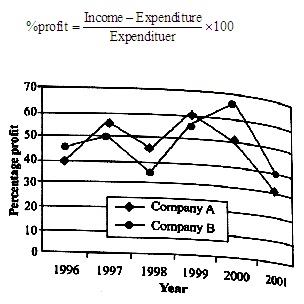
Percent profit earned by two companies over the given years.
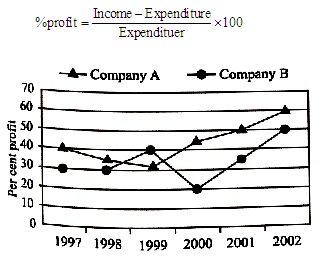
If the income of Company A in 2002 was Rs. 600 crores, what was its expenditure?
A
Rs.360 crores
B
Rs. 480 crores
C
Rs. 375 crores
D
Cannot be deterrmined
E
None of these
Question 108Single Answer
Passage :
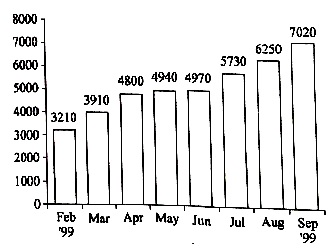
Crude oil Price (in RS) per given below :
Crude oil Price (in RS) per metric tonne
If in April the crude oil price had been lesser than the given by Rs 223 per metric tonne then, how much would have been the percentage increase in pricre over the earlier month?
A
10
B
12
C
14
D
16
E
None of these
Question 109Single Answer
Passage :
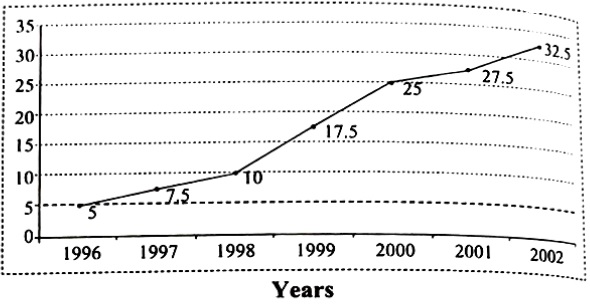
Production of a company (in lakh units) over the given years
The prodution in 2002 is what percent of production in 1996 ?
A
650%
B
550%
C
325%
D
320%
E
None of these
Question 110Single Answer
Passage :
Percentage of marks obtained by six students in six subjects is –
Faculty
Institution
Arts
Commerce
Science
Engineering
Management
A
125
187
216
98
74
B
96
152
198
157
147
C
144
235
110
164
127
D
165
138
245
66
36
E
215
196
287
86
66
F
184
212
195
112
97
G
225
206
182
138
89
Approximately what is the overall percentage of marks obtained by Q in all the subjects ?
A
77
B
72
C
78
D
70
E
74
Question 111Single Answer
Passage :
Number of students studying in different faculties in seven institutions.
Faculty
Institution
Arts
Commerce
Science
Engineering
Management
A
125
187
216
98
74
B
96
152
198
157
147
C
144
235
110
164
127
D
165
138
245
66
36
E
215
196
287
86
66
F
184
212
195
112
97
G
225
206
182
138
89
What is the percentage of students studying science in the institue G with respect to the total number of students studying in the institute G?
A
17.20
B
12.70
C
D
E
None of these
Question 112Single Answer
Passage :
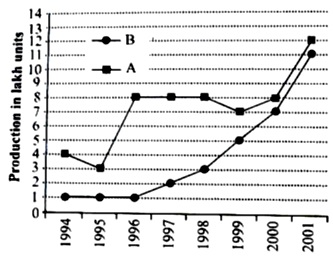
Production of two companies A & B over the years (Production in lakh units).
For Company A, in which year is the percentage increase/decrease in the production from the previous year the highest ?
A
2001
B
1995
C
1999
D
1996
E
None of these
Question 113Single Answer
Passage :
Centrewise and Postwise number of candidates
Post Specialist Center
Officer
Clerk
Filed Officer
Supervisor
Specialist Officer
Bangalore
2000
5000
50
2050
750
Delhi
15000
17000
160
11000
750
Mumbai
17000
19500
70
7000
900
Hyderabad
3500
20000
300
9000
1150
Kolkata
14900
17650
70
1300
1200
Lucknow
11360
15300
30
1500
650
Chennai
9000
11000
95
1650
500
Which centre has the highest number of candidates ?
A
Delhi
B
Kolkata
C
Hyderabad
D
Mumbai
E
None of these
Question 114Single Answer
Passage :
A factory was opened in 1994 with certain initial strengths in different untis as shown in the table. At the beginning of the subsequent years some of the workers left and some new workers were deployed. No worker left or joined in between. Details are given in the table given below. Study it carefully and answer the questions that follow.
UNIT
Year
A
B
C
D
E
1994
156
132
98
76
125
(Initial Strength)
L
J
L
J
L
J
L
J
L
J
1995
12
15
23
32
12
36
6
26
11
13
1996
17
18
16
14
8
19
17
28
11
15
1997
9
20
12
12
17
14
9
16
19
16
1998
32
40
14
17
23
35
12
23
23
14
1999
22
35
11
15
18
25
14
24
32
38
2000
26
32
17
21
13
18
11
19
21
36
In 1999 the strength of workers was maxmium in which unit ?
A
E
B
D
C
C
D
B
E
A
Question 115Single Answer
Passage :
Percentage of students passed over appeared from six States over the years in an admission test.
State/Year
A
B
C
D
E
F
1996
32
35
37
41
39
29
1997
45
26
29
37
43
37
1998
28
38
22
27
36
42
1999
36
42
38
38
29
45
2000
40
34
26
26
35
30
2001
24
29
33
33
41
36
2002
35
43
40
38
39
28
If the average number of students qualified from State E for the given years was 532, what was the average number of students appeared ?
A
1420
B
1350
C
1422
D
Cannot be determined
E
None of these
Question 116Single Answer
Passage :
Number of bales of wool processed by 5 woollen mills
Name Of Company
Month
Polar
Shephered
Kiwi
Warmwear
Comfy
Jan
900
850
350
1000
850
Feb
800
700
1050
1100
850
March
1050
800
1000
1100
950
April
800
850
850
1100
850
May
950
900
1050
1150
850
Total
4500
4100
4900
5450
4350
In the case of which mill is the processing of wool in March the highest percentage of the total processing by that mill during the five month period ?
A
Polar
B
Shephered
C
Kiwi
D
Warmwear
E
Comfy
Question 117Single Answer
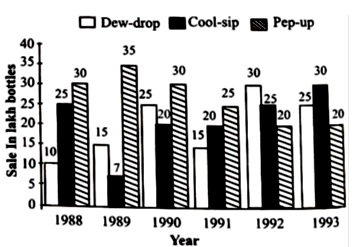
Passage :
Study the following graph carefully and answer the question given below
In the case of Cool–sip drink, what was the approximate percent increase in sale in 1992 over its sale in 1991?
A
Less than 20
B
20 –25
(a) Less than 20 (b) 20 –25
(c) 25 (d) 31 – 35
(e) 36 – 40
C
25
D
31 – 35
E
36 – 40
Question 118Single Answer
Passage :
In 6 educational years, number of studeunts taking admission and leaving from the 5 different schools which are founded in 1990 are given below.
School
A
B
C
D
E
AD
L
AD
L
AD
L
AD
L
AD
L
1990
1025
-
950
-
1100
-
1500
-
1450
-
1991
230
120
350
150
320
130
340
150
250
125
1992
190
110
225
115
300
150
300
160
280
130
1993
245
100
185
110
260
125
295
120
310
120
1994
280
150
200
90
240
140
320
125
340
110
1995
250
130
240
120
310
180
360
140
325
115
In th above table shown Ad = Admitted, L = Left
In which of the following schools, percentage increase in the number of students from the year 1990 to 1995 is maximum?
A
A
B
B
C
C
D
D
E
E
Question 119Single Answer
Passage :
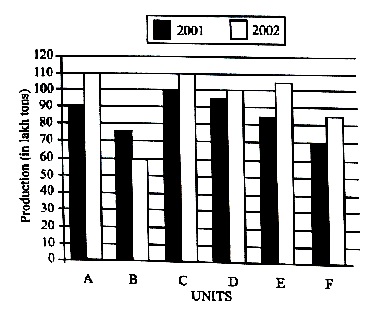
Production (in lakh tons) of six units of a company in 2001 and 2002
Average production of three A, B & C in 2001 is what percent of the average production of units D, E & F in 2002? (rounded off to two digits after decimal).
A
109.43
B
90.37
C
91.38
D
106.43
E
None of these
Question 120Single Answer
Passage :
Percentage profit earned by two companies over the given years.
If the total income of Company A in 1999 was equal to the expenditure of Company B in 2000, then what was the ratio of expenditure of Company A in 1999 to the income of Company B in 2000?
A
25 : 66
B
66 : 25
C
10 : 13
D
13 : 10
E
None of these
English Language
Question 121Single Answer
Passage :
Direction : Question below has two blanks, each blank indicting that some thing has been omitted. Choose the word for each blank which best fits the meaning of the sentence as a whole.
The Finance Department has ……………a centralized online databank system for all statutory government bodies to …………an eye on their assets and liabilities.
A
presented , stay
B
introduced , keep
C
announce , make
D
created , let
E
proclaimed , hold
Question 122Single Answer
Passage :
Direction : The five items in this section consists of a word or group of words followed by four words as (a), (b), (c) and (d). Select the word which is nearly opposite to the meaning of the original word or group of words and mark your response as (a), (b), (c) and (d), as the case may be, in your Answer Sheet.
Assets
A
liabilities
B
responsibilities
C
estates
D
profits
Question 123Single Answer
Passage :
Direction : In the question, out of the four alternatives, choose the word which is opposite in meaning to the given word and click the button corresponding to it
Affidavit
A
Affirmation
B
Slander
C
Oath
D
Testimony
Question 124Single Answer
Passage :
Direction: In the following question, out of the four alternatives, choose the word which is opposite in meaning to the given word and click the button corresponding to it
Hollow
A
Alveolate
B
Cleft
C
Cavernous
D
Solid
Question 125Single Answer
Passage :
Directions: In the following question, out of the four alternatives, choose the word which is opposite in meaning to the given word and click the button corresponding to it
Cosset
A
Ignoreb
B
Close
C
Caress
D
Fondle
Question 126Single Answer
Passage :
Directions: In the following question, out of the four alternatives, choose the word which is opposite in meaning to the given word and click the button corresponding to it
Ogle
A
Leer
B
Gaze
C
Ignore
D
Gawk
Question 127Single Answer
Passage :
Directions:In the following question, out of the four alternatives, choose the word which is opposite in meaning to the given word and click the button corresponding to it
Intrinsic
A
Elemental
B
Innate
C
Connate
D
Acquired
Question 128Single Answer
Passage :
Direction : In the following question, out of the four alternatives, choose the word which is opposite in meaning to the given word and click the button corresponding to it
Coalesce
A
Separate
B
Adhere
C
Cleave
D
Amalgamate
Question 129Single Answer
Passage :
Directions: In the following question, out of the four alternatives, choose the word which is opposite in meaning to the given word and click the button corresponding to it
Loiter
A
lag
B
Hasten
C
Amble
D
Loii
Question 130Single Answer
Passage :
Direction : Question below has two blanks, blank indicating that something has been omitted. Choose the set of words for blank which best fits the meaning of the sentence as a whole.
The protests were......... at ......... awareness among the elite and the educated.
A
held, generating
B
aimed, creating
C
targeted, awakening
D
focused, building
E
concentrated, producing
Question 131Single Answer
Passage :
Directions:In the following question, out of the four alternatives, choose the word which is opposite in meaning to the given word and click the button corresponding to it
Deep-seated
A
Chronic
B
Temporary
C
inbred
D
Subconscious
Question 132Single Answer
Passage :
Directions: In the following question, out of the four alternatives, choose the word which is opposite in meaning to the given word and click the button corresponding to it
Vibrant
A
Drab
B
Gaudy
C
Jazzy
D
Vivid
Question 133Single Answer
Passage :
Directions: In the following question, out of the four alternatives, choose the word which is opposite in meaning to the given word and click the button corresponding to it
To scowl
A
To glower
B
To smirk
C
To Grimace
D
To grin
Question 134Single Answer
Passage :
In the following questions, one part of the sentence may have an error. Find out which part of the sentence has an error .
I used (A)/ a pair of black trousers (B) / for a week (C)/ No error (D)
A
A
B
B
C
C
D
D
Question 135Single Answer
Passage :
Direction: In the following question, out of the four alternatives, choose the word which is opposite in meaning to the given word and click the button corresponding to it
Atheist
A
Skeptic
B
Pagan
C
Disciple
D
Agnostic
Question 136Single Answer
Passage :
Directions: in the following question, out of the four alternatives, choose the word which is opposite in meaning to the given word and click the button corresponding to it
Abdicate
A
Forgo
B
Usurp
C
Waive
D
Cede
Question 137Single Answer
Passage :
Direction: A passage is given with question following it. Read the passage carefully and choose the best answer to question out of the four alternatives and click the button corresponding to it.
Some languages are used by a few people. Others, such a Mandarin Chinese and English, are spoken by millions. Many people speak two or more languages. They may use one language at home with family and friends and other at work or school. Regional variations of language are known as dialects. The Anglo-Saxons, who conquered Britain at the end of the Roman Empire, spoke a Germanic language include Danish, Dutch, German and Swedish. English also contains Drench-derived words after it was ruled by French-speaking king following the Norman Conquest.
Mandarin Chinese is spoken by people.
A
Little
B
Few
C
Many
D
Big
Question 138Single Answer
Passage :
Direction: A passage is given with question following it. Read the passage carefully and choose the best answer to question out of the four alternatives and click the button corresponding to it. Passage Some languages are used by a few people. Others, such a Mandarin Chinese and English, are spoken by millions. Many people speak two or more languages. They may use one language at home with family and friends and other at work or school. Regional variations of language are known as dialects. The Anglo-Saxons, who conquered Britain at the end of the Roman Empire, spoke a Germanic language include Danish, Dutch, German and Swedish. English also contains Drench-derived words after it was ruled by French-speaking king following the Norman Conquest.
A person who is good at foreign languages is known as-
A
Virtuoso
B
Linguist
C
Ventriloquist
D
Scholar
Question 139Single Answer
Passage :
Directions:In the following question, out of the four alternatives, choose the word which is opposite in meaning to the given word and click the button corresponding to it
Astringe
A
Liberate
B
Constringe
C
Circumscribe
D
Tauten
Question 140Single Answer
Passage :
Direction: A passage is given with question following it. Read the passage carefully and choose the best answer to question out of the four alternatives and click the button corresponding to it. Passage
The………of gurudakshina is very ancient and it is ……… to the Indian culture and tradition. If you are absolutely ……… about India, then it’s advisable that you first try to understand the meaning of a guru and the …………. of his presence in you to understand what gurudakshina is in ancient India, a teacher or a guru was a spiritually …………. Guide.
The ………..of gurudakshina is very ancient.
A
habit
B
approach
C
perception
D
concept
Question 141Single Answer
Passage :
Direction: A passage is given with question following it. Read the passage carefully and choose the best answer to each question out of the four alternatives and click the button corresponding to it. Passage
Some languages are used by a few people. Others, such a Mandarin Chinese and English, are spoken by millions. Many people speak two or more languages. They may use one language at home with family and friends and other at work or school. Regional variations of language are known as dialects. The Anglo-Saxons, who conquered Britain at the end of the Roman Empire, spoke a Germanic language include Danish, Dutch, German and Swedish. English also contains Drench-derived words after it was ruled by French-speaking king following the Norman Conquest.
are regional variations of a language.
A
English
B
Mandarin Chinese
C
Home language
D
Dialects
Question 142Single Answer
Passage :
Direction: A passage is given with question following it. Read the passage carefully and choose the best answer to each question out of the four alternatives and click the button corresponding to it. Passage
The………of gurudakshina is very ancient and it is ……… to the Indian culture and tradition. If you are absolutely ……… about India, then it’s advisable that you first try to understand the meaning of a guru and the …………. of his presence in you to understand what gurudakshina is in ancient India, a teacher or a guru was a spiritually …………. Guide.
It is ……… to the Indian culture and tradition.
A
unique
B
rare
C
different
D
particular
Question 143Single Answer
Passage :
Direction: A passage is given with question following it. Read the passage carefully and choose the best answer to each question out of the four alternatives and click the button corresponding to it. Passage
Some languages are used by a few people. Others, such a Mandarin Chinese and English, are spoken by millions. Many people speak two or more languages. They may use one language at home with family and friends and other at work or school. Regional variations of language are known as dialects. The Anglo-Saxons, who conquered Britain at the end of the Roman Empire, spoke a Germanic language include Danish, Dutch, German and Swedish. English also contains Drench-derived words after it was ruled by French-speaking king following the Norman Conquest.
English also included French words the Norman Conquest.
A
After
B
Prior
C
Before
D
During
Question 144Single Answer
Select the wrongly spelt words .
A
career
B
callous
C
calander
D
carriage
Question 145Single Answer
Passage :
Directions:In the following question, out of the four alternatives, choose the word which is opposite in meaning to the given word and click the button corresponding to it
To spurn
A
To Accept
B
To flout
C
To Scorn
D
To rebuff
Question 146Single Answer
Passage :
Direction: A passage is given with question following it. Read the passage carefully and choose the best answer to each question out of the four alternatives and click the button corresponding to it. Passage
Some languages are used by a few people. Others, such a Mandarin Chinese and English, are spoken by millions. Many people speak two or more languages. They may use one language at home with family and friends and other at work or school. Regional variations of language are known as dialects. The Anglo-Saxons, who conquered Britain at the end of the Roman Empire, spoke a Germanic language include Danish, Dutch, German and Swedish. English also contains Drench-derived words after it was ruled by French-speaking king following the Norman Conquest.
Is part of a Germanic language.
A
Britain
B
Anglo-Saxons
C
English
D
Roman Empire
Question 147Single Answer
Passage :
Direction: A passage is given with question following it. Read the passage carefully and choose the best answer to each question out of the four alternatives and click the button corresponding to it. Passage
The………of gurudakshina is very ancient and it is ……… to the Indian culture and tradition. If you are absolutely ……… about India, then it’s advisable that you first try to understand the meaning of a guru and the …………. of his presence in you to understand what gurudakshina is in ancient India, a teacher or a guru was a spiritually …………. Guide.
If you are absolutely ……….. about India.
A
unknowing
B
unknowledgeable
C
naive
D
blind to
Question 148Single Answer
Passage :
Direction : In this test paper, Question is given in Direct speech followed by four alternatives in Indirect Speech. Select the one which best expresses the same sentence in Direct speech and mark your answer in answer sheet.
“ Do you know that all your friends have failed to pass the test?” jeered his angry mother.
A
The angry mother jeered and asked her son if he knew that all his friends had failed to pass the tests.
B
His angry mother jeered and asked if he did know that all his friends had failed to pass the test.
C
His angry mother jeered and told if he knew that all his friends had failed to pass
D
His angry mother jeered and asked if he had know that all his friends had failed to pass the test.
Question 149Single Answer
Passage :
Direction: A passage is given with question following it. Read the passage carefully and choose the best answer to each question out of the four alternatives and click the button corresponding to it. Passage
My worries were increasing. The boy at the shop was becoming more clamorous. My sales were poor, as the railways were admitting more peddlers on the platforms. My cash receipts were going down and my credit sales alone flourished. The wholesale merchants who supplied me with goods stopped credit to me. The boy’s methods of account-keeping was so chaotic that I did not know whether I was moving forward or backward. He produced cash from the counter in a haphazard manner, and there were immense gaps on the shelves all that nothing one wanted was ever available. Suddenly the railways gave me notice to quit. I
pleaded with the old station master and porter, but they could do nothing; the order had come from high up. The shop was given to a new contractor.
I could not contemplate the prospect of being cut off from the railways. I grew respect and angry. I shed tears at seeing a new man in the place where I and my father had sat. I slapped the boy on the cheek and the cried, and his father, the porter, came down on me and said, ‘this is what he gets helping you! I’d always told the boy- He was not your paid servant, anyway.’
Why does the speaker say that his sales were poor?
A
Because his cash receipt were going down
B
Because the boy at the shop was becoming more clamorous
C
Because the railways were admitting more pedlars on the platform
D
Because there were no buyers
Question 150Single Answer
Passage :
Direction : The following question, select the related word/letters/number/figure from the given alternatives.
Soil : Erosion : : Forest : ?
A
Pollution
B
Degradation
C
Dense
D
Deforestation
Question 151Single Answer
Passage :
Direction: A passage is given with question following it. Read the passage carefully and choose the best answer to each question out of the four alternatives and click the button corresponding to it. Passage
My worries were increasing. The boy at the shop was becoming more clamorous. My sales were poor, as the railways were admitting more peddlers on the platforms. My cash receipts were going down and my credit sales alone flourished. The wholesale merchants who supplied me with goods stopped credit to me. The boy’s methods of account-keeping was so chaotic that I did not know whether I was moving forward or backward. He produced cash from the counter in a haphazard manner, and there were immense gaps on the shelves all that nothing one wanted was ever available. Suddenly the railways gave me notice to quit. I
pleaded with the old station master and porter, but they could do nothing; the order had come from high up. The shop was given to a new contractor.
I could not contemplate the prospect of being cut off from the railways. I grew respect and angry. I shed tears at seeing a new man in the place where I and my father had sat. I slapped the boy on the cheek and the cried, and his father, the porter, came down on me and said, ‘this is what he gets helping you! I’d always told the boy- He was not your paid servant, anyway.’
How did the boy’s method of account-keeping affect the speaker?
A
His worries increased
B
He produced cash from the counter in a haphazard manner
C
His sales were poor
D
He did not know if he was moving forward or backward
Question 152Single Answer
Passage :
Direction: A passage is given with question following it. Read the passage carefully and choose the best answer to each question out of the four alternatives and click the button corresponding to it. Passage
My worries were increasing. The boy at the shop was becoming more clamorous. My sales were poor, as the railways were admitting more peddlers on the platforms. My cash receipts were going down and my credit sales alone flourished. The wholesale merchants who supplied me with goods stopped credit to me. The boy’s methods of account-keeping was so chaotic that I did not know whether I was moving forward or backward. He produced cash from the counter in a haphazard manner, and there were immense gaps on the shelves all that nothing one wanted was ever available. Suddenly the railways gave me notice to quit. I
pleaded with the old station master and porter, but they could do nothing; the order had come from high up. The shop was given to a new contractor.
I could not contemplate the prospect of being cut off from the railways. I grew respect and angry. I shed tears at seeing a new man in the place where I and my father had sat. I slapped the boy on the cheek and the cried, and his father, the porter, came down on me and said, ‘this is what he gets helping you! I’d always told the boy- He was not your paid servant, anyway.’
Why did the public complain?
A
Because his credit at the wholesalers’ was gone
B
Because nothing one ever wanted was available
C
Because there gaps on the selves all over the shop
D
Because the railways gave him notice to quite
Question 153Single Answer
Passage :
Direction: A passage is given with question following it. Read the passage carefully and choose the best answer to each question out of the four alternatives and click the button corresponding to it. Passage
My worries were increasing. The boy at the shop was becoming more clamorous. My sales were poor, as the railways were admitting more peddlers on the platforms. My cash receipts were going down and my credit sales alone flourished. The wholesale merchants who supplied me with goods stopped credit to me. The boy’s methods of account-keeping was so chaotic that I did not know whether I was moving forward or backward. He produced cash from the counter in a haphazard manner, and there were immense gaps on the shelves all that nothing one wanted was ever available. Suddenly the railways gave me notice to quit. I
pleaded with the old station master and porter, but they could do nothing; the order had come from high up. The shop was given to a new contractor.
I could not contemplate the prospect of being cut off from the railways. I grew respect and angry. I shed tears at seeing a new man in the place where I and my father had sat. I slapped the boy on the cheek and the cried, and his father, the porter, came down on me and said, ‘this is what he gets helping you! I’d always told the boy- He was not your paid servant, anyway.’
Where did the order to quite come from?
A
From the old station master
B
From high up
C
From the railway authorities
D
From the contractor
Question 154Single Answer
Passage :
Directions: in the following question, out of the four alternatives, choose the word which is opposite in meaning to the given word and click the button corresponding to it
Content
A
Ease
B
Depressed
C
Gratified
D
Smug
Question 155Single Answer
Passage :
Direction: A passage is given with question following it. Read the passage carefully and choose the best answer to each question out of the four alternatives and click the button corresponding to it. Passage
The………of gurudakshina is very ancient and it is ……… to the Indian culture and tradition. If you are absolutely ……… about India, then it’s advisable that you first try to understand the meaning of a guru and the …………. of his presence in you to understand what gurudakshina is in ancient India, a teacher or a guru was a spiritually …………. Guide.
The ………..of his presence in the lives of those around him.
A
connotation
B
implication
C
understanding
D
significance
Question 156Single Answer
Passage :
Direction: A passage is given with question following it. Read the passage carefully and choose the best answer to each question out of the four alternatives and click the button corresponding to it. Passage
My worries were increasing. The boy at the shop was becoming more clamorous. My sales were poor, as the railways were admitting more peddlers on the platforms. My cash receipts were going down and my credit sales alone flourished. The wholesale merchants who supplied me with goods stopped credit to me. The boy’s methods of account-keeping was so chaotic that I did not know whether I was moving forward or backward. He produced cash from the counter in a haphazard manner, and there were immense gaps on the shelves all that nothing one wanted was ever available. Suddenly the railways gave me notice to quit. I
pleaded with the old station master and porter, but they could do nothing; the order had come from high up. The shop was given to a new contractor.
I could not contemplate the prospect of being cut off from the railways. I grew respect and angry. I shed tears at seeing a new man in the place where I and my father had sat. I slapped the boy on the cheek and the cried, and his father, the porter, came down on me and said, ‘this is what he gets helping you! I’d always told the boy- He was not your paid servant, anyway.’
Why did the speaker shed tears?
A
Because he saw a new person, where he and his father had sat
B
Because he was cut off from the railways
C
Because he grew desperate and angry
D
Because he slapped the boy on the cheek
Question 157Single Answer
Passage :
Directions: in the following question, out of the four alternatives, choose the word which is opposite in meaning to the given word and click the button corresponding to it
To placate
A
To provoke
B
To propitiate
C
To tranquilize
D
To mollify
Question 158Single Answer
Passage :
Direction: A passage is given with question following it. Read the passage carefully and choose the best answer to each question out of the four alternatives and click the button corresponding to it. Passage
A Knowledge of grammar is essential for good speaking and writing, by which one’s mind is judged. Studying grammar means hard work: it be learned as a whole, with no part omitted, and it demand must thought and patience. But, once acquired, it study requires no physical hardship, no special room or expenses. If people spent only they leisure time studying grammar they could master it in one year. As a private soldier earning sixpence a day, he sat on his bed and studied. Unable to afford candle or oil, he read in winter by firelight (when it was his turn). If he could manage it thus, and with no outside encouragement, ten any youth, however poor or busy, could do the same.
Why should we learn grammar?
A
To develop speaking skills
B
To develop writing skills
C
To have a mastery over language
D
To acquire good speaking and writing skills
Question 159Single Answer
Passage :
Direction: A passage is given with question following it. Read the passage carefully and choose the best answer to each question out of the four alternatives and click the button corresponding to it. Passage
A Knowledge of grammar is essential for good speaking and writing, by which one’s mind is judged. Studying grammar means hard work: it be learned as a whole, with no part omitted, and it demand must thought and patience. But, once acquired, it study requires no physical hardship, no special room or expenses. If people spent only they leisure time studying grammar they could master it in one year. As a private soldier earning sixpence a day, he sat on his bed and studied. Unable to afford candle or oil, he read in winter by firelight (when it was his turn). If he could manage it thus, and with no outside encouragement, ten any youth, however poor or busy, could do the same.
How does the world judge a man’s mind?
A
By his dress
B
By his manners
C
By his appearance
D
By his speech and writing
Question 160Single Answer
Passage :
Direction: A passage is given with question following it. Read the passage carefully and choose the best answer to each question out of the four alternatives and click the button corresponding to it. Passage
A Knowledge of grammar is essential for good speaking and writing, by which one’s mind is judged. Studying grammar means hard work: it be learned as a whole, with no part omitted, and it demand must thought and patience. But, once acquired, it study requires no physical hardship, no special room or expenses. If people spent only they leisure time studying grammar they could master it in one year. As a private soldier earning sixpence a day, he sat on his bed and studied. Unable to afford candle or oil, he read in winter by firelight (when it was his turn). If he could manage it thus, and with no outside encouragement, ten any youth, however poor or busy, could do the same.
How long would it take to gain mastery over grammar?
A
One year
B
Six months
C
Two years
D
Ten months
Hind Language
Question 161Single Answer
Passage :
प्रश्न में दी गई इटैलिक अशुद्ध वर्तनी का शुद्ध रूप चयन कीजिए।
तुम्हारा यह कथन मात्र अतिश्योक्ती है।
A
अंतोश्योक्ती
B
अतीश्योक्टि
C
अतिश्योक्ति
D
अतिशयोक्ति
Question 162Single Answer
Passage :
प्रश्न में एक शब्द दिया गया है जिसका सन्धि-विच्छेद चार प्रकार से किया गया है। इनमें सें केवल एक ही विकल्प सही है। सही सन्धि-विच्छेद का चयन कीजिए -
बहिष्कार
A
बहि: + कार
B
बहिष + कर
C
बहि + अकार
D
बहि़ + सकार
Question 163Single Answer
Passage :
प्रश्न में एक शब्द दिया गया है जिसका सन्धि-विच्छेद चार प्रकार से किया गया है। इनमें सें केवल एक ही विकल्प सही है । सही सन्धि-विच्छेद का चयन कीजिए -
नाविक
A
नौ + इक
B
ना + इक
C
नो + इक
D
ना + विक
Question 164Single Answer
Passage :
प्रश्न में एक शब्द दिया गया है जिसका सन्धि-विच्छेद चार प्रकार से किया गया है। इनमें सें केवल एक ही विकल्प सही है । सही सन्धि-विच्छेद का चयन कीजिए -
दिगम्बर
A
दि + गम्बर
B
दिगम् + बर
C
दिक् + अम्बर
D
दिग + अम्बर
Question 165Single Answer
Passage :
प्रश्न में एक शब्द दिया गया है जिसका सन्धि-विच्छेद चार प्रकार से किया गया है। इनमें सें केवल एक ही विकल्प सही है । सही सन्धि-विच्छेद का चयन कीजिए -
निराशा
A
निरा + आशा
B
निर् + आशा
C
निर: + आशा
D
निर + आशा
Question 166Single Answer
Passage :
प्रश्न में एक शब्द दिया गया है जिसका सन्धि-विच्छेद चार प्रकार से किया गया है। इनमें सें केवल एक ही विकल्प सही है । सही सन्धि-विच्छेद का चयन कीजिए -
मनोरथ
A
मनो + अर्थ
B
मन: + रथ
C
मन: + अरथ
D
मने + ओरथ
Question 167Single Answer
Passage :
प्रश्न में एक शब्द दिया गया है जिसका सन्धि-विच्छेद चार प्रकार से किया गया है। इनमें सें केवल एक ही विकल्प सही है । सही सन्धि-विच्छेद का चयन कीजिए -
यद्यपि
A
यद्य + आपि
B
य + द्यपि
C
यदि + अपि
D
यद्य + आपि
Question 168Single Answer
Passage :
प्रश्न में एक शब्द दिया गया है जिसका सन्धि-विच्छेद चार प्रकार से किया गया है। इनमें सें केवल एक ही विकल्प सही है । सही सन्धि-विच्छेद का चयन कीजिए -
तिरस्कार
A
तिरस + कार
B
तिर: + कार
C
ति: + कार
D
तिर + कार
Question 169Single Answer
Passage :
प्रश्न में एक शब्द दिया गया है जिसका सन्धि-विच्छेद चार प्रकार से किया गया है। इनमें सें केवल एक ही विकल्प सही है । सही सन्धि-विच्छेद का चयन कीजिए -
स्वार्थ
A
स्व +अर्थ
B
स्वा + अर्थ
C
स्वा + अथ
D
स्व +आर्थ
Question 170Single Answer
Passage :
प्रश्न में एक शब्द दिया गया है जिसका सन्धि-विच्छेद चार प्रकार से किया गया है। इनमें सें केवल एक ही विकल्प सही है । सही सन्धि-विच्छेद का चयन कीजिए -
जगदीश
A
जगद़् + ईश
B
जगत़् + ईश
C
जग़ + ईश
D
जग़ + दीश
Question 171Single Answer
Passage :
दिए गए शब्दों में प्रयुक्तसन्धि का चयन कीजिए -
सदानन्द शब्द का सन्धि विच्छेद है
A
सदा़ + नन्द
B
सद़ + आनन्द
C
सदा़ + आनन्द
D
सत़् + आनन्द
Question 172Single Answer
Passage :
प्रश्न में एक शब्द दिया गया है जिसका सन्धि-विच्छेद चार प्रकार से किया गया है। इनमें सें केवल एक ही विकल्प सही है । सही सन्धि-विच्छेद का चयन कीजिए -
विसर्ग सन्धि का उदाहरण है
A
युधिष्ठिर
B
निष्ठुर
C
भयंकर
D
मनोयोग
Question 173Single Answer
Passage :
प्रश्न में एक शब्द दिया गया है जिसका सन्धि-विच्छेद चार प्रकार से किया गया है। इनमें सें केवल एक ही विकल्प सही है । सही सन्धि-विच्छेद का चयन कीजिए -
मनोहर में कौन सी सन्धि है?
A
विसर्ग
B
गुण
C
वृद्धि
D
व्यंजन
Question 174Single Answer
Passage :
प्रश्न में एक शब्द दिया गया है जिसका सन्धि-विच्छेद चार प्रकार से किया गया है। इनमें सें केवल एक ही विकल्प सही है । सही सन्धि-विच्छेद का चयन कीजिए -
परन्तु
A
पऱअंतु
B
परम़्तु
C
प़रंतु
D
परंतू
Question 175Single Answer
Passage :
प्रश्न में एक शब्द दिया गया है जिसका सन्धि-विच्छेद चार प्रकार से किया गया है। इनमें सें केवल एक ही विकल्प सही है । सही सन्धि-विच्छेद का चयन कीजिए -
नि + रन्तर
A
ऩि + अंतर
B
निऱ + अंतर
C
निरू़ + अंतर
D
निरा + ऩतर
Question 176Single Answer
Passage :
प्रश्न में एक शब्द दिया गया है जिसका सन्धि-विच्छेद चार प्रकार से किया गया है। इनमें सें केवल एक ही विकल्प सही है । सही सन्धि-विच्छेद का चयन कीजिए -
सर्वाेदय में कौन सी सन्धि है -
A
गुण सन्धि
B
व्यंजन सन्धि
C
विसर्ग सन्धि
D
यण सन्धि
Question 177Single Answer
Passage :
प्रश्न में एक शब्द दिया गया है जिसका सन्धि-विच्छेद चार प्रकार से किया गया है। इनमें सें केवल एक ही विकल्प सही है । सही सन्धि-विच्छेद का चयन कीजिए -
अन्नाभाव का सन्धि विच्छेद है -
A
अन्ना़ + भाव
B
अन्ऩ + अभाव
C
अन्य़ + अभाव
D
अन्ऩ + आभाव
Question 178Single Answer
Passage :
दिए गए शब्दों में प्रयुक्त सन्धि का चयन कीजिए ।
धर्मात्मा
A
स्वर सन्धि
B
व्यंजन सन्धि
C
विसर्ग सन्धि
D
यण सन्धि
Question 179Single Answer
Passage :
दिए गए शब्दों में प्रयुक्त सन्धि का चयन कीजिए ।
महर्षि
A
स्वर सन्धि
B
व्यंजन सन्धि
C
गुण सन्धि
D
स्वर और विसर्ग सन्धि
Question 180Single Answer
Passage :
निम्नलिखित प्रश्नों में सही सन्धि-विच्छेद का चयन कीजिए ।
धरेश
A
धऱईश
B
धरा़ईश
C
धरे़ईश
D
धरा़ईश
Question 181Single Answer
Passage :
निम्नलिखित प्रश्नों में सही सन्धि- विच्छेद का चयन कीजिए ।
पुनर्जन्म
A
पुनरू़जन्मण्
B
पुनऱ्जन्म
C
पुनरू़आजम
D
पुनु़आजम
Question 182Single Answer
Passage :
दिए गए शब्दों में प्रयुक्त सन्धि का चयन कीजिए -
व्याकुल
A
दीर्घ सन्धि
B
यण सन्धि
C
व्यंजन सन्धि
D
अयादि सन्धि
Question 183Single Answer
Passage :
दिए गए शब्दों में प्रयुक्त सन्धि का चयन कीजिए -
दुरूपयोग
A
विसर्ग सन्धि
B
यण सन्धि
C
गुण सन्धि
D
दीर्घ सन्धि
Question 184Single Answer
Passage :
दिए गए शब्दों में प्रयुक्त सन्धि का चयन कीजिए -
कवीशर
A
दीर्घ सन्धि
B
गुण सन्धि
C
व्यंजन सन्धि
D
स्वर सन्धि
Question 185Single Answer
Passage :
दिए गए शब्दों में प्रयुक्त सन्धि का चयन कीजिए ?
संसार
A
स्वर सन्धि
B
विसर्ग सन्धि
C
व्यंजन सन्धि
D
इनमें से कोई नहीं
Question 186Single Answer
Passage :
दिए गए शब्दों में प्रयुक्त सन्धि का चयन कीजिए
तन्मय
A
व्यंजन सन्धि
B
विसर्ग सन्धि
C
स्वर सन्धि
D
इनमेंसे कोई नहीं
Question 187Single Answer
Passage :
दिए गए शब्दों में प्रयुक्त सन्धि का चयन कीजिए
सरयूर्मि का संधि है
A
दीर्घ
B
यण
C
व्यंजन
D
स्वर
Question 188Single Answer
Passage :
प्रश्न में एक शब्द दिया गया है जिसका सन्घि-विच्छेद चार प्रकार से किया गया है। इनमें सें केवल एक ही विकल्प सही है । सही सन्घि-विच्छेद का चयन कीजिए -
गौः+चरतिष्की सन्धि है.
A
गोस्चरति
B
गौचरति
C
गौश्चरति
D
गौहचरति
Question 189Single Answer
Passage :
दिए गए शब्दों में प्रयुक्त सन्धि का चयन कीजिए
यशोदा में प्रयुक्त सन्धि का नाम है
A
स्वर
B
व्यंजन
C
विसर्ग
D
इनमं से कोई नहीं
Question 190Single Answer
Passage :
दिए गए शब्दों में प्रयुक्त सन्धि का चयन कीजिए -
निम्न सन्धि विच्छेद की सन्धि के लिए सही विकल्प चुनिए
A
सु़+उक्ति
B
सक्ति
C
सेक्ति
D
सूक्ति
E
सैक्ति
Question 191Single Answer
Passage :
दिए गए सन्धि -विच्छेद में सही विकल्प चुनिए -
दुराशा
A
दुरा़+आशा
B
दुरा़+शा
C
दु+रू़आशा
D
दुऱ+आशा
Question 192Single Answer
Passage :
दिए गए सन्धि -विच्छेद में सही विकल्प चुनिए -
पौ़ + अन को सन्धि युक्त करने पर क्या रूप है
A
पवन
B
पावन
C
पौन
D
पाचन
Question 193Single Answer
Passage :
दिए गए शब्दों में प्रयुक्त सन्धि का चयन कीजिए
वाणी़+औचित्य का सही सन्धि शब्द कौन.सा है
A
वाण्यौचित्य
B
वाणैचित्य
C
वाण्यैचित्य
D
वाणौचित्य
Question 194Single Answer
Passage :
दिए गए शब्दों में प्रयुक्त सन्धि का चयन कीजिए
निर्धन में कौन सी सन्धि है?
A
अयादि सन्धि
B
यण सन्धि
C
व्यंजन सन्धि
D
विसर्ग सन्धि
Question 195Single Answer
Passage :
दिए गए सन्धि -विच्छेद में सही विकल्प चुनिए -
आशीर्वाद शब्द का शुद्ध सन्धि विच्छेद क्या होगा?
A
अशीऱ+वाद
B
आर्शी़+वाद
C
आशी;+वाद
D
आशी़+र्वाद
Question 196Single Answer
Passage :
दिए गए शब्दों में प्रयुक्त सन्धि का चयन कीजिए
हिमालय में किस सन्धि का प्रयोग हुआ है?
A
गुण स्वर सन्धि
B
यण स्वर सन्धि
C
दीर्घ स्वर सन्धि
D
विसर्ग सन्धि
Question 197Single Answer
Passage :
दिए गए सन्धि -विच्छेद में सही विकल्प चुनिए -
"आत्मोत्सर्ग" का सन्धि विच्छेद है -
A
आत्मा़+स्वर्ग
B
आत्म़+सवर्ग
C
आत्मा़+स्वर्ग
D
आत्म़+उत्सर्ग
Question 198Single Answer
Passage :
दिए गए सन्धि विच्छेद में सही विकल्प चुनिए ?
निम्नलिखित प्रश्न में दिए गए शब्द में प्रयुक्त सन्धि के प्रकार का चयन उसके नीचें दिए गए विकल्पो में सें कीजिए ।
A
तपोवन
B
स्वर सन्धि
C
व्यंजन सन्धि
D
विसर्ग सन्धि
E
इनमें से कोई नहीं
Question 199Single Answer
Passage :
निम्नलिखित प्रश्न में दिए गए शब्द में प्रयुक्त सन्धि के प्रकार का चयन उसके नीचें दिए गए विकल्पो में सें कीजिए ।
सप्तर्षि
A
सप्तर +ऋषि
B
सप्त:ऋषि
C
सप्त़+ऋषि
D
इनमें से कोई नहीं
Question 200Single Answer
Passage :
निम्नलिखित प्रश्न में दिए गए शब्द में प्रयुक्त सन्धि के प्रकार का चयन उसके नीचें दिए गए विकल्पो में सें कीजिए ।


 , # and
 are used with the followning meaning as illustrated bellow :
 E, E
 v
 K, K @ F, F S J
 B, B $ W, W # H, H
 M
 D, D $ J, J # M, M @ K
 , @,
 , % and * are used with the following meaning as illustrated below :
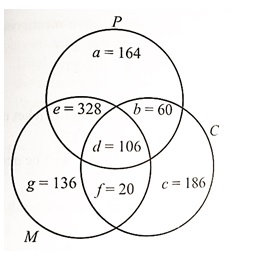
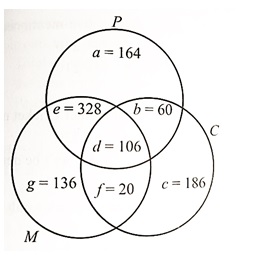
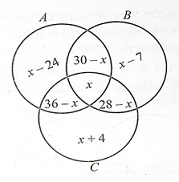
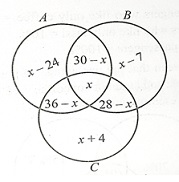
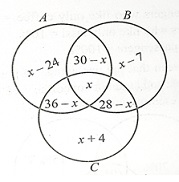
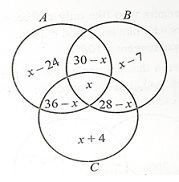
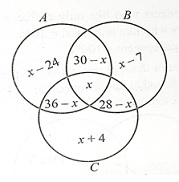
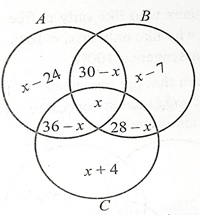
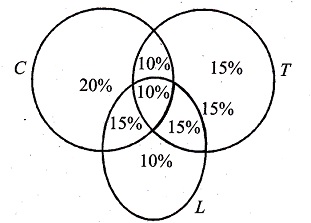
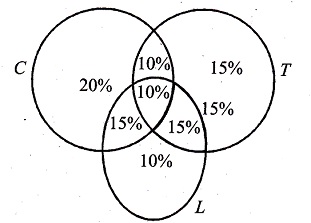
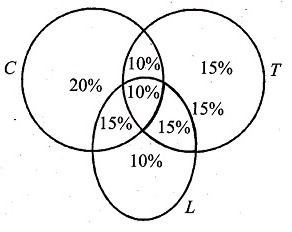
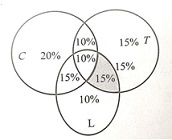
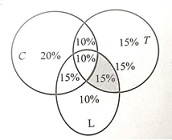
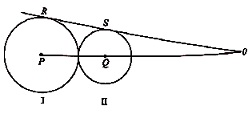


 The value of y
 is less than g. In bag B, number of yellow colored balls is
 more than that of bag A. If two balls are picked at random from bag B then the probability of getting both green color ball is
 . Total number of balls in bag B is 75.

 . Then find the value of x ?