The payment was collected by the hardworking salesman.
A
The hardworking salesman collected the payment.
B
the salesman who worked heard was able to collect the payment.
C
to collect the payment the salesman had to work hard.
D
The hardworking salesman was able to collect the payment.
Question 4Single Answer
I had to stop all my work to complete this project.
A
All other work had to be stopped to complete this project by me
B
For completing this project all other work must be stopped
C
For completing this project I had to stop all my work
D
To complete this project all other work had been stopped by me
Question 5Single Answer
Passage :
Direction : Question below has two blanks, each blank indicting that some thing has been omitted. Choose the word for each blank which best fits the meaning of the sentence as a whole.
The Finance Department has ……………a centralized online databank system for all statutory government bodies to …………an eye on their assets and liabilities.
A
presented , stay
B
introduced , keep
C
announce , make
D
created , let
E
proclaimed , hold
Question 6Single Answer
Passage :
Direction : The five items in this section consists of a word or group of words followed by four words as (a), (b), (c) and (d). Select the word which is nearly opposite to the meaning of the original word or group of words and mark your response as (a), (b), (c) and (d), as the case may be, in your Answer Sheet.
Assets
A
liabilities
B
responsibilities
C
estates
D
profits
Question 7Single Answer
Passage :
Direction : In the question, out of the four alternatives, choose the word which is opposite in meaning to the given word and click the button corresponding to it
Affidavit
A
Affirmation
B
Slander
C
Oath
D
Testimony
Question 8Single Answer
Passage :
Direction: In the following question, out of the four alternatives, choose the word which is opposite in meaning to the given word and click the button corresponding to it
Hollow
A
Alveolate
B
Cleft
C
Cavernous
D
Solid
Question 9Single Answer
Passage :
Directions: In the following question, out of the four alternatives, choose the word which is opposite in meaning to the given word and click the button corresponding to it
Cosset
A
Ignoreb
B
Close
C
Caress
D
Fondle
Question 10Single Answer
Passage :
Directions: In the following question, out of the four alternatives, choose the word which is opposite in meaning to the given word and click the button corresponding to it
Ogle
A
Leer
B
Gaze
C
Ignore
D
Gawk
Question 11Single Answer
How many such pairs of letters are there in the word ‘CLEANLINESS’ each of the which has as many letters between them in the word as they have in the English alphabet, in the same sequence?
A
Two
B
Three
C
Five
D
Four
E
None of these
Question 12Single Answer
Team A has scored more goals than Team B
Team C has scored fewer goals than Team B
Team A has scored fewer goals than Team C .
If the first two statements are true, the third statement is
A
True
B
False
C
Uncertain
D
None
Question 13Single Answer
If it is possible to make only one meaningful word with the second, the third, the sixth and the eight letters of the word FRAGMENT using each only once, which of the following will be the third letter of that word ? If no such word can be formed, give ‘X’ as the answer and if more than one such word can be formed, give ‘Y’ as the answer.
A
A
B
E
C
T
D
X
E
Y
Question 14Single Answer
How many such letters are there in the word ORIENTAL each of which is as far away from the beginning of the word as when they are arranged alphabetically?
A
None
B
One
C
Two
D
Three
E
More than three
Question 15Single Answer
How many such pairs of letters in the word CREDIT each of which has as many letters between them in the word as in the English alphabet?
A
None
B
One
C
Two
D
Three
E
More than three
Question 16Single Answer
How many meaningful words can be made from the letters ‘LMEA’ using each letter only once in each word?
A
None
B
One
C
Two
D
Three
E
More than three
Question 17Single Answer
Passage :
A B C D E F G H I J K L M N O P Q R S T U V W X Y Z .
Which letter in this alphabet is the eighth letter to the right of the letter and which is tenth letter to the left of the last but one letter of the alphabet ?
A
X
B
W
C
I
D
H
Question 18Single Answer
Passage :
Direction : The following question is based on the five words given below:
AND FOR THE BIG SUM (The new words formed after performing the mentioned operations may or may not necessarily the meaningful English words.)
If the third alphabet of each of the words is changed to the next alphabet in the English alphabetical series, which of the following will form a meaningful English word?
A
SUM
B
BIG
C
Both BIG and THE
D
FOR
E
Both FOR and BIG
Question 19Single Answer
Passage :
Direction : The following question is based on the five words given below:
AND FOR THE BIG SUM (The new words formed after performing the mentioned operations may or may not necessarily the meaningful English words.)
If the given words are arranged in the order as they would appear in a dictionary from left to right, which of the following will be second from the right ?
A
AND
B
FOR
C
THE
D
BIG
E
SUM
Question 20Single Answer
Passage :
Direction: The following question is based on the five words given below:
AND FOR THE BIG SUM (The new words formed after performing the mentioned operations may or may not necessarily the meaningful English words.)
If second alphabet in each of the words is changed to next alphabet in the English alphabetical order, how many words having two vowels (same or different vowels) will be formed ?
A
None
B
One
C
Two
D
Three
E
Four
Question 21Single Answer
Passage :
Direction : The following question is based on the five words given below:
AND FOR THE BIG SUM (The new words formed after performing the mentioned operations may or may not necessarily the meaningful English words.)
How many letters are there in the English alphabetical series between the second letter of the word which is second from the right and the second letter of the word which is second from the left of the given words?
A
Two
B
Five
C
Six
D
Nine
E
Three
Question 22Single Answer
Passage :
Direction: The following question is based on the five words given below:
AND FOR THE BIG SUM (The new words formed after performing the mentioned operations may or may not necessarily the meaningful English words.)
If in each of the given words, each of the consonant is changed to previous letter and each vowel is changed to next letter in the English alphabetical series, in how many words thus formed will no vowels appear?
A
None
B
One
C
Two
D
Three
E
More than three
Question 23Single Answer
Passage :
Direction : Following question is based on five words given below: BRU LEGINKCATOWN
(The new words formed after performing the mentioned operations may or may not necessarily be meaningful English words)
If the third alphabet in each of the words is changed to the next alphabet in the English alphabetical order, how many words having two vowels (same or different vowels) will be formed?
A
None
B
One
C
Two
D
Three
E
Four
Question 24Single Answer
Passage :
Direction : Following question is based on five words given below: BRU LEGINKCATOWN
(The new words formed after performing the mentioned operations may or may not necessarily be meaningful English words)
If the position of the first and the second alphabets of each of the words are interchanged, which of the following will form a meaningful English word?
A
Both CAT and OWN
B
Both BRU and INK
C
Only CAT
D
Only INK
E
Only LEG
Question 25Single Answer
Passage :
Direction: Following question is based on five words given below: BRU LEGINKCATOWN
(The new words formed after performing the mentioned operations may or may not necessarily be meaningful English words)
If the given words are arranged in the order as they would appear in a dictionary from left to right, which of the following will be exactly in the middle of the five words?
A
OWN
B
LEG
C
BRU
D
CAT
E
INK
Question 26Single Answer
The cash difference between the selling prices of an article at a profit of 4% and 6% is Rs. 3. The ratio of the two selling prices is:__________ ?
A
51:52
B
52:53
C
51:53
D
52:55
Question 27Single Answer
Which of the following numbers is irrational ?
A
√49
B
0.125
C
√2
D
22/7
Question 28Single Answer
356 x 936 – 356 x 836 = ?
A
35600
B
34500
C
9630
D
93600
Question 29Single Answer
Arrange in descending order: 5/8, 7/10, 3/4
A
3/4 > 7/10 > 5/8
B
7/10 > 3/4 > 5/8
C
3/4 > 5/8 > 7/10
D
5/8 > 7/10 > 3/4
Question 30Single Answer
What is (3^{4} times 9^{2}) ?
A
36
B
38
C
310
D
96
Question 31Single Answer
If 34X-2 = 729, then find the value of X.
A
4
B
3
C
2
D
5
Question 32Single Answer
Convert 0.6 into fraction ?
A
3/5
B
2/3
C
4/5
Question 33Single Answer
The no. plate of a bus had peculiarity. The bus number was a perfect square. It was also a perfect square when the plate numbers were reversed. The bus company had only five hundred buses numbered from 1 to 500. What was the number ?
A
169
B
36
C
196
D
Can not say
Question 34Single Answer
If a and b are positive integers, such that ab = 125, then (a-b)a+b-4 = ?
A
16
B
25
C
28
D
30
Question 35Single Answer
If x*y = x2 + y2 – xy, then value of 9*11 is
A
93
B
103
C
60.5
D
121
Question 36Single Answer
Which is greater ?
A
15/16
B
17/18
C
Equal
D
Cannot compare
Question 37Single Answer
If sum of two numbers is 42 and their product is 437, then find their difference.
A
3
B
4
C
5
D
7
Question 38Single Answer
Passage :
information given below and answer the question that follow.
The result of an exam is given below. Out of 1000 students who appeared
(i) 658 failed in Physics
(ii) 166 failed in Physics and Chemistry
(iii) 372 failed in Chemistry, 434 failed in Physics and Maths
(iv) 590 failed in Maths, 126 failed in Maths & Chemistry
Find the number of people who failed in (assuming that none is passed in all subjects.
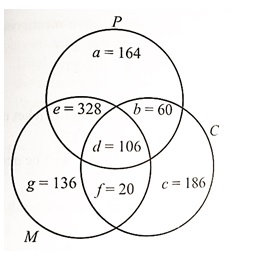
We have the following equations:
a+ b + c + d + e + f + g = 1000
a + b + d + e = 658, b + d = 166
b + d + c + f = 372
d + e = 434 as in the figure.
d + e + f + g = 590, d + f = 126. Find the values
Chemistry but not in Physics.
A
318
B
198
C
213
D
206
Question 39Single Answer
Passage :
Direction: information given below and answer the question that follow.
The result of an exam is given below. Out of 1000 students who appeared
(i) 658 failed in Physics
(ii) 166 failed in Physics and Chemistry
(iii) 372 failed in Chemistry, 434 failed in Physics and Maths
(iv) 590 failed in Maths, 126 failed in Maths & Chemistry
Find the number of people who failed in (assuming that none is passed in all subjects.
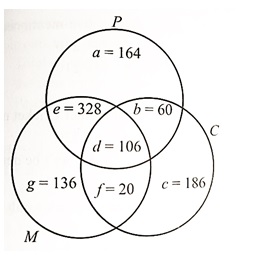
We have the following equations:
a+ b + c + d + e + f + g = 1000
a + b + d + e = 658, b + d = 166
b + d + c + f = 372
d + e = 434 as in the figure.
d + e + f + g = 590, d + f = 126. Find the values
Physics or Maths but not in Chemistry.
A
558
B
718
C
628
D
None of these
Question 40Single Answer
Passage :
For the next four question that follow:
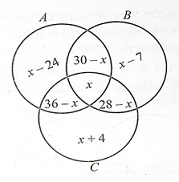
In a city, three daily newspapers A, B, C are published, 42% read A; 51% read B; 68% read C; 30% read A and B; 28% read B and C; 36% read A and C; 8% do not read any of the three newspapers.
Let x% people read all the three newspapers.
Since 8% people do not read any newspapers.
(x – 24) + (x – 7) + (x + 4) + (30 – x) + (36 – x) + (28 – x) + x = 92
→ x + 98 – 31 = 92
→ x = 92 – 67 = 25
What is the percentage of persons who read all the three papers ?
A
20%
B
25%
C
30%
D
40%
Technical Subject (Finance)
Question 41Single Answer
Profits can be frauduletly inflated by
A
Suppression of sales returns
B
Treating capital expenditure as revenue
C
Overestimation of liabilities
D
Omission of prepaid expenses
Question 42Single Answer
A credit sale of goods to shivendra should be, debited to
A
sales Account
B
Goods Account
C
Shivendra Account
D
Purchase Account
Question 43Single Answer
which of the following assets does not dpreciate?
A
Machinery and equipment
B
Patents
C
Land
D
Furniture
Question 44Single Answer
Valuing the stock in trade at market price or cost price which is less is an example of the convention of
A
consistency
B
disclosure
C
knowing the value
D
none of these
Question 45Single Answer
The preparation of a trial balance helps in
A
Locating errors of principle
B
Locating errors of commission
C
Locating column of the cash book
D
Locating compensatory errors
Question 46Single Answer
A cheque received and deposited in the bank on the same day is recorded in the
A
Cash column of the cash book
B
Bank column of the cash book
C
Credited in the cash book
D
Debited in the cash book
Question 47Single Answer
A reserve is charge against
A
Trading account
B
Profit and loss account
C
Profit and loss appropriation account
D
none of these
Question 48Single Answer
The payment side of cash book is under cost by Rs 200 when over draft as per pass book is the starting point
A
Rs. 200 will be deducted
B
Rs. 200 will be added
C
No effect will be in the pass book
D
None of these
Question 49Single Answer
Expenditure incurred by a publisher for acquiring copy rights is a
A
Capital expenditure
B
Revenue expenditure
C
Deferred revenue expenditure
D
None of these
Question 50Single Answer
Immediately after purchasing a new truck Rs. 1,000 is paid to have the name of the companyand other advertising material painted on the truck this Rs. 1,000 is a
A
Capitalexpenditure
B
Deferred revenue expenditure
C
Revenue expenditure
D
None of these
Important Questions Package
BSNL Senior Executive Trainee Exam Online Question Bank Package
Buy BSNL Senior Executive Trainee Important Questions, MCQ, question answer in Hindi & English. It will help you to score high marks in BSNL Senior Executive Trainee question bank 2026 in Online, PDF & Print study material.
+ Free Monthly Current Affairs, GK & more PDF Download
Sr.
Package Name
Amount
1.
BSNL Senior Executive Trainee (Telecom) Exam - Hindi
Description : 1000 Question with Answer
₹101[₹500]
2.
BSNL Senior Executive Trainee (Telecom) Exam - Hindi
Description : 2000 Question with Answer
₹151[₹500]
3.
BSNL Senior Executive Trainee (Telecom) Exam - English
Description : 1000 Question with Answer
₹101[₹500]
4.
BSNL Senior Executive Trainee (Telecom) Exam - English
Description : 2000 Question with Answer
₹151[₹500]
5.
BSNL Senior Executive Trainee (Telecom) Exam - English
Description : 3000 Question with Answer
₹181[₹500]
6.
BSNL Senior Executive Trainee (Finance) Exam - Hindi
Description : 1000 Question with Answer
₹101[₹500]
7.
BSNL Senior Executive Trainee (Finance) Exam - Hindi
Description : 2000 Question with Answer
₹151[₹500]
8.
BSNL Senior Executive Trainee (Finance) Exam - Hindi
Description : 3000 Question with Answer
₹181[₹500]
9.
BSNL Senior Executive Trainee (Finance) Exam - English
Description : 1000 Question with Answer
₹101[₹500]
10.
BSNL Senior Executive Trainee (Finance) Exam - English
Description : 2000 Question with Answer
₹151[₹500]
11.
BSNL Senior Executive Trainee (Finance) Exam - English
Description : 3000 Question with Answer
₹181[₹500]
12.
BSNL Senior Executive Trainee (Telecom) Exam - Hindi
Description : 1000 Question & Answer Download in PDF (Send by Email)
₹151[₹450]
13.
BSNL Senior Executive Trainee (Telecom) Exam - English
Description : 1000 Question & Answer Download in PDF (Send by Email)
₹151[₹450]
14.
BSNL Senior Executive Trainee (Finance) Exam - Hindi
Description : 1000 Question & Answer Download in PDF (Send by Email)
₹151[₹450]
15.
BSNL Senior Executive Trainee (Finance) Exam - English
Description : 1000 Question & Answer Download in PDF (Send by Email)
₹151[₹450]
16.
BSNL Senior Executive Trainee (Telecom) Exam Question Bank Book - Hindi
Description : 1000 Question with Answer (Printed Material)
₹450[₹800]
17.
BSNL Senior Executive Trainee (Telecom) Exam Question Bank Book - English
Description : 1000 Question with Answer (Printed Material)
₹390[₹600]
18.
BSNL Senior Executive Trainee (Finance) Exam Question Bank Book - Hindi
Description : 1000 Question with Answer (Printed Material)
₹450[₹800]
19.
BSNL Senior Executive Trainee (Finance) Exam Question Bank Book - English
Description : 1000 Question with Answer (Printed Material)
₹390[₹600]
20.
BSNL Senior Executive Trainee (Telecom Stream) Exam - Hindi (Old)
Description : 4000 Question with Answer.
₹201[₹500]
21.
BSNL Senior Executive Trainee (Telecom Stream) Exam - English (Old)
Description : 2000 Question with Answer.
₹151[₹500]
22.
BSNL Senior Executive Trainee (Telecom Stream) Exam - English (Old)
Description : 3000 Question with Answer.
₹181[₹500]
23.
BSNL Senior Executive Trainee (Telecom Stream) Exam - English (Old)
Description : 4000 Question with Answer.
₹201[₹500]
24.
BSNL Senior Executive Trainee (Finance) Exam - English (Old)
Description : 1000 Question with Answer
₹101[₹500]
25.
BSNL Senior Executive Trainee (Finance) Exam - English (Old)
Description : 2000 Question with Answer
₹151[₹500]
26.
BSNL Senior Executive Trainee (Finance) Exam - English (Old)
Description : 1000 Question & Answer Download in PDF (Send by Email)
₹151[₹450]
Technical Subject (Finance)
Question 51Single Answer
Which of the following is the apex financial institution in India ?
A
Reserve Bank of India
B
Securities and Exchange Board of India
C
Insurance Regulatory and Development Authority of India
D
Pension Fund Regulatory and Development Authority of India
Question 52Single Answer
The Reserve Bank of India is responsible for :
A
Issuing currency notes
B
Regulating the banking sector
C
Maintaining the country's foreign exchange reserves
D
All of the above
Question 53Single Answer
The Securities and Exchange Board of India (SEBI) is responsible for ?
A
Regulating the securities market
B
Protecting the interests of investors
C
Promoting fair and transparent trading practices
D
All of the above
Question 54Single Answer
The Insurance Regulatory and Development Authority of India (IRDAI) is responsible for :
A
Regulating the insurance sector
B
Protecting the interests of policyholders
C
Promoting fair and transparent insurance practices
D
All of the above
Question 55Single Answer
The Pension Fund Regulatory and Development Authority of India (PFRDA) is responsible for :
A
Regulating the pension sector
B
Protecting the interests of pension subscribers
C
Promoting fair and transparent pension practices
D
All of the above
Question 56Single Answer
Which of the following is NOT a function of a financial regulatory body ?
A
Issuing licenses to financial institutions
B
Conducting inspections and audits of financial institutions
C
Investigating and prosecuting financial crimes
D
Managing the country's fiscal policy
Question 57Single Answer
Which of the following is an example of a regulatory measure that can be taken by a financial regulatory body ?
A
Raising or lowering interest rates
B
Setting limits on lending
C
Requiring financial institutions to disclose certain information
D
All of the above
Question 58Single Answer
What is the importance of financial regulation ?
A
To protect consumers
B
To promote financial stability
C
To ensure fair and transparent markets
D
All of the above
Question 59Single Answer
Which of the following is a challenge faced by financial regulators in India ?
A
The growing complexity of the financial system
B
The increasing use of technology
C
The globalization of financial markets
D
All of the above
Question 60Single Answer
What are the two main categories of taxes in India ?
A
Income tax and property tax
B
Direct taxes and indirect taxes
C
Central taxes and state taxes
D
Corporate tax and sales tax
Question 61Single Answer
Which of the following is an example of a direct tax in India ?
A
Goods and Services Tax (GST)
B
Value Added Tax (VAT)
C
Income Tax
D
Excise Duty
Question 62Single Answer
Which tax is imposed on the income earned by individuals and businesses in India ?
A
Sales Tax
B
Property Tax
C
Income Tax
D
Service Tax
Question 63Single Answer
What is the maximum rate of income tax for individuals and Hindu Undivided Families (HUFs) in India as of the knowledge cutoff date in 2021 ?
A
10 %
B
20 %
C
30 %
D
40 %
Question 64Single Answer
Which of the following taxes is considered an indirect tax in India ?
A
Property Tax
B
Goods and Services Tax (GST)
C
Income Tax
D
Wealth Tax
Question 65Single Answer
What can be done to improve financial regulation in India ?
A
Increase the resources available to financial regulators
B
Enhance coordination between different regulatory bodies
C
Strengthen the enforcement of financial regulations
D
All of the above
Question 66Single Answer
Under the GST regime in India, which entity is responsible for the collection of GST ?
A
State Governments
B
Central Government
C
Local Municipalities
D
Both Central and State Governments
Question 67Single Answer
The RBI Act, 1934 established the ?
A
Reserve Bank of India
B
Securities and Exchange Board of India
C
Insurance Regulatory and Development Authority of India
D
Pension Fund Regulatory and Development Authority of India
Question 68Single Answer
GST stands for :
A
Goods and Services Tax
B
General Sales Tax
C
Gross State Tax
D
Goods and Sales Tax
Question 69Single Answer
What is the main objective of the Goods and Services Tax (GST) in India ?
A
To increase the burden of taxation on businesses
B
To streamline and simplify the indirect tax system
C
To eliminate all forms of taxation
D
To reduce the rates of direct taxes
Question 70Single Answer
The SEBI Act, 1992 established the :
A
Securities and Exchange Board of India
B
Insurance Regulatory and Development Authority of India
C
Pension Fund Regulatory and Development Authority of India
D
Reserve Bank of India
Question 71Single Answer
Which body is responsible for recommending the distribution of tax revenues between the Central and State Governments in India ?
A
Ministry of Finance
B
Planning Commission
C
Finance Commission
D
Reserve Bank of India (RBI)
Question 72Single Answer
The IRDAI Act, 1999 established the :
A
Insurance Regulatory and Development Authority of India
B
Pension Fund Regulatory and Development Authority of India
C
Securities and Exchange Board of India
D
Reserve Bank of India
Question 73Single Answer
The PFRDA Act, 2011 established the :
A
Pension Fund Regulatory and Development Authority of India
B
Securities and Exchange Board of India
C
Insurance Regulatory and Development Authority of India
D
Reserve Bank of India
Question 74Single Answer
How often is the Finance Commission in India constituted to recommend the distribution of tax revenues ?
A
Every year
B
Every two years
C
Every three years
D
Every five years
Question 75Single Answer
Which of the following is NOT a member of the Financial Stability and Development Council ?
A
Reserve Bank of India
B
Securities and Exchange Board of India
C
Insurance Regulatory and Development Authority of India
D
Ministry of Finance
Question 76Single Answer
The Fiscal Policy of a country primarily deals with :
A
Tax evasion
B
Tax collection
C
Government spending and taxation
D
Monetary policy
Question 77Single Answer
The RBI has a Monetary Policy Committee (MPC) that sets interest rates in India. The MPC consists of how many members ?
A
4
B
6
C
8
D
10
Question 78Single Answer
What is the primary goal of fiscal policy in India ?
A
To maximize inflation
B
To minimize government spending
C
To achieve economic stability and growth
D
To reduce the fiscal deficit
Question 79Single Answer
SEBI has a board of directors that consists of how many members ?
A
9
B
11
C
13
D
15
Question 80Single Answer
What is the Fiscal Responsibility and Budget Management Act (FRBM) in India ?
A
A law that restricts individuals from borrowing money
B
A law that aims to reduce the fiscal deficit and promote fiscal discipline
C
A law that encourages excessive government spending
D
A law that abolishes all taxes
Question 81Single Answer
What is the fiscal deficit ?
A
The excess of government revenue over government expenditure
B
The excess of government expenditure over government revenue
C
The total government debt
D
The amount of money collected through taxes
Question 82Single Answer
IRDAI has a board of directors that consists of how many members ?
A
9
B
11
C
13
D
15
Question 83Single Answer
PFRDA has a board of directors that consists of how many members ?
A
9
B
11
C
13
D
15
Question 84Single Answer
Which of the following is considered a non - tax source of revenue for the Indian government ?
A
Income Tax
B
Goods and Services Tax (GST)
C
Dividend from Public Sector Undertakings (PSUs)
D
Value Added Tax (VAT)
Question 85Single Answer
Which of the following is NOT a major function of a financial regulatory body ?
A
Promoting financial inclusion
B
Educating consumers about financial products and services
C
Providing financial assistance to distressed financial institutions
D
Managing the country's foreign exchange reserves
Question 86Single Answer
What is the primary source of revenue for the Indian government ?
A
Income Tax
B
Corporate Tax
C
Customs Duty
D
Indirect taxes including GST
Question 87Single Answer
Which of the following is NOT a type of financial institution that is regulated by the RBI ?
A
Commercial banks
B
Cooperative banks
C
Non - banking financial companies (NBFCs)
D
Insurance companies
Question 88Single Answer
What is the primary source of revenue for the Central Government in India ?
A
State Taxes
B
Union Territory Taxes
C
Corporate Tax
D
Goods and Services Tax (GST)
Question 89Single Answer
Which of the following is NOT a type of financial instrument that is regulated by SEBI ?
A
Shares
B
Debentures
C
Mutual funds
D
Insurance policies
Question 90Single Answer
The Finance Commission in India is a :
A
Constitutional body
B
Advisory body
C
Regulatory body
D
Judicial body
Question 91Single Answer
What is the primary purpose of cost accounting?
A
To calculate the profit of an organization
B
To determine the cost of goods sold
C
To determine and control the cost of production
D
To assess the market value of a product
Question 92Single Answer
Which of the following is NOT an element of cost?
A
Direct materials
B
Direct labor
C
Administrative expenses
D
Factory rent
Question 93Single Answer
A 'cost unit' refers to:
A
A group of cost centers
B
A unit of product or service to which costs are assigned
C
A method of allocating indirect costs
D
A method of pricing products
Question 94Single Answer
Which of the following is an example of a 'cost center'?
A
The entire manufacturing unit
B
A specific department like production or maintenance
C
The final product
D
A product line
Question 95Single Answer
What is the role of a cost center in cost accounting?
A
To determine profit and loss
B
To accumulate costs for a specific area of responsibility
C
To calculate overheads
D
To determine the market price of products
Question 96Single Answer
Which of the following is an example of direct cost?
A
Rent of factory building
B
Salaries of sales personnel
C
Cost of raw materials used in production
D
Insurance of machinery
Question 97Single Answer
In cost accounting, indirect costs are also known as:
A
Prime costs
B
Operating costs
C
Overheads
D
Direct costs
Question 98Single Answer
Which system of cost ascertainment is most suitable for a company manufacturing a large number of standardized products?
A
Job order costing
B
Process costing
C
Contract costing
D
Activity-based costing
Question 99Single Answer
Which of the following is a method for controlling direct material costs?
A
Standard costing
B
Budgeting
C
Both a and b
D
Absorption costing
Question 100Single Answer
The cost of materials used in production is classified as:
A
Fixed cost
B
Variable cost
C
Direct cost
D
Indirect cost
Question 101Single Answer
What is the primary objective of an audit?
A
To detect and prevent fraud.
B
To ensure that financial statements are free from error.
C
To express an opinion on the fairness of financial statements.
D
To provide tax advice to the client.
Question 102Single Answer
Who are the primary users of audited financial statements?
A
Shareholders
B
Creditors
C
Investors
D
All of the above
Question 103Single Answer
What are the three main types of audit opinions?
A
Unqualified, qualified, disclaimer of opinion
B
Favorable, unfavorable, no opinion
C
Clean, qualified, adverse
D
Positive, negative, neutral
Question 104Single Answer
What does an unqualified audit opinion mean?
A
The financial statements are free from material misstatements.
B
The financial statements contain some material misstatements.
C
The auditor is unable to express an opinion on the financial statements.
D
The financial statements are materially misstated.
Question 105Single Answer
What does a qualified audit opinion mean?
A
The financial statements are free from material misstatements.
B
The financial statements contain some material misstatements.
C
The auditor is unable to express an opinion on the financial statements.
D
The financial statements are materially misstated.
Question 106Single Answer
What does a disclaimer of opinion mean?
A
The financial statements are free from material misstatements.
B
The financial statements contain some material misstatements.
C
The auditor is unable to express an opinion on the financial statements.
D
The financial statements are materially misstated.
Question 107Single Answer
What are audit standards?
A
Guidelines and rules that govern the conduct of audits.
B
Financial statements prepared by the company.
C
Internal controls of the company.
D
The auditor's working papers.
Question 108Single Answer
What is the purpose of audit standards?
A
To ensure consistency and quality in audit work.
B
To protect the interests of investors and other stakeholders.
C
To enhance public confidence in the financial reporting process.
D
All of the above
Question 109Single Answer
Who issues auditing standards in India?
A
The Institute of Chartered Accountants of India (ICAI)
B
The Reserve Bank of India (RBI)
C
The Securities and Exchange Board of India (SEBI)
D
The Ministry of Corporate Affairs
Question 110Single Answer
What are audit procedures?
A
The specific steps taken by the auditor to gather audit evidence.
B
The financial statements prepared by the company.
C
The internal controls of the company.
D
The auditor's working papers.
Question 111Single Answer
What is the main purpose of determining the residential status of an individual for tax purposes?
A
To calculate the age of the taxpayer
B
To determine the tax liability in India
C
To decide the amount of salary to be paid
D
To assess the social status of the individual
Question 112Single Answer
Under the Income Tax Act, a person is considered a resident in India if they stay in India for at least:
A
182 days in the previous year
B
240 days in the previous year
C
120 days in the previous year
D
365 days in the previous year
Question 113Single Answer
Which section of the Income Tax Act deals with the determination of residential status?
A
Section 2
B
Section 6
C
Section 10
D
Section 80C
Question 114Single Answer
An individual is considered a Non-Resident (NR) if they do not meet the conditions for:
A
Ordinary Resident
B
Resident but Not Ordinarily Resident
C
Resident
D
Foreign Resident
Question 115Single Answer
The status "Resident but Not Ordinarily Resident (RNOR)" is applicable to individuals who have been non-residents in India for:
A
1 out of the last 10 years
B
2 out of the last 10 years
C
5 out of the last 10 years
D
7 out of the last 10 years
Question 116Single Answer
Which of the following is NOT a factor in determining the residential status of a company?
A
Place of incorporation
B
Place of effective management (POEM)
C
Number of employees
D
Location of board meetings
Question 117Single Answer
An individual who is an Indian citizen working abroad and receiving income in a foreign country is considered:
A
Resident
B
Non-Resident
C
Resident but Not Ordinarily Resident
D
Partially Resident
Question 118Single Answer
A company is considered a resident in India if:
A
It has employees in India
B
It is listed on the Indian Stock Exchange
C
Its Place of Effective Management (POEM) is in India
D
It pays taxes in India
Question 119Single Answer
Residential status is determined for each:
A
Financial year
B
Calendar year
C
Assessment year
D
Five-year period
Question 120Single Answer
A Hindu Undivided Family (HUF) is considered a resident in India if:
A
Its business is conducted in India
B
Its karta (head) is a resident in India
C
It has property in India
D
It earns income only from agriculture
Question 121Single Answer
The primary objective of financial management is to:
A
Maximize profit
B
Minimize risk
C
Maximize shareholder wealth
D
Ensure liquidity
Question 122Single Answer
Which of the following is not a function of financial management?
A
Investment decision
B
Financing decision
C
Dividend decision
D
Marketing decision
Question 123Single Answer
Financial management mainly focuses on:
A
Short-term financial planning
B
Long-term financial planning
C
Both short-term and long-term planning
D
Only day-to-day transactions
Question 124Single Answer
Which of the following is a major financial management decision?
A
Capital budgeting
B
Branding strategy
C
Recruitment process
D
Market segmentation
Question 125Single Answer
The term 'financial leverage' refers to:
A
Use of equity capital only
B
Use of debt to increase return on equity
C
Use of retained earnings for funding
D
Reducing capital expenditure
Question 126Single Answer
Which of the following is not a finance function?
A
Decision on capital structure
B
Investment decisions
C
Market research
D
Dividend policy decisions
Question 127Single Answer
The finance manager's main responsibility is to:
A
Minimize taxes
B
Manage funds efficiently
C
Increase operational cost
D
Reduce shareholder value
Question 128Single Answer
Which financial function focuses on short-term financial management?
A
Working capital management
B
Capital budgeting
C
Dividend decisions
D
Capital structure decisions
Question 129Single Answer
The process of allocating financial resources to different investment opportunities is called:
A
Budgeting
B
Capital structure planning
C
Investment decision-making
D
Financial forecasting
Question 130Single Answer
Which of the following best describes financial risk?
A
Loss due to market conditions
B
Risk of debt financing leading to default
C
Risk due to change in tax policies
D
Fluctuation in foreign exchange rates
Question 131Single Answer
Overcapitalization occurs when:
A
A company has excess capital
B
A company lacks sufficient funds
C
A company invests in multiple sectors
D
Debt is used instead of equity
Question 132Single Answer
Undercapitalization refers to:
A
Inadequate capital to support operations
B
Excessive borrowing
C
Investing too much in fixed assets
D
Issuing too many shares
Question 133Single Answer
The Modigliani and Miller (MM) Theory states that:
A
Capital structure affects firm value
B
Capital structure is irrelevant under certain conditions
C
Debt financing is always better
D
Equity financing is risk-free
Question 134Single Answer
The traditional theory of capital structure suggests that:
A
Debt is always better than equity
B
There is an optimal mix of debt and equity
C
A firm should only use retained earnings
D
Equity financing is always preferred
Question 135Single Answer
The term 'trading on equity' refers to:
A
Issuing equity to finance business operations
B
Using debt to increase returns to equity shareholders
C
Buying back shares from the market
D
Investing in multiple businesses
Question 136Single Answer
The cost of capital is used to:
A
Measure profitability
B
Determine the required return on investment
C
Reduce tax burden
D
Increase liquidity
Question 137Single Answer
The cost of debt is generally lower than the cost of equity because:
A
Interest is tax-deductible
B
Debt is risk-free
C
Equity holders do not expect returns
D
Debt financing does not involve any cost
Question 138Single Answer
The cost of retained earnings is equal to:
A
Zero
B
Cost of new equity
C
Cost of debt
D
Risk-free rate
Question 139Single Answer
The weighted average cost of capital (WACC) includes:
A
Only debt financing
B
Only equity financing
C
Both debt and equity financing
D
Only short-term financing
Question 140Single Answer
The Capital Asset Pricing Model (CAPM) is used to estimate:
A
Cost of debt
B
Cost of equity
C
Cost of capital for banks
D
Market return
Question 141Single Answer
What is the primary objective of setting accounting standards?
A
To minimize the tax liability of companies.
B
To ensure comparability and consistency in financial reporting.
C
To maximize the profits reported by companies.
D
To comply with the requirements of the Companies Act.
Question 142Single Answer
Which body is primarily responsible for formulating accounting standards in India?
A
Reserve Bank of India (RBI).
B
Securities and Exchange Board of India (SEBI).
C
Accounting Standards Board (ASB) of ICAI.
D
Ministry of Corporate Affairs (MCA).
Question 143Single Answer
What is the typical process followed by the ASB in setting accounting standards?
A
Issuing a standard directly after international consultation.
B
Identifying areas, forming a study group, preparing a draft, public consultation, and issuing the standard.
C
Adopting IFRS without any modifications.
D
Following the guidelines issued by the government.
Question 144Single Answer
What are International Financial Reporting Standards (IFRS)?
A
Accounting standards issued by the Indian government.
B
A set of accounting standards issued by the International Accounting Standards Board (IASB).
C
Guidelines for taxation of multinational corporations.
D
Rules for internal audit procedures.
Question 145Single Answer
What is the concept of convergence with IFRS in the context of Indian Accounting Standards?
A
Completely adopting IFRS without any changes.
B
Aligning Indian Accounting Standards with IFRS while considering local economic and legal conditions.
C
Ignoring IFRS and developing purely domestic standards.
D
Partially adopting some aspects of IFRS.
Question 146Single Answer
What is the main difference between convergence and adoption of IFRS?
A
Convergence involves modifications, while adoption means taking IFRS verbatim.
B
Adoption is mandatory, while convergence is optional.
C
Convergence is done by IASB, while adoption is done by national bodies.
D
There is no significant difference between the two.
Question 147Single Answer
What does the term "carve-out" refer to in the context of formulating Indian Accounting Standards based on IFRS?
A
Including additional requirements in Ind AS compared to IFRS.
B
Excluding certain requirements of IFRS while formulating Ind AS.
C
Postponing the application of certain IFRS requirements.
D
Simplifying the language of IFRS for easier understanding.
Question 148Single Answer
What could be a reason for having "carve-outs" in Indian Accounting Standards compared to IFRS?
A
To make the standards more complex.
B
To align with specific legal or economic conditions prevalent in India.
C
To delay the implementation of new accounting practices.
D
To confuse the users of financial statements.
Question 149Single Answer
What does the term "carve-in" potentially refer to in the context of formulating Indian Accounting Standards based on IFRS?
A
Excluding certain India-specific requirements from Ind AS.
B
Including additional requirements in Ind AS that are not present in IFRS.
C
Simplifying the application guidance of IFRS.
D
Accelerating the adoption of certain IFRS requirements.
Question 150Single Answer
Which of the following is a potential benefit of having accounting standards?
A
Reducing the cost of preparing financial statements.
B
Enhancing the reliability and credibility of financial information.
C
Allowing companies to follow accounting practices that best suit their interests.
D
Making it easier for companies to evade taxes.
Question 151Single Answer
What is the role of the Ministry of Corporate Affairs (MCA) in the context of Accounting Standards in India?
A
Formulating the accounting standards.
B
Enforcing the application of notified accounting standards.
C
Providing interpretations of accounting standards.
D
Conducting audits of companies' financial statements.
Question 152Single Answer
Which of the following is NOT a stated objective of the Accounting Standards Board (ASB)?
A
To formulate accounting standards so that they may be established by the Council of ICAI.
B
To promote the acceptance and application of these accounting standards.
C
To assist the National Financial Reporting Authority (NFRA) in its functions.
D
To ensure that all companies follow the same accounting policies regardless of their size.
Question 153Single Answer
What is the significance of the "true and fair view" concept in financial reporting, which accounting standards aim to uphold?
A
It ensures that financial statements are absolutely accurate in every detail.
B
It implies that financial statements present a faithful and unbiased representation of a company's financial position and performance.
C
It allows companies to manipulate figures to present a favorable image.
D
It is a legal requirement that has no impact on accounting standards.
Question 154Single Answer
How does the adoption of accounting standards likely affect the comparability of financial statements across different companies?
A
It decreases comparability as different companies may interpret standards differently.
B
It increases comparability by prescribing uniform accounting policies and practices.
C
It has no impact on the comparability of financial statements.
D
It makes financial statements more complex and harder to compare.
Question 155Single Answer
What is the role of the International Accounting Standards Board (IASB)?
A
To enforce the application of IFRS globally.
B
To develop a single set of high-quality, understandable, enforceable, and globally accepted financial reporting standards.
C
To provide interpretations of accounting standards issued by national bodies.
D
To conduct research on accounting practices in different countries.
Question 156Single Answer
Which of the following is a potential challenge in the convergence of Indian Accounting Standards with IFRS?
A
Lack of qualified accounting professionals in India.
B
Differences in legal, regulatory, and economic environments between India and other countries.
C
Unwillingness of Indian companies to adopt international practices.
D
Higher costs associated with implementing IFRS.
Question 157Single Answer
What is the relationship between Accounting Standards (AS) and Indian Accounting Standards (Ind AS) in India?
A
Ind AS are applicable to all companies, while AS are outdated.
B
Ind AS are converged with IFRS and are applicable to specified classes of companies, while AS continue to apply to others.
C
AS are more detailed than Ind AS.
D
There is no significant difference between AS and Ind AS.
Question 158Single Answer
Which of the following factors is typically considered by the ASB while formulating accounting standards?
A
The personal preferences of the board members.
B
The prevailing political climate in the country.
C
The needs of the users of financial statements.
D
The accounting practices followed by the smallest companies.
Question 159Single Answer
What is the purpose of issuing exposure drafts of accounting standards?
A
To finalize the standard before public consultation.
B
To gather feedback from stakeholders before finalizing the standard.
C
To test the technical feasibility of the standard.
D
To provide a summary of the final standard.
Question 160Single Answer
How does the implementation of accounting standards contribute to economic efficiency?
A
By increasing the complexity of financial reporting.
B
By reducing the transparency of financial information.
C
By facilitating informed investment decisions through reliable and comparable financial data.
D
By allowing companies to manipulate their financial results more easily.
Question 161Single Answer
Interest income accruing outside India but received by a resident in India is taxable in India if he is:
A
A non-resident
B
A resident but not ordinarily resident
C
A resident who is ordinarily resident
D
Any resident
Question 162Single Answer
Income from a business controlled from India is taxable in the hands of a resident who is ordinarily resident even if it accrues or arises outside India, if:
A
The whole income is taxable
B
50% of the income is taxable
C
Only the income attributable to the control in India is taxable
D
The income is exempt
Question 163Single Answer
A foreign company is said to be resident in India if its place of effective management (POEM) in the previous year is:
A
In India
B
Outside India
C
Partly in India and partly outside India
D
Irrelevant for residency
Question 164Single Answer
An individual who has been a non-resident in India for 9 out of the 10 previous years preceding the relevant previous year is a:
A
Resident
B
Resident but Not Ordinarily Resident
C
Non-resident
D
Deemed resident
Question 165Single Answer
An individual who has been in India for a period of 730 days or more during the 7 previous years preceding the relevant previous year and also satisfies the basic condition for being a resident is a:
A
Non-resident
B
Resident who is Ordinarily Resident
C
Resident but Not Ordinarily Resident
D
Deemed resident
Question 166Single Answer
Income earned from agricultural land situated in Pakistan is taxable in India for:
A
A resident who is ordinarily resident in India
B
A resident but not ordinarily resident in India
C
A non-resident in India
D
All the assessees
Question 167Single Answer
Salary received in India for services rendered outside India is taxable in the case of:
A
Non-resident only
B
Resident only
C
All assessees
D
Resident but Not Ordinarily Resident only
Question 168Single Answer
Profits from a business situated in London but controlled entirely from India are taxable in India for:
A
A resident who is ordinarily resident in India
B
A resident but not ordinarily resident in India
C
A non-resident in India
D
All the assessees
Question 169Single Answer
Interest received outside India by a non-resident from a business controlled in India is:
A
Fully taxable in India
B
Not taxable in India
C
Taxable only if remitted to India
D
Taxable at a concessional rate
Question 170Single Answer
Royalty received outside India by a resident but not ordinarily resident from a business in India is:
A
Taxable in India
B
Not taxable in India
C
Taxable only if remitted to India
D
Exempt from tax
Question 171Single Answer
Income from house property situated in Nepal, received in Nepal, is taxable in India for:
A
A resident who is ordinarily resident in India
B
A resident but not ordinarily resident in India
C
A non-resident in India
D
All the assessees
Question 172Single Answer
For the purpose of determining the residential status of an individual, the previous year is:
A
The calendar year
B
The financial year following the assessment year
C
The financial year immediately preceding the assessment year
D
Any period of 12 months
Question 173Single Answer
An individual who is a citizen of India and a member of the crew of a foreign-going ship leaving India, the period of stay in India for determining residency shall not include the period:
A
Of joining the ship
B
Of disembarking from the ship
C
Of official leave in India
D
Commencing from the date entered into the Continuous Discharge Certificate in respect of joining the ship and ending on the date entered therein in respect of signing off from the ship
Question 174Single Answer
A person is deemed to be resident in India if he is not liable to tax in any other country or territory by reason of his:
A
Domicile only
B
Residence only
C
Domicile or residence or any other criteria of similar nature
D
Nationality only
Question 175Single Answer
A deemed resident individual is always considered as:
A
Resident and Ordinarily Resident
B
Resident but Not Ordinarily Resident
C
Non-resident
D
Having an option for residency status
Question 176Single Answer
Income from salary earned in India but received outside India is taxable for:
A
All assessees
B
Resident only
C
Non-resident only
D
Resident but Not Ordinarily Resident only
Question 177Single Answer
Profits from a business situated in India but controlled from outside India are taxable for:
A
Resident only
B
All assessees
C
Non-resident only
D
Resident but Not Ordinarily Resident only
Question 178Single Answer
Interest income accruing in India and received outside India is taxable for:
A
All assessees
B
Resident only
C
Non-resident only
D
Resident but Not Ordinarily Resident only
Question 179Single Answer
Rent from a property situated outside India but received in India is taxable for:
A
All assessees
B
Resident only
C
Non-resident only
D
Resident but Not Ordinarily Resident only
Question 180Single Answer
Income earned and received outside India from a business controlled outside India is taxable for:
A
A non-resident
B
A resident but not ordinarily resident
C
A resident who is ordinarily resident
D
All the assessees
Question 181Single Answer
What is the primary purpose of Cost Accounting?
A
Ascertainment and control of costs
B
Financial reporting to external users
C
Tax planning and compliance
D
Investment decisions
Question 182Single Answer
Which of the following best describes Management Accounting?
A
A process primarily focused on historical data
B
A system for external reporting only
C
Providing information to managers for decision making, planning, and control
D
A legally mandated reporting system
Question 183Single Answer
What is 'Costing' defined as?
A
The technique and process of ascertaining costs
B
The process of cost ascertainment
C
The application of costing principles
D
The recording of all expenses incurred
Question 184Single Answer
Which of these is NOT an objective of Cost Accounting?
A
Ascertainment of cost
B
Ensuring the company makes a profit
C
Cost control and cost reduction 1
D
Determination of selling price
Question 185Single Answer
Management Accounting information is primarily directed towards whom?
A
Internal users like managers
B
Shareholders and investors
C
Government authorities
D
Creditors and lenders
Question 186Single Answer
Which of the following is a key difference between Cost Accounting and Management Accounting?
A
Cost Accounting is broader in scope than Management Accounting
B
Management Accounting uses principles of Cost Accounting
C
Cost Accounting is primarily future-oriented
D
Management Accounting is mandatory
Question 187Single Answer
What is a 'Cost Unit'?
A
A location for which cost is ascertained
B
A factor that causes a change in the cost
C
The total cost of production
D
A unit of product, service, or time in relation to which costs are ascertained
Question 188Single Answer
What is a 'Cost Centre'?
A
The total cost incurred by a department
B
A unit of output for which cost is calculated
C
A location, person, or item of equipment for which costs may be ascertained and used for cost control
D
The selling price of a product
Question 189Single Answer
Which of the following is an example of a direct material cost?
A
Salary of a factory supervisor
B
Wood used in furniture manufacturing
C
Rent of the factory
D
Lubricants used in machinery
Question 190Single Answer
What are 'Overheads'?
A
Total direct costs
B
Total indirect costs
C
Prime cost
D
Total cost of sales
Question 191Single Answer
How is Prime Cost calculated?
A
Direct Material + Direct Labour
B
Direct Material + Direct Labour + Direct Expenses
C
Direct Material + Factory Overheads
D
Direct Labour + Factory Overheads
Question 192Single Answer
What does 'Conversion Cost' include?
A
Direct Material Cost and Direct Labour Cost
B
Direct Labour Cost and Factory Overheads
C
Direct Material Cost and Factory Overheads
D
Prime Cost and Selling Overheads
Question 193Single Answer
Which of the following is a characteristic of a fixed cost?
A
It varies directly with the level of activity
B
It remains constant per unit of output
C
It includes both fixed and variable components
D
It remains constant in total regardless of the level of activity within a relevant range
Question 194Single Answer
What is a 'Variable Cost'?
A
A cost that varies directly in proportion to changes in the volume of output
B
A cost that remains fixed in total
C
A cost that contains both fixed and variable elements
D
A cost that is always indirect
Question 195Single Answer
What is a 'Semi-variable Cost'?
A
A cost that is fixed up to a certain level and then becomes variable
B
A cost that increases in steps
C
A cost that has both fixed and variable components, varying with activity but not in direct proportion
D
A cost that can be controlled
Question 196Single Answer
Telephone expenses, where there is a fixed rental charge and a variable charge per call, are an example of what type of cost?
A
Fixed Cost
B
Semi-variable Cost
C
Variable Cost
D
Step Cost
Question 197Single Answer
Which of the following is generally considered a controllable cost by a departmental manager?
A
Rent of the factory building
B
Cost of materials consumed by the department
C
Salary of the Managing Director
D
Share of corporate office expenses allocated to the department
Question 198Single Answer
What is a 'Sunk Cost'?
A
A cost that has already been incurred and cannot be recovered
B
A cost that is relevant for decision making
C
A cost that is yet to be incurred
D
The cost of an alternative foregone
Question 199Single Answer
What is 'Opportunity Cost'?
A
The actual cost incurred in the past
B
A cost that does not involve any cash outflow
C
The value of the benefit sacrificed in favour of an alternative course of action