Temperature can be expressed as derived quantity in terms of
A
length and mass
B
mass and time
C
length, mass and time
D
None of these
Question 2Single Answer
Electron volt is a unit of
A
potential difference
B
charge
C
energy
D
capacity
Question 3Single Answer
Dimensions of impulse are
A
[MLT –1]
B
[MLT²]
C
[MT–2]
D
[ML–1T–3]
Question 4Single Answer
Potential is measured in
A
joule/coulomb
B
watt/coulomb
C
newton–second
D
None of these
Question 5Single Answer
One Nanometer is equal to
A
10–9m
B
10–6m
C
10–10m
D
10–3m
Question 6Single Answer
Maxwell is the unit of
A
magnetic susceptibility
B
intensity of Magnetisation
C
magnetic Flux
D
magnetic Permeability
Question 7Single Answer
Which of the following is derived physical quantity ?
A
Mass
B
Velocity
C
Length
D
Time
Question 8Single Answer
What are the units of magnetic permeability ?
A
Wb A–1 m–1
B
Wb–1 Am
C
Wb A m–1
D
Wb A–1 m
Question 9Single Answer
The dimensions of pressure gradient are
A
[ML–2 T–2]
B
[ML–2 T–1]
C
[ML–1 T–1]
D
[ML–1 T–2]
Question 10Single Answer
The dimensions of Rydberg's constant are
A
[M0L–1T]
B
[MLT–1]
C
[M0 L–1T0]
D
[ML0 T2]
Question 11Single Answer
'Farad' is the unit of
A
resistance
B
conductance
C
capacitance
D
inductance
Question 12Single Answer
S.I. unit of surface tension is
A
degree/cm
B
N/m
C
N/m²
D
Nm
Question 13Single Answer
Which one of the following pairs does not have the same dimension ?
A
Potential energy and Kinetic energy
B
Density and specific gravity
C
Focal length and height
D
Gravitational force and frictional force
Question 14Single Answer
Which one of the following physical quantity has the same unit as that of pressure ?
A
Angular momentum
B
Stress
C
Strain
D
Work
Question 15Single Answer
The symbol of SI unit of inductance is H. It stands for
A
Holm
B
Halogen
C
Henry
D
Hertz
Question 16Single Answer
Light year is a measure of
A
time
B
distance
C
total amount of light falling on the Earth in a year
D
average intensity of light falling on the Earth in a year
Question 17Single Answer
Which one of the following is not a dimension less quantity ?
A
Strain
B
Relative density
C
Frequency
D
Angle
Question 18Single Answer
The dimensions of universal gas constant are
A
[L² M¹ T–2 K–1]
B
[L¹ M² T–2 K–1]
C
[L¹ M¹ T–2 K–1]
D
[L² M² T–2 K–1]
Question 19Single Answer
The dimensions of magnetic moment are
A
[L²A¹]
B
[L²A–1]
C
[L²/A³]
D
[LA²]
Question 20Single Answer
The dimensions of Wien's constant are
A
[ML0TK]
B
[M0LT0K]
C
[M0L0TK]
D
[MLTK]
Question 21Single Answer
The dimensional formula of wave number is
A
[M0L0T–1]
B
[M0L–1T0]
C
[M–1 L–1 T0]
D
[M0 L0 T0]
Question 22Single Answer
The dimensional of Hubble ‘s wave number is
A
[T–1]
B
[M0L0T–2]
C
[MLT4]
D
[MT–1]
Question 23Single Answer
The dimensions of solar constant is
A
[M0L0T0]
B
[MLT–2]
C
[ML²T–2]
D
MT–3
Question 24Single Answer
The dimensional formula for entropy is
A
[MLT–2K¹]
B
[ML2 T-2]
C
[ML²T–2K–1]
D
[ML²T–2K]
Question 25Single Answer
Dimension of specific heat are
A
[ML² T–2 K]
B
[ML² T–2 K–1]
C
[ML²T²K–1]
D
[L²T–2K–2]
Question 26Single Answer
The slope of a velocity-time graph represents?
A
Displacement
B
Velocity
C
Acceleration
D
Change in position
Question 27Single Answer
The area under a velocity-time graph gives?
A
Speed
B
Acceleration
C
Displacement
D
Force
Question 28Single Answer
If the position-time graph is a straight line passing through origin, the body has?
A
Zero acceleration
B
Variable velocity
C
Uniform acceleration
D
Constant velocity
Question 29Single Answer
The slope of position-time graph at any instant gives?
A
Average velocity
B
Instantaneous velocity
C
Acceleration
D
Displacement
Question 30Single Answer
A curved position-time graph indicates?
A
Constant acceleration only
B
Uniform motion
C
Zero motion
D
Non-uniform motion
Question 31Single Answer
The area under acceleration-time graph represents?
A
Velocity
B
Displacement
C
Change in velocity
D
Force
Question 32Single Answer
If acceleration-time graph is a straight line parallel to time axis, acceleration is?
A
Zero
B
Constant
C
Increasing
D
Decreasing
Question 33Single Answer
The second derivative of position with respect to time gives?
A
Velocity
B
Acceleration
C
Displacement
D
Speed
Question 34Single Answer
The first derivative of position with respect to time gives?
A
Velocity
B
Acceleration
C
Displacement
D
Force
Question 35Single Answer
Integration of acceleration with respect to time gives?
A
Velocity
B
Displacement
C
Force
D
Momentum
Question 36Single Answer
Double integration of acceleration with respect to time gives?
A
Velocity
B
Displacement
C
Force
D
Momentum
Question 37Single Answer
In vector analysis, the resolution of a vector into two perpendicular components uses?
A
No law
B
Triangle law
C
Polygon law
D
Parallelogram law
Question 38Single Answer
The unit vector in the direction of vector A is?
A
|A| / A
B
A / |A|
C
A x |A|
D
A + |A|
Question 39Single Answer
If two vectors are perpendicular, their dot product is?
A
Zero
B
Maximum
C
Minimum
D
Equal to magnitude product
Question 40Single Answer
The magnitude of cross product of two vectors is equal to?
A
No area
B
Dot product
C
Scalar triple product
D
Area of parallelogram formed by them
Question 41Single Answer
Relative velocity of A with respect to B is?
A
VB - VA
B
VA - VB
C
VA + VB
D
VA x VB
Question 42Single Answer
If two bodies are moving in opposite directions, relative velocity is?
A
Product
B
Difference of magnitudes
C
Zero
D
Sum of magnitudes
Question 43Single Answer
In projectile motion, horizontal component of velocity is?
A
Decreasing
B
Increasing
C
Constant
D
Zero
Question 44Single Answer
In projectile motion, vertical component of velocity?
A
Remains constant
B
Changes due to gravity
C
Increases horizontally
D
Becomes zero at highest point
Question 45Single Answer
The trajectory of a projectile is?
A
Parabola
B
Straight line
C
Circle
D
Hyperbola
Question 46Single Answer
The time of flight for a projectile thrown at angle A is?
A
u cosA / g
B
u sinA / g
C
2u sinA / g
D
2u cosA / g
Question 47Single Answer
The horizontal range of a projectile is maximum when A is?
A
30 degree
B
45 degree
C
60 degree
D
90 degree
Question 48Single Answer
At highest point of projectile path, vertical component of velocity is?
A
Maximum
B
Zero
C
u sinA
D
u cosA
Question 49Single Answer
If a projectile is thrown vertically upward, time of flight is?
A
2u/g
B
u/g
C
u sinA / g
D
2u cosA / g
Question 50Single Answer
The angle of projection for maximum range on horizontal plane is?
A
60 degree
B
30 degree
C
45 degree
D
90 degree
Important Questions Package
CG PET Exam Online Question Bank Package
Buy CG PET Important Questions, MCQ, question answer in Hindi & English. It will help you to score high marks in CG PET question bank 2026 in Online, PDF & Print study material.
+ Free Monthly Current Affairs, GK & more PDF Download
Sr.
Package Name
Amount
1.
CG PET Exam - Hindi
Description : 1000 Question with Answer
₹101[₹500]
2.
CG PET Exam - Hindi
Description : 2000 Question with Answer
₹151[₹450]
3.
CG PET Exam - Hindi
Description : 3000 Question with Answer
₹181[₹500]
4.
CG PET Exam - English
Description : 1000 Question with Answer
₹101[₹500]
5.
CG PET Exam - English
Description : 2000 Question with Answer
₹151[₹500]
6.
CG PET Exam - English
Description : 3000 Question with Answer
₹181[₹500]
7.
CG PET Exam - Hindi
Description : 1000 Question & Answer Download in PDF (Send by Email)
₹151[₹450]
8.
CG PET Exam - English
Description : 1000 Question & Answer Download in PDF (Send by Email)
₹151[₹450]
9.
CG PET Exam Question Bank Book - Hindi
Description : 1000 Question with Answer (Printed Material)
₹450[₹800]
10.
CG PET Exam Question Bank Book - English
Description : 1000 Question with Answer (Printed Material)
₹390[₹600]
Chemistry
Question 51Single Answer
Which quantum number determines the size of an orbital?
A
Azimuthal quantum number
B
Magnetic quantum number
C
Principal quantum number
D
Spin quantum number
Question 52Single Answer
Which quantum number describes the shape of an orbital?
A
Principal quantum number
B
Azimuthal quantum number
C
Magnetic quantum number
D
Spin quantum number
Question 53Single Answer
Which quantum number gives the orientation of an orbital in space?
A
Principal quantum number
B
Azimuthal quantum number
C
Magnetic quantum number
D
Spin quantum number
Question 54Single Answer
Which quantum number has only two possible values?
A
n
B
l
C
m
D
s
Question 55Single Answer
The value of azimuthal quantum number (l) for s-orbital is?
A
0
B
1
C
2
D
3
Question 56Single Answer
How many orbitals are present in p-subshell?
A
1
B
2
C
3
D
5
Question 57Single Answer
Total number of orbitals in d-subshell is?
A
3
B
5
C
7
D
10
Question 58Single Answer
Maximum number of electrons in a shell is given by?
A
2n
B
n²
C
2n²
D
4n²
Question 59Single Answer
Which orbital has spherical shape?
A
p
B
d
C
f
D
s
Question 60Single Answer
Which rule explains pairing of electrons in orbitals?
A
Aufbau principle
B
Pauli exclusion principle
C
Hund’s rule
D
Heisenberg principle
Question 61Single Answer
Aufbau principle is based on?
A
Shape of orbitals
B
Increasing atomic number
C
Increasing energy of orbitals
D
Nuclear charge
Question 62Single Answer
Which orbital is filled after 3p according to Aufbau rule?
A
3d
B
4s
C
4p
D
5s
Question 63Single Answer
The maximum electrons in p-subshell are?
A
2
B
4
C
6
D
10
Question 64Single Answer
Which principle states that no two electrons have same set of quantum numbers?
A
Hund’s rule
B
Aufbau principle
C
Pauli exclusion principle
D
Heisenberg principle
Question 65Single Answer
Number of nodal planes in p-orbital is?
A
0
B
1
C
2
D
3
Question 66Single Answer
Which subshell has maximum penetration power?
A
f
B
d
C
p
D
s
Question 67Single Answer
Which orbital has dumbbell shape?
A
s
B
p
C
d
D
f
Question 68Single Answer
Which subshell has highest energy in the same shell?
A
s
B
p
C
d
D
f
Question 69Single Answer
Degeneracy of p-orbitals means?
A
Same shape
B
Same size
C
Same energy
D
Same orientation
Question 70Single Answer
Total number of electrons in f-subshell is?
A
10
B
12
C
14
D
16
Question 71Single Answer
The value of magnetic quantum number ranges from?
A
0 to n
B
–l to +l
C
–n to +n
D
–1 to +1
Question 72Single Answer
Which orbital has clover-leaf shape?
A
s
B
p
C
d
D
f
Question 73Single Answer
Which orbital has maximum number of nodal planes?
A
s
B
p
C
d
D
f
Question 74Single Answer
Which rule explains extra stability of half-filled orbitals?
A
Pauli principle
B
Aufbau principle
C
Hund’s rule
D
Heisenberg principle
Question 75Single Answer
The electronic configuration of Cr shows anomaly due to?
A
Nuclear charge
B
Pairing energy
C
Extra stability of half-filled orbitals
D
Screening effect
Question 76Single Answer
Which orbital is lowest in energy?
A
2p
B
3s
C
4s
D
1s
Question 77Single Answer
Which orbital has zero angular momentum?
A
p
B
d
C
f
D
s
Question 78Single Answer
Which quantum number decides energy in multi-electron atoms?
A
n only
B
l only
C
n and l
D
m only
Question 79Single Answer
The order of increasing energy is?
A
s < p < d < f
B
p < s < d < f
C
d < p < s < f
D
f < d < p < s
Question 80Single Answer
Which orbital has two nodal planes?
A
s
B
p
C
d
D
f
Question 81Single Answer
Maximum electrons in d-subshell are?
A
6
B
8
C
10
D
14
Question 82Single Answer
The number of orbitals in f-subshell is?
A
5
B
7
C
9
D
14
Question 83Single Answer
Which orbital penetration order is correct?
A
p > s > d > f
B
d > p > s > f
C
s > p > d > f
D
f > d > p > s
Question 84Single Answer
The shape of 3d orbitals is?
A
Spherical
B
Dumbbell
C
Clover leaf
D
Linear
Question 85Single Answer
Which orbital does not exist?
A
1s
B
2p
C
3d
D
1p
Question 86Single Answer
Which quantum number indicates spin direction?
A
n
B
l
C
m
D
s
Question 87Single Answer
Which orbital has maximum shielding effect?
A
s
B
p
C
d
D
f
Question 88Single Answer
The probability of finding electron is maximum at nucleus for?
A
p
B
d
C
f
D
s
Question 89Single Answer
The nodal plane passes through nucleus in which orbital?
A
s
B
p
C
d
D
f
Question 90Single Answer
Total orbitals in third shell are?
A
3
B
5
C
7
D
9
Question 91Single Answer
Which orbital has highest angular momentum?
A
s
B
p
C
d
D
f
Question 92Single Answer
Electronic configuration depends on?
A
Atomic mass
B
Atomic number
C
Neutrons
D
Isotopes
Question 93Single Answer
Which orbital is filled last in 3rd shell?
A
3s
B
3p
C
3d
D
3f
Question 94Single Answer
The value of l for f-orbital is?
A
1
B
2
C
3
D
4
Question 95Single Answer
Which orbital has four lobes?
A
s
B
p
C
d
D
f
Question 96Single Answer
Which orbital has no nodal plane?
A
s
B
p
C
d
D
f
Question 97Single Answer
The energy of orbital increases with increase in?
A
n
B
l
C
n + l
D
m
Question 98Single Answer
Which principle violates electron pairing in same orbital?
A
Hund’s rule
B
Pauli principle
C
Aufbau principle
D
Heisenberg principle
Question 99Single Answer
The shape of electron cloud represents?
A
Orbit
B
Path
C
Probability
D
Charge
Question 100Single Answer
Which orbital is most stable?
A
2p
B
3s
C
4s
D
1s
Mathematics
Question 101Single Answer
The elements of the set {x : x is an integer, x2 : 4} can be represent as .....Z..... . Here, Z refers to
A
{–2, 2}
B
{–1, 0, 1}
C
{–2, –1, 0, 1, 2}
D
{0, 1, 2}
Question 102Single Answer
A
B
C
D
None of these
Question 103Single Answer
If Y = {x : x is a positive factor of the number 2p – 1(2p – 1), where 2p – 1 is a prime number}, then Y can be represent in roster form as
A
{2}
B
{1, 2}
C
{1, 2, 22, ....., 2p – 1}
D
{1, 2, 22, 23,.... 2p – 1, (2p – 1)}
Question 104Single Answer
The set {x : x is a positive integer less than 6 and 3x – 1 is an even number} in roster form is
A
{1, 2, 3, 4, 5}
B
{1, 2, 3, 4, 5, 6}
C
{2, 4, 6}
D
{1, 3, 5}
Question 105Single Answer
If A B and A B, then
A
A is called a proper subset of B
B
A is called a super set of B
C
A is not a subset of B
D
B is a subset of A
Question 106Single Answer
The number of non-empty subsets of the set{1, 2, 3, 4} is
A
15
B
14
C
16
D
17
Question 107Single Answer
The number of elements of the power set of a set containing m elements is
A
2m – 1
B
m
C
m2
D
2m
Question 108Single Answer
If A = {x : x = n2, n = 1, 2, 3}, then number of proper subsets is
A
3
B
8
C
7
D
None of these
Question 109Single Answer
If A = {x : x = 4n + 1, 2 £ n £ 5},then number of subsets of A is
A
16
B
15
C
4
D
None of these
Question 110Single Answer
Let A and B be two non-empty subsets of a set X such that A is not a subset of B, then
A
A is always a subset of the complement of B
B
B is always a subset of A
C
A and B are always disjoint
D
A and the complement of B are always non-disjoint
Question 111Single Answer
Which of the following is/are empty set?
A = {x : x2 + x + 1 = 0 and x Î Z} B = {x : x is a prime number and 19 < x < 23}
A
A
B
B
C
Both A and B
D
None of the above
Question 112Single Answer
The set {x : x4 = 1 and x R} is .....X.... set. Here, X refers to
A
empty
B
finite
C
infinite
D
singleton
Question 113Single Answer
The universal set for the sets
A = {x : x2 – 5x + 6 = 0} and
B = {x : x2 – 3x + 2 = 0} having least number of elements is
A
{1, 2}
B
{1, 3}
C
{1, 2, 3}
D
{0, 1, 2, 3}
Question 114Single Answer
If A = {1, 2, 3}, B = {x € R : x2 – 2x + 1 = 0},
C = {1, 2, 2, 3} and
D = {x € R : x3 – 6x2 + 11x – 6 = 0}, then the equal sets are
A
A and B
B
A and C
C
A, B and C
D
A, C and D
Question 115Single Answer
If A = (–3, 5) and B = [–7, 9], then
A
A = B
B
A B
C
B A
D
None of these
Question 116Single Answer
Two finite sets have m and n elements, respectively. The total number of subsets of first set is 56 more than the total number of subsets of the second set. The value of m and n respectively are
A
7, 6
B
5, 1
C
6, 3
D
8, 7
Question 117Single Answer
Combine terms: 12a + 26b - 4b – 16a .
A
4a + 22b
B
-28a + 30b
C
-4a + 22b
D
28a + 30b
Question 118Single Answer
The average of first 50 natural numbers is ………… .
A
25.30
B
25.5
C
25.00
D
12.25
Question 119Single Answer
60 Times of 8 Equals to
A
480
B
300
C
250
D
400
Question 120Single Answer
Consider the sets
A = {x : x is a real number and x2 + 1 = 0}
B = {x : x is a real number and x2 – 16 = 0}
C = {x : x is a real number and x2 = x + 2}
Which of the following is are null set ?
A
A
B
A and B
C
A and C
D
A, B and C
Question 121Single Answer
If X = {4n – 3n – 1: n Î N} and Y = {9(n – 1): n Î N}; where N is the set of natural numbers, then X È Y is equal to
A
N
B
Y – X
C
X
D
Y
Question 122Single Answer
Which of the following is / are correct?
I. {2, 3, 4} {1, 2, 3, 4, 5}
II. {a, b, c} {b, c, d}
III. {x : x is an equilateral triangle in a plane} Ì {x : x is a triangle in the same plane}
IV. {x : x is an even natural number} {x : x is an integer}
A
I and III are correct
B
II and III are correct
C
Only IV is correct
D
All above are correct
Question 123Single Answer
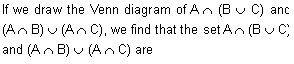
A
B
C
D
Question 124Single Answer
Consider the following statements :
1. The set of all irrational numbers between √2 and √5 is an infinite set .
2. The set of all odd integers less than 100 is a finite set .
Which of the statements given above is/are correct ?
A
1 only
B
2 only
C
Both 1 and 2
D
Neither 1 nor 2
Question 125Single Answer
What is the Next Prime Number after 7 ?
A
13
B
12
C
14
D
11
Question 126Single Answer
If A and B are two given sets, then A (A B)C is equal to
A
A
B
B
C
D
Question 127Single Answer
121 Divided by 11 is
A
11
B
10
C
19
D
18
Question 128Single Answer
Let X be the universal set for sets A and B, if n(A) = 200, n(B) = 300 and n = 100, then n is equal to 300 provided n(X) is equal to
A
600
B
700
C
800
D
900
Question 129Single Answer
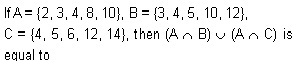
A
{3, 4, 10}
B
{2, 8, 10}
C
{4, 5, 6}
D
{3, 5, 14}
Question 130Single Answer
Let A = {x : x is a prime factor of 240} B = {x : x is the sum of any two prime factors of 240}, then
A
B
C
D
Question 131Single Answer
If A = {x : x is a multiple of 4 and x N} and B = {x : x is a multiple of 6 and x N}, then A B consists of all multiples of
A
16
B
12
C
8
D
4
Question 132Single Answer
A
A = B
B
B = C
C
A = C
D
None of these
Question 133Single Answer
A
equal
B
disjoint
C
either equal or disjoint
D
none of the above
Question 134Single Answer
A
{–i, i}
B
{–1, 1}
C
{–1, 1, i, –i}
D
None of these
Question 135Single Answer
If A = {x : f(x)= 0} and
B = {x : g(x) = 0}, then A B will be
A
[f(x)]2 + [g(x)]2 = 0
B
C
D
None of the above
Question 136Single Answer
In a group of 400 people, 250 can speak Hindi and 200 can speak English. Then, people who can speak both Hindi and English are
A
60
B
80
C
50
D
45
Question 137Single Answer
20 teachers of a school either teach Mathematics or Physics. 12 of them teach Mathematics while 4 teach both the subjects. The number of teacher teaching Physics only, is
A
12
B
8
C
16
D
20
Question 138Single Answer
In a class of 100 students, 70 have taken Science, 60 have taken Mathematics, 40 have taken both Science and Mathematics. The number of students who have not taken Science or Mathematics or both Science and Mathematics, is equal to
A
90
B
10
C
30
D
20
Question 139Single Answer
A market research group conducted a survey of 1000 consumers and reported that 720 consumers like product A and 450 consumers like the product B, then least number that must have like both products, is
A
730
B
170
C
180
D
1270
Question 140Single Answer
If there are three athletic teams in a school, 21 are in the basketball team, 26 in hockey team and 29 in the football team. 14 play hockey and basketball, 15 play hockey and football, 12 play football and basketball and 8 play all the games. The total number of members is
A
42
B
43
C
45
D
None of these
Question 141Single Answer
A college awarded 38 medals in football, 15 in basketball and 20 in cricket. If these medals went to a total of 58 men and only three men got medals in all the three sports, then number of men who received meal in exactly two of the three sports is
A
18
B
15
C
9
D
24
Question 142Single Answer
In the class of 175 students, the following data shows the number of students opting one or more subjects. Mathematics 100; Physics 70; Chemistry 40; Mathematics and Physics 30; Mathematics and Chemistry 28; Physics and Chemistry 23; Mathematics, Physics and Chemistry 18. Then, number of students opted Mathematics alone is
A
35
B
48
C
60
D
20
Question 143Single Answer
In a town of 10000 families it was found that 40% family buy newspaper A, 20% family buy newspaper B and 10% family buy newspaper C, 5% families buy and B, 3% families buy B and C and 4% families buy A and C. If 2% families buy all the three newspapers. Then, number of families which by A only is
A
3100
B
3300
C
2900
D
1400
Question 144Single Answer
In a city, 20% of the population travles by car, 50% travles by bus and 10% travles by both car and bus. Then, person travelling by car or bus, is
A
80%
B
40%
C
60%
D
70%
Question 145Single Answer
Universal set,
U = {x | x5 – 6x4 + 11x3 – 6 x 2 = 0}
A = {x | x2 – 5x + 6 = 0}
B = {x | x2 – 3x + 2 = 0}
What is the value of (A B)?
A
{1, 3}
B
{1, 2, 3}
C
{0, 1, 3}
D
{0, 1, 2, 3}
Question 146Single Answer
A
B
C
D
Question 147Single Answer
If P(A) denotes the power set of A and A is the void set, then what is the number of elements in P{P{P{P(A)}}}?
A
Zero
B
1
C
4
D
16
Question 148Single Answer
If A = {1, 2, 3, 4, 5}, b = {x : x2 – 5x + 6 = 0} and C = {x : x2 = 4 or x = 1}, then
A
B
C
Both (a) and (b)
D
None of the above
Question 149Single Answer
In a group of 50 people, 35 speak Hindi, 25 speak both English and Hindi and all the people speak atleast one of two languages. The number of people who speak 'English', 'English but not Hindi' are respectively
A
40, 15
B
15, 40
C
35, 15
D
25, 15
Question 150Single Answer
If P = {1, 2}, then P × P × P = {(1, 1, 1), (1, 1, 2), (1, 2, 1), (2, 1, 2), (2, 2, 1), (2, 2, 2)}. The ordered triplet missing in P × P × P are






 B and A
 B, then
 R} is .....X.... set. Here, X refers to
 B
 A





 (A


 = 100, then n
 is equal to 300 provided n(X) is equal to


 N} and B = {x : x is a multiple of 6 and x
 N}, then A
 B consists of all multiples of


 B will be


 B)?






