📚 Exam by Category
▾
Objective Questions

Latest CUET PG General Paper Exam Question (Objective Questions), MCQ in English

Subjects : Language Comprehension, Mathematical/ Quantitative Ability, Data Interpretation, Logical Reasoning

Question Bank CUET PG General Paper Exam (PGQP38) - English
Back to Exam

Language Comprehension

Question 1Single Answer
I go to Madurai by —– Vaigai Express
  1. A
    a
  2. B
    an
  3. C
    some
  4. D
    the
Question 2Single Answer
Have the car stolen!
  1. A
    Steal the car
  2. B
    You should have the stolen car
  3. C
    Get someone to steal the car
  4. D
    They have stolen the car
Question 3Single Answer
The payment was collected by the hardworking salesman.
  1. A
    The hardworking salesman collected the payment.
  2. B
    the salesman who worked heard was able to collect the payment.
  3. C
    to collect the payment the salesman had to work hard.
  4. D
    The hardworking salesman was able to collect the payment.
Question 4Single Answer
I had to stop all my work to complete this project.
  1. A
    All other work had to be stopped to complete this project by me
  2. B
    For completing this project all other work must be stopped
  3. C
    For completing this project I had to stop all my work
  4. D
    To complete this project all other work had been stopped by me
Question 5Single Answer
They have published the names of all the successful candidates.
  1. A
    The candidates who have succeeded their names they had published.
  2. B
    The names of all the successful candidates have been published by them
  3. C
    The candidates who have succeeded their names have been published by them.
  4. D
    The names of all the successful candidate were published by them. 
Question 6Single Answer
Passage :
Direction :  Question below has two blanks, each blank indicting that some thing has been omitted. Choose the word for each blank which best fits the meaning of the sentence as a whole.
The Finance Department has ……………a centralized online databank system for all statutory government bodies to …………an eye on their assets and liabilities.
  1. A
     presented , stay
  2. B
    introduced , keep
  3. C
    announce , make
  4. D
    created , let
  5. E
    proclaimed , hold
Question 7Single Answer
Passage :
Direction : The five items in this section consists of a word or group of words followed by four words as (a), (b), (c) and (d). Select the word which is nearly opposite to the meaning of the original word or group of words and mark your response as (a), (b), (c) and (d), as the case may be, in your Answer Sheet.
Assets
  1. A
    liabilities
  2. B
    responsibilities
  3. C
    estates
  4. D
    profits
Question 8Single Answer
Passage :
Direction : In the question, out of the four alternatives, choose the word which is opposite in meaning to the given word and click the button corresponding to it
Affidavit
  1. A
     Affirmation
  2. B
    Slander
  3. C
    Oath
  4. D
    Testimony
Question 9Single Answer
Passage :
Direction: In the following question, out of the four alternatives, choose the word which is opposite in meaning to the given word and click the button corresponding to it
Hollow
  1. A
    Alveolate
  2. B
    Cleft
  3. C
     Cavernous
  4. D
    Solid
Question 10Single Answer
Passage :
Directions: In the following question, out of the four alternatives, choose the word which is opposite in meaning to the given word and click the button corresponding to it
Cosset 
  1. A
    Ignoreb
  2. B
    Close
  3. C
    Caress
  4. D
    Fondle
Question 11Single Answer
Passage :
Direction : Read the following passage carefully and answer the questions that follow by selecting the correct/most appropriate options.
Did you know that there is a fiber that is as flexible and lightweight as nylon yet five times stronger than steel ? Did you know that this fabric is resistant to temperatures higher than 500°F ? Did you know that a woman invented this fiber ? This miraculous fabric is called Kevlar and it is used to make everything from body armor to musical instruments.
The year was 1964. There were gasoline shortages due to conflict in the Middle East. A Polish - American chemist named Stephanie Louise Kwolek was working for DuPont, an American Chemical Company. She and her group were trying to make a lightweight, yet durable fibre to be used in tires. Lighter tires would allow vehicles to get better gas mileage, but the tires had to be strong enough to resist the wear and tear of the road. They had been working on the problem for some time and had little success, until Kwolek had a breakthrough.
Kwolek and her group were synthesizing or creating fibres to test. During one of the steps in the process, Kwolek created a milky white solution by mixing two chemicals that were often used in the process. This solution was usually thrown away, but Kwolek convinced one of the technicians to help her test it. They were amazed to discover that the fabric that Kwolek had created was not only more durable than nylon, it was more durable than steel.
Kwolek had invented Kevlar. Kevlar is a remarkable fabric known for its strength and durability. Since its invention it has found its way into a wide variety of products. Kevlar is used in sporting equipment like bike tires, bowstrings and tennis racquets. It is used in musical instruments like drum heads, reeds and speaker cones. And it is used in protective gear like motorcycle safety jackets, gloves and shoes. However, Kevlar is best known for its ability to stop bullets.
Richard Armellino created the first Kevlar bulletproof vest in 1975. It contained 15 layers of Kevlar, which could stop handgun and shotgun bullets. The vest also had a steel plate over the heart, which made the vest strong enough to stop rifle rounds. Vests like Armellino's were quickly picked up by police forces and it is estimated that by 1990, half of all police officers in America wore bulletproof vests daily. By 2006, there were over 2,000 documented police vest 'saves', or instances where officers were protected from deadly wounds by wearing bulletproof vests.
Which one of the following is not a product that has been made with Kevlar ?
  1. A
    Body armor
  2. B
    Tennis racquets
  3. C
    Bungee jumping cord
  4. D
    Brake pads
Question 12Single Answer
Passage :
Direction : Read the following passage carefully and answer the questions that follow by selecting the correct/most appropriate options.
Did you know that there is a fiber that is as flexible and lightweight as nylon yet five times stronger than steel ? Did you know that this fabric is resistant to temperatures higher than 500°F ? Did you know that a woman invented this fiber ? This miraculous fabric is called Kevlar and it is used to make everything from body armor to musical instruments.
The year was 1964. There were gasoline shortages due to conflict in the Middle East. A Polish - American chemist named Stephanie Louise Kwolek was working for DuPont, an American Chemical Company. She and her group were trying to make a lightweight, yet durable fibre to be used in tires. Lighter tires would allow vehicles to get better gas mileage, but the tires had to be strong enough to resist the wear and tear of the road. They had been working on the problem for some time and had little success, until Kwolek had a breakthrough.
Kwolek and her group were synthesizing or creating fibres to test. During one of the steps in the process, Kwolek created a milky white solution by mixing two chemicals that were often used in the process. This solution was usually thrown away, but Kwolek convinced one of the technicians to help her test it. They were amazed to discover that the fabric that Kwolek had created was not only more durable than nylon, it was more durable than steel.
Kwolek had invented Kevlar. Kevlar is a remarkable fabric known for its strength and durability. Since its invention it has found its way into a wide variety of products. Kevlar is used in sporting equipment like bike tires, bowstrings and tennis racquets. It is used in musical instruments like drum heads, reeds and speaker cones. And it is used in protective gear like motorcycle safety jackets, gloves and shoes. However, Kevlar is best known for its ability to stop bullets.
Richard Armellino created the first Kevlar bulletproof vest in 1975. It contained 15 layers of Kevlar, which could stop handgun and shotgun bullets. The vest also had a steel plate over the heart, which made the vest strong enough to stop rifle rounds. Vests like Armellino's were quickly picked up by police forces and it is estimated that by 1990, half of all police officers in America wore bulletproof vests daily. By 2006, there were over 2,000 documented police vest 'saves', or instances where officers were protected from deadly wounds by wearing bulletproof vests.
For which of the following characteristics is Kevlar known ?
  1. A
    Durability
  2. B
    Heat resistant
  3. C
    Strength
  4. D
    All of these
Question 13Single Answer
Passage :
Direction : Read the following passage carefully and answer the questions that follow by selecting the correct/most appropriate options.
Did you know that there is a fiber that is as flexible and lightweight as nylon yet five times stronger than steel ? Did you know that this fabric is resistant to temperatures higher than 500°F ? Did you know that a woman invented this fiber ? This miraculous fabric is called Kevlar and it is used to make everything from body armor to musical instruments.
The year was 1964. There were gasoline shortages due to conflict in the Middle East. A Polish - American chemist named Stephanie Louise Kwolek was working for DuPont, an American Chemical Company. She and her group were trying to make a lightweight, yet durable fibre to be used in tires. Lighter tires would allow vehicles to get better gas mileage, but the tires had to be strong enough to resist the wear and tear of the road. They had been working on the problem for some time and had little success, until Kwolek had a breakthrough.
Kwolek and her group were synthesizing or creating fibres to test. During one of the steps in the process, Kwolek created a milky white solution by mixing two chemicals that were often used in the process. This solution was usually thrown away, but Kwolek convinced one of the technicians to help her test it. They were amazed to discover that the fabric that Kwolek had created was not only more durable than nylon, it was more durable than steel.
Kwolek had invented Kevlar. Kevlar is a remarkable fabric known for its strength and durability. Since its invention it has found its way into a wide variety of products. Kevlar is used in sporting equipment like bike tires, bowstrings and tennis racquets. It is used in musical instruments like drum heads, reeds and speaker cones. And it is used in protective gear like motorcycle safety jackets, gloves and shoes. However, Kevlar is best known for its ability to stop bullets.
Richard Armellino created the first Kevlar bulletproof vest in 1975. It contained 15 layers of Kevlar, which could stop handgun and shotgun bullets. The vest also had a steel plate over the heart, which made the vest strong enough to stop rifle rounds. Vests like Armellino's were quickly picked up by police forces and it is estimated that by 1990, half of all police officers in America wore bulletproof vests daily. By 2006, there were over 2,000 documented police vest 'saves', or instances where officers were protected from deadly wounds by wearing bulletproof vests.
Which one of the following caused the search for a fabric like Kevlar ?
  1. A
    The want of better musical instruments
  2. B
    A shortage in the gasoline supply
  3. C
    A desire to protect police officers
  4. D
    The need to replace asbestos
Question 14Single Answer
Passage :
Direction : Read the following passage carefully and answer the questions that follow by selecting the correct/most appropriate options.
Did you know that there is a fiber that is as flexible and lightweight as nylon yet five times stronger than steel ? Did you know that this fabric is resistant to temperatures higher than 500°F ? Did you know that a woman invented this fiber ? This miraculous fabric is called Kevlar and it is used to make everything from body armor to musical instruments.
The year was 1964. There were gasoline shortages due to conflict in the Middle East. A Polish - American chemist named Stephanie Louise Kwolek was working for DuPont, an American Chemical Company. She and her group were trying to make a lightweight, yet durable fibre to be used in tires. Lighter tires would allow vehicles to get better gas mileage, but the tires had to be strong enough to resist the wear and tear of the road. They had been working on the problem for some time and had little success, until Kwolek had a breakthrough.
Kwolek and her group were synthesizing or creating fibres to test. During one of the steps in the process, Kwolek created a milky white solution by mixing two chemicals that were often used in the process. This solution was usually thrown away, but Kwolek convinced one of the technicians to help her test it. They were amazed to discover that the fabric that Kwolek had created was not only more durable than nylon, it was more durable than steel.
Kwolek had invented Kevlar. Kevlar is a remarkable fabric known for its strength and durability. Since its invention it has found its way into a wide variety of products. Kevlar is used in sporting equipment like bike tires, bowstrings and tennis racquets. It is used in musical instruments like drum heads, reeds and speaker cones. And it is used in protective gear like motorcycle safety jackets, gloves and shoes. However, Kevlar is best known for its ability to stop bullets.
Richard Armellino created the first Kevlar bulletproof vest in 1975. It contained 15 layers of Kevlar, which could stop handgun and shotgun bullets. The vest also had a steel plate over the heart, which made the vest strong enough to stop rifle rounds. Vests like Armellino's were quickly picked up by police forces and it is estimated that by 1990, half of all police officers in America wore bulletproof vests daily. By 2006, there were over 2,000 documented police vest 'saves', or instances where officers were protected from deadly wounds by wearing bulletproof vests.
A vest made of 15 layers of Kevlar with no steel plates could stop all but which of the following rounds ?
  1. A
    Rifle rounds
  2. B
    Handgun rounds
  3. C
    Shotgun pellets
  4. D
    It could stop all of these
Question 15Single Answer
Passage :
Direction : Read the following passage carefully and answer the questions that follow by selecting the correct/most appropriate options.
Did you know that there is a fiber that is as flexible and lightweight as nylon yet five times stronger than steel ? Did you know that this fabric is resistant to temperatures higher than 500°F ? Did you know that a woman invented this fiber ? This miraculous fabric is called Kevlar and it is used to make everything from body armor to musical instruments.
The year was 1964. There were gasoline shortages due to conflict in the Middle East. A Polish - American chemist named Stephanie Louise Kwolek was working for DuPont, an American Chemical Company. She and her group were trying to make a lightweight, yet durable fibre to be used in tires. Lighter tires would allow vehicles to get better gas mileage, but the tires had to be strong enough to resist the wear and tear of the road. They had been working on the problem for some time and had little success, until Kwolek had a breakthrough.
Kwolek and her group were synthesizing or creating fibres to test. During one of the steps in the process, Kwolek created a milky white solution by mixing two chemicals that were often used in the process. This solution was usually thrown away, but Kwolek convinced one of the technicians to help her test it. They were amazed to discover that the fabric that Kwolek had created was not only more durable than nylon, it was more durable than steel.
Kwolek had invented Kevlar. Kevlar is a remarkable fabric known for its strength and durability. Since its invention it has found its way into a wide variety of products. Kevlar is used in sporting equipment like bike tires, bowstrings and tennis racquets. It is used in musical instruments like drum heads, reeds and speaker cones. And it is used in protective gear like motorcycle safety jackets, gloves and shoes. However, Kevlar is best known for its ability to stop bullets.
Richard Armellino created the first Kevlar bulletproof vest in 1975. It contained 15 layers of Kevlar, which could stop handgun and shotgun bullets. The vest also had a steel plate over the heart, which made the vest strong enough to stop rifle rounds. Vests like Armellino's were quickly picked up by police forces and it is estimated that by 1990, half of all police officers in America wore bulletproof vests daily. By 2006, there were over 2,000 documented police vest 'saves', or instances where officers were protected from deadly wounds by wearing bulletproof vests.
How much stronger is Kevlar than steel ?
  1. A
    200 times as strong
  2. B
    Half as strong
  3. C
    As strong
  4. D
    Five times as strong
Question 16Single Answer
Passage :
Direction : Read the following passage carefully and answer the questions that follow by selecting the correct/most appropriate options.
Did you know that there is a fiber that is as flexible and lightweight as nylon yet five times stronger than steel ? Did you know that this fabric is resistant to temperatures higher than 500°F ? Did you know that a woman invented this fiber ? This miraculous fabric is called Kevlar and it is used to make everything from body armor to musical instruments.
The year was 1964. There were gasoline shortages due to conflict in the Middle East. A Polish - American chemist named Stephanie Louise Kwolek was working for DuPont, an American Chemical Company. She and her group were trying to make a lightweight, yet durable fibre to be used in tires. Lighter tires would allow vehicles to get better gas mileage, but the tires had to be strong enough to resist the wear and tear of the road. They had been working on the problem for some time and had little success, until Kwolek had a breakthrough.
Kwolek and her group were synthesizing or creating fibres to test. During one of the steps in the process, Kwolek created a milky white solution by mixing two chemicals that were often used in the process. This solution was usually thrown away, but Kwolek convinced one of the technicians to help her test it. They were amazed to discover that the fabric that Kwolek had created was not only more durable than nylon, it was more durable than steel.
Kwolek had invented Kevlar. Kevlar is a remarkable fabric known for its strength and durability. Since its invention it has found its way into a wide variety of products. Kevlar is used in sporting equipment like bike tires, bowstrings and tennis racquets. It is used in musical instruments like drum heads, reeds and speaker cones. And it is used in protective gear like motorcycle safety jackets, gloves and shoes. However, Kevlar is best known for its ability to stop bullets.
Richard Armellino created the first Kevlar bulletproof vest in 1975. It contained 15 layers of Kevlar, which could stop handgun and shotgun bullets. The vest also had a steel plate over the heart, which made the vest strong enough to stop rifle rounds. Vests like Armellino's were quickly picked up by police forces and it is estimated that by 1990, half of all police officers in America wore bulletproof vests daily. By 2006, there were over 2,000 documented police vest 'saves', or instances where officers were protected from deadly wounds by wearing bulletproof vests.
What product was Kwolek trying to improve when she invented Kevlar ?
  1. A
    Armor
  2. B
    Tires
  3. C
    Milk
  4. D
    Brake pads
Question 17Single Answer
Passage :
Direction : Read the following passage carefully and answer the questions that follow by selecting the correct/most appropriate options.
Man who is believed to have evolved from apes, is a curious mixture of varied motives. He is not only the subject of needs, but is also their creator. He not only seeks to satisfy his needs but also caters to his desire for beauty and grace. He is eager to satisfy his passion for more and more knowledge. Although in a general way, the maxim 'necessity is the mother of invention' is true, it is by no means the whole truth. Man is something much greater than an intelligent being using his intellect to make newer inventions from time to time.
He has within him a spirit which is ever exhorting him to cut down his needs and learn to be happy with what he has. The real purpose underlying this maxim lies in its utility in the worldly sense. It tells us to be up and doing, not to be passive in our attitude to life. It asks us not to remain slaves of old habits and ways of life. We must face the new situations with a creative mind. Every new difficulty, every new problem, which confronts us in life, can be tackled successfully with the spirit of inventiveness.
Which one of the following is not the whole truth according to the passage ?
  1. A
    Man learns to be happy with what he has
  2. B
    Man has a desire for beauty and grace
  3. C
    Necessity is the mother of invention
  4. D
    Man desires to cut down his needs and wants
Question 18Single Answer
Passage :
Direction : Read the following passage carefully and answer the questions that follow by selecting the correct/most appropriate options.
Man who is believed to have evolved from apes, is a curious mixture of varied motives. He is not only the subject of needs, but is also their creator. He not only seeks to satisfy his needs but also caters to his desire for beauty and grace. He is eager to satisfy his passion for more and more knowledge. Although in a general way, the maxim 'necessity is the mother of invention' is true, it is by no means the whole truth. Man is something much greater than an intelligent being using his intellect to make newer inventions from time to time.
He has within him a spirit which is ever exhorting him to cut down his needs and learn to be happy with what he has. The real purpose underlying this maxim lies in its utility in the worldly sense. It tells us to be up and doing, not to be passive in our attitude to life. It asks us not to remain slaves of old habits and ways of life. We must face the new situations with a creative mind. Every new difficulty, every new problem, which confronts us in life, can be tackled successfully with the spirit of inventiveness.
What does the maxim mentioned in the passage teach us ?
  1. A
    To be active in life and do something to help mankind
  2. B
    To be worldly in the strict sense of the term
  3. C
    To be slave of our needs and wants
  4. D
    To endeavour constantly to create new passions and desires
Question 19Single Answer
Passage :
Direction : Read the following passage carefully and answer the questions that follow by selecting the correct/most appropriate options.
Man who is believed to have evolved from apes, is a curious mixture of varied motives. He is not only the subject of needs, but is also their creator. He not only seeks to satisfy his needs but also caters to his desire for beauty and grace. He is eager to satisfy his passion for more and more knowledge. Although in a general way, the maxim 'necessity is the mother of invention' is true, it is by no means the whole truth. Man is something much greater than an intelligent being using his intellect to make newer inventions from time to time.
He has within him a spirit which is ever exhorting him to cut down his needs and learn to be happy with what he has. The real purpose underlying this maxim lies in its utility in the worldly sense. It tells us to be up and doing, not to be passive in our attitude to life. It asks us not to remain slaves of old habits and ways of life. We must face the new situations with a creative mind. Every new difficulty, every new problem, which confronts us in life, can be tackled successfully with the spirit of inventiveness.
Which of the following statement(s) is/are true in the context of the passage ?
I. Man should be passive in his attitude to life.
II. Spirit of inventiveness may not stand in good stead in solving every new problem.
III. Man has a passion for more and more knowledge.
  1. A
    Only II and III
  2. B
    Only I
  3. C
    Only I and II
  4. D
    Only III
Question 20Single Answer
Passage :
Direction : Read the following passage carefully and answer the questions that follow by selecting the correct/most appropriate options.
Man who is believed to have evolved from apes, is a curious mixture of varied motives. He is not only the subject of needs, but is also their creator. He not only seeks to satisfy his needs but also caters to his desire for beauty and grace. He is eager to satisfy his passion for more and more knowledge. Although in a general way, the maxim 'necessity is the mother of invention' is true, it is by no means the whole truth. Man is something much greater than an intelligent being using his intellect to make newer inventions from time to time.
He has within him a spirit which is ever exhorting him to cut down his needs and learn to be happy with what he has. The real purpose underlying this maxim lies in its utility in the worldly sense. It tells us to be up and doing, not to be passive in our attitude to life. It asks us not to remain slaves of old habits and ways of life. We must face the new situations with a creative mind. Every new difficulty, every new problem, which confronts us in life, can be tackled successfully with the spirit of inventiveness.
Which of the following statement(s) is/are true in the context of the passage ?
I. Man should be passive in his attitude to life.
II. Spirit of inventiveness may not stand in good stead in solving every new problem.
III. Man has a passion for more and more knowledge.
  1. A
    Only II and III
  2. B
    Only I
  3. C
    Only I and II
  4. D
    Only III
Question 21Single Answer
Passage :
Direction : Read the following passage carefully and answer the questions that follow by selecting the correct/most appropriate options.
Man who is believed to have evolved from apes, is a curious mixture of varied motives. He is not only the subject of needs, but is also their creator. He not only seeks to satisfy his needs but also caters to his desire for beauty and grace. He is eager to satisfy his passion for more and more knowledge. Although in a general way, the maxim 'necessity is the mother of invention' is true, it is by no means the whole truth. Man is something much greater than an intelligent being using his intellect to make newer inventions from time to time.
He has within him a spirit which is ever exhorting him to cut down his needs and learn to be happy with what he has. The real purpose underlying this maxim lies in its utility in the worldly sense. It tells us to be up and doing, not to be passive in our attitude to life. It asks us not to remain slaves of old habits and ways of life. We must face the new situations with a creative mind. Every new difficulty, every new problem, which confronts us in life, can be tackled successfully with the spirit of inventiveness.
Which one of the following is similar in meaning to the word 'maxim' as used in the passage ?
  1. A
    Observation
  2. B
    Principle
  3. C
    Direction
  4. D
    Value
Question 22Single Answer
Passage :
Direction : Read the following passage carefully and answer the questions that follow by selecting the correct/most appropriate options.
Man who is believed to have evolved from apes, is a curious mixture of varied motives. He is not only the subject of needs, but is also their creator. He not only seeks to satisfy his needs but also caters to his desire for beauty and grace. He is eager to satisfy his passion for more and more knowledge. Although in a general way, the maxim 'necessity is the mother of invention' is true, it is by no means the whole truth. Man is something much greater than an intelligent being using his intellect to make newer inventions from time to time.
He has within him a spirit which is ever exhorting him to cut down his needs and learn to be happy with what he has. The real purpose underlying this maxim lies in its utility in the worldly sense. It tells us to be up and doing, not to be passive in our attitude to life. It asks us not to remain slaves of old habits and ways of life. We must face the new situations with a creative mind. Every new difficulty, every new problem, which confronts us in life, can be tackled successfully with the spirit of inventiveness.
Which one of the following is not the characteristic of man as per the passage ?
  1. A
    Man desires to have more and more comforts and money
  2. B
    Man has many needs and motives
  3. C
    Man creates many needs for himself
  4. D
    Man seeks to satisfy his needs
Question 23Single Answer
Passage :
Direction : Read the following passage carefully and answer the questions that follow by selecting the correct/most appropriate options.
Man who is believed to have evolved from apes, is a curious mixture of varied motives. He is not only the subject of needs, but is also their creator. He not only seeks to satisfy his needs but also caters to his desire for beauty and grace. He is eager to satisfy his passion for more and more knowledge. Although in a general way, the maxim 'necessity is the mother of invention' is true, it is by no means the whole truth. Man is something much greater than an intelligent being using his intellect to make newer inventions from time to time.
He has within him a spirit which is ever exhorting him to cut down his needs and learn to be happy with what he has. The real purpose underlying this maxim lies in its utility in the worldly sense. It tells us to be up and doing, not to be passive in our attitude to life. It asks us not to remain slaves of old habits and ways of life. We must face the new situations with a creative mind. Every new difficulty, every new problem, which confronts us in life, can be tackled successfully with the spirit of inventiveness.
Which one of the following statements is not true as per the passage ?
  1. A
    Man's inner spirit tells him to be on the look out for newer and higher wants
  2. B
    Spirit of inventiveness will stand in good stead
  3. C
    Man is the subject of various wants
  4. D
    Man creates new needs because they are sometimes good and beautiful
Question 24Single Answer
Passage :
Direction : Read the following passage carefully and answer the questions that follow by selecting the correct/most appropriate options.
Man who is believed to have evolved from apes, is a curious mixture of varied motives. He is not only the subject of needs, but is also their creator. He not only seeks to satisfy his needs but also caters to his desire for beauty and grace. He is eager to satisfy his passion for more and more knowledge. Although in a general way, the maxim 'necessity is the mother of invention' is true, it is by no means the whole truth. Man is something much greater than an intelligent being using his intellect to make newer inventions from time to time.
He has within him a spirit which is ever exhorting him to cut down his needs and learn to be happy with what he has. The real purpose underlying this maxim lies in its utility in the worldly sense. It tells us to be up and doing, not to be passive in our attitude to life. It asks us not to remain slaves of old habits and ways of life. We must face the new situations with a creative mind. Every new difficulty, every new problem, which confronts us in life, can be tackled successfully with the spirit of inventiveness.
Choose the word which is opposite in meaning to the word 'Seeks' as used in the passage.
  1. A
    Approaches
  2. B
    Deplores
  3. C
    Avoids
  4. D
    Vanishes
Question 25Single Answer
Passage :
Direction : Read the following passage carefully and answer the questions that follow by selecting the correct/most appropriate options.
Man who is believed to have evolved from apes, is a curious mixture of varied motives. He is not only the subject of needs, but is also their creator. He not only seeks to satisfy his needs but also caters to his desire for beauty and grace. He is eager to satisfy his passion for more and more knowledge. Although in a general way, the maxim 'necessity is the mother of invention' is true, it is by no means the whole truth. Man is something much greater than an intelligent being using his intellect to make newer inventions from time to time.
He has within him a spirit which is ever exhorting him to cut down his needs and learn to be happy with what he has. The real purpose underlying this maxim lies in its utility in the worldly sense. It tells us to be up and doing, not to be passive in our attitude to life. It asks us not to remain slaves of old habits and ways of life. We must face the new situations with a creative mind. Every new difficulty, every new problem, which confronts us in life, can be tackled successfully with the spirit of inventiveness.
Which one of the following is similar in meaning to the word 'exhorting' as used in the passage ?
  1. A
    Clarifying
  2. B
    Urging
  3. C
    Supporting
  4. D
    Demanding

Mathematical/ Quantitative Ability

Question 26Single Answer
The cash difference between the selling prices of an article at a profit of 4% and 6% is Rs. 3. The ratio of the two selling prices is:__________ ?
  1. A
    51:52
  2. B
    52:53
  3. C
    51:53
  4. D
    52:55
Question 27Single Answer
Which of the following numbers is irrational ?
  1. A
    √49
  2. B
    0.125
  3. C
    √2
  4. D
    22/7
Question 28Single Answer
356 x 936 – 356 x 836 = ?
  1. A
    35600  
  2. B
    34500
  3. C
    9630
  4. D
    93600
Question 29Single Answer
Arrange in descending order: 5/8, 7/10, 3/4
  1. A
    3/4 > 7/10 > 5/8
  2. B
    7/10 > 3/4 > 5/8
  3. C
    3/4 > 5/8 > 7/10
  4. D
    5/8 > 7/10 > 3/4
Question 30Single Answer
What is (3^{4} times 9^{2}) ?
  1. A
    36
  2. B
    38
  3. C
    310
  4. D
    96
     
Question 31Single Answer
If 34X-2 = 729, then find the value of X.
  1. A
    4     
  2. B
    3
  3. C
    2 
  4. D
    5
Question 32Single Answer
Convert 0.6 into fraction ?
  1. A
    3/5
  2. B
    2/3
  3. C
    4/5
Question 33Single Answer
The no. plate of a bus had peculiarity. The bus number was a perfect square. It was also a perfect square when the plate numbers were reversed. The bus company had only five hundred buses numbered from 1 to 500. What was the number ?
  1. A
    169  
  2. B
    36
  3. C
    196 
  4. D
    Can not say
Question 34Single Answer
If a and b are positive integers, such that ab = 125, then (a-b)a+b-4 = ?
  1. A
    16   
  2. B
    25
  3. C
    28  
  4. D
    30
Question 35Single Answer
If x*y = x2 + y2 – xy, then value of 9*11 is
  1. A
    93     
  2. B
    103
  3. C
    60.5
  4. D
    121
Question 36Single Answer
Which is greater ?
  1. A
    15/16
  2. B
    17/18
  3. C
    Equal
  4. D
    Cannot compare
Question 37Single Answer
If sum of two numbers is 42 and their product is 437, then find their difference.
  1. A
    3 
  2. B
    4
  3. C
    5    
  4. D
    7
Question 38Single Answer
Write the 44000 in Roman numerals
  1. A
    XLI 
  2. B
    XLVI
  3. C
    XLIV 
  4. D
    XLVIC
Question 39Single Answer
Convert 0.0909… into fraction ?
  1. A
    1/11
  2. B
    9/11
  3. C
    1/9
  4. D
    9/10
Question 40Single Answer
What is (98 times 102) ?
  1. A
    9996
  2. B
    10000
  3. C
    10096
  4. D
    10196
Question 41Single Answer
Passage :
information given below and answer the question that follow.
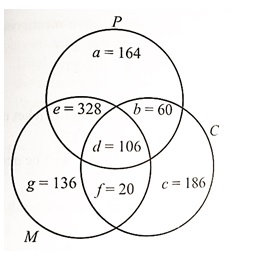
The result of an exam is given below. Out of 1000 students who appeared
(i) 658 failed in Physics
(ii) 166 failed in Physics and Chemistry
(iii) 372 failed in Chemistry, 434 failed in Physics and Maths
(iv) 590 failed in Maths, 126 failed in Maths & Chemistry
Find the number of people who failed in (assuming that none is passed in all subjects.

We have the following equations:
a+ b + c + d + e + f + g = 1000
a + b + d + e = 658, b + d = 166
b + d + c + f = 372
d + e = 434 as in the figure.
d + e + f + g = 590, d + f = 126. Find the values
Chemistry but not in Physics.
  1. A
    318
  2. B
    198
  3. C
    213 
  4. D
    206
Question 42Single Answer
Passage :
Direction: information given below and answer the question that follow.
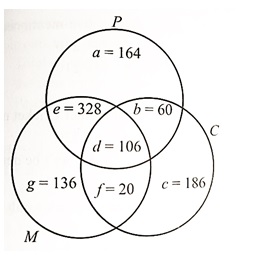
The result of an exam is given below. Out of 1000 students who appeared
(i) 658 failed in Physics
(ii) 166 failed in Physics and Chemistry
(iii) 372 failed in Chemistry, 434 failed in Physics and Maths
(iv) 590 failed in Maths, 126 failed in Maths & Chemistry
Find the number of people who failed in (assuming that none is passed in all subjects.

We have the following equations:
a+ b + c + d + e + f + g = 1000
a + b + d + e = 658, b + d = 166
b + d + c + f = 372
d + e = 434 as in the figure.
d + e + f + g = 590, d + f = 126. Find the values
Physics or Maths but not in Chemistry.
  1. A
    558   
  2. B
    718
  3. C
    628  
  4. D
    None of these
Question 43Single Answer
Passage :
For the next four question that follow:
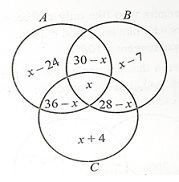
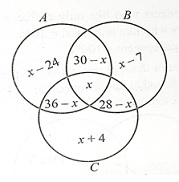
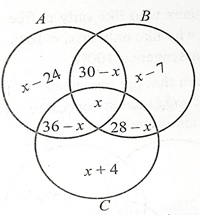
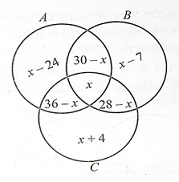
In a city, three daily newspapers A, B, C are published, 42% read A; 51% read B; 68% read C; 30% read A and B; 28% read B and C; 36% read A and C; 8% do not read any of the three newspapers.

Let x% people read all the three newspapers.
Since 8% people do not read any newspapers.
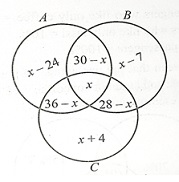
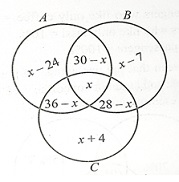
 (x – 24) + (x – 7) + (x + 4) + (30 – x) + (36 – x) + (28 – x) + x = 92
→ x + 98 – 31 = 92
→ x = 92 – 67 = 25
What is the percentage of persons who read all the three papers ?
  1. A
    20%  
  2. B
    25%
  3. C
    30%  
  4. D
    40%
Question 44Single Answer
Passage :
For the next four : question that follow :
In a city, three daily newspapers A, B, C are published, 42% read A; 51% read B; 68% read C; 30% read A and B; 28% read B and C; 36% read A and C; 8% do not read any of the three newspapers.

Let x% people read all the three newspapers.
Since 8% people do not read any newspapers.
 (x – 24) + (x – 7) + (x + 4) + (30 – x) + (36 – x) + (28 – x) + x = 92
→ x + 98 – 31 = 92
→ x = 92 – 67 = 25
What is the percentage of persons who read only two papers?
  1. A
    19%  
  2. B
    31%
  3. C
    44%
  4. D
    None of these
Question 45Single Answer
Passage :
For the next four : question that follow :
In a city, three daily newspapers A, B, C are published, 42% read A; 51% read B; 68% read C; 30% read A and B; 28% read B and C; 36% read A and C; 8% do not read any of the three newspapers.

Let x% people read all the three newspapers.
Since 8% people do not read any newspapers.
(x – 24) + (x – 7) + (x + 4) + (30 – x) + (36 – x) + (28 – x) + x = 92
→ x + 98 – 31 = 92
→ x = 92 – 67 = 25
What is the percentage of persons who read only one paper ?
  1. A
    38% 
  2. B
    48%
  3. C
    51%  
  4. D
    None of these
Question 46Single Answer
Passage :
For the next four : question that follow:
In a city, three daily newspapers A, B, C are published, 42% read A; 51% read B; 68% read C; 30% read A and B; 28% read B and C; 36% read A and C; 8% do not read any of the three newspapers.

Let x% people read all the three newspapers.
Since 8% people do not read any newspapers.
 (x – 24) + (x – 7) + (x + 4) + (30 – x) + (36 – x) + (28 – x) + x = 92
→ x + 98 – 31 = 92
→ x = 92 – 67 = 25
What is the percentage of persons who read only A but neither B nor C ?
  1. A
    4%
  2. B
    3%
  3. C
    1%  
  4. D
    None of these
Question 47Single Answer
Passage :
For the next four : question that follow:
In a city, three daily newspapers A, B, C are published, 42% read A; 51% read B; 68% read C; 30% read A and B; 28% read B and C; 36% read A and C; 8% do not read any of the three newspapers.

Let x% people read all the three newspapers.
Since 8% people do not read any newspapers.
 (x – 24) + (x – 7) + (x + 4) + (30 – x) + (36 – x) + (28 – x) + x = 92
→ x + 98 – 31 = 92
→ x = 92 – 67 = 25
If A and B are any two sets, then what is A ᴖ (A ᴗ B) equal to ?
  1. A
    Complement of A 
  2. B
    Complement of B
  3. C
    B   
  4. D
    A
Question 48Single Answer
Passage :
For the next four : question that follow:
In a city, three daily newspapers A, B, C are published, 42% read A; 51% read B; 68% read C; 30% read A and B; 28% read B and C; 36% read A and C; 8% do not read any of the three newspapers.

Let x% people read all the three newspapers.
Since 8% people do not read any newspapers.
 (x – 24) + (x – 7) + (x + 4) + (30 – x) + (36 – x) + (28 – x) + x = 92
→ x + 98 – 31 = 92
→ x = 92 – 67 = 25
40% of the people read newspaper X, 50% read newspaper Y and 10% read both the papers. What percentage of the people read neither newspaper ?
  1. A
    10%    
  2. B
    15%
  3. C
    20%  
  4. D
    25%
Question 49Single Answer
Passage :
Read the passage below and solve the question based on it.
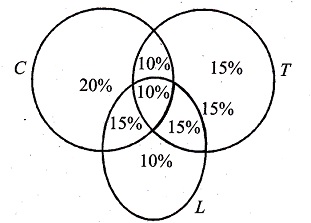
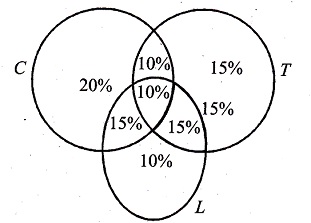
5% of the passengers do not like coffee, tea and lassi and 10% like all the three, 20% like coffee and tea, 25% like lassi and coffee and 25% like lassi and tea. 55% like coffee, 50% like tea, and 50% like lassi.

Where C = Coffee, T = Tea and L =Lassi
The passengers who like only coffee is greater than the passengers who like only lassi by
  1. A
    25%   
  2. B
    100%
  3. C
    75%   
  4. D
    0%
Question 50Single Answer
Passage :
Read the passage below and solve the question based on it.
5% of the passengers do not like coffee, tea and lassi and 10% like all the three, 20% like coffee and tea, 25% like lassi and coffee and 25% like lassi and tea. 55% like coffee, 50% like tea, and 50% like lassi.

Where C = Coffee, T = Tea and L =Lassi
The percentage of passengers who like both tea and lassi but not coffee, is
  1. A
    15 
  2. B
    25
  3. C
    40 
  4. D
    75
Important Questions Package

CUET PG General Paper Exam Online Question Bank Package

Buy CUET PG General Paper Important Questions, MCQ, question answer in Hindi & English. It will help you to score high marks in CUET PG General Paper question bank 2026 in Online, PDF & Print study material.

+ Free Monthly Current Affairs, GK & more PDF Download
Sr.Package NameAmount
1.CUET PG General Paper Exam (PGQP38) - Hindi
Description : 1000 Question with Answer
₹101 [₹500]
2.CUET PG General Paper Exam (PGQP38) - Hindi
Description : 2000 Question with Answer
₹151 [₹500]
3.CUET PG General Paper Exam (PGQP38) - English
Description : 1000 Question with Answer
₹101 [₹500]
4.CUET PG General Paper Exam (PGQP38) - English
Description : 2000 Question with Answer
₹151 [₹500]
5.CUET PG General Paper Exam (PGQP40) - Hindi
Description : 1000 Question with Answer
₹101 [₹500]
6.CUET PG General Paper Exam (PGQP40) - Hindi
Description : 2000 Question with Answer
₹151 [₹500]
7.CUET PG General Paper Exam (PGQP40) - English
Description : 1000 Question with Answer
₹101 [₹500]
8.CUET PG General Paper Exam (PGQP40) - English
Description : 2000 Question with Answer
₹151 [₹500]
9.CUET PG General Paper Exam (PGQP38) - Hindi
Description : 1000 Question & Answer Download in PDF (Send by Email)
₹151 [₹450]
10.CUET PG General Paper Exam (PGQP38) - English
Description : 1000 Question & Answer Download in PDF (Send by Email)
₹151 [₹450]
11.CUET PG General Paper Exam (PGQP40) - Hindi
Description : 1000 Question & Answer Download in PDF (Send by Email)
₹151 [₹450]
12.CUET PG General Paper Exam (PGQP40) - English
Description : 1000 Question & Answer Download in PDF (Send by Email)
₹151 [₹450]
13.CUET PG General Paper Exam Question Bank Book (PGQP38) - Hindi
Description : 1000 Question with Answer (Printed Material)
₹450 [₹800]
14.CUET PG General Paper Exam Question Bank Book (PGQP38) - English
Description : 1000 Question with Answer (Printed Material)
₹390 [₹600]
15.CUET PG General Paper Exam Question Bank Book (PGQP40) - Hindi
Description : 1000 Question with Answer (Printed Material)
₹450 [₹800]
16.CUET PG General Paper Exam Question Bank Book (PGQP40) - English
Description : 1000 Question with Answer (Printed Material)
₹390 [₹600]
Back to Exam
Question for CUET PG General Paper 2027 - Quiz / Questions / MCQ - Toppersexam