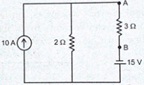
Assuming both the voltage sources are in phase, the value of R for which maximum power is transferred from circuit A to circuit B is
A
0.8 Ω
B
1.4 Ω
C
2 Ω
D
2.8 Ω
Question 2Single Answer
For the intrinsic gallium-arsenide, the conductivity at room temperature 25°C is 10-6 (ohm-m)-1, the electron and hole nobilities are 0.85 m2/V-s and 0.04 m2/V-s respectively. What is the intrinsic carrier concentration at the room temperature?
A
7.0 × 10¹² m-3
B
7.0 × 10⁻¹² m-3
C
7.0 × 10⁻¹² m3
D
7.0 × 10¹² m3
Question 3Single Answer
The resistivity of intrinsic germanium at 30°C is 0.46 –m. What is the intrinsic carrier density at 30°C if the electron mobility is 0.38 m2/V-s and the hole mobility is 0.18 m2/V-s?
A
9.2 × 10⁵/m3
B
2.77 × 10³/m3
C
2.43 × 10¹⁹/m3
D
8.9 × 10¹²/m3
Question 4Single Answer
Heat conduction in a semiconductor takes place
A
By the mobility of the carriers
B
Due to energy gap between conduction band and valency band
C
By the holes and thermal vibrations of atoms
D
By the electrons and thermal vibrations of atoms
Question 5Single Answer
Brewster angle is the angle when a wave is incident on the surface of a perfect dielectric at which there is no reflected wave and the incident wave is
A
Parallel polarized
B
Perpendicularly polarized
C
Normally polarized
D
None of the above
Question 6Single Answer
An electrical breakdown of a p-n junction occurs if
A
Forward voltage increases up to the rating
B
Reverse voltage increases beyond the rating
C
Forward voltage decreases below the rating
D
Reverse voltage decreases below the rating
Question 7Single Answer
The chief deterrent to the widespread application of superconducting materials is
A
Very difficult to form, machine or case
B
The difficult in attaining and maintaining extremely low temperature
C
The poor strength-to-weight ratio
D
The lower oxidation rate at elevated temperatures
Question 8Single Answer
Which one of the following properties is not observed in the carbon nanotubes ?
A
High stiffness and strengths
B
Low densities
C
Unusual electrical property
D
Non-ductile
Question 9Single Answer
The evidence for the importance of electron-phonon interaction in super-conductors comes from
A
Meissner effect
B
Josephson effect
C
Isotope effect
D
x quantization experiments
Question 10Single Answer
Which one of the following materials is used for cable insulation ?
A
Phenol formaldehyde
B
Polytetrafluoroethylene
C
Polyvinyl chloride
D
Acrylonitrile butadiene styrene
Question 11Single Answer
For high speed reading and storing of information in a computer, the material used is
A
Ferrite
B
Piezoelectric
C
Pyroelectric
D
Ferromagnetic above 768°C
Question 12Single Answer
The temperature above which an anti-ferromagnetic material becomes paramagnetic is called
A
Peak temperature
B
Neel temperatur
C
Critical temperature
D
Weiss temperature
Question 13Single Answer
Which effect is the converse of Peltier effect ?
A
Seeback effect
B
Thomson effect
C
Hall effect
D
Joule effect
Question 14Single Answer
Magnetic materials which may be readily magnetized in either direction are
A
Soft magnetic materials
B
Hard magnetic materials
C
High eddy current loss materials
D
High hysteresis loss materials
Question 15Single Answer
Consider the following statements regarding a ferromagnetic material:
1.Below the ferromagnetic Curie temperature, the ferromagnetic materials exhibit hysteresis effect.
2.The coercive force is the filed required to reduce the flux density to zero.
Which of the above statements is/are correct?
A
Both 1 and 2
B
Neither 1 nor 2
C
1 only
D
2 only
Question 16Single Answer
The impact ionization phenomenon in semiconductor may be viewed as the reverse process of
A
Radiative recombination
B
Auger recombination
C
Surface recombination
D
Shockley-Read-Hall recombination
Question 17Single Answer
Refractive index of a slice glass can be reduced by doping it with tiny amount of
A
GeO2
B
B2O3
C
P2O5x
D
Al2O3
Question 18Single Answer
If a diameter of a copper wire is increased by two times keeping its terminal voltage same, then the drift velocity will
A
Become twice
B
Become half
C
ecome four times
D
Remain unchanged
Question 19Single Answer
In an induction type energy meter, the steady speed attained by the rotating disc is
1.Proportional to the deflecting torque.
2.Proportional to the resistance of the path of eddy currents.
3.Inversely proportional to the effective readings of disc from its axis.
4.Inversely proportional to the square of brake magnetic flux.
Which of the above are correct?
A
1, 2 and 3 only
B
1, 2 and 4 only
C
2, 3 and 4 only
D
1, 2, 3 and 4
Question 20Single Answer
If ‘KCLFTSB’ stands for ‘best of luck’ and ‘SHSWDG’ stands for ‘good wishes’, which of the following indicates ‘ace the exam’?
A
MCHTX
B
MXHTC
C
XMHCT
D
XMHTC
Question 21Single Answer
Consider the following statements associated with the basic electrostatic properties of ideal conductors:
1.The resultant field inside is zero.
2.The net charge density in the interior is zero.
3.Any net charges reside on the surface.
4.The surface is always equipotential.
5.The field just outside is zero.
Which of the above statements are correct?
A
1, 2, 3 and 4
B
3, 4 and 5 only
C
1, 2 and 3 only
D
2 and 3 only
Question 22Single Answer
A semiconductor device made out of a material having very high temperature coefficient of resistance is
A
Transistor
B
Varistor
C
Thyristor
D
Thermistor
Question 23Single Answer
The electrical conductivity of a semiconductor increases with increase in temperature because
A
The carrier concentration increases
B
The mobility of carrier increases
C
Both carrier concentration and mobility increases
D
The band gap decreases
Question 24Single Answer
Which of the following are associated with soft superconductors?
1.Silsbee’s rule
2.Meissner effect
3.Faraday rotation
4.Curie-Weiss law
A
2, 3 and 4
B
1 and 3 only
C
1 and 2 only
D
2 and 3 only
Question 25Single Answer
In a two-channel oscilloscope operating in x-y mode, two in-phase 50 Hz sinusoidal waveforms of equal amplitude are fed to the two channels. What will be the resultant pattern on the screen?
A
An ellipse
B
A parabola
C
Straight line inclined at 45 with respect to x-axis
D
A circle
Question 26Single Answer
Materials, whose resistivity at very low temperature plunges from a finite value to zero and remains there upon further cooling, are known as
A
Ferromagnetic materials
B
High-energy hard magnetic materials
C
Superconductors
D
Ferromagnetic materials
Question 27Single Answer
In a superconductor, is the temperature is decreased below its critical temperature, the value of critical magnetic field will
A
Increase
B
Decrease
C
Not change
D
Increase or decrease depending on the superconductor material
Question 28Single Answer
The imaginary part of dielectric constant determines
A
Component of current which is in phase with the applied field
B
Component of energy absorbed per m3
C
Amount of applied field
D
Component of voltage which is in phase with the applied field
Question 29Single Answer
Direction:Each of the items consists of two statements, one labeled as the ‘Statement (I)’ and the other as ‘Statement (II)’. Examine these two statements carefully and select the answers to these items using the codes given below
A
Statement (I):Hard magnetic materials are used for making permanent magnets. Statement (II):
Hard magnetic materials have relatively small and narrow hysteresis loop.
B
Both Statement (I) and Statement (II) are individually true and Statement (II) is the correct explanation of Statement (I)
C
Both Statement (I) and Statement (II) are individually true and Statement (II) is NOT the correct explanation of Statement (I)
D
Statement (I) is true but Statement (II) is false
E
Statement (I) is false but Statement (II) is true
Question 30Single Answer
In 8085A microprocessor, the operation performed by the instruction LHLD 2100 H is
A
(H) ← 21 H, (L) ←00
B
(H) ← M (2100 H), (L) ←M(2101H)
C
(H) ← M (2100 H), (L) ←M(2100H)
D
(H) ← 00H, (L) ←21H
Question 31Single Answer
If the magnetic susceptibility of a specimen is small and positive, the specimen is
A
Diamagnetic
B
Paramagnetic
C
Ferromagnetic
D
Non-magnetic
Question 32Single Answer
Manganese ferrite is a 1 : 1 mixture of
A
Manganese nitride and iron oxide
B
Manganese oxide and iron nitride
C
Manganese nitride and iron sulphide
D
Manganese oxide and iron sulphide
Question 33Single Answer
When a ferromagnetic substance is magnetized, small changes in dimensions occur. Such a phenomenon is known as
A
Magnetic hysteresis
B
Magnetic expansion
C
Magnetostriction
D
Magneto-calorisation
Question 34Single Answer
In ferromagnetic , anti-ferromagnetic and ferromagnetic materials, the atomic thermal motions counteract the coupling forces between the adjacent atomic dipole moments, thereby causing
A
Some dipole misalignment regardless of whether an external field is present
B
Increase in dipole alignment regardless of whether an external field is present
C
No effect on dipole alignment
D
Atoms tend to de-randomize the direction of moments
Question 35Single Answer
The Hall effect voltage in intrinsic silicon
A
Is positive
B
Is zero
C
Is negative
D
Changes its sign based on application of magnetic field
Question 36Single Answer
Most outstanding property of indium antimonide is
A
A very wide range gap
B
High resistivity at room temperature
C
High carrier mobility
D
Very low conductivity at room temperature
Question 37Single Answer
Which of the following semiconducting compounds is used in photoconductive devices?
A
Caesium antimonide
B
Barium oxide
C
Lead sulphide
D
Zinc oxide
Question 38Single Answer
Consider the following transducers:
1.LVDT
2.Piezoelectric
3.Thermocouple
4.Photovoltaic cell
Which of the above are active transducers?
A
1, 2 and 3
B
1, 2 and 4
C
2 and 3 only
D
2, 3 and 4
Question 39Single Answer
Consider the following statements regarding magnetic materials:
1.A diamagnetic material has no permanent dipole
2.Paramagnetic material has anti-parallel orientation of equal moments with neighboring dipoles
3.Ferrimagnetic material has anti parallel orientation of unequal moments between neighboring dipoles
4.Anti-ferromagnetic material has negligible interaction between neighboring dipoles
Which of these statements are correct?
A
1 and 2
B
3 and 4
C
2 and 4
D
1 and 3
Question 40Single Answer
Consider the following statements regarding hysteresis loops of hard and soft magnetic materials:
1.Hysteresis loss of hard magnetic material will be less than that of soft material
2.Coercivity of hard materials will be greater than that of soft material
3.Retentivity of the two materials will always be equal
Which of these statements are correct?
A
1, 2 and 3
B
2 only
C
3 only
D
1 and 3 only
Question 41Single Answer
Loss-tangent in plane waves in lossy dielectrics will be
A
Proportional to the Y component of the magnetic field intensity (HY)
B
Inversely proportional to the Y component of the magnetic field intensity (HY)
C
Inversely proportional to the X component of the magnetic field intensity (HX)
D
proportional to the X component of the magnetic field intensity (HX)
Question 42Single Answer
Orientational polarization is
A
Inversely proportional to temperature and proportional to the square of the permanent dipole moment
B
proportional to temperature as well as to the square of the permanent dipole moment
C
proportional to temperature and inversely proportional to the square of the permanent dipole moment
D
Inversely proportional to temperature as well as to the square of the permanent dipole moment
Question 43Single Answer
Behavior of conductors, semiconductors and insulators is explained on the basis of
A
Atomic nature
B
Molecular structure
C
Energy band structure
D
All of the above
Question 44Single Answer
In general, for a superconductor, which of the following statements is true?
A
A superconductor is a perfect paramagnetic material with the magnetic susceptibility equals to positive unity
B
A superconductor is a perfect diamagnetic material with the magnetic susceptibility equals to negative one
C
A superconductor is a perfect ferromagnetic material with the magnetic susceptibility equals to positive one
D
A superconductor is a perfect piezoelectric material with the magnetic susceptibility equals to negative one
Question 45Single Answer
Ferro-electric materials have a
A
High dielectric constant which varies non linearly
B
Low dielectric constant and is non-linear
C
High dielectric constant which varies linearly
D
Low dielectric constant but linear
Question 46Single Answer
In the magnetic core the electromotive forces (emf) induced in accordance with Faraday’s law of electromagnetic induction give rise to
A
Eddy current
B
Excitation current
C
Armature current
D
Field current
Question 47Single Answer
Consider the following characterizing parameters of a material:
1.Magnetic permeability
2.Electron relaxation time 3.Electron effective mass
4.Energy band gap
In case of metals, increase in one of the above parameter decreases its conductivity, while increase in another increases the conductivity. There are respectively
A
1 and 3
B
3 and 2
C
4 and 3
D
1 and 2
Question 48Single Answer
Some magnetic materials may be classified on the basis of
1.Susceptibility
2.Saturation
3.Spin arrangement
4.Nature of hysteresis loop
5.Domain structure
6.Critical temperature above which it behaves as a paramagnetic material
Which of these can be used to distinguish between ferri and ferromagnetic materials?
A
1, 3 and 4 only
B
2, 3 and 6 only
C
3, 4 and 5 only
D
1, 2, 3, 4, 5 and 6
Question 49Single Answer
Magnetism is mainly due to only electron spin around their axis in case of
A
Diamagnetic materials
B
Paramagnetic materials
C
Ferromagnetic materials
D
Paramagnetic and Diamagnetic materials
Question 50Single Answer
For Paramagnetic materials, the relative permeability is
A
Less than unity but magnetic susceptibility is relatively small and positive
B
greater than unity and magnetic susceptibility is relatively small but positive
C
equal to unity and magnetic susceptibility is relatively large but positive
D
Less than unity but magnetic susceptibility is relatively large and positive
Important Questions Package
DRDO Scientist B Exam Online Question Bank Package
Buy DRDO Scientist B Important Questions, MCQ, question answer in Hindi & English. It will help you to score high marks in DRDO Scientist B question bank 2026 in Online, PDF & Print study material.
+ Free Monthly Current Affairs, GK & more PDF Download
Sr.
Package Name
Amount
1.
DRDO Scientist B (Electrical) Exam - English.
Description : 2000 Question with Answer.
₹231[₹500]
2.
DRDO Scientist B (Electrical) Exam - Hindi.
Description : 1730 Question with Answer.
₹231[₹500]
Electrical
Question 51Single Answer
Permalloy and Mumetal are examples of
A
Silicon and iron alloys
B
Nickel and iron alloys
C
Cobalt and iron alloys
D
Permanent magnetic materials
Question 52Single Answer
When a ferromagnetic substance is magnetized, the phenomenon of ‘magnetostriction’ causes
A
Increase in the body temperature
B
Change in the permeability of the substance
C
Small change in its dimensions
D
Decrease in the saturation flux-density
Question 53Single Answer
The resistivity of ‘Ferrites’ is very much higher than that of ferromagnetic metals, because
A
Ferrites are chemical compounds and the electrons in them are subject to restraint of valence forces
B
Ferrites have a low eddy current loss
C
Ferrites have a non-homogeneous molecular structure
D
Ferrites have varying flux-density inside the core
Question 54Single Answer
When the temperature exceeds the transition temperature, a ferromagnetic material becomes similar to
A
Anti- ferromagnetic material
B
Diamagnetic material
C
ferrimagnetic material
D
paramagnetic material
Question 55Single Answer
Einstein relation is referred between
A
The diffusion constant and the mobility
B
The conduction and diffusion currents
C
The conduction and diffusion voltages
D
None of the above
Question 56Single Answer
In a piezoelectric crystal oscillator, the oscillation or tuning frequency is linearly proportional to the
A
Mass of the crystal
B
Square root of the Mass of the crystal
C
Square of the Mass of the crystal
D
Inverse of the Square root of the Mass of the crystal
Question 57Single Answer
Which of the following are piezoelectric substances?
1.Barium Titanate
2.Lead Titanate
3.Lead Zirconate
4.Cadmium Suplhate
A
1, 2 and 4
B
1, 3 and 4
C
1, 2 and 3
D
2, 3 and 4
Question 58Single Answer
Consider the following statements:
1.Fermi level in a p-type semiconductor lies close to the top of the valence bond.
2.The forbidden energy in Germanium at 0°K is exactly 0.75 eV.
3.When a p-n junction is reverse biased, then electrons and holes move away from the junction.
Which of these statements are correct?
A
1, 2 and 3
B
1 and 2 only
C
2 and 3 only
D
1 and 3 only
Question 59Single Answer
For a fully transposed transmission line
A
positive negative and zero sequence impedances are equal
B
positive and negative sequence impedances are equal
C
zero and positive sequence impedances are equal
D
negative and zero sequence impedances are equal
Question 60Single Answer
The unit of magnetic flux density is
A
Gauss
B
Tesla
C
Bohr
D
Wber/sec
Question 61Single Answer
Skin depth is the distance from the conductor surface where the field strength has fallen to
A
of its strength at the surface
B
of its strength at the surface
C
(1/ ) of its strength at the surface
D
(1/ ) of its strength at the surface
Question 62Single Answer
The electric field in the vicinity of two oppositely charged parallel conductors is
A
Radial uniformly
B
In parallel lines between the two imaginary parallel planes passing through the centers of the two conductors
C
Non uniform and its direction changes from point to point
D
In parallel circular paths between the two conductors, with the center of the circles located at the mid-point of a line joining the two centers of the two conductors
Question 63Single Answer
Two charges are placed at a distance apart. Now, if a glass slab is inserted between them, then the force between the charges will
A
Reduce to zero
B
Increase
C
Decrease
D
Not change
Question 64Single Answer
The transfer function of a second order real system with a perfectly flat magnitude response of unity has a pole at (2 – j3). List all the poles and zeros.
A
Poles at (2 ± j3), no zeroes.
B
Poles at (±2 - j3), no zeroes.
C
Poles at (2 - j3),(-2 + j3) zeroes at (-2 – j3), (2 + j3).
D
Poles at (2 ± j3), zeroes at (-2 ± j3).
Question 65Single Answer
The presence of one of the following materials, in iron or steel for use as a magnetic material, tends to reduce the hysteresis loss
A
Carbon
B
Sulphur
C
Phosphorous
D
Silicon
Question 66Single Answer
The depth of penetration of a wave in a lossy dielectric increases with increasing
A
Conductivity
B
Permeability
C
Wavelength
D
Permittivity
Question 67Single Answer
Match List-I and List-II and select the correct answer using the code given below the lists: List-I List-II
A.Carbon (Diamond) 1. Conducting
B.Silicon 2. Semiconducting
C.Tin (Grey) 3. Insulating
D.Lead
A
A B C D
3 2 1 1
B
1 2 1 3
C
3 1 2 1
D
1 1 2 3
Question 68Single Answer
It is possible to destroy the superconductivity of a material by applying
A
A strong magnetic field
B
A temperature much below the transition temperature
C
A strong electric field
D
A pressure below that of the atmosphere
Question 69Single Answer
Consider the following properties regarding insulation for cables:
1. A low specific resistance
2. High temperature withstand
3. High dielectric strength
Which of the above properties of insulation are correct while using cables?
A
1 and 2 only
B
1 and 3 only
C
2 and 3 only
D
1,2 and 3
Question 70Single Answer
The open loop poles of a third order unity feedback system are at 0, -1, -2, let the frequency corresponding to the point, where the root locus of the system transits to unstable region be K. now suppose we introduce a zero in the open loop transfer function at -3, while keeping all the earlier open loop poles intact. Which one of the following is correct about the point, where the root locus of the modified system transits to unstable region?
A
it corresponds to a frequency greater than K
B
it corresponds to a frequency less that K
C
it corresponds to a frequency K
D
Root locus of modified system never transits to unstable region
Question 71Single Answer
Which of the following moving particles cannot be deflected by magnetic fields?
A
α - Particles
B
Neutrons
C
Protons
D
Electrons
Question 72Single Answer
The Fermi level in an n-type semiconductor at zero degree kelvin lies
A
Below the donor level
B
Half-way between the conduction band and the donor level
C
Half-way between the conduction band and the valence level
D
Close to the valence band
Question 73Single Answer
According to free electron theory, electrons in a metal are subjected to
A
Constant potential
B
Sinusoidal potential
C
Square wave potential
D
Non-periodic potential
Question 74Single Answer
Controlled addition of group III element to an elemental semiconductor results in the formation of
A
Intrinsic semiconductor
B
n-type semiconductor
C
p-type semiconductor
D
Degenerate semiconductor
Question 75Single Answer
Phonons (Quanta of lattice vibration) obey
A
Maxwell distribution
B
Maxwell-Boltzmann distribution
C
Fermi-Dirac distribution
D
Bose-Einstein distribution
Question 76Single Answer
Did not you buy…………..when you went shopping?
A
any paper
B
much paper
C
no paper
D
a few paper
Question 77Single Answer
Consider the following standard symbols for two-port parameters :
1.h12 and h21 are dimensionless. 2.h11 ohms and B have dimensions of ohms.
3.BC is dimensionless.
4.C is dimensionless.
Which of the above are correct ?
A
1, 2 and 3 only
B
1, 2 and 4 only
C
3 and 4 only
D
1, 2, 3 and 4
Question 78Single Answer
An iron-cored choke coil has an equivalent resistance of 5Ω. It draws 10 A when the applied voltage is 240V, 50Hz. Its inductance and power factor respectively are
A
7.5 mH and 0.1 (lag)
B
74.7 mH and 0.1 (lag)
C
74.7 mH and 0.208 (lag)
D
7.5 mH and 0.208 (lag)
Question 79Single Answer
A voltage of 100 V is applied to an impedance of Z = (3 + j4) Ω. What are the values of active power, reactive power and volt-amperes respectively ?
A
1200 W, 1220 VAR and 2000 VA
B
1600 W, 1600 VAR and 2200 VA
C
1200 W, 1600 VAR and 2000 VA
D
1600 W, 1200 VAR and 2200 VA
Question 80Single Answer
The voltage across an impedance Z is 100∠15° V and the current through Z is 20∠-45° A. The active and the reactive powers in Z respectively are
A
1000 W and 1732 VAR
B
500 W and 1732 VAR
C
1000 W and 6000 VAR
D
500 W and 6000 VAR
Question 81Single Answer
An a.c. source of 200 V r.m.s. supplies an active power of 1200 W and a reactive power of 1600 VAR to a load. The r.m.s. current and the power factor of the load respectively are
A
10 A and 0.6
B
8 A and 0.8
C
10 A and 0.8
D
8 A and 0.6
Question 82Single Answer
A shunt capacitor used for reactive power compensation is operated at 98% of its rated frequency and 95% of its rated voltage. The reactive power supplied by this capacitor (as compared to its rated capacity) is
A
7.9% lower
B
11.5% lower
C
11.5% higher
D
7.9% higher
Question 83Single Answer
Consider two nodes A and B connected by an impedance of j5 W. If the voltages at nodes A and B are 100∠30° V and 100∠0° V respectively, the real power that can be transferred from node A to B is
A
2000 W
B
1000 W
C
2769 W
D
276.9 W
Question 84Single Answer
The Thevenin equivalent voltage and resistance across AB shown in the figure respectively are
A
5 V and 5 Ω
B
25 V and 3 Ω
C
35 V and 2 Ω
D
25 V and 5 Ω
Question 85Single Answer
The theorem which states that in any linear, non-linear, passive, active, time-variant, time-invariant network, summation of instantaneous power is zero will be called as
A
Tellegen’s theorem
B
Compensation theorem
C
Reciprocity theorem
D
Superposition theorem
Question 86Single Answer
Transients are cause because
1.The load is suddenly connected to or disconnected from the supply
2.Of the sudden change in applied voltage form one finite value to the other
3.Of the change in stored energy in inductors and capacitors
Which of the above statements are correct?
A
1 and 2 only
B
1 and 3 only
C
2 and 3 only
D
1, 2 and 3
Question 87Single Answer
Which of the following can produce maximum induced voltage?
A
1 A d.c. current
B
50 A d.c. current
C
1 A, 60 Hz a.c. current
D
1 A, 490 Hz a.c. current
Question 88Single Answer
For cleat wiring and 250 volts supply, the cables will be placed _____ a part centre to centre for single corw cables.
A
4.5 cm
B
2.5 cm
C
3 cm
D
4 cm
Question 89Single Answer
Which insulation is most widely used for covering wires/cables used in internal wiring ?
A
Paper
B
Wood
C
Glass
D
PVC
Question 90Single Answer
If the Q-factor of a coil at resonant frequency of 1.5 MHz is 150 for a series resonant circuit, then the corresponding bandwidth is
A
225 MHz
B
106 MHz
C
50 kHz
D
10 kHz
Question 91Single Answer
The number of p-n junctions in a thyristor (SCR) is/are:
A
1
B
2
C
3
D
4
Question 92Single Answer
In a two-wattmeter method of measuring power in a balanced 3-phase circuit, the ratio of the two wattmeter readings is 1 : 2. The circuit power
A
0.707
B
0.5
C
0.866
D
Indeterminate
Question 93Single Answer
A balanced delta-connected load (16 + j12)Ω/phase is connected to a 3-phase 230 V balanced supply. The line current and the real power drawn respectively are
A
19.9 A and 3.17 W
B
11.5 A and 6.34 W
C
19.9 A and 6.34 W
D
11.5 A and 3.17 W
Question 94Single Answer
A balanced load of 5 + j4 is connected in delta. What is the impedance per phase of the equivalent star connection?
A
5 + j4
B
1.66 + j1.33
C
15 + j12
D
2.5 + j2
Question 95Single Answer
In an electric circuit, the number of independent meshes M is
A
2B – N + 1
B
B – N + 1
C
2B – N – 1
D
B – N – 1
Question 96Single Answer
A.d.c. voltage of 12 volts applied across an inductance in series with a switch
A
Can produce the induced voltage as the current decreases when the switch is opened
B
Cannot produce the induced voltage as the voltage applied has the one polarity
C
Produces more induced voltage when the switch is closed than the switch is opened
D
None of the above
Question 97Single Answer
The power factor of a circuit in which voltage and current waves are non-sinusoidal is defined as
A
It is the cosine of the angle of phase difference between the voltage and current waves
B
It is the cosine of the angle of phase difference between the two complex waves
C
It is the cosine of the angle of phase difference between two equivalent sine waves having respectively r.m.s. values equal to those of the voltage and current in the circuit
D
It is the sine of the angle of phase difference between the two complex waves
Question 98Single Answer
The low-frequency circuit impedance and the high-frequency circuit impedance for a series resonant circuit respectively are
A
Capacitive and inductive
B
Inductive and capacitive
C
Resistive and inductive
D
Capacitive and resistive
Question 99Single Answer
Which of the following is an invalid state in an 8-4-2-1 binary codede decimal counter
A
1000
B
1001
C
0011
D
1100
Question 100Single Answer
The maximum space rate of change of the function which is in increasing direction of the function is known as
Direction:Study the given information carefully and answer the given question
P, Q, R, S, T, V, X and Y are seated in a straight line facing North. P sits fourth to the left of V. V sits either sixth from the left end of the line or fourth from the right end of the line. S sits second to the right of R. R is not an immediate neighbor of V. T and Q are immediate neighbours of each other but neither T not Q sits at extreme ends of the line. Only one person sits between T and X. X does not sit at the extreme end of the line
According to the passage, what is the main purpose of data protection laws ?
A
To ensure that foreign countries invest in research for drugs to treat diseases like TB
B
To attract Indian scientists back to the country
C
To prevent misuse of research to make profit by competing companies
D
To make clinical trials more acceptable to the public
E
None of these
Question 102Single Answer
‘Gram’ is relatd to ‘Mass’ in the same way as ‘Centimetre’ is related to
A
Area
B
Volume
C
Length
D
Sound
E
Energy
Question 103Single Answer
'Mustard' is related to 'Seed' in the same way as 'Carrot' is related to
A
Fruit
B
Stem
C
Flower
D
Root
E
None of these
Question 104Single Answer
Which of the following pairs of words have the same relationship as Fan : Heat?
A
Water : Drink
B
Light : Night
C
Teach : Student
D
Air : Breathe
E
Food : Hunger
Question 105Single Answer
'Radish' is related to 'Root', in the same way as 'Brinjal' is related to
A
Fruit
B
Stem
C
Flower
D
Root
E
None of these
Question 106Single Answer
'Jackal' is related to 'Carnivorous', in the same way as 'Goat' is related to
A
Omnivorous
B
Carnivorous
C
Herbivorous
D
Multivorous
E
None of these
Question 107Single Answer
Which of the following pairs has similar relationship as Run : Race?
A
Party : Dance
B
Study : Book
C
Lecture : Study
D
Enjoy : Journey
E
None of these
Question 108Single Answer
Which of the following has same relationship as that of Money : Wealth?
A
Pity : Kindness
B
Cruel : Anger
C
Wise : Education
D
Pride : Humility
E
None of these
Question 109Single Answer
Which of the following is related to ‘Melody’, in the same way as ‘Delicious’ is related to 'Taste'?
A
Memory
B
Highness
C
Tongue
D
Speak
E
Voice
Question 110Single Answer
Offhand’ is related to ‘Premeditation’ in the same way as ‘Above board’ is related to
A
Integrity
B
Honesty
C
Guide
D
Competition
E
None of these
Question 111Single Answer
5 : 7 : : ? : 28
A
20
B
14
C
56
D
26
E
None of these
Question 112Single Answer
Which one is different form the remaining three?
A
GIJK
B
DFGH
C
CEFG
D
ABCD
E
None of these
Question 113Single Answer
Three of the following four are alike in certain way and so form a group. Which is one that does not belong to the group?
A
71
B
73
C
77
D
67
E
None of these
Question 114Single Answer
Unscramble the letters in the given words and find the odd one out.
A
UMRSME
B
EIWNTR
C
PIGRSN
D
LCUOD
E
None of these
Question 115Single Answer
What should come next in the following number series?
0 2 4 6 2 3 0 2 4 6 4 5 0 2 4 6 6 7 0 2?
A
4
B
2
C
6
D
8
E
5
Question 116Single Answer
What will be there is the place of question mark in the following series?
E G 3 5, I K 9 9, M O 1 9 5, Q S 3 2 3?
A
UW483
B
ZA26
C
TU420
D
ST380
E
None of these
Question 117Single Answer
What should come next in the following letter series?
A Z A B Y A B C X A B C D W A B C D E V A B C D E
A
U
B
T
C
A
D
G
E
None of these
Question 118Single Answer
What should come next in the following letter series?
H G F E D C B A G F E D C B A G F E D C B
A
E
B
G
C
F
D
B
E
None of these
Question 119Single Answer
What should come next in the following letter series?
Z X V T R P N L J Y W U S Q O
A
M
B
K
C
H
D
J
E
None of these
Question 120Single Answer
Which of the following should come next in the given sequence of numbers?
24 3 2 4 3 1 2 4 3 1 2 2 4 3 1 2 3 1 2 3 2 4 3 1 2 3
A
2
B
3
C
4
D
5
E
None of these
Question 121Single Answer
What should come next in the following letter series?
P P O PO N PO N M P O N M L P O N M L
A
P
B
K
C
J
D
I
E
None of these
Question 122Single Answer
What should come next in the following number series?
9 8 7 6 5 4 3 2 1 1 2 3 4 5 6 7 8 9 9 8 7 6 5 4 3 2 2 3 4 5 6 7 8
A
8
B
1
C
9
D
2
E
None of these
Question 123Single Answer
What should come next in the following number series?
3 4 4 3 4 4 5 3 4 4 5 6 3 4 4 5 6 7 3 4 4 5 6
A
4
B
5
C
6
D
7
E
None of these
Question 124Single Answer
What should come next in the following letter series?
A A B A B C A B C D A B C D E A B C D E F
A
A
B
G
C
H
D
B
E
None of these
Question 125Single Answer
What should come in the place of the question mark (?) in the following series of combination of alpha-numerals and symbols?Y 9B*W*D7*U5F?
A
S 3 H *
B
T#H*
C
T*#H
D
S*H5
E
SH*1
Question 126Single Answer
What should come next in the following number series?9 7 5 3 1 1 8 6 4 2 2 9 7 5 3 1 8 6 4 2 2 9 7 5 3 1 8 6 4 2 9 7 5 3 1 8 6 4 2 9 7 5
A
1
B
8
C
3
D
5
E
None of these
Question 127Single Answer
What should come next in the place of question mark(?) in the following letter sequence?AZB, CYD, EXF,?,IVJ, KUL
A
FYH
B
GWG
C
HWH
D
GUF
E
None of these
Question 128Single Answer
Four of the following five are alike in a certain way and so form a group. Which is the one that does not belong to that group?
A
215
B
143
C
247
D
91
E
65
Question 129Single Answer
Four of the following five are alike in a certain way and so form a group. Which is the one that does not belong to that group?
A
78
B
48
C
72
D
54
E
42
Question 130Single Answer
Four of the following five are alike in a certain way and so form a group. Which is the one that does not belong to that group?
A
45
B
51
C
39
D
93
E
85
Question 131Single Answer
Four of the following five are alike in a certain way and so form a group. Which is the one that does not belong to that group?
A
39
B
27
C
48
D
42
E
24
Question 132Single Answer
Four of the following five are alike in a certain way and so form a group. Which is the one that does not belong to that group?
A
187
B
323
C
119
D
221
E
289
Question 133Single Answer
Four of the following five are alike in a certain way and so form a group. Which is the one that does not belong to that group?
A
35
B
80
C
45
D
60
E
75
Question 134Single Answer
Four of the following five are alike in a certain way and so form a group. Which is the one that does not belong to that group?
A
31
B
39
C
47
D
41
E
43
Question 135Single Answer
Four of the following five are alike in a certain way and so form a group. Which is the one that does not belong to that group?
A
27
B
64
C
125
D
216
E
384
Question 136Single Answer
Four of the following five are alike in a certain way and so form a group. Which is the one that does not belong to that group?
A
25
B
64
C
189
D
225
E
121
Question 137Single Answer
Four of the following five are alike in a certain way and so form a group. Which is the one that does not belong to that group?
A
23
B
29
C
37
D
39
E
31
Question 138Single Answer
Four of the following five are alike in a certain way and so form a group. Which is the one that does not belong to that group?
A
115
B
145
C
95
D
155
E
75
Question 139Single Answer
Four of the following five are alike in a certain way and so form a group. Which is the one that does not belong to that group?
A
126
B
217
C
345
D
513
E
730
Question 140Single Answer
Four of the following five are alike in a certain way and so form a group. Which is the one that does not belong to that group?
A
144
B
169
C
256
D
288
E
324
Question 141Single Answer
Four of the following five are alike in a certain way and so form a group. Which is the one that does not belong to that group?
A
143
B
168
C
224
D
195
E
257
Question 142Single Answer
Four of the following five are alike in a certain way and so form a group. Which is the one that does not belong to that group?
A
29
B
85
C
147
D
125
E
53
Question 143Single Answer
Four of the following five are alike in a certain way (based on the English alphabet series) and hence form a group. Which is the one that does not belong to that group, if the English alphabetical series is broken into two equal halves, i.e. the first 13 alphabets are clubbed together and the last 13 alphabets are clubbed separately?
A
FH
B
SU
C
MA
D
CK
E
LB
Question 144Single Answer
Direction :Four of the following five are alike in a certain way based upon the order in which they appear in the English alphabetical series and hence form a group. Which is the one that does not belong to that group?
A
MPQO
B
DGHF
C
RUTV
D
VYZX
E
JMNL
Question 145Single Answer
Direction :Four of the following five are alike in a certain way based upon the order in which they appear in the English alphabetical series and hence form a group. Which is the one that does not belong to that group?
A
AMCL
B
WIVK
C
GVIU
D
XDZC
E
HRJQ
Question 146Single Answer
Direction :Four of the following five are alike in a certain way based upon the order in which they appear in the English alphabetical series and hence form a group. Which is the one that does not belong to that group?
A
AZMN
B
BYEF
C
CXUV
D
FUNO
E
IRDV
Question 147Single Answer
Four of the following five are alike in a certain way and so form a group. Which is the one that does not belong to that group?
A
LOJ
B
FID
C
RUP
D
ILN
E
CFA
Question 148Single Answer
Four of the following five are alike in a certain way and so form a group. Which is the one that does not belong to that group?
A
RICE : ECIR
B
WINGS : SGNIW
C
SMART : RTSMA
D
COUSIN : SINCOU
E
BRAKE : AKRFB
Question 149Single Answer
the one that does not belong to that group?
A
VT
B
MK
C
DB
D
KH
E
XV
Question 150Single Answer
Four of the following five are alike in a certain way and so form a group. Which is the one that does not belong to that group?