Latest DSSSB JSA Chemistry Exam Question (Objective Questions), MCQ in English
Subjects : General Awareness, General Intelligence & Reasoning Ability, Arithmetical & Numerical Ability, Hindi Language & Comprehension, English Language & Comprehension, Concerned Subject (Chemistry)
Question Bank DSSSB Junior Scientific Assistant (Chemistry) Exam - English
Kurukshetra a journal on rural development is published by
A
Ministry of Finance
B
Ministry of Information and Broadcastin
C
Ministry of Rural Development
D
Planning Commission
Question 3Single Answer
Devaluation of a currency means
A
Fixing the value of the currency in conjuction with the movement in the value of a basket of predetermined currencies
B
Reduction in the value of a currency vis-à-vis major internationally traded currencies
C
Fixing the value of currency in multilateral consultaion with the IMF the World Bank and major trading partners
D
Permitting the currency to seek its worth in the international market
Question 4Single Answer
In India rural incomes are generally lower than the urban incomes, which of the following reasons account for this
1. a large number of farmers are illiterate and know little about scientific agriculture
2. prices of primary products are lower than those of manufactured products
3. Investments in agriculture has been low when compared to investment in industry
A
1 and 3
B
2 and 3
C
1 and 2
D
1,2 and 3
Question 5Single Answer
In ruby laser, the stimulated emission is due to transition from
A
metastable state to any lower state
B
any higher state of lower state
C
metastable state to ground state
D
any higher state to ground state
Question 6Single Answer
10-6 M NaOH is diluted 100 times. The pH of the diluted base is
A
between 7 and 8
B
between 5 and 6
C
between 6 and 7
D
between 10 and 11
Question 7Single Answer
The respiratory quotient during cellular respiration would depend on
A
the nature of enzymes involved
B
the nature of the substrate
C
the amount of carbon dioxide released
D
the amount of oxygen utilised
Question 8Single Answer
"Who said, 'India was a parrot unto itself'?
A
Malik Muhammad Joyce
B
Raskhan
C
Rich Khusrow
D
Rich Hasan
Question 9Single Answer
Which is the national game of Bhutan ?
A
badminton
B
basketball
C
football
D
archery
Question 10Single Answer
When was the Constituent Assembly of India formed?
A
1946
B
1947
C
1948
D
1950
Question 11Single Answer
Who is known as the "Father of the Indian Renaissance" ?
A
Raja Ram Mohan Roy
B
Swami Vivekananda
C
Rabindranath Tagore
D
Mahatma Gandhi
Question 12Single Answer
Who is known as the "Missile Man of India"?
A
Dr. Homi J. Bhabha
B
Dr. Vikram Sarabhai
C
Dr. APJ Abdul Kalam
D
Dr. Satish Dhawan
Question 13Single Answer
What is the name of the next phase of India’s semiconductor programme notified by the Government in August 2026?
A
Chip India 3.0
B
India Chip Mission
C
Semicon 2.0
D
Semiconductor Bharat
Question 14Single Answer
Which country conferred its highest honour for foreign leaders, the ‘Oliy Darajali Do‘stlik Order’, on Prime Minister Narendra Modi?
A
Kazakhstan
B
Kyrgyzstan
C
Uzbekistan
D
Tajikistan
Question 15Single Answer
Where was the 2026 SCO Leaders’ Summit held?
A
Tashkent
B
Bishkek
C
Dushanbe
D
Astana
Question 16Single Answer
India and Uzbekistan recently upgraded their bilateral relationship to which level?
A
Strategic Partnership
B
Economic Partnership
C
Comprehensive Strategic Partnership
D
Defence Partnership
Question 17Single Answer
Which two organisations signed an MoU to promote smart domestic PNG meters?
A
ONGC and IOCL
B
GAIL and NTPC
C
PNGRB and EESL
D
HPCL and BPCL
Question 18Single Answer
What is the official name of Delhi?
A
Delhi Capital State
B
Federal Territory of Delhi
C
National Capital Territory of Delhi
D
National Metropolitan Territory
Question 19Single Answer
Delhi is constitutionally classified as which type of territory?
A
Federal State
B
Full State
C
Autonomous Province
D
Union Territory
Question 20Single Answer
Which city serves as the capital of India?
A
New Delhi
B
Kolkata
C
Mumbai
D
Chennai
General Intelligence & Reasoning Ability
Question 21Single Answer
How many such pairs of letters are there in the word ‘CLEANLINESS’ each of the which has as many letters between them in the word as they have in the English alphabet, in the same sequence?
A
Two
B
Three
C
Five
D
Four
E
None of these
Question 22Single Answer
Team A has scored more goals than Team B
Team C has scored fewer goals than Team B
Team A has scored fewer goals than Team C .
If the first two statements are true, the third statement is
A
True
B
False
C
Uncertain
D
None
Question 23Single Answer
If it is possible to make only one meaningful word with the second, the third, the sixth and the eight letters of the word FRAGMENT using each only once, which of the following will be the third letter of that word ? If no such word can be formed, give ‘X’ as the answer and if more than one such word can be formed, give ‘Y’ as the answer.
A
A
B
E
C
T
D
X
E
Y
Question 24Single Answer
How many such letters are there in the word ORIENTAL each of which is as far away from the beginning of the word as when they are arranged alphabetically?
A
None
B
One
C
Two
D
Three
E
More than three
Question 25Single Answer
How many such pairs of letters in the word CREDIT each of which has as many letters between them in the word as in the English alphabet?
A
None
B
One
C
Two
D
Three
E
More than three
Question 26Single Answer
How many meaningful words can be made from the letters ‘LMEA’ using each letter only once in each word?
A
None
B
One
C
Two
D
Three
E
More than three
Question 27Single Answer
If it is possible to make only one meaningful word with the first, the second, the seventh and the eighth letters of the word TEMPORAL, which of the following will be the first letter of that word? If more than one such word can be made, give ‘Y’ as the answer and if no such word can be made, give ‘X’ as the answer.
A
T
B
L
C
E
D
Y
E
X
Question 28Single Answer
If the letters of the word HANDOVER are arranged alphabetically from left to right how many letters will remain at the same position?
A
None
B
One
C
Two
D
Three
E
More than three
Question 29Single Answer
Passage :
A B C D E F G H I J K L M N O P Q R S T U V W X Y Z .
Which letter in this alphabet is the eighth letter to the right of the letter and which is tenth letter to the left of the last but one letter of the alphabet ?
A
X
B
W
C
I
D
H
Question 30Single Answer
Passage :
Direction : The following question is based on the five words given below:
AND FOR THE BIG SUM (The new words formed after performing the mentioned operations may or may not necessarily the meaningful English words.)
If the third alphabet of each of the words is changed to the next alphabet in the English alphabetical series, which of the following will form a meaningful English word?
A
SUM
B
BIG
C
Both BIG and THE
D
FOR
E
Both FOR and BIG
Question 31Single Answer
Passage :
Direction : The following question is based on the five words given below:
AND FOR THE BIG SUM (The new words formed after performing the mentioned operations may or may not necessarily the meaningful English words.)
If the given words are arranged in the order as they would appear in a dictionary from left to right, which of the following will be second from the right ?
A
AND
B
FOR
C
THE
D
BIG
E
SUM
Question 32Single Answer
Passage :
Direction: The following question is based on the five words given below:
AND FOR THE BIG SUM (The new words formed after performing the mentioned operations may or may not necessarily the meaningful English words.)
If second alphabet in each of the words is changed to next alphabet in the English alphabetical order, how many words having two vowels (same or different vowels) will be formed ?
A
None
B
One
C
Two
D
Three
E
Four
Question 33Single Answer
Passage :
Direction : The following question is based on the five words given below:
AND FOR THE BIG SUM (The new words formed after performing the mentioned operations may or may not necessarily the meaningful English words.)
How many letters are there in the English alphabetical series between the second letter of the word which is second from the right and the second letter of the word which is second from the left of the given words?
A
Two
B
Five
C
Six
D
Nine
E
Three
Question 34Single Answer
Passage :
Direction: The following question is based on the five words given below:
AND FOR THE BIG SUM (The new words formed after performing the mentioned operations may or may not necessarily the meaningful English words.)
If in each of the given words, each of the consonant is changed to previous letter and each vowel is changed to next letter in the English alphabetical series, in how many words thus formed will no vowels appear?
A
None
B
One
C
Two
D
Three
E
More than three
Question 35Single Answer
Passage :
Direction : Following question is based on five words given below: BRU LEGINKCATOWN
(The new words formed after performing the mentioned operations may or may not necessarily be meaningful English words)
If the third alphabet in each of the words is changed to the next alphabet in the English alphabetical order, how many words having two vowels (same or different vowels) will be formed?
A
None
B
One
C
Two
D
Three
E
Four
Question 36Single Answer
Passage :
Direction : Following question is based on five words given below: BRU LEGINKCATOWN
(The new words formed after performing the mentioned operations may or may not necessarily be meaningful English words)
If the position of the first and the second alphabets of each of the words are interchanged, which of the following will form a meaningful English word?
A
Both CAT and OWN
B
Both BRU and INK
C
Only CAT
D
Only INK
E
Only LEG
Question 37Single Answer
Passage :
Direction: Following question is based on five words given below: BRU LEGINKCATOWN
(The new words formed after performing the mentioned operations may or may not necessarily be meaningful English words)
If the given words are arranged in the order as they would appear in a dictionary from left to right, which of the following will be exactly in the middle of the five words?
A
OWN
B
LEG
C
BRU
D
CAT
E
INK
Question 38Single Answer
Passage :
Direction: Following question is based on five words given below: BRU LEGINKCATOWN
(The new words formed after performing the mentioned operations may or may not necessarily be meaningful English words)
If in each of the given words, each of the consonants is changed to previous letter and each vowel is changed to next letter in the English alphabetical series, in how many words thus formed will the same alphabet appear twice?
A
None
B
One
C
Two
D
Three
E
More than three
Question 39Single Answer
Passage :
Find the missing number in the following series ?
3, 5, 5, 19, 7, 41, 9, ?
A
71
B
61
C
79
D
69
Question 40Single Answer
Passage :
Direction: following question is based on five words given below:
LAP BUT CAR SON HID
(The new words formed after performing the mentioned operations may or may not necessarily be meaningful English words.)
If the positions of the first and the third alphabets of each of the words are interchanged, which of the following would form meaningful words with the new arrangement?
A
HID
B
SON
C
Both LAP and BUT
D
CAR
E
Both CAR and LAP
Arithmetical & Numerical Ability
Question 41Single Answer
The cash difference between the selling prices of an article at a profit of 4% and 6% is Rs. 3. The ratio of the two selling prices is:__________ ?
A
51:52
B
52:53
C
51:53
D
52:55
Question 42Single Answer
Which of the following numbers is irrational ?
A
√49
B
0.125
C
√2
D
22/7
Question 43Single Answer
356 x 936 – 356 x 836 = ?
A
35600
B
34500
C
9630
D
93600
Question 44Single Answer
Arrange in descending order: 5/8, 7/10, 3/4
A
3/4 > 7/10 > 5/8
B
7/10 > 3/4 > 5/8
C
3/4 > 5/8 > 7/10
D
5/8 > 7/10 > 3/4
Question 45Single Answer
What is (3^{4} times 9^{2}) ?
A
36
B
38
C
310
D
96
Question 46Single Answer
If 34X-2 = 729, then find the value of X.
A
4
B
3
C
2
D
5
Question 47Single Answer
Convert 0.6 into fraction ?
A
3/5
B
2/3
C
4/5
Question 48Single Answer
The no. plate of a bus had peculiarity. The bus number was a perfect square. It was also a perfect square when the plate numbers were reversed. The bus company had only five hundred buses numbered from 1 to 500. What was the number ?
A
169
B
36
C
196
D
Can not say
Question 49Single Answer
If a and b are positive integers, such that ab = 125, then (a-b)a+b-4 = ?
A
16
B
25
C
28
D
30
Question 50Single Answer
If x*y = x2 + y2 – xy, then value of 9*11 is
A
93
B
103
C
60.5
D
121
Important Questions Package
DSSSB JSA Chemistry Exam Online Question Bank Package
Buy DSSSB JSA Chemistry Important Questions, MCQ, question answer in Hindi & English. It will help you to score high marks in DSSSB JSA Chemistry question bank 2026 in Online, PDF & Print study material.
+ Free Monthly Current Affairs, GK & more PDF Download
Sr.
Package Name
Amount
1.
DSSSB Junior Scientific Assistant (Chemistry) Exam - Hindi
Description : 1000 Question with Answer
₹101[₹500]
2.
DSSSB Junior Scientific Assistant (Chemistry) Exam - Hindi
Description : 2000 Question with Answer
₹151[₹500]
3.
DSSSB Junior Scientific Assistant (Chemistry) Exam - Hindi
Description : 3000 Question with Answer
₹181[₹500]
4.
DSSSB Junior Scientific Assistant (Chemistry) Exam - Hindi
Description : 4000 Question with Answer
₹201[₹500]
5.
DSSSB Junior Scientific Assistant (Chemistry) Exam - English
Description : 1000 Question with Answer
₹101[₹500]
6.
DSSSB Junior Scientific Assistant (Chemistry) Exam - English
Description : 2000 Question with Answer
₹151[₹500]
7.
DSSSB Junior Scientific Assistant (Chemistry) Exam - English
Description : 3000 Question with Answer
₹181[₹500]
8.
DSSSB Junior Scientific Assistant (Chemistry) Exam - English
Description : 4000 Question with Answer
₹201[₹500]
9.
DSSSB Junior Scientific Assistant (Chemistry) Exam - Hindi
Description : 1000 Question & Answer Download in PDF (Send by Email)
₹151[₹450]
10.
DSSSB Junior Scientific Assistant (Chemistry) Exam - English
Description : 1000 Question & Answer Download in PDF (Send by Email)
₹151[₹450]
11.
DSSSB Junior Scientific Assistant (Chemistry) Exam Question Bank Book - Hindi
Description : 1000 Question with Answer (Printed Material)
₹450[₹800]
12.
DSSSB Junior Scientific Assistant (Chemistry) Exam Question Bank Book - English
Description : 1000 Question with Answer (Printed Material)
₹390[₹600]
13.
DSSSB Junior Scientific Assistant (Chemistry) Exam - Hindi (Old)
Description : 1000 Question with Answer.
₹101[₹500]
14.
DSSSB Junior Scientific Assistant (Chemistry) Exam - Hindi (Old)
Description : 2000 Question with Answer.
₹151[₹500]
15.
DSSSB Junior Scientific Assistant (Chemistry) Exam - English (Old)
Description : 2000 Question with Answer.
₹151[₹500]
Arithmetical & Numerical Ability
Question 51Single Answer
Which is greater ?
A
15/16
B
17/18
C
Equal
D
Cannot compare
Question 52Single Answer
If sum of two numbers is 42 and their product is 437, then find their difference.
A
3
B
4
C
5
D
7
Question 53Single Answer
Write the 44000 in Roman numerals
A
XLI
B
XLVI
C
XLIV
D
XLVIC
Question 54Single Answer
Convert 0.0909… into fraction ?
A
1/11
B
9/11
C
1/9
D
9/10
Question 55Single Answer
What is (98 times 102) ?
A
9996
B
10000
C
10096
D
10196
Question 56Single Answer
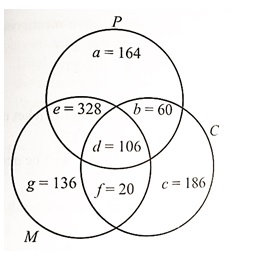
Passage :
information given below and answer the question that follow.
The result of an exam is given below. Out of 1000 students who appeared
(i) 658 failed in Physics
(ii) 166 failed in Physics and Chemistry
(iii) 372 failed in Chemistry, 434 failed in Physics and Maths
(iv) 590 failed in Maths, 126 failed in Maths & Chemistry
Find the number of people who failed in (assuming that none is passed in all subjects.
We have the following equations:
a+ b + c + d + e + f + g = 1000
a + b + d + e = 658, b + d = 166
b + d + c + f = 372
d + e = 434 as in the figure.
d + e + f + g = 590, d + f = 126. Find the values
Chemistry but not in Physics.
A
318
B
198
C
213
D
206
Question 57Single Answer
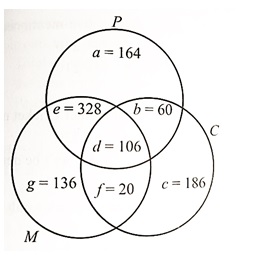
Passage :
Direction: information given below and answer the question that follow.
The result of an exam is given below. Out of 1000 students who appeared
(i) 658 failed in Physics
(ii) 166 failed in Physics and Chemistry
(iii) 372 failed in Chemistry, 434 failed in Physics and Maths
(iv) 590 failed in Maths, 126 failed in Maths & Chemistry
Find the number of people who failed in (assuming that none is passed in all subjects.
We have the following equations:
a+ b + c + d + e + f + g = 1000
a + b + d + e = 658, b + d = 166
b + d + c + f = 372
d + e = 434 as in the figure.
d + e + f + g = 590, d + f = 126. Find the values
Physics or Maths but not in Chemistry.
A
558
B
718
C
628
D
None of these
Question 58Single Answer
Passage :
For the next four question that follow:
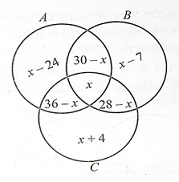
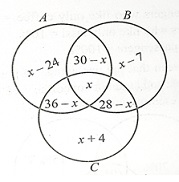
In a city, three daily newspapers A, B, C are published, 42% read A; 51% read B; 68% read C; 30% read A and B; 28% read B and C; 36% read A and C; 8% do not read any of the three newspapers.
Let x% people read all the three newspapers.
Since 8% people do not read any newspapers.
(x – 24) + (x – 7) + (x + 4) + (30 – x) + (36 – x) + (28 – x) + x = 92
→ x + 98 – 31 = 92
→ x = 92 – 67 = 25
What is the percentage of persons who read all the three papers ?
A
20%
B
25%
C
30%
D
40%
Question 59Single Answer
Passage :
For the next four : question that follow :
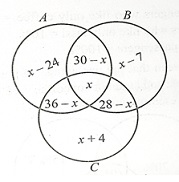
In a city, three daily newspapers A, B, C are published, 42% read A; 51% read B; 68% read C; 30% read A and B; 28% read B and C; 36% read A and C; 8% do not read any of the three newspapers.
Let x% people read all the three newspapers.
Since 8% people do not read any newspapers.
(x – 24) + (x – 7) + (x + 4) + (30 – x) + (36 – x) + (28 – x) + x = 92
→ x + 98 – 31 = 92
→ x = 92 – 67 = 25
What is the percentage of persons who read only two papers?
A
19%
B
31%
C
44%
D
None of these
Question 60Single Answer
Passage :
For the next four : question that follow :
In a city, three daily newspapers A, B, C are published, 42% read A; 51% read B; 68% read C; 30% read A and B; 28% read B and C; 36% read A and C; 8% do not read any of the three newspapers.
Let x% people read all the three newspapers.
Since 8% people do not read any newspapers.
(x – 24) + (x – 7) + (x + 4) + (30 – x) + (36 – x) + (28 – x) + x = 92
→ x + 98 – 31 = 92
→ x = 92 – 67 = 25
What is the percentage of persons who read only one paper ?
A
38%
B
48%
C
51%
D
None of these
Hindi Language & Comprehension
Question 61Single Answer
शुद्ध वर्तनी का चयन कीजिए
A
अधम्र
B
अध्रम
C
अधर्म
D
अध्रिम
Question 62Single Answer
शुद्ध वर्तनी का चयन कीजिए
A
स्थायि
B
स्थायी
C
स्थाई
D
स्थाइ
Question 63Single Answer
वर्तनी की दृष्टि से सही शब्द है?
A
महत्व
B
महतव
C
महत्तव
D
महतत्व
Question 64Single Answer
निम्नलिखित में से शुद्ध छांटिए?
A
आयुष्मान
B
आयुश्मान
C
आयुशमान
D
आयुश्यमान
Question 65Single Answer
शुद्ध शब्द नहीं हैं?
A
कवियत्री
B
कौसल्या
C
एश्वर्य
D
श्रृंगार
Question 66Single Answer
शुद्ध वर्तनी है -
A
पूज
B
पुजय
C
पूज्य
D
पुज्य
Question 67Single Answer
शुद्ध वर्तनी है -
A
अनुसरण
B
अनूशरणन
C
अनुशरण
D
अणुशर
Question 68Single Answer
किस क्रमांक में सभी शुद्ध हैं?
A
एक्य,साप्ताहिक
B
आजीविका,आशीर्वाद
C
आर्शिवाद ,अनूकूल
D
निरिक्षण ,कृपालु
Question 69Single Answer
'उज्वल' शब्द का शुद्ध रूप है ?
A
उज्जव
B
उज्ज्ल
C
उज्ज्वल
D
उजवल
Question 70Single Answer
निम्नलिखित प्रश्न में चार वैकल्पिक वर्तनियाॅ दी गई है?
A
जागृत
B
जाग्रति
C
जाग्रित
D
जाग्रत
Question 71Single Answer
निम्नलिखित प्रश्न में चार वैकल्पिक वर्तनियाॅ दी गई है?
A
उन्नति
B
उनति
C
उन्ती
D
उनती
Question 72Single Answer
निम्नलिखित प्रश्न मे चार वैकल्पिक वर्तनियाॅ दी गई है?
A
अनुशहरण
B
अनोसरण
C
अनुसरन
D
अनुसरण
Question 73Single Answer
'पृथ्वीराज रासो' किस काल की रचना है ?
A
आदिकाल
B
रीतिकाल
C
भक्तिकाल
D
आधुनिक काल
Question 74Single Answer
हिन्दी की उत्पत्ति किस भाषा से हुई है?
A
प्राकृत
B
संस्कृत
C
शौरसैनी अपभ्रंश
D
मागधी
Question 75Single Answer
राजभाषा आयोग के प्रथम अध्यक्ष थे ?
A
बी. जी. खरे
B
राजा लक्ष्मण सिंह
C
प्रताप नारायण मिश्र
D
इंशाअल्ला खा
Question 76Single Answer
निम्नलिखित बोलियों में से कौन - सी बोली उत्तर प्रदेश में नहीं बाली जाती?
A
मैथिली
B
अवधी
C
ब्रज
D
खड़ी बोली
Question 77Single Answer
भारत की प्रथम देशज भाषा कौन-सी है?
A
पालि
B
प्राकृत
C
संस्कृत
D
इसमें से कोई नहीं
Question 78Single Answer
भारतेन्दु ने किस पत्रिका का संपादन किया?
A
हिन्दी प्रदीप
B
इन्दु
C
कविवचन सुधा
D
भारतबन्धु
Question 79Single Answer
पूर्वी हिन्दी विकसित हुई है?
A
पैशाची अपभ्रंश
B
अर्धमागधी अपभ्रंश
C
शौरसैनी अपभ्रंश
D
मागधी अपभ्रंश
Question 80Single Answer
मानक हिन्दी का आधार क्या है?
A
खड़ी बोली
B
अपभ्रंश
C
पूर्वी हिन्दी
D
परिनिष्ठ हिन्दी
English Language & Comprehension
Question 81Single Answer
I go to Madurai by —– Vaigai Express
A
a
B
an
C
some
D
the
Question 82Single Answer
Have the car stolen!
A
Steal the car
B
You should have the stolen car
C
Get someone to steal the car
D
They have stolen the car
Question 83Single Answer
The payment was collected by the hardworking salesman.
A
The hardworking salesman collected the payment.
B
the salesman who worked heard was able to collect the payment.
C
to collect the payment the salesman had to work hard.
D
The hardworking salesman was able to collect the payment.
Question 84Single Answer
I had to stop all my work to complete this project.
A
All other work had to be stopped to complete this project by me
B
For completing this project all other work must be stopped
C
For completing this project I had to stop all my work
D
To complete this project all other work had been stopped by me
Question 85Single Answer
Passage :
Direction : Question below has two blanks, each blank indicting that some thing has been omitted. Choose the word for each blank which best fits the meaning of the sentence as a whole.
The Finance Department has ……………a centralized online databank system for all statutory government bodies to …………an eye on their assets and liabilities.
A
presented , stay
B
introduced , keep
C
announce , make
D
created , let
E
proclaimed , hold
Question 86Single Answer
Passage :
Direction : The five items in this section consists of a word or group of words followed by four words as (a), (b), (c) and (d). Select the word which is nearly opposite to the meaning of the original word or group of words and mark your response as (a), (b), (c) and (d), as the case may be, in your Answer Sheet.
Assets
A
liabilities
B
responsibilities
C
estates
D
profits
Question 87Single Answer
Passage :
Direction : In the question, out of the four alternatives, choose the word which is opposite in meaning to the given word and click the button corresponding to it
Affidavit
A
Affirmation
B
Slander
C
Oath
D
Testimony
Question 88Single Answer
Passage :
Direction: In the following question, out of the four alternatives, choose the word which is opposite in meaning to the given word and click the button corresponding to it
Hollow
A
Alveolate
B
Cleft
C
Cavernous
D
Solid
Question 89Single Answer
Passage :
Directions: In the following question, out of the four alternatives, choose the word which is opposite in meaning to the given word and click the button corresponding to it
Cosset
A
Ignoreb
B
Close
C
Caress
D
Fondle
Question 90Single Answer
Passage :
Directions: In the following question, out of the four alternatives, choose the word which is opposite in meaning to the given word and click the button corresponding to it
Ogle
A
Leer
B
Gaze
C
Ignore
D
Gawk
Question 91Single Answer
Read sentence to find out whether there is any grammatical error in it. The sentences are In three separate parts and each one is labelled (a), (b), (c) and (d). In that case, letter (d) will signify a ‘No error’ response.
A
He was in the temper
B
and refused
C
discuss the matter again
D
No error
Question 92Single Answer
Read sentence to find out whether there is any grammatical error in it. The sentences are In three separate parts and each one is labelled (a), (b), (c) and (d). In that case, letter (d) will signify a ‘No error’ response.
A
A flower makes no garland
B
so we must do a thing together
C
in a unit for a good result
D
No error
Question 93Single Answer
Read sentence to find out whether there is any grammatical error in it. The sentences are In three separate parts and each one is labelled (a), (b), (c) and (d). In that case, letter (d) will signify a ‘No error’ response.
A
My friend is a software engineer
B
and his wife is doctor
C
so they don’t have enough time for each other
D
No error
Question 94Single Answer
Read sentence to find out whether there is any grammatical error in it. The sentences are In three separate parts and each one is labelled (a), (b), (c) and (d). In that case, letter (d) will signify a ‘No error’ response.
A
I don’t have much time that
B
I hear you in detail with verbosity
C
tell everything in nutshell
D
No error
Question 95Single Answer
Read sentence to find out whether there is any grammatical error in it. The sentences are In three separate parts and each one is labelled (a), (b), (c) and (d). In that case, letter (d) will signify a ‘No error’ response.
A
The atmosphere is changing
B
so I have severe pain in my body
C
if you have any painkiller, please give it to me
D
No error
Question 96Single Answer
Passage :
In the following question, out of the four alternatives, select the alternative which best expresses the meaning of the idiom/phrase.
To sleep with the fishes
A
Always be in a dream world
B
To make absurd excuses
C
To sleep peacefully
D
To be dead
Question 97Single Answer
Passage :
In the following question, out of the four alternatives, select the alternative which best expresses the meaning of the idiom/phrase.
To free someone or something form a constraint or difficulty.
A
To exterminate
B
To expurgate
C
To intricate
D
To extricate
Question 98Single Answer
Passage :
In the following question, out of the four alternatives, select the alternative which best expresses the meaning of the idiom/phrase.
Liquids forming a homogeneous mixture when added together
A
Irascible
B
Crucible
C
Miscible
D
Risible
Question 99Single Answer
Passage :
In the following question, out of the four alternatives, select the alternative which best expresses the meaning of the idiom/phrase.
Shooting fish in a barrel
A
To do random acts of stupidity
B
To behave in a cruel manner
C
Ridiculously easy
D
To escape through a narrow opening
Question 100Single Answer
Passage :
In the following question, out of the four alternatives, select the alternative which best expresses the meaning of the idiom/phrase.
What does the phrase ‘knew no bounds’ mean ?
A
was bounded by
B
was limitless
C
was limited
D
was bound to
Concerned Subject (Chemistry)
Question 101Single Answer
Across a period, atomic radius generally:
A
Decreases
B
Increases
C
Remains constant
D
First decreases then increases
Question 102Single Answer
Down a group, ionization enthalpy generally:
A
Increases
B
Remains constant
C
Decreases
D
Becomes zero
Question 103Single Answer
The most electronegative element is:
A
Fluorine
B
Chlorine
C
Oxygen
D
Nitrogen
Question 104Single Answer
Which element has the highest first ionization enthalpy?
A
He
B
Ne
C
F
D
H
Question 105Single Answer
Electron affinity is most negative for:
A
F
B
I
C
Br
D
Cl
Question 106Single Answer
The atomic size of alkali metals increases from Li to Cs because of:
A
Increase in effective nuclear charge only
B
Decrease in shielding
C
Addition of new electron shells
D
Decrease in principal quantum number
Question 107Single Answer
Which alkali metal has the smallest atomic radius?
A
Rb
B
Na
C
K
D
Li
Question 108Single Answer
Which alkaline earth metal shows maximum diagonal relationship with aluminium?
A
Be
B
Mg
C
Ca
D
Sr
Question 109Single Answer
Lithium shows diagonal relationship with:
A
Be
B
Mg
C
Ca
D
Al
Question 110Single Answer
Which property generally increases from left to right across a period?
A
Electronegativity
B
Atomic radius
C
Metallic character
D
Electropositive character
Question 111Single Answer
Metallic character generally:
A
Increases across a period
B
Decreases down a group
C
Remains constant
D
Decreases across a period
Question 112Single Answer
Which ion is smallest?
A
Na⁺
B
Al³⁺
C
Mg²⁺
D
F⁻
Question 113Single Answer
Na⁺, Mg²⁺ and Al³⁺ are:
A
Isotopes
B
Isoelectronic
C
Isobars
D
Isotones
Question 114Single Answer
Among isoelectronic species, radius decreases with:
A
Decreasing nuclear charge
B
Increasing nuclear charge
C
Increasing mass number only
D
Increasing neutron number
Question 115Single Answer
The inert pair effect is most prominent in:
A
Heavier p-block elements
B
Lighter p-block elements
C
Alkali metals
D
First-row transition elements
Question 116Single Answer
Tl(I) is more stable than Tl(III) mainly because of:
A
Inert pair effect
B
Lanthanide contraction
C
Hydrogen bonding
D
Back bonding
Question 117Single Answer
The oxidation state of Pb that becomes increasingly stable down Group 14 is:
A
+4
B
+3
C
+2
D
0
Question 118Single Answer
Which oxide is amphoteric?
A
Na₂O
B
MgO
C
SO₃
D
Al₂O₃
Question 119Single Answer
Which oxide is strongly acidic?
A
Na₂O
B
SO₃
C
Al₂O₃
D
CaO
Question 120Single Answer
Basic character of oxides across a period generally:
A
Increases
B
Shows no trend
C
Remains constant
D
Decreases
Question 121Single Answer
The chief ore of aluminium is:
A
Calamine
B
Galena
C
Cinnabar
D
Bauxite
Question 122Single Answer
Boron differs from other Group 13 elements because of its:
A
Small size and high ionization enthalpy
B
Metallic nature
C
Large size
D
Low electronegativity
Question 123Single Answer
BF₃ acts as a:
A
Lewis base
B
Lewis acid
C
Brønsted base
D
Reducing agent only
Question 124Single Answer
BF₃ is planar because boron is:
A
sp hybridized
B
sp² hybridized
C
sp³ hybridized
D
dsp² hybridized
Question 125Single Answer
The electron-deficient compound is:
A
CH₄
B
B₂H₆
C
NH₃
D
H₂O
Question 126Single Answer
Diborane contains:
A
Three-center two-electron bonds
B
Only two-center two-electron bonds
C
Ionic bonds only
D
Metal-metal bonds
Question 127Single Answer
Borazine is often called:
A
Inorganic ethene
B
Inorganic methane
C
Inorganic benzene
D
Inorganic graphite
Question 128Single Answer
The formula of borazine is:
A
BN
B
B₃N₃H₆
C
B₂H₆
D
B₄H₁₀
Question 129Single Answer
Graphite conducts electricity because it has:
A
Ionic bonds
B
Delocalized electrons
C
No covalent bonds
D
Free protons
Question 130Single Answer
Diamond is an electrical:
A
Conductor
B
Semiconductor
C
Superconductor
D
Insulator
Question 131Single Answer
Fullerene C₆₀ resembles a:
A
Cube
B
Tetrahedron
C
Football
D
Linear chain
Question 132Single Answer
Silicon dioxide has mainly a:
A
Molecular structure
B
Giant covalent structure
C
Metallic structure
D
Ionic lattice only
Question 133Single Answer
Carbon monoxide is isoelectronic with:
A
NO
B
O₂
C
N₂
D
F₂
Question 134Single Answer
CO acts as a strong ligand because it is:
A
σ donor and π acceptor
B
Only a σ donor
C
Only a π donor
D
Purely ionic
Question 135Single Answer
Nitrogen exists as N₂ with a:
A
Single bond
B
Double bond
C
Triple bond
D
Coordinate bond
Question 136Single Answer
NH₃ has which molecular geometry?
A
Trigonal planar
B
Tetrahedral
C
Trigonal pyramidal
D
Linear
Question 137Single Answer
PH₃ is a weaker base than NH₃ mainly because:
A
Lone pair on P is less available
B
P is smaller than N
C
PH₃ is ionic
D
NH₃ lacks a lone pair
Question 138Single Answer
The most stable allotrope of phosphorus at room temperature is:
A
Black phosphorus
B
Red phosphorus
C
White phosphorus
D
Violet phosphorus only
Question 139Single Answer
White phosphorus is stored under water because it:
A
Dissolves in water
B
Reacts readily with oxygen
C
Is highly basic
D
Reacts only with nitrogen
Question 140Single Answer
The formula of phosphine is:
A
PH₅
B
P₂H₄
C
PH₃
D
H₃PO₄
Question 141Single Answer
H₃PO₂ is:
A
Monobasic
B
Dibasic
C
Tribasic
D
Tetrabasic
Question 142Single Answer
H₃PO₃ is:
A
Monobasic
B
Dibasic
C
Tribasic
D
Non-acidic
Question 143Single Answer
H₃PO₄ is:
A
Monobasic
B
Tribasic
C
Dibasic
D
Neutral
Question 144Single Answer
H₃PO₂ is a good reducing agent because it contains:
A
P–OH bond only
B
P=O bond only
C
P–H bonds
D
O–H bonds only
Question 145Single Answer
Oxygen is paramagnetic due to:
A
Paired electrons only
B
Two unpaired electrons
C
One unpaired electron
D
Absence of π orbitals
Question 146Single Answer
Ozone has a:
A
Linear structure
B
Tetrahedral structure
C
Trigonal planar structure
D
Bent structure
Question 147Single Answer
Ozone acts mainly as a strong:
A
Oxidizing agent
B
Reducing agent
C
Base
D
Ligand
Question 148Single Answer
Hydrogen peroxide contains an O–O:
A
Single bond
B
Double bond
C
Triple bond
D
Ionic bond
Question 149Single Answer
H₂O₂ can act as:
A
Only oxidizing agent
B
Both oxidizing and reducing agent
C
Only reducing agent
D
Neither
Question 150Single Answer
Sulfur commonly exists as:
A
S₂
B
S₄
C
S₈
D
S₁₀ only
Question 151Single Answer
The shape of SF₆ is:
A
Tetrahedral
B
Square planar
C
Octahedral
D
Trigonal bipyramidal
Question 152Single Answer
The shape of SF₄ is:
A
See-saw
B
Square planar
C
Tetrahedral
D
Linear
Question 153Single Answer
The shape of XeF₂ is:
A
Bent
B
Trigonal planar
C
T-shaped
D
Linear
Question 154Single Answer
XeF₄ is:
A
Tetrahedral
B
Linear
C
Trigonal pyramidal
D
Square planar
Question 155Single Answer
XeF₆ has how many Xe–F bonds?
A
2
B
4
C
8
D
6
Question 156Single Answer
The halogen having the highest electron affinity is:
A
F
B
Cl
C
Br
D
I
Question 157Single Answer
The strongest oxidizing halogen is:
A
Cl₂
B
F₂
C
Br₂
D
I₂
Question 158Single Answer
The weakest reducing halide ion is:
A
I⁻
B
Cl⁻
C
Br⁻
D
F⁻
Question 159Single Answer
Interhalogen compound IF₇ has a:
A
Tetrahedral geometry
B
Octahedral geometry
C
Square pyramidal geometry
D
Pentagonal bipyramidal geometry
Question 160Single Answer
ClF₃ has a:
A
Linear geometry
B
T-shaped geometry
C
Square planar geometry
D
Tetrahedral geometry
Question 161Single Answer
According to Arrhenius, an acid produces which ion in water?
A
OH⁻
B
H⁺
C
Na⁺
D
Cl⁻
Question 162Single Answer
According to Brønsted–Lowry theory, an acid is a:
A
Proton acceptor
B
Electron-pair donor
C
Proton donor
D
Salt donor
Question 163Single Answer
A Brønsted–Lowry base is a:
A
Proton donor
B
Radical acceptor
C
Neutron donor
D
Proton acceptor
Question 164Single Answer
A Lewis acid is an:
A
Electron-pair acceptor
B
Electron-pair donor
C
Proton acceptor only
D
Hydroxide donor
Question 165Single Answer
NH₃ is a Lewis:
A
Acid
B
Salt
C
Base
D
Oxidizing agent only
Question 166Single Answer
AlCl₃ behaves as a Lewis acid because aluminium has:
A
An incomplete octet
B
A complete octet
C
Excess lone pairs
D
Zero oxidation state
Question 167Single Answer
Which is an amphiprotic species?
A
CH₄
B
HCO₃⁻
C
Na⁺
D
Cl⁻
Question 168Single Answer
The conjugate base of H₂CO₃ is:
A
CO₃²⁻
B
OH⁻
C
H₃O⁺
D
HCO₃⁻
Question 169Single Answer
The conjugate acid of NH₃ is:
A
NH₂⁻
B
NH₂OH
C
N₂H₄
D
NH₄⁺
Question 170Single Answer
At 25°C, neutral water has pH:
A
0
B
1
C
14
D
7
Question 171Single Answer
At 25°C, pH + pOH equals:
A
7
B
10
C
14
D
1
Question 172Single Answer
A solution with pH 3 is:
A
Basic
B
Neutral
C
Acidic
D
Amphoteric only
Question 173Single Answer
A buffer solution resists change in:
A
Temperature
B
Pressure
C
Volume
D
pH
Question 174Single Answer
An acidic buffer may contain:
A
CH₃COOH and CH₃COONa
B
HCl and NaCl
C
NaOH and NaCl
D
HNO₃ and KNO₃
Question 175Single Answer
A basic buffer may contain:
A
NH₄OH and NH₄Cl
B
HCl and KCl
C
NaOH and NaCl
D
HNO₃ and NaNO₃
Question 176Single Answer
The Henderson–Hasselbalch equation for an acidic buffer is:
A
pH = pKa − log([salt]/[acid])
B
pH = pKa + log([salt]/[acid])
C
pH = pKb + log([acid]/[salt])
D
pH = 14 + pKa
Question 177Single Answer
The leveling solvent commonly used in acid–base chemistry is:
A
Hexane
B
Benzene
C
Water
D
Toluene
Question 178Single Answer
Liquid ammonia is a useful:
A
Strong mineral acid
B
Non-aqueous solvent
C
Hydrocarbon
D
Solid adsorbent
Question 179Single Answer
Autoionization of liquid ammonia gives:
A
H₃O⁺ and OH⁻
B
NH₄⁺ and NH₂⁻
C
Na⁺ and NH₂⁻
D
H⁺ and N³⁻
Question 180Single Answer
Liquid ammonia generally dissolves alkali metals to produce:
A
Colorless non-conducting solutions
B
Yellow gases
C
Red precipitates
D
Blue conducting solutions
Question 181Single Answer
The blue color of alkali metals in liquid ammonia is due to:
A
Ammonium ions
B
Solvated electrons
C
Metal oxides
D
Nitride ions
Question 182Single Answer
A protogenic solvent is one that:
A
Accepts protons strongly
B
Donates protons
C
Donates electrons only
D
Contains no hydrogen
Question 183Single Answer
A protophilic solvent tends to:
A
Donate protons
B
Produce neutrons
C
Accept protons
D
Form only ionic solids
Question 184Single Answer
Acetic acid as a solvent is predominantly:
A
Metallic
B
Aprotic
C
Protogenic
D
Nonpolar hydrocarbon
Question 185Single Answer
Dimethyl sulfoxide is generally classified as a:
A
Nonpolar solvent
B
Polar aprotic solvent
C
Protic mineral acid
D
Liquid metal
Question 186Single Answer
An organometallic compound contains a direct bond between:
A
Metal and oxygen only
B
Metal and carbon
C
Carbon and oxygen only
D
Nitrogen and oxygen
Question 187Single Answer
Grignard reagents have the general formula:
A
RMgX
B
RX
C
R₂CuLi only
D
RCOOH
Question 188Single Answer
Grignard reagents must be protected from:
A
Dry ether
B
Argon
C
Nitrogen
D
Moisture
Question 189Single Answer
Ferrocene is an example of a:
A
Sandwich compound
B
Simple ionic salt
C
Hydride
D
Carbide
Question 190Single Answer
The metal in ferrocene is:
A
Cr
B
Co
C
Ni
D
Fe
Question 191Single Answer
The cyclopentadienyl ligand is commonly represented as:
A
Py
B
Cp
C
en
D
acac only
Question 192Single Answer
In ferrocene, each cyclopentadienyl ring contributes how many π electrons to aromaticity?
A
6
B
4
C
2
D
8
Question 193Single Answer
Metal carbonyls contain the ligand:
A
CO₂
B
CO
C
CN⁻ only
D
NH₃ only
Question 194Single Answer
Ni(CO)₄ has a:
A
Tetrahedral geometry
B
Square planar geometry
C
Octahedral geometry
D
Linear geometry
Question 195Single Answer
Fe(CO)₅ is:
A
Square planar
B
Trigonal bipyramidal
C
Tetrahedral
D
Octahedral
Question 196Single Answer
Cr(CO)₆ has a:
A
Octahedral structure
B
Linear structure
C
Tetrahedral structure
D
Square planar structure
Question 197Single Answer
Back bonding in metal carbonyls involves donation from:
A
Ligand σ orbital to ligand
B
Metal s orbital to metal p orbital
C
Metal d orbital to ligand π orbital
D
Ligand lone pair to hydrogen
Question 198Single Answer
The 18-electron rule is analogous to the:
A
Noble gas configuration concept
B
Duplet rule
C
Pauli exclusion principle only
D
Hund rule only
Question 199Single Answer
Which compound obeys the 18-electron rule?
A
AlCl₃
B
BH₃
C
BF₃
D
Fe(CO)₅
Question 200Single Answer
Oxidative addition generally increases the oxidation state of a metal by: