Latest DSSSB Legal Assistant Exam Question (Objective Questions), MCQ in English
Subjects : General Awareness, General Intelligence & Reasoning Ability, Arithmetical & Numerical Ability, Test of Hindi Language & Comprehension, Test of English Language & Comprehension, Concerned Subject (Legal Assistant)
Question Bank DSSSB Legal Assistant Tier 1 Exam - English
Kurukshetra a journal on rural development is published by
A
Ministry of Finance
B
Ministry of Information and Broadcastin
C
Ministry of Rural Development
D
Planning Commission
Question 3Single Answer
Devaluation of a currency means
A
Fixing the value of the currency in conjuction with the movement in the value of a basket of predetermined currencies
B
Reduction in the value of a currency vis-à-vis major internationally traded currencies
C
Fixing the value of currency in multilateral consultaion with the IMF the World Bank and major trading partners
D
Permitting the currency to seek its worth in the international market
Question 4Single Answer
In India rural incomes are generally lower than the urban incomes, which of the following reasons account for this
1. a large number of farmers are illiterate and know little about scientific agriculture
2. prices of primary products are lower than those of manufactured products
3. Investments in agriculture has been low when compared to investment in industry
A
1 and 3
B
2 and 3
C
1 and 2
D
1,2 and 3
Question 5Single Answer
Which of the following programmes aims at the promotion of savings among rural women
A
Rashtriya Mahila Kosh
B
Indira Mahila Yojna
C
Jawahar Rozgar Yojna
D
Mahila Samridhi Yojna
Question 6Single Answer
What is Net National Product
A
the money value of final goods and services produced annually in the economy
B
the money value of annual service generation in the economy
C
the money value of tangible goods produced annually in the economy
D
The money value of tangible goods available in the economy
Question 7Single Answer
In ruby laser, the stimulated emission is due to transition from
A
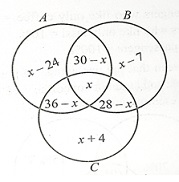
metastable state to any lower state
B
any higher state of lower state
C
metastable state to ground state
D
any higher state to ground state
Question 8Single Answer
10-6 M NaOH is diluted 100 times. The pH of the diluted base is
A
between 7 and 8
B
between 5 and 6
C
between 6 and 7
D
between 10 and 11
Question 9Single Answer
The respiratory quotient during cellular respiration would depend on
A
the nature of enzymes involved
B
the nature of the substrate
C
the amount of carbon dioxide released
D
the amount of oxygen utilised
Question 10Single Answer
"Who said, 'India was a parrot unto itself'?
A
Malik Muhammad Joyce
B
Raskhan
C
Rich Khusrow
D
Rich Hasan
Question 11Single Answer
Which is the national game of Bhutan ?
A
badminton
B
basketball
C
football
D
archery
Question 12Single Answer
When was the Constituent Assembly of India formed?
A
1946
B
1947
C
1948
D
1950
Question 13Single Answer
Who is known as the "Father of the Indian Renaissance" ?
A
Raja Ram Mohan Roy
B
Swami Vivekananda
C
Rabindranath Tagore
D
Mahatma Gandhi
Question 14Single Answer
What is the study of ethics primarily concerned with ?
A
Economic behavior
B
Human values and moral principles
C
Physical health
D
Political systems
Question 15Single Answer
Who is known as the "Missile Man of India"?
A
Dr. Homi J. Bhabha
B
Dr. Vikram Sarabhai
C
Dr. APJ Abdul Kalam
D
Dr. Satish Dhawan
Question 16Single Answer
The Indian Navy recently received its second indigenous Diving Support Vessel (DSV). What is its name?
A
Nistar
B
Nipun
C
INS Vikrant
D
INS Arihant
Question 17Single Answer
The Public Examinations (Prevention of Unfair Means) Amendment Bill, 2026, was passed by the Rajya Sabha on which date?
A
27 July 2026
B
29 July 2026
C
31 July 2026
D
30 July 2026
Question 18Single Answer
Who won the silver medal in the men’s javelin throw at the Commonwealth Games 2026 held in Glasgow?
A
Yash Vir Singh
B
Neeraj Chopra
C
Kishore Jena
D
Rohit Yadav
Question 19Single Answer
India became which numbered WTO member to accept the Agreement on Fisheries Subsidies (as per recent updates)?
A
120th
B
121st
C
123rd
D
125th
Question 20Single Answer
Which organisation released the Global Tiger Recovery Report 2026?
A
UNEP
B
WWF
C
Global Tiger Forum
D
IUCN
General Intelligence & Reasoning Ability
Question 21Single Answer
How many such pairs of letters are there in the word ‘CLEANLINESS’ each of the which has as many letters between them in the word as they have in the English alphabet, in the same sequence?
A
Two
B
Three
C
Five
D
Four
E
None of these
Question 22Single Answer
Team A has scored more goals than Team B
Team C has scored fewer goals than Team B
Team A has scored fewer goals than Team C .
If the first two statements are true, the third statement is
A
True
B
False
C
Uncertain
D
None
Question 23Single Answer
If it is possible to make only one meaningful word with the second, the third, the sixth and the eight letters of the word FRAGMENT using each only once, which of the following will be the third letter of that word ? If no such word can be formed, give ‘X’ as the answer and if more than one such word can be formed, give ‘Y’ as the answer.
A
A
B
E
C
T
D
X
E
Y
Question 24Single Answer
How many such letters are there in the word ORIENTAL each of which is as far away from the beginning of the word as when they are arranged alphabetically?
A
None
B
One
C
Two
D
Three
E
More than three
Question 25Single Answer
How many such pairs of letters in the word CREDIT each of which has as many letters between them in the word as in the English alphabet?
A
None
B
One
C
Two
D
Three
E
More than three
Question 26Single Answer
How many meaningful words can be made from the letters ‘LMEA’ using each letter only once in each word?
A
None
B
One
C
Two
D
Three
E
More than three
Question 27Single Answer
If it is possible to make only one meaningful word with the first, the second, the seventh and the eighth letters of the word TEMPORAL, which of the following will be the first letter of that word? If more than one such word can be made, give ‘Y’ as the answer and if no such word can be made, give ‘X’ as the answer.
A
T
B
L
C
E
D
Y
E
X
Question 28Single Answer
If the letters of the word HANDOVER are arranged alphabetically from left to right how many letters will remain at the same position?
A
None
B
One
C
Two
D
Three
E
More than three
Question 29Single Answer
Passage :
A B C D E F G H I J K L M N O P Q R S T U V W X Y Z .
Which letter in this alphabet is the eighth letter to the right of the letter and which is tenth letter to the left of the last but one letter of the alphabet ?
A
X
B
W
C
I
D
H
Question 30Single Answer
Passage :
Direction : The following question is based on the five words given below:
AND FOR THE BIG SUM (The new words formed after performing the mentioned operations may or may not necessarily the meaningful English words.)
If the third alphabet of each of the words is changed to the next alphabet in the English alphabetical series, which of the following will form a meaningful English word?
A
SUM
B
BIG
C
Both BIG and THE
D
FOR
E
Both FOR and BIG
Question 31Single Answer
Passage :
Direction : The following question is based on the five words given below:
AND FOR THE BIG SUM (The new words formed after performing the mentioned operations may or may not necessarily the meaningful English words.)
If the given words are arranged in the order as they would appear in a dictionary from left to right, which of the following will be second from the right ?
A
AND
B
FOR
C
THE
D
BIG
E
SUM
Question 32Single Answer
Passage :
Direction: The following question is based on the five words given below:
AND FOR THE BIG SUM (The new words formed after performing the mentioned operations may or may not necessarily the meaningful English words.)
If second alphabet in each of the words is changed to next alphabet in the English alphabetical order, how many words having two vowels (same or different vowels) will be formed ?
A
None
B
One
C
Two
D
Three
E
Four
Question 33Single Answer
Passage :
Direction : The following question is based on the five words given below:
AND FOR THE BIG SUM (The new words formed after performing the mentioned operations may or may not necessarily the meaningful English words.)
How many letters are there in the English alphabetical series between the second letter of the word which is second from the right and the second letter of the word which is second from the left of the given words?
A
Two
B
Five
C
Six
D
Nine
E
Three
Question 34Single Answer
Passage :
Direction: The following question is based on the five words given below:
AND FOR THE BIG SUM (The new words formed after performing the mentioned operations may or may not necessarily the meaningful English words.)
If in each of the given words, each of the consonant is changed to previous letter and each vowel is changed to next letter in the English alphabetical series, in how many words thus formed will no vowels appear?
A
None
B
One
C
Two
D
Three
E
More than three
Question 35Single Answer
Passage :
Direction : Following question is based on five words given below: BRU LEGINKCATOWN
(The new words formed after performing the mentioned operations may or may not necessarily be meaningful English words)
If the third alphabet in each of the words is changed to the next alphabet in the English alphabetical order, how many words having two vowels (same or different vowels) will be formed?
A
None
B
One
C
Two
D
Three
E
Four
Question 36Single Answer
Passage :
Direction : Following question is based on five words given below: BRU LEGINKCATOWN
(The new words formed after performing the mentioned operations may or may not necessarily be meaningful English words)
If the position of the first and the second alphabets of each of the words are interchanged, which of the following will form a meaningful English word?
A
Both CAT and OWN
B
Both BRU and INK
C
Only CAT
D
Only INK
E
Only LEG
Question 37Single Answer
Passage :
Direction: Following question is based on five words given below: BRU LEGINKCATOWN
(The new words formed after performing the mentioned operations may or may not necessarily be meaningful English words)
If the given words are arranged in the order as they would appear in a dictionary from left to right, which of the following will be exactly in the middle of the five words?
A
OWN
B
LEG
C
BRU
D
CAT
E
INK
Question 38Single Answer
Passage :
Direction: Following question is based on five words given below: BRU LEGINKCATOWN
(The new words formed after performing the mentioned operations may or may not necessarily be meaningful English words)
If in each of the given words, each of the consonants is changed to previous letter and each vowel is changed to next letter in the English alphabetical series, in how many words thus formed will the same alphabet appear twice?
A
None
B
One
C
Two
D
Three
E
More than three
Question 39Single Answer
Passage :
Find the missing number in the following series ?
3, 5, 5, 19, 7, 41, 9, ?
A
71
B
61
C
79
D
69
Question 40Single Answer
Passage :
Direction: following question is based on five words given below:
LAP BUT CAR SON HID
(The new words formed after performing the mentioned operations may or may not necessarily be meaningful English words.)
If the positions of the first and the third alphabets of each of the words are interchanged, which of the following would form meaningful words with the new arrangement?
A
HID
B
SON
C
Both LAP and BUT
D
CAR
E
Both CAR and LAP
Arithmetical & Numerical Ability
Question 41Single Answer
The cash difference between the selling prices of an article at a profit of 4% and 6% is Rs. 3. The ratio of the two selling prices is:__________ ?
A
51:52
B
52:53
C
51:53
D
52:55
Question 42Single Answer
Which of the following numbers is irrational ?
A
√49
B
0.125
C
√2
D
22/7
Question 43Single Answer
356 x 936 – 356 x 836 = ?
A
35600
B
34500
C
9630
D
93600
Question 44Single Answer
Arrange in descending order: 5/8, 7/10, 3/4
A
3/4 > 7/10 > 5/8
B
7/10 > 3/4 > 5/8
C
3/4 > 5/8 > 7/10
D
5/8 > 7/10 > 3/4
Question 45Single Answer
What is (3^{4} times 9^{2}) ?
A
36
B
38
C
310
D
96
Question 46Single Answer
If 34X-2 = 729, then find the value of X.
A
4
B
3
C
2
D
5
Question 47Single Answer
Convert 0.6 into fraction ?
A
3/5
B
2/3
C
4/5
Question 48Single Answer
The no. plate of a bus had peculiarity. The bus number was a perfect square. It was also a perfect square when the plate numbers were reversed. The bus company had only five hundred buses numbered from 1 to 500. What was the number ?
A
169
B
36
C
196
D
Can not say
Question 49Single Answer
If a and b are positive integers, such that ab = 125, then (a-b)a+b-4 = ?
A
16
B
25
C
28
D
30
Question 50Single Answer
If x*y = x2 + y2 – xy, then value of 9*11 is
A
93
B
103
C
60.5
D
121
Important Questions Package
DSSSB Legal Assistant Exam Online Question Bank Package
Buy DSSSB Legal Assistant Important Questions, MCQ, question answer in Hindi & English. It will help you to score high marks in DSSSB Legal Assistant question bank 2026 in Online, PDF & Print study material.
+ Free Monthly Current Affairs, GK & more PDF Download
Sr.
Package Name
Amount
1.
DSSSB Legal Assistant Tier 1 Exam - Hindi
Description : 1000 Question with Answer
₹101[₹500]
2.
DSSSB Legal Assistant Tier 1 Exam - Hindi
Description : 2000 Question with Answer
₹151[₹500]
3.
DSSSB Legal Assistant Tier 1 Exam - Hindi
Description : 3000 Question with Answer
₹181[₹500]
4.
DSSSB Legal Assistant Tier 1 Exam - Hindi
Description : 4000 Question with Answer
₹201[₹500]
5.
DSSSB Legal Assistant Tier 1 Exam - English
Description : 1000 Question with Answer
₹101[₹500]
6.
DSSSB Legal Assistant Tier 1 Exam - English
Description : 2000 Question with Answer
₹151[₹500]
7.
DSSSB Legal Assistant Tier 1 Exam - English
Description : 3000 Question with Answer
₹181[₹500]
8.
DSSSB Legal Assistant Tier 1 Exam - English
Description : 4000 Question with Answer
₹201[₹500]
9.
DSSSB Legal Assistant Tier 1 Exam - Hindi
Description : 1000 Question & Answer Download in PDF (Send by Email)
₹151[₹450]
10.
DSSSB Legal Assistant Tier 1 Exam - English
Description : 1000 Question & Answer Download in PDF (Send by Email)
₹151[₹450]
11.
DSSSB Legal Assistant Tier 1 Exam Question Bank Book - Hindi
Description : 1000 Question with Answer (Printed Material)
₹450[₹800]
12.
DSSSB Legal Assistant Tier 1 Exam Question Bank Book - English
Description : 1000 Question with Answer (Printed Material)
₹390[₹600]
13.
DSSSB Legal Assistant Tier 1 Exam - English (Old)
Description : 3000 Question with Answer
₹181[₹500]
Arithmetical & Numerical Ability
Question 51Single Answer
Which is greater ?
A
15/16
B
17/18
C
Equal
D
Cannot compare
Question 52Single Answer
If sum of two numbers is 42 and their product is 437, then find their difference.
A
3
B
4
C
5
D
7
Question 53Single Answer
Write the 44000 in Roman numerals
A
XLI
B
XLVI
C
XLIV
D
XLVIC
Question 54Single Answer
Convert 0.0909… into fraction ?
A
1/11
B
9/11
C
1/9
D
9/10
Question 55Single Answer
What is (98 times 102) ?
A
9996
B
10000
C
10096
D
10196
Question 56Single Answer
Passage :
information given below and answer the question that follow.
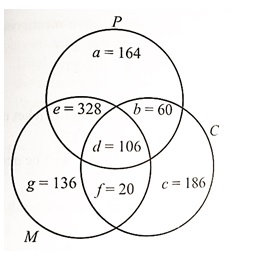
The result of an exam is given below. Out of 1000 students who appeared
(i) 658 failed in Physics
(ii) 166 failed in Physics and Chemistry
(iii) 372 failed in Chemistry, 434 failed in Physics and Maths
(iv) 590 failed in Maths, 126 failed in Maths & Chemistry
Find the number of people who failed in (assuming that none is passed in all subjects.
We have the following equations:
a+ b + c + d + e + f + g = 1000
a + b + d + e = 658, b + d = 166
b + d + c + f = 372
d + e = 434 as in the figure.
d + e + f + g = 590, d + f = 126. Find the values
Chemistry but not in Physics.
A
318
B
198
C
213
D
206
Question 57Single Answer
Passage :
Direction: information given below and answer the question that follow.
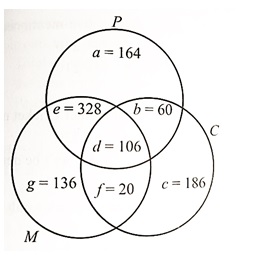
The result of an exam is given below. Out of 1000 students who appeared
(i) 658 failed in Physics
(ii) 166 failed in Physics and Chemistry
(iii) 372 failed in Chemistry, 434 failed in Physics and Maths
(iv) 590 failed in Maths, 126 failed in Maths & Chemistry
Find the number of people who failed in (assuming that none is passed in all subjects.
We have the following equations:
a+ b + c + d + e + f + g = 1000
a + b + d + e = 658, b + d = 166
b + d + c + f = 372
d + e = 434 as in the figure.
d + e + f + g = 590, d + f = 126. Find the values
Physics or Maths but not in Chemistry.
A
558
B
718
C
628
D
None of these
Question 58Single Answer
Passage :
For the next four question that follow:
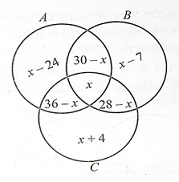
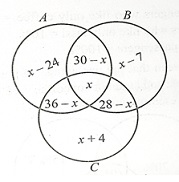
In a city, three daily newspapers A, B, C are published, 42% read A; 51% read B; 68% read C; 30% read A and B; 28% read B and C; 36% read A and C; 8% do not read any of the three newspapers.
Let x% people read all the three newspapers.
Since 8% people do not read any newspapers.
(x – 24) + (x – 7) + (x + 4) + (30 – x) + (36 – x) + (28 – x) + x = 92
→ x + 98 – 31 = 92
→ x = 92 – 67 = 25
What is the percentage of persons who read all the three papers ?
A
20%
B
25%
C
30%
D
40%
Question 59Single Answer
Passage :
For the next four : question that follow :
In a city, three daily newspapers A, B, C are published, 42% read A; 51% read B; 68% read C; 30% read A and B; 28% read B and C; 36% read A and C; 8% do not read any of the three newspapers.
Let x% people read all the three newspapers.
Since 8% people do not read any newspapers.
(x – 24) + (x – 7) + (x + 4) + (30 – x) + (36 – x) + (28 – x) + x = 92
→ x + 98 – 31 = 92
→ x = 92 – 67 = 25
What is the percentage of persons who read only two papers?
A
19%
B
31%
C
44%
D
None of these
Question 60Single Answer
Passage :
For the next four : question that follow :
In a city, three daily newspapers A, B, C are published, 42% read A; 51% read B; 68% read C; 30% read A and B; 28% read B and C; 36% read A and C; 8% do not read any of the three newspapers.
Let x% people read all the three newspapers.
Since 8% people do not read any newspapers.
(x – 24) + (x – 7) + (x + 4) + (30 – x) + (36 – x) + (28 – x) + x = 92
→ x + 98 – 31 = 92
→ x = 92 – 67 = 25
What is the percentage of persons who read only one paper ?
A
38%
B
48%
C
51%
D
None of these
Test of Hindi Language & Comprehension
Question 61Single Answer
शुद्ध वर्तनी का चयन कीजिए
A
अधम्र
B
अध्रम
C
अधर्म
D
अध्रिम
Question 62Single Answer
शुद्ध वर्तनी का चयन कीजिए
A
स्थायि
B
स्थायी
C
स्थाई
D
स्थाइ
Question 63Single Answer
वर्तनी की दृष्टि से सही शब्द है?
A
महत्व
B
महतव
C
महत्तव
D
महतत्व
Question 64Single Answer
निम्नलिखित में से शुद्ध छांटिए?
A
आयुष्मान
B
आयुश्मान
C
आयुशमान
D
आयुश्यमान
Question 65Single Answer
शुद्ध शब्द नहीं हैं?
A
कवियत्री
B
कौसल्या
C
एश्वर्य
D
श्रृंगार
Question 66Single Answer
शुद्ध वर्तनी है -
A
पूज
B
पुजय
C
पूज्य
D
पुज्य
Question 67Single Answer
शुद्ध वर्तनी है -
A
अनुसरण
B
अनूशरणन
C
अनुशरण
D
अणुशर
Question 68Single Answer
किस क्रमांक में सभी शुद्ध हैं?
A
एक्य,साप्ताहिक
B
आजीविका,आशीर्वाद
C
आर्शिवाद ,अनूकूल
D
निरिक्षण ,कृपालु
Question 69Single Answer
'उज्वल' शब्द का शुद्ध रूप है ?
A
उज्जव
B
उज्ज्ल
C
उज्ज्वल
D
उजवल
Question 70Single Answer
निम्नलिखित प्रश्न में चार वैकल्पिक वर्तनियाॅ दी गई है?
A
जागृत
B
जाग्रति
C
जाग्रित
D
जाग्रत
Question 71Single Answer
निम्नलिखित प्रश्न में चार वैकल्पिक वर्तनियाॅ दी गई है?
A
उन्नति
B
उनति
C
उन्ती
D
उनती
Question 72Single Answer
निम्नलिखित प्रश्न मे चार वैकल्पिक वर्तनियाॅ दी गई है?
A
अनुशहरण
B
अनोसरण
C
अनुसरन
D
अनुसरण
Question 73Single Answer
'पृथ्वीराज रासो' किस काल की रचना है ?
A
आदिकाल
B
रीतिकाल
C
भक्तिकाल
D
आधुनिक काल
Question 74Single Answer
हिन्दी की उत्पत्ति किस भाषा से हुई है?
A
प्राकृत
B
संस्कृत
C
शौरसैनी अपभ्रंश
D
मागधी
Question 75Single Answer
राजभाषा आयोग के प्रथम अध्यक्ष थे ?
A
बी. जी. खरे
B
राजा लक्ष्मण सिंह
C
प्रताप नारायण मिश्र
D
इंशाअल्ला खा
Question 76Single Answer
निम्नलिखित बोलियों में से कौन - सी बोली उत्तर प्रदेश में नहीं बाली जाती?
A
मैथिली
B
अवधी
C
ब्रज
D
खड़ी बोली
Question 77Single Answer
भारत की प्रथम देशज भाषा कौन-सी है?
A
पालि
B
प्राकृत
C
संस्कृत
D
इसमें से कोई नहीं
Question 78Single Answer
भारतेन्दु ने किस पत्रिका का संपादन किया?
A
हिन्दी प्रदीप
B
इन्दु
C
कविवचन सुधा
D
भारतबन्धु
Question 79Single Answer
पूर्वी हिन्दी विकसित हुई है?
A
पैशाची अपभ्रंश
B
अर्धमागधी अपभ्रंश
C
शौरसैनी अपभ्रंश
D
मागधी अपभ्रंश
Question 80Single Answer
मानक हिन्दी का आधार क्या है?
A
खड़ी बोली
B
अपभ्रंश
C
पूर्वी हिन्दी
D
परिनिष्ठ हिन्दी
Test of English Language & Comprehension
Question 81Single Answer
I go to Madurai by —– Vaigai Express
A
a
B
an
C
some
D
the
Question 82Single Answer
Have the car stolen!
A
Steal the car
B
You should have the stolen car
C
Get someone to steal the car
D
They have stolen the car
Question 83Single Answer
The payment was collected by the hardworking salesman.
A
The hardworking salesman collected the payment.
B
the salesman who worked heard was able to collect the payment.
C
to collect the payment the salesman had to work hard.
D
The hardworking salesman was able to collect the payment.
Question 84Single Answer
I had to stop all my work to complete this project.
A
All other work had to be stopped to complete this project by me
B
For completing this project all other work must be stopped
C
For completing this project I had to stop all my work
D
To complete this project all other work had been stopped by me
Question 85Single Answer
They have published the names of all the successful candidates.
A
The candidates who have succeeded their names they had published.
B
The names of all the successful candidates have been published by them
C
The candidates who have succeeded their names have been published by them.
D
The names of all the successful candidate were published by them.
Question 86Single Answer
The online shopping site lowered the prices.
A
Lowering of the prices was done by the online shopping site
B
The prices were lowered by the online shopping site
C
The prices had been lowered by the online shopping site
D
The prices have been lowered by the online shopping site
Question 87Single Answer
Who taught you to drive a truck ?
A
To drive a truck by whom were you taught?
B
Driving a truck by who were you taught?
C
Driving a truck by who were you being taught?
D
By whom were you taught to drive a truck?
Question 88Single Answer
We shall invite Suresh.
A
Suresh would be invited by us
B
Suresh would have been invited by us
C
Suresh will be invited by us
D
Suresh will have been invited by us
Question 89Single Answer
Passage :
Direction : Question below has two blanks, each blank indicting that some thing has been omitted. Choose the word for each blank which best fits the meaning of the sentence as a whole.
The Finance Department has ……………a centralized online databank system for all statutory government bodies to …………an eye on their assets and liabilities.
A
presented , stay
B
introduced , keep
C
announce , make
D
created , let
E
proclaimed , hold
Question 90Single Answer
Passage :
Direction : The five items in this section consists of a word or group of words followed by four words as (a), (b), (c) and (d). Select the word which is nearly opposite to the meaning of the original word or group of words and mark your response as (a), (b), (c) and (d), as the case may be, in your Answer Sheet.
Assets
A
liabilities
B
responsibilities
C
estates
D
profits
Question 91Single Answer
Passage :
Direction : In the question, out of the four alternatives, choose the word which is opposite in meaning to the given word and click the button corresponding to it
Affidavit
A
Affirmation
B
Slander
C
Oath
D
Testimony
Question 92Single Answer
Passage :
Direction: In the following question, out of the four alternatives, choose the word which is opposite in meaning to the given word and click the button corresponding to it
Hollow
A
Alveolate
B
Cleft
C
Cavernous
D
Solid
Question 93Single Answer
Passage :
Directions: In the following question, out of the four alternatives, choose the word which is opposite in meaning to the given word and click the button corresponding to it
Cosset
A
Ignoreb
B
Close
C
Caress
D
Fondle
Question 94Single Answer
Passage :
Directions: In the following question, out of the four alternatives, choose the word which is opposite in meaning to the given word and click the button corresponding to it
Ogle
A
Leer
B
Gaze
C
Ignore
D
Gawk
Question 95Single Answer
Passage :
Directions:In the following question, out of the four alternatives, choose the word which is opposite in meaning to the given word and click the button corresponding to it
Intrinsic
A
Elemental
B
Innate
C
Connate
D
Acquired
Question 96Single Answer
Passage :
Direction : In the following question, out of the four alternatives, choose the word which is opposite in meaning to the given word and click the button corresponding to it
Coalesce
A
Separate
B
Adhere
C
Cleave
D
Amalgamate
Question 97Single Answer
Passage :
Directions: In the following question, out of the four alternatives, choose the word which is opposite in meaning to the given word and click the button corresponding to it
Loiter
A
lag
B
Hasten
C
Amble
D
Loii
Question 98Single Answer
Passage :
Direction : Question below has two blanks, blank indicating that something has been omitted. Choose the set of words for blank which best fits the meaning of the sentence as a whole.
The protests were......... at ......... awareness among the elite and the educated.
A
held, generating
B
aimed, creating
C
targeted, awakening
D
focused, building
E
concentrated, producing
Question 99Single Answer
Passage :
Directions:In the following question, out of the four alternatives, choose the word which is opposite in meaning to the given word and click the button corresponding to it
Deep-seated
A
Chronic
B
Temporary
C
inbred
D
Subconscious
Question 100Single Answer
Passage :
Directions: In the following question, out of the four alternatives, choose the word which is opposite in meaning to the given word and click the button corresponding to it
Vibrant
A
Drab
B
Gaudy
C
Jazzy
D
Vivid
Concerned Subject (Legal Assistant)
Question 101Single Answer
The term “legal method” primarily refers to?
A
Method of collecting taxes
B
Procedure for conducting elections
C
Method of police investigation
D
Techniques used for understanding, interpreting and applying law
Question 102Single Answer
Which is regarded as a primary source of law in India?
A
Newspaper editorial
B
Textbook
C
Legislation
D
Legal dictionary
Question 103Single Answer
A judicial precedent is?
A
A rule made by Parliament
B
A previous judicial decision used as authority in later cases
C
An administrative notification
D
A private agreement
Question 104Single Answer
The binding principle contained in a judicial decision is called?
A
Obiter dictum
B
Res judicata
C
Ratio decidendi
D
Caveat emptor
Question 105Single Answer
“Obiter dictum” means?
A
Binding statutory provision
B
Final decree of a court
C
Rule of evidence
D
Observation made by a judge that is not essential to the decision
Question 106Single Answer
Under the doctrine of precedent, decisions of the Supreme Court are binding on?
A
Only High Courts
B
Only subordinate courts
C
All courts within India
D
Only constitutional courts
Question 107Single Answer
Article 141 of the Constitution of India deals with?
A
Law declared by the Supreme Court
B
Judicial review
C
Appointment of judges
D
Original jurisdiction of High Courts
Question 108Single Answer
The doctrine of stare decisis means?
A
No one should be judge in his own cause
B
Hear the other side
C
Let the decision stand
D
Ignorance of law is no excuse
Question 109Single Answer
Which part of a judicial decision normally contains the legal principle forming the basis of the decision?
A
Cause title
B
Ratio decidendi
C
Obiter dictum
D
Prayer clause
Question 110Single Answer
A precedent that a court must follow is known as?
A
Binding precedent
B
Persuasive precedent
C
Declaratory precedent
D
Historical precedent
Question 111Single Answer
A decision of one High Court for another High Court is generally?
A
Binding
B
Unconstitutional
C
Persuasive
D
Statutory
Question 112Single Answer
Which source of law develops primarily through long-established social practices?
A
Legislation
B
Custom
C
Ordinance
D
Delegated legislation
Question 113Single Answer
For a custom to be legally valid, it should generally be?
A
Uncertain
B
Certain and reasonable
C
Unreasonable
D
Recently created
Question 114Single Answer
Legislation made directly by the supreme legislative body is called?
A
Subordinate legislation
B
Supreme legislation
C
Judicial legislation
D
Customary legislation
Question 115Single Answer
Rules and regulations made under authority granted by a statute are known as?
A
Delegated legislation
B
Constitutional conventions
C
Personal laws
D
Judicial precedents
Question 116Single Answer
The literal rule of statutory interpretation gives words?
A
A retrospective meaning
B
A meaning preferred by judges
C
Only a technical meaning
D
Their ordinary and natural meaning
Question 117Single Answer
The golden rule of interpretation permits a court to modify the ordinary meaning of words primarily to?
A
Avoid absurdity
B
Increase punishment
C
Repeal legislation
D
Replace Parliament
Question 118Single Answer
The mischief rule originated from?
A
Donoghue v Stevenson
B
Carlill v Carbolic Smoke Ball Co.
C
Heydon’s Case
D
Rylands v Fletcher
Question 119Single Answer
The mischief rule principally seeks to determine?
A
The grammatical structure of a statute
B
The political opinion of judges
C
The defect or mischief that the statute intended to remedy
D
The financial effect of legislation
Question 120Single Answer
The purposive approach to statutory interpretation focuses on?
A
Custom alone
B
Judicial hierarchy only
C
Dictionary definitions exclusively
D
Legislative purpose
Question 121Single Answer
The maxim “ejusdem generis” means?
A
Of the same kind or class
B
Express mention excludes others
C
A thing speaks for itself
D
No injury without damage
Question 122Single Answer
The rule of ejusdem generis is generally applied where?
A
Specific words are followed by general words
B
A statute has no words
C
Two statutes are identical
D
A judgment is unanimous
Question 123Single Answer
“Noscitur a sociis” means that?
A
A person is innocent until proved guilty
B
Equity follows the law
C
A word is known by the company it keeps
D
Law ignores customs
Question 124Single Answer
“Expressio unius est exclusio alterius” broadly means?
A
A court cannot interpret statutes
B
Every statute operates retrospectively
C
General words override specific words
D
Express mention of one thing may imply exclusion of another
Question 125Single Answer
The preamble of an enactment may be used primarily to?
A
Override clear statutory language
B
Create a criminal offence independently
C
Understand the object and purpose of legislation
D
Repeal the enactment
Question 126Single Answer
Which is an internal aid to statutory interpretation?
A
Parliamentary debates
B
Preamble
C
Dictionary
D
Law Commission report
Question 127Single Answer
Which is generally treated as an external aid to interpretation?
A
Proviso
B
Explanation
C
Law Commission report
D
Schedule
Question 128Single Answer
A proviso in a statute normally serves to?
A
Determine court fees
B
Repeal the Constitution
C
Qualify or create an exception to the main provision
D
Abolish the principal section automatically
Question 129Single Answer
An explanation appended to a statutory provision is generally intended to?
A
Transfer legislative power
B
Repeal the provision
C
Clarify its meaning
D
Create a new Constitution
Question 130Single Answer
The heading of a section may generally be used as?
A
A substitute for the text of the section
B
Conclusive proof of guilt
C
An aid to interpretation
D
An independent statute
Question 131Single Answer
The doctrine of harmonious construction is employed when?
A
Parliament is dissolved
B
A statute has already been repealed
C
No written law exists
D
Two provisions appear to conflict
Question 132Single Answer
Harmonious construction seeks to?
A
Make one provision ineffective
B
Give preference to subordinate legislation over the Constitution
C
Permit courts to amend statutes
D
Give effect to apparently conflicting provisions as far as possible
Question 133Single Answer
A statute dealing with a specific subject normally prevails over a general statute under the principle?
A
Generalia specialibus non derogant
B
Volenti non fit injuria
C
Res ipsa loquitur
D
Actus non facit reum
Question 134Single Answer
“Generalia specialibus non derogant” means?
A
General provisions do not derogate from special provisions
B
Special law is always unconstitutional
C
Customs prevail over statutes
D
Judicial decisions cannot be reviewed
Question 135Single Answer
A legal fiction requires the court to?
A
Ignore the statute
B
Apply foreign law automatically
C
Decide without evidence
D
Assume something to be true for a particular legal purpose
Question 136Single Answer
The presumption against retrospective operation is particularly strong in relation to?
A
Procedural changes
B
Penal legislation imposing liability
C
Administrative circulars
D
Court schedules
Question 137Single Answer
A declaratory statute generally?
A
Creates a new Constitution
B
Clarifies the existing law
C
Abolishes judicial review
D
Establishes a new court in every case
Question 138Single Answer
A codifying statute primarily seeks to?
A
Repeal every precedent
B
Collect and state law systematically
C
Create judicial appointments
D
Regulate elections only
Question 139Single Answer
A consolidating statute primarily?
A
Converts criminal law into civil law
B
Creates customary law
C
Suspends judicial review
D
Combines existing statutory provisions relating to a subject
Question 140Single Answer
A remedial statute is generally interpreted?
A
Strictly in every circumstance
B
In a manner that advances the remedy intended
C
Against its stated purpose
D
Without considering its object
Question 141Single Answer
Penal statutes have traditionally been subject to?
A
Automatic retrospective application
B
No interpretation
C
Interpretation only by Parliament
D
Strict construction
Question 142Single Answer
A precedent may lose its binding force when it is?
A
Reported
B
Referred to in a textbook
C
Cited by a lawyer
D
Overruled by a competent higher court
Question 143Single Answer
Overruling occurs when?
A
Parliament passes a budget
B
The same court postpones hearing
C
A higher court declares the legal principle in an earlier decision incorrect
D
A witness changes testimony
Question 144Single Answer
Distinguishing a precedent means?
A
Declaring the Constitution invalid
B
Repealing the precedent through legislation
C
Refusing to apply an earlier case because material facts differ
D
Treating every precedent as binding
Question 145Single Answer
Reversing a decision generally occurs when?
A
Parliament repeals a law
B
A higher court changes the decision in the same case on appeal
C
A subordinate court criticizes a High Court
D
A precedent is published
Question 146Single Answer
A decision rendered “per incuriam” is one made?
A
With full knowledge of every authority
B
By arbitration
C
By Parliament
D
In ignorance of a binding statute or precedent
Question 147Single Answer
“Sub silentio” in precedent generally refers to a point?
A
Expressly decided after detailed argument
B
Referred to arbitration
C
Decided by legislation
D
Passed over without conscious consideration
Question 148Single Answer
Which statement best describes persuasive authority?
A
It may influence the court but is not binding
B
It must always be followed
C
It automatically overrides legislation
D
It can only consist of statutes
Question 149Single Answer
A dissenting judgment is generally?
A
Binding as the majority decision
B
Not binding but may have persuasive value
C
A statute
D
Automatically void
Question 150Single Answer
The majority opinion of a multi-judge bench generally determines?
A
The opinion of Parliament
B
The operative decision of the court
C
Customary law exclusively
D
The content of subordinate legislation
Question 151Single Answer
Legal research primarily involves?
A
Preparing financial accounts
B
Collecting political slogans
C
Conducting census surveys only
D
Identifying and analysing relevant legal authorities
Question 152Single Answer
A case citation primarily helps a researcher to?
A
Register a company
B
Calculate damages
C
Determine witness credibility
D
Identify and locate a reported judicial decision
Question 153Single Answer
A law report contains?
A
Police diaries exclusively
B
Parliamentary election results only
C
Judicial decisions
D
Private contracts only
Question 154Single Answer
Which is a secondary legal source?
A
Constitution
B
Legal commentary
C
Act of Parliament
D
Judicial decision
Question 155Single Answer
Legal dictionaries and textbooks are generally regarded as?
A
Primary legislation
B
Secondary sources
C
Constitutional amendments
D
Delegated legislation
Question 156Single Answer
The Indian Contract Act was enacted in?
A
1858
B
1872
C
1860
D
1882
Question 157Single Answer
Under the Indian Contract Act, an agreement enforceable by law is called?
A
Promise
B
Proposal
C
Contract
D
Consideration
Question 158Single Answer
Every promise and every set of promises forming consideration for each other constitute?
A
An agreement
B
A decree
C
A tort
D
A trust
Question 159Single Answer
A proposal becomes a promise when it is?
A
Revoked
B
Accepted
C
Published
D
Registered
Question 160Single Answer
The person making a proposal is called?
A
Promisee
B
Promisor
C
Proposer
D
Agent
Question 161Single Answer
The person accepting a proposal is called?
A
Promisee
B
Indemnifier
C
Surety
D
Principal debtor
Question 162Single Answer
Acceptance must generally be?
A
Conditional and uncertain
B
Registered in every case
C
Oral in every case
D
Absolute and unqualified
Question 163Single Answer
An acceptance that introduces new terms is generally treated as?
A
Valid acceptance
B
Completed contract
C
Counter-offer
D
Void consideration
Question 164Single Answer
A valid offer must be?
A
Definite and capable of creating legal relations
B
Always addressed to one person
C
Always made in writing
D
Registered with a court
Question 165Single Answer
An offer made to the public at large is known as?
A
Specific offer
B
General offer
C
Cross offer
D
Standing acceptance
Question 166Single Answer
Carlill v Carbolic Smoke Ball Co. is associated with?
A
Negligence
B
General offer
C
Strict liability
D
Bailment
Question 167Single Answer
An invitation to offer is?
A
Always an offer capable of immediate acceptance
B
A form of consideration
C
A completed contract
D
An invitation to others to make offers
Question 168Single Answer
Display of goods in a self-service shop is generally regarded as?
A
Acceptance
B
Invitation to offer
C
Completed sale
D
Counter-offer
Question 169Single Answer
Communication of an offer is complete when?
A
It is written
B
Consideration is paid
C
It is posted
D
It comes to the knowledge of the person to whom it is made
Question 170Single Answer
An offer can generally be revoked?
A
After acceptance becomes complete against the proposer
B
Never
C
Only after performance
D
Before acceptance becomes complete against the proposer
Question 171Single Answer
Consideration under Indian contract law may move from?
A
Promisee alone
B
Promisor alone
C
Promisee or any other person
D
Court alone
Question 172Single Answer
The phrase “quid pro quo” means?
A
No consideration
B
Something in return for something
C
Illegal purpose
D
Future damages
Question 173Single Answer
Consideration may be?
A
Present only
B
Past, present or future
C
Future only
D
Past only
Question 174Single Answer
As a general rule, an agreement without consideration is?
A
Valid
B
Void
C
Illegal in every case
D
Criminal
Question 175Single Answer
Which is an exception to the rule “no consideration, no contract”?
A
Agreement to commit an offence
B
Written and registered agreement based on natural love and affection between near relatives
C
Wagering agreement
D
Agreement with an unlawful object
Question 176Single Answer
Consideration must be given at the desire of?
A
A stranger
B
A court
C
The promisor
D
The government in every case
Question 177Single Answer
Consideration need not be?
A
Real
B
Adequate
C
Lawful
D
At the desire of the promisor
Question 178Single Answer
Inadequacy of consideration by itself generally makes an agreement?
A
Void automatically
B
Valid if consent was freely given, subject to other requirements
C
Criminal
D
A wagering agreement
Question 179Single Answer
Parties competent to contract must generally have attained?
A
15 years
B
16 years in every case
C
14 years
D
Majority
Question 180Single Answer
A minor’s agreement is generally?
A
Voidable only
B
Void ab initio
C
Fully enforceable against the minor
D
Illegal in every case
Question 181Single Answer
Mohori Bibee v Dharmodas Ghose is a leading case concerning?
A
Minor’s agreement
B
Negligence
C
Defamation
D
Company incorporation
Question 182Single Answer
A person is of sound mind for contracting when the person?
A
Can merely sign the document
B
Can understand the contract and form a rational judgment about its effect on interests
C
Has reached 15 years of age
D
Owns immovable property
Question 183Single Answer
Consent means that parties agree upon?
A
The same thing in the same sense
B
Different things in different senses
C
Only the price
D
Only written terms
Question 184Single Answer
“Consensus ad idem” means?
A
Contingent agreement
B
Agreement without consideration
C
Illegal agreement
D
Agreement upon the same thing in the same sense
Question 185Single Answer
Consent is free when it is not caused by?
A
Lawful negotiation
B
Undue influence
C
Fraud
D
Coercion
Question 186Single Answer
Coercion includes?
A
Mere silence in every circumstance
B
Ordinary persuasion
C
Commercial bargaining
D
Committing or threatening to commit an act forbidden by penal law
Question 187Single Answer
Undue influence arises where?
A
Both parties bargain independently
B
One party dominates the will of another and obtains an unfair advantage
C
Goods are sold in a shop
D
An offer is rejected
Question 188Single Answer
Fraud includes?
A
Innocent error only
B
Suggestion of a false fact by one who does not believe it to be true
C
Lawful silence in every case
D
Performance of a contractual obligation
Question 189Single Answer
Misrepresentation generally involves?
A
An innocent false statement inducing the contract
B
A criminal threat
C
Physical violence only
D
Performance according to contract
Question 190Single Answer
A contract caused by coercion is generally?
A
Voidable at the option of the party whose consent was so caused
B
Void ab initio
C
Automatically illegal
D
Valid beyond challenge
Question 191Single Answer
A bilateral mistake of fact essential to an agreement generally makes it?
A
A contingent contract
B
Valid without exception
C
Criminal
D
Void
Question 192Single Answer
A unilateral mistake of fact generally?
A
Makes every agreement void
B
Constitutes coercion
C
Makes every contract illegal
D
Does not by itself make a contract void, subject to exceptions
Question 193Single Answer
An agreement with an unlawful object is?
A
Valid
B
Always voidable only
C
Enforceable after registration
D
Void
Question 194Single Answer
An agreement whose object is forbidden by law has?
A
A lawful object
B
An unlawful object
C
Valid consideration automatically
D
A contingent object
Question 195Single Answer
An agreement in restraint of marriage of an adult is generally?
A
Valid
B
Void
C
Enforceable if oral
D
A contract of indemnity
Question 196Single Answer
An agreement in restraint of trade is generally?
A
A criminal offence in every case
B
Always valid
C
Void, subject to recognized exceptions
D
A contract of guarantee
Question 197Single Answer
An agreement absolutely restricting a party from enforcing contractual rights through ordinary legal proceedings is generally?
A
Valid
B
An indemnity
C
A guarantee
D
Void to that extent, subject to statutory exceptions
Question 198Single Answer
A wagering agreement under the Indian Contract Act is generally?
A
Void
B
Valid
C
A contract of indemnity
D
A quasi-contract
Question 199Single Answer
A contingent contract is a contract to do or not do something if?
A
A criminal offence occurs
B
Consideration is absent
C
A collateral uncertain event happens or does not happen