Latest DSSSB Optometrist Exam Question (Objective Questions), MCQ in English
Subjects : English Language & Comprehension, General Awareness, Hindi Language & Comprehension, General Intelligence & Reasoning, Arithmetic & Numerical Ability, Technical Subject (Optometrist)
The payment was collected by the hardworking salesman.
A
The hardworking salesman collected the payment.
B
the salesman who worked heard was able to collect the payment.
C
to collect the payment the salesman had to work hard.
D
The hardworking salesman was able to collect the payment.
Question 4Single Answer
I had to stop all my work to complete this project.
A
All other work had to be stopped to complete this project by me
B
For completing this project all other work must be stopped
C
For completing this project I had to stop all my work
D
To complete this project all other work had been stopped by me
Question 5Single Answer
They have published the names of all the successful candidates.
A
The candidates who have succeeded their names they had published.
B
The names of all the successful candidates have been published by them
C
The candidates who have succeeded their names have been published by them.
D
The names of all the successful candidate were published by them.
Question 6Single Answer
The online shopping site lowered the prices.
A
Lowering of the prices was done by the online shopping site
B
The prices were lowered by the online shopping site
C
The prices had been lowered by the online shopping site
D
The prices have been lowered by the online shopping site
Question 7Single Answer
Who taught you to drive a truck ?
A
To drive a truck by whom were you taught?
B
Driving a truck by who were you taught?
C
Driving a truck by who were you being taught?
D
By whom were you taught to drive a truck?
Question 8Single Answer
We shall invite Suresh.
A
Suresh would be invited by us
B
Suresh would have been invited by us
C
Suresh will be invited by us
D
Suresh will have been invited by us
Question 9Single Answer
Dark clouds have overcast the evening sky.
A
By the dark clouds the evening sky was overcast.
B
The evening sky has been overcast by the dark clouds.
C
Dark clouds overcastted the evening sky.
D
The sky of the evening was overcasted by dark clouds.
Question 10Single Answer
The partners will celebrate their triumph tomorrow.
A
The triumph would be celebrated by the partners a day before
B
The triumph would be celebrated by the partners a day after
C
The triumph would have been celebrated by the partners a day after
D
The triumph will have been celebrated by the partners tomorrow
Question 11Single Answer
Passage :
Direction : Question below has two blanks, each blank indicting that some thing has been omitted. Choose the word for each blank which best fits the meaning of the sentence as a whole.
The Finance Department has ……………a centralized online databank system for all statutory government bodies to …………an eye on their assets and liabilities.
A
presented , stay
B
introduced , keep
C
announce , make
D
created , let
E
proclaimed , hold
Question 12Single Answer
Passage :
Direction : The five items in this section consists of a word or group of words followed by four words as (a), (b), (c) and (d). Select the word which is nearly opposite to the meaning of the original word or group of words and mark your response as (a), (b), (c) and (d), as the case may be, in your Answer Sheet.
Assets
A
liabilities
B
responsibilities
C
estates
D
profits
Question 13Single Answer
Passage :
Direction : In the question, out of the four alternatives, choose the word which is opposite in meaning to the given word and click the button corresponding to it
Affidavit
A
Affirmation
B
Slander
C
Oath
D
Testimony
Question 14Single Answer
Passage :
Direction: In the following question, out of the four alternatives, choose the word which is opposite in meaning to the given word and click the button corresponding to it
Hollow
A
Alveolate
B
Cleft
C
Cavernous
D
Solid
Question 15Single Answer
Passage :
Directions: In the following question, out of the four alternatives, choose the word which is opposite in meaning to the given word and click the button corresponding to it
Cosset
A
Ignoreb
B
Close
C
Caress
D
Fondle
Question 16Single Answer
Passage :
Directions: In the following question, out of the four alternatives, choose the word which is opposite in meaning to the given word and click the button corresponding to it
Ogle
A
Leer
B
Gaze
C
Ignore
D
Gawk
Question 17Single Answer
Passage :
Directions:In the following question, out of the four alternatives, choose the word which is opposite in meaning to the given word and click the button corresponding to it
Intrinsic
A
Elemental
B
Innate
C
Connate
D
Acquired
Question 18Single Answer
Passage :
Direction : In the following question, out of the four alternatives, choose the word which is opposite in meaning to the given word and click the button corresponding to it
Coalesce
A
Separate
B
Adhere
C
Cleave
D
Amalgamate
Question 19Single Answer
Passage :
Directions: In the following question, out of the four alternatives, choose the word which is opposite in meaning to the given word and click the button corresponding to it
Loiter
A
lag
B
Hasten
C
Amble
D
Loii
Question 20Single Answer
Passage :
Direction : Question below has two blanks, blank indicating that something has been omitted. Choose the set of words for blank which best fits the meaning of the sentence as a whole.
The protests were......... at ......... awareness among the elite and the educated.
A
held, generating
B
aimed, creating
C
targeted, awakening
D
focused, building
E
concentrated, producing
General Awareness
Question 21Single Answer
Yojna a weekly journal
A
Ministry of Finance
B
Ministry of Information and Broadcastin
C
Ministry of Rural Development
D
Planning Commission
Question 22Single Answer
Kurukshetra a journal on rural development is published by
A
Ministry of Finance
B
Ministry of Information and Broadcastin
C
Ministry of Rural Development
D
Planning Commission
Question 23Single Answer
Sattriya dance form is famous in which of these states ?
A
Assam
B
Himachal Pradesh
C
Punjab
D
Tamil Nadu
Question 24Single Answer
Which of the following statements is true ?
Statement I: Indian techniques such as Rasa and Bhawa in classical dances have their origins in Bharatmuni's Natyashastra.
Statement II: Bharatanatyam has its origin in Odisha.
A
Only Statement II is true
B
Both Statement I and Statement II are true
C
Neither Statement I nor Statement II is true
D
Only Statement I is true
Question 25Single Answer
"Who said, 'India was a parrot unto itself'?
A
Malik Muhammad Joyce
B
Raskhan
C
Rich Khusrow
D
Rich Hasan
Question 26Single Answer
What was the real name of Amir Khusro?
A
Muhammad Hasan
B
Muhammad Hussain
C
Muhammad Khusrow
D
Muhammad Mine
Question 27Single Answer
Which is the national game of Bhutan ?
A
badminton
B
basketball
C
football
D
archery
Question 28Single Answer
What is the national game of the United States of America ?
A
water polo
B
Rugby
C
Polo
D
baseball
Question 29Single Answer
When was the Constituent Assembly of India formed?
A
1946
B
1947
C
1948
D
1950
Question 30Single Answer
Who is known as the "Father of the Indian Renaissance" ?
A
Raja Ram Mohan Roy
B
Swami Vivekananda
C
Rabindranath Tagore
D
Mahatma Gandhi
Question 31Single Answer
What is the study of ethics primarily concerned with ?
A
Economic behavior
B
Human values and moral principles
C
Physical health
D
Political systems
Question 32Single Answer
Who is known as the "Missile Man of India"?
A
Dr. Homi J. Bhabha
B
Dr. Vikram Sarabhai
C
Dr. APJ Abdul Kalam
D
Dr. Satish Dhawan
Question 33Single Answer
Which organization is responsible for India's space exploration programs?
A
BARC
B
ISRO
C
DRDO
D
HAL
Question 34Single Answer
Which is the longest river in India?
A
Yamuna
B
Ganges
C
Brahmaputra
D
Godavari
Question 35Single Answer
Which organization developed the "Bharatpol" portal?
A
Intelligence Bureau
B
Central Bureau of Investigation
C
National Investigation Agency
D
Enforcement Directorate
Question 36Single Answer
Who is the President of Singapore who visited India from?
A
Bongbong Marcos
B
Lee Hsien Loong
C
Tharman Shanmugaratnam
D
Sam Altman
Question 37Single Answer
The Mahabharata Vatika, featuring 37 plant species mentioned in the epic, was developed by the Uttarakhand forest department in which location?
A
Roorkee
B
Pithoragarh
C
Haldwani
D
Kashipur
Question 38Single Answer
The "Global Education Monitoring Report 2025" was released by which organization?
A
World Bank
B
UNESCO
C
OECD
D
UNICEF
Question 39Single Answer
The "World Urban Forum 2025" is scheduled to be held in which city?
A
Paris
B
Kuala Lumpur
C
Abu Dhabi
D
Nairobi
Question 40Single Answer
Who among the following was associated with Enlightenment philosophy?
A
Voltaire
B
Shakespeare
C
Erasmus
D
All of the above
Hindi Language & Comprehension
Question 41Single Answer
शुद्ध वर्तनी का चयन कीजिए
A
अधम्र
B
अध्रम
C
अधर्म
D
अध्रिम
Question 42Single Answer
शुद्ध वर्तनी का चयन कीजिए
A
स्थायि
B
स्थायी
C
स्थाई
D
स्थाइ
Question 43Single Answer
वर्तनी की दृष्टि से सही शब्द है?
A
महत्व
B
महतव
C
महत्तव
D
महतत्व
Question 44Single Answer
निम्नलिखित में से शुद्ध छांटिए?
A
आयुष्मान
B
आयुश्मान
C
आयुशमान
D
आयुश्यमान
Question 45Single Answer
शुद्ध शब्द नहीं हैं?
A
कवियत्री
B
कौसल्या
C
एश्वर्य
D
श्रृंगार
Question 46Single Answer
शुद्ध वर्तनी है -
A
पूज
B
पुजय
C
पूज्य
D
पुज्य
Question 47Single Answer
शुद्ध वर्तनी है -
A
अनुसरण
B
अनूशरणन
C
अनुशरण
D
अणुशर
Question 48Single Answer
किस क्रमांक में सभी शुद्ध हैं?
A
एक्य,साप्ताहिक
B
आजीविका,आशीर्वाद
C
आर्शिवाद ,अनूकूल
D
निरिक्षण ,कृपालु
Question 49Single Answer
'उज्वल' शब्द का शुद्ध रूप है ?
A
उज्जव
B
उज्ज्ल
C
उज्ज्वल
D
उजवल
Question 50Single Answer
निम्नलिखित प्रश्न में चार वैकल्पिक वर्तनियाॅ दी गई है?
A
जागृत
B
जाग्रति
C
जाग्रित
D
जाग्रत
Important Questions Package
DSSSB Optometrist Exam Online Question Bank Package
Buy DSSSB Optometrist Important Questions, MCQ, question answer in Hindi & English. It will help you to score high marks in DSSSB Optometrist question bank 2026 in Online, PDF & Print study material.
+ Free Monthly Current Affairs, GK & more PDF Download
Sr.
Package Name
Amount
1.
DSSSB Optometrist Exam - Hindi
Description : 1000 Question with Answer
₹101[₹500]
2.
DSSSB Optometrist Exam - Hindi
Description : 2000 Question with Answer
₹151[₹500]
3.
DSSSB Optometrist Exam - English
Description : 1000 Question with Answer
₹101[₹500]
4.
DSSSB Optometrist Exam - English
Description : 2000 Question with Answer
₹151[₹500]
5.
DSSSB Optometrist Exam - Hindi
Description : 1000 Question & Answer Download in PDF (Send by Email)
₹151[₹450]
6.
DSSSB Optometrist Exam - English
Description : 1000 Question & Answer Download in PDF (Send by Email)
₹151[₹450]
7.
DSSSB Optometrist Exam Question Bank Book - Hindi
Description : 1000 Question with Answer (Printed Material)
₹450[₹800]
8.
DSSSB Optometrist Exam Question Bank Book - English
Description : 1000 Question with Answer (Printed Material)
₹390[₹600]
Hindi Language & Comprehension
Question 51Single Answer
निम्नलिखित प्रश्न में चार वैकल्पिक वर्तनियाॅ दी गई है?
A
उन्नति
B
उनति
C
उन्ती
D
उनती
Question 52Single Answer
निम्नलिखित प्रश्न मे चार वैकल्पिक वर्तनियाॅ दी गई है?
A
अनुशहरण
B
अनोसरण
C
अनुसरन
D
अनुसरण
Question 53Single Answer
'पृथ्वीराज रासो' किस काल की रचना है ?
A
आदिकाल
B
रीतिकाल
C
भक्तिकाल
D
आधुनिक काल
Question 54Single Answer
हिन्दी की उत्पत्ति किस भाषा से हुई है?
A
प्राकृत
B
संस्कृत
C
शौरसैनी अपभ्रंश
D
मागधी
Question 55Single Answer
राजभाषा आयोग के प्रथम अध्यक्ष थे ?
A
बी. जी. खरे
B
राजा लक्ष्मण सिंह
C
प्रताप नारायण मिश्र
D
इंशाअल्ला खा
Question 56Single Answer
Passage :
प्रश्न में दी गई इटैलिक अशुद्ध वर्तनी का शुद्ध रूप चयन कीजिए।
तुम्हारा यह कथन मात्र अतिश्योक्ती है।
A
अंतोश्योक्ती
B
अतीश्योक्टि
C
अतिश्योक्ति
D
अतिशयोक्ति
Question 57Single Answer
Passage :
प्रश्न में एक शब्द दिया गया है जिसका सन्धि-विच्छेद चार प्रकार से किया गया है। इनमें सें केवल एक ही विकल्प सही है। सही सन्धि-विच्छेद का चयन कीजिए -
बहिष्कार
A
बहि: + कार
B
बहिष + कर
C
बहि + अकार
D
बहि़ + सकार
Question 58Single Answer
Passage :
प्रश्न में एक शब्द दिया गया है जिसका सन्धि-विच्छेद चार प्रकार से किया गया है। इनमें सें केवल एक ही विकल्प सही है । सही सन्धि-विच्छेद का चयन कीजिए -
नाविक
A
नौ + इक
B
ना + इक
C
नो + इक
D
ना + विक
Question 59Single Answer
Passage :
प्रश्न में एक शब्द दिया गया है जिसका सन्धि-विच्छेद चार प्रकार से किया गया है। इनमें सें केवल एक ही विकल्प सही है । सही सन्धि-विच्छेद का चयन कीजिए -
दिगम्बर
A
दि + गम्बर
B
दिगम् + बर
C
दिक् + अम्बर
D
दिग + अम्बर
Question 60Single Answer
Passage :
प्रश्न में एक शब्द दिया गया है जिसका सन्धि-विच्छेद चार प्रकार से किया गया है। इनमें सें केवल एक ही विकल्प सही है । सही सन्धि-विच्छेद का चयन कीजिए -
निराशा
A
निरा + आशा
B
निर् + आशा
C
निर: + आशा
D
निर + आशा
General Intelligence & Reasoning
Question 61Single Answer
How many such pairs of letters are there in the word ‘CLEANLINESS’ each of the which has as many letters between them in the word as they have in the English alphabet, in the same sequence?
A
Two
B
Three
C
Five
D
Four
E
None of these
Question 62Single Answer
Team A has scored more goals than Team B
Team C has scored fewer goals than Team B
Team A has scored fewer goals than Team C .
If the first two statements are true, the third statement is
A
True
B
False
C
Uncertain
D
None
Question 63Single Answer
If it is possible to make only one meaningful word with the second, the third, the sixth and the eight letters of the word FRAGMENT using each only once, which of the following will be the third letter of that word ? If no such word can be formed, give ‘X’ as the answer and if more than one such word can be formed, give ‘Y’ as the answer.
A
A
B
E
C
T
D
X
E
Y
Question 64Single Answer
How many such letters are there in the word ORIENTAL each of which is as far away from the beginning of the word as when they are arranged alphabetically?
A
None
B
One
C
Two
D
Three
E
More than three
Question 65Single Answer
How many such pairs of letters in the word CREDIT each of which has as many letters between them in the word as in the English alphabet?
A
None
B
One
C
Two
D
Three
E
More than three
Question 66Single Answer
How many meaningful words can be made from the letters ‘LMEA’ using each letter only once in each word?
A
None
B
One
C
Two
D
Three
E
More than three
Question 67Single Answer
If it is possible to make only one meaningful word with the first, the second, the seventh and the eighth letters of the word TEMPORAL, which of the following will be the first letter of that word? If more than one such word can be made, give ‘Y’ as the answer and if no such word can be made, give ‘X’ as the answer.
A
T
B
L
C
E
D
Y
E
X
Question 68Single Answer
If the letters of the word HANDOVER are arranged alphabetically from left to right how many letters will remain at the same position?
A
None
B
One
C
Two
D
Three
E
More than three
Question 69Single Answer
How many such pairs of letters are there in the word EXCURSION, each of which has as many letters between them in the word as they have in the English alphabet?
A
None
B
One
C
Two
D
Three
E
More than three
Question 70Single Answer
If it is possible to make only one meaningful word with the first, the second, the third, the sixth and the eighth letters of the word DEVIATION first letter of that word is your answer? If more than one such word can be made formed your answer is ‘A’ and if no such word can be formed your answer is ‘B’.
A
V
B
T
C
E
D
A
E
B
Question 71Single Answer
Passage :
A B C D E F G H I J K L M N O P Q R S T U V W X Y Z .
Which letter in this alphabet is the eighth letter to the right of the letter and which is tenth letter to the left of the last but one letter of the alphabet ?
A
X
B
W
C
I
D
H
Question 72Single Answer
Passage :
Direction : The following question is based on the five words given below:
AND FOR THE BIG SUM (The new words formed after performing the mentioned operations may or may not necessarily the meaningful English words.)
If the third alphabet of each of the words is changed to the next alphabet in the English alphabetical series, which of the following will form a meaningful English word?
A
SUM
B
BIG
C
Both BIG and THE
D
FOR
E
Both FOR and BIG
Question 73Single Answer
Passage :
Direction : The following question is based on the five words given below:
AND FOR THE BIG SUM (The new words formed after performing the mentioned operations may or may not necessarily the meaningful English words.)
If the given words are arranged in the order as they would appear in a dictionary from left to right, which of the following will be second from the right ?
A
AND
B
FOR
C
THE
D
BIG
E
SUM
Question 74Single Answer
Passage :
Direction: The following question is based on the five words given below:
AND FOR THE BIG SUM (The new words formed after performing the mentioned operations may or may not necessarily the meaningful English words.)
If second alphabet in each of the words is changed to next alphabet in the English alphabetical order, how many words having two vowels (same or different vowels) will be formed ?
A
None
B
One
C
Two
D
Three
E
Four
Question 75Single Answer
Passage :
Direction : The following question is based on the five words given below:
AND FOR THE BIG SUM (The new words formed after performing the mentioned operations may or may not necessarily the meaningful English words.)
How many letters are there in the English alphabetical series between the second letter of the word which is second from the right and the second letter of the word which is second from the left of the given words?
A
Two
B
Five
C
Six
D
Nine
E
Three
Question 76Single Answer
Passage :
Direction: The following question is based on the five words given below:
AND FOR THE BIG SUM (The new words formed after performing the mentioned operations may or may not necessarily the meaningful English words.)
If in each of the given words, each of the consonant is changed to previous letter and each vowel is changed to next letter in the English alphabetical series, in how many words thus formed will no vowels appear?
A
None
B
One
C
Two
D
Three
E
More than three
Question 77Single Answer
Passage :
Direction : Following question is based on five words given below: BRU LEGINKCATOWN
(The new words formed after performing the mentioned operations may or may not necessarily be meaningful English words)
If the third alphabet in each of the words is changed to the next alphabet in the English alphabetical order, how many words having two vowels (same or different vowels) will be formed?
A
None
B
One
C
Two
D
Three
E
Four
Question 78Single Answer
Passage :
Direction : Following question is based on five words given below: BRU LEGINKCATOWN
(The new words formed after performing the mentioned operations may or may not necessarily be meaningful English words)
If the position of the first and the second alphabets of each of the words are interchanged, which of the following will form a meaningful English word?
A
Both CAT and OWN
B
Both BRU and INK
C
Only CAT
D
Only INK
E
Only LEG
Question 79Single Answer
Passage :
Direction: Following question is based on five words given below: BRU LEGINKCATOWN
(The new words formed after performing the mentioned operations may or may not necessarily be meaningful English words)
If the given words are arranged in the order as they would appear in a dictionary from left to right, which of the following will be exactly in the middle of the five words?
A
OWN
B
LEG
C
BRU
D
CAT
E
INK
Question 80Single Answer
Passage :
Direction: Following question is based on five words given below: BRU LEGINKCATOWN
(The new words formed after performing the mentioned operations may or may not necessarily be meaningful English words)
If in each of the given words, each of the consonants is changed to previous letter and each vowel is changed to next letter in the English alphabetical series, in how many words thus formed will the same alphabet appear twice?
A
None
B
One
C
Two
D
Three
E
More than three
Arithmetic & Numerical Ability
Question 81Single Answer
The cash difference between the selling prices of an article at a profit of 4% and 6% is Rs. 3. The ratio of the two selling prices is:__________ ?
A
51:52
B
52:53
C
51:53
D
52:55
Question 82Single Answer
Which of the following numbers is irrational ?
A
√49
B
0.125
C
√2
D
22/7
Question 83Single Answer
356 x 936 – 356 x 836 = ?
A
35600
B
34500
C
9630
D
93600
Question 84Single Answer
Arrange in descending order: 5/8, 7/10, 3/4
A
3/4 > 7/10 > 5/8
B
7/10 > 3/4 > 5/8
C
3/4 > 5/8 > 7/10
D
5/8 > 7/10 > 3/4
Question 85Single Answer
What is (3^{4} times 9^{2}) ?
A
36
B
38
C
310
D
96
Question 86Single Answer
If 34X-2 = 729, then find the value of X.
A
4
B
3
C
2
D
5
Question 87Single Answer
Convert 0.6 into fraction ?
A
3/5
B
2/3
C
4/5
Question 88Single Answer
The no. plate of a bus had peculiarity. The bus number was a perfect square. It was also a perfect square when the plate numbers were reversed. The bus company had only five hundred buses numbered from 1 to 500. What was the number ?
A
169
B
36
C
196
D
Can not say
Question 89Single Answer
If a and b are positive integers, such that ab = 125, then (a-b)a+b-4 = ?
A
16
B
25
C
28
D
30
Question 90Single Answer
If x*y = x2 + y2 – xy, then value of 9*11 is
A
93
B
103
C
60.5
D
121
Question 91Single Answer
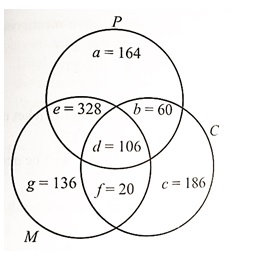
Passage :
information given below and answer the question that follow.
The result of an exam is given below. Out of 1000 students who appeared
(i) 658 failed in Physics
(ii) 166 failed in Physics and Chemistry
(iii) 372 failed in Chemistry, 434 failed in Physics and Maths
(iv) 590 failed in Maths, 126 failed in Maths & Chemistry
Find the number of people who failed in (assuming that none is passed in all subjects.
We have the following equations:
a+ b + c + d + e + f + g = 1000
a + b + d + e = 658, b + d = 166
b + d + c + f = 372
d + e = 434 as in the figure.
d + e + f + g = 590, d + f = 126. Find the values
Chemistry but not in Physics.
A
318
B
198
C
213
D
206
Question 92Single Answer
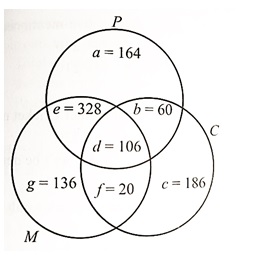
Passage :
Direction: information given below and answer the question that follow.
The result of an exam is given below. Out of 1000 students who appeared
(i) 658 failed in Physics
(ii) 166 failed in Physics and Chemistry
(iii) 372 failed in Chemistry, 434 failed in Physics and Maths
(iv) 590 failed in Maths, 126 failed in Maths & Chemistry
Find the number of people who failed in (assuming that none is passed in all subjects.
We have the following equations:
a+ b + c + d + e + f + g = 1000
a + b + d + e = 658, b + d = 166
b + d + c + f = 372
d + e = 434 as in the figure.
d + e + f + g = 590, d + f = 126. Find the values
Physics or Maths but not in Chemistry.
A
558
B
718
C
628
D
None of these
Question 93Single Answer
Passage :
For the next four question that follow:
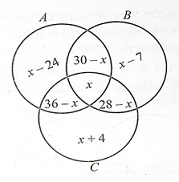
In a city, three daily newspapers A, B, C are published, 42% read A; 51% read B; 68% read C; 30% read A and B; 28% read B and C; 36% read A and C; 8% do not read any of the three newspapers.
Let x% people read all the three newspapers.
Since 8% people do not read any newspapers.
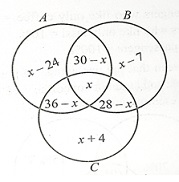
(x – 24) + (x – 7) + (x + 4) + (30 – x) + (36 – x) + (28 – x) + x = 92
→ x + 98 – 31 = 92
→ x = 92 – 67 = 25
What is the percentage of persons who read all the three papers ?
A
20%
B
25%
C
30%
D
40%
Question 94Single Answer
Passage :
For the next four : question that follow :
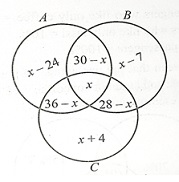
In a city, three daily newspapers A, B, C are published, 42% read A; 51% read B; 68% read C; 30% read A and B; 28% read B and C; 36% read A and C; 8% do not read any of the three newspapers.
Let x% people read all the three newspapers.
Since 8% people do not read any newspapers.
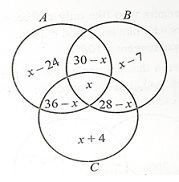
(x – 24) + (x – 7) + (x + 4) + (30 – x) + (36 – x) + (28 – x) + x = 92
→ x + 98 – 31 = 92
→ x = 92 – 67 = 25
What is the percentage of persons who read only two papers?
A
19%
B
31%
C
44%
D
None of these
Question 95Single Answer
Passage :
For the next four : question that follow :
In a city, three daily newspapers A, B, C are published, 42% read A; 51% read B; 68% read C; 30% read A and B; 28% read B and C; 36% read A and C; 8% do not read any of the three newspapers.
Let x% people read all the three newspapers.
Since 8% people do not read any newspapers.
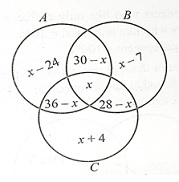
(x – 24) + (x – 7) + (x + 4) + (30 – x) + (36 – x) + (28 – x) + x = 92
→ x + 98 – 31 = 92
→ x = 92 – 67 = 25
What is the percentage of persons who read only one paper ?
A
38%
B
48%
C
51%
D
None of these
Question 96Single Answer
Passage :
For the next four : question that follow:
In a city, three daily newspapers A, B, C are published, 42% read A; 51% read B; 68% read C; 30% read A and B; 28% read B and C; 36% read A and C; 8% do not read any of the three newspapers.
Let x% people read all the three newspapers.
Since 8% people do not read any newspapers.
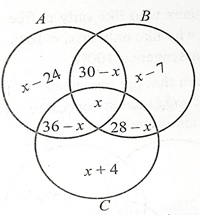
(x – 24) + (x – 7) + (x + 4) + (30 – x) + (36 – x) + (28 – x) + x = 92
→ x + 98 – 31 = 92
→ x = 92 – 67 = 25
What is the percentage of persons who read only A but neither B nor C ?
A
4%
B
3%
C
1%
D
None of these
Question 97Single Answer
Passage :
For the next four : question that follow:
In a city, three daily newspapers A, B, C are published, 42% read A; 51% read B; 68% read C; 30% read A and B; 28% read B and C; 36% read A and C; 8% do not read any of the three newspapers.
Let x% people read all the three newspapers.
Since 8% people do not read any newspapers.
(x – 24) + (x – 7) + (x + 4) + (30 – x) + (36 – x) + (28 – x) + x = 92
→ x + 98 – 31 = 92
→ x = 92 – 67 = 25
If A and B are any two sets, then what is A ᴖ (A ᴗ B) equal to ?
A
Complement of A
B
Complement of B
C
B
D
A
Question 98Single Answer
Passage :
For the next four : question that follow:
In a city, three daily newspapers A, B, C are published, 42% read A; 51% read B; 68% read C; 30% read A and B; 28% read B and C; 36% read A and C; 8% do not read any of the three newspapers.
Let x% people read all the three newspapers.
Since 8% people do not read any newspapers.
(x – 24) + (x – 7) + (x + 4) + (30 – x) + (36 – x) + (28 – x) + x = 92
→ x + 98 – 31 = 92
→ x = 92 – 67 = 25
40% of the people read newspaper X, 50% read newspaper Y and 10% read both the papers. What percentage of the people read neither newspaper ?
A
10%
B
15%
C
20%
D
25%
Question 99Single Answer
Passage :
Read the passage below and solve the question based on it.
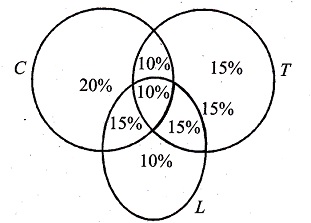
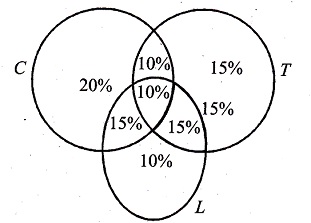
5% of the passengers do not like coffee, tea and lassi and 10% like all the three, 20% like coffee and tea, 25% like lassi and coffee and 25% like lassi and tea. 55% like coffee, 50% like tea, and 50% like lassi.
Where C = Coffee, T = Tea and L =Lassi
The passengers who like only coffee is greater than the passengers who like only lassi by
A
25%
B
100%
C
75%
D
0%
Question 100Single Answer
Passage :
Read the passage below and solve the question based on it.
5% of the passengers do not like coffee, tea and lassi and 10% like all the three, 20% like coffee and tea, 25% like lassi and coffee and 25% like lassi and tea. 55% like coffee, 50% like tea, and 50% like lassi.
Where C = Coffee, T = Tea and L =Lassi
The percentage of passengers who like both tea and lassi but not coffee, is
A
15
B
25
C
40
D
75
Technical Subject (Optometrist)
Question 101Single Answer
Which phenomenon explains the bending of light when it passes from one medium to another?
A
Refraction
B
Diffraction
C
Reflection
D
Polarization
Question 102Single Answer
Which law states that the angle of incidence equals the angle of reflection?
A
Snell’s Law
B
Fermat’s Principle
C
Huygens Principle
D
Law of Reflection
Question 103Single Answer
Which mirror always forms a virtual and erect image?
A
Concave mirror
B
Convex mirror
C
Plane mirror
D
Parabolic mirror
Question 104Single Answer
The focal length of a plane mirror is:
A
Half of radius
B
Zero
C
Equal to radius
D
Infinite
Question 105Single Answer
What is the refractive index of a medium defined as?
A
Ratio of wavelength to frequency
B
Ratio of speed of light in vacuum to speed in medium
C
Ratio of intensity to amplitude
D
Ratio of speed in medium to vacuum
Question 106Single Answer
Snell’s law relates:
A
Refraction angles and refractive indices
B
Reflection angles
C
Intensity of light
D
Wavelength of light
Question 107Single Answer
Which lens converges parallel rays of light to a focal point?
A
Convex lens
B
Concave lens
C
Cylindrical lens
D
Prism
Question 108Single Answer
Which lens diverges parallel rays of light?
A
Convex lens
B
Plano-convex lens
C
Concave lens
D
Biconvex lens
Question 109Single Answer
The unit of power of a lens is:
A
Diopter
B
Meter
C
Watt
D
Candela
Question 110Single Answer
Power of a lens is defined as:
A
Focal length × radius
B
1/focal length in meters
C
Radius/focal length
D
Wavelength/frequency
Question 111Single Answer
A +2 D lens has a focal length of:
A
1 m
B
2 m
C
0.5 m
D
0.25 m
Question 112Single Answer
Which aberration results from different colors focusing at different points?
A
Spherical aberration
B
Coma
C
Chromatic aberration
D
Astigmatism
Question 113Single Answer
Spherical aberration occurs due to:
A
Different wavelengths
B
Lens thickness
C
Peripheral rays focusing differently than paraxial rays
D
Reflection loss
Question 114Single Answer
Coma aberration causes:
A
Circular blur
B
Double image
C
Comet-shaped image
D
Color fringes
Question 115Single Answer
A prism deviates light toward:
A
Apex
B
Base
C
Center
D
Edge
Question 116Single Answer
The unit of prism power is:
A
Diopter
B
Prism diopter
C
Lux
D
Watt
Question 117Single Answer
One prism diopter deviates light by:
A
10 cm at 1 m
B
1 mm at 1 m
C
1 cm at 10 m
D
1 cm at 1 m
Question 118Single Answer
The optical center of a lens is the point where:
A
Rays converge
B
Rays pass undeviated
C
Rays diverge
D
Rays reflect
Question 119Single Answer
The line passing through centers of curvature of a lens is called:
A
Focal axis
B
Meridian axis
C
Optical path
D
Principal axis
Question 120Single Answer
The reduced eye model was proposed by:
A
Helmholtz
B
Gullstrand
C
Listing
D
Newton
Question 121Single Answer
In the schematic eye, the average axial length is about:
A
24 mm
B
22 mm
C
18 mm
D
28 mm
Question 122Single Answer
Emmetropia refers to:
A
Normal refractive state of eye
B
Near vision defect
C
Distance vision defect
D
Color blindness
Question 123Single Answer
Myopia is corrected with:
A
Convex lens
B
Concave lens
C
Cylindrical lens
D
Prism
Question 124Single Answer
Hypermetropia is corrected with:
A
Cylindrical lens
B
Concave lens
C
Convex lens
D
Prism
Question 125Single Answer
Astigmatism is commonly corrected using:
A
Prism lens
B
Concave lens
C
Bifocal lens
D
Cylindrical lens
Question 126Single Answer
Accommodation of the eye is mainly due to change in:
A
Lens curvature
B
Corneal curvature
C
Retina position
D
Iris size
Question 127Single Answer
Accommodation decreases with age causing:
A
Presbyopia
B
Myopia
C
Hyperopia
D
Astigmatism
Question 128Single Answer
The near point of a normal adult eye is approximately:
A
10 cm
B
15 cm
C
50 cm
D
25 cm
Question 129Single Answer
The far point of an emmetropic eye is:
A
25 cm
B
Infinity
C
50 cm
D
1 m
Question 130Single Answer
Objective refraction includes:
A
Subjective test
B
Retinoscopy
C
Visual acuity test
D
Color test
Question 131Single Answer
Subjective refraction depends on:
A
Patient response
B
Instrument reading
C
Retinal thickness
D
Corneal diameter
Question 132Single Answer
Retinoscopy is based on:
A
Polarization
B
Diffraction of light
C
Reflection of light from retina
D
Interference
Question 133Single Answer
Which instrument measures refractive error automatically?
A
Keratometer
B
Ophthalmoscope
C
Perimeter
D
Autorefractometer
Question 134Single Answer
Keratometer measures:
A
Lens thickness
B
Retina thickness
C
Corneal curvature
D
Pupil size
Question 135Single Answer
Visual acuity is commonly tested using:
A
Snellen chart
B
Ishihara chart
C
Amsler grid
D
Maddox rod
Question 136Single Answer
The normal visual acuity is expressed as:
A
6/18
B
6/12
C
6/6
D
6/24
Question 137Single Answer
Which aberration is minimized by stopping down the aperture?
A
Chromatic aberration
B
Astigmatism
C
Coma
D
Spherical aberration
Question 138Single Answer
Total internal reflection occurs when light travels from:
A
Denser to rarer medium
B
Rarer to denser medium
C
Air to glass
D
Vacuum to air
Question 139Single Answer
Critical angle is defined as:
A
Angle of reflection
B
Angle of incidence for which refraction angle is 90°
C
Angle of refraction
D
Angle of deviation
Question 140Single Answer
The prism used in eye examination to measure deviation is:
A
All of the above
B
Fresnel prism
C
Trial prism
D
Base-out prism
Question 141Single Answer
Accommodation amplitude is measured using:
A
Push-up method
B
Retinoscopy
C
Keratometry
D
Tonometry
Question 142Single Answer
The power of cornea is approximately:
A
20 D
B
43 D
C
30 D
D
60 D
Question 143Single Answer
Total optical power of the eye is approximately:
A
40 D
B
50 D
C
70 D
D
60 D
Question 144Single Answer
The principal refracting surface of the eye is:
A
Cornea
B
Lens
C
Retina
D
Iris
Question 145Single Answer
The refractive index of cornea is approximately:
A
1.376
B
1.336
C
1.000
D
1.450
Question 146Single Answer
The refractive index of aqueous humor is about:
A
1.500
B
1.400
C
1.450
D
1.336
Question 147Single Answer
Which method neutralizes reflex in retinoscopy?
A
Prism addition
B
Lens addition
C
Mirror movement
D
Eye closure
Question 148Single Answer
Streak retinoscope is used for:
A
Tonometry
B
Color vision test
C
Field test
D
Objective refraction
Question 149Single Answer
Accommodation is controlled by:
A
Optic nerve
B
Oculomotor nerve
C
Trigeminal nerve
D
Facial nerve
Question 150Single Answer
Presbyopia usually begins around age:
A
40 years
B
30 years
C
20 years
D
60 years
Question 151Single Answer
Which optical device splits light into its component colors?
A
Lens
B
Mirror
C
Prism
D
Filter
Question 152Single Answer
A thick lens differs from thin lens because:
A
Thickness is negligible
B
No aberrations occur
C
No refraction occurs
D
Thickness affects focal length
Question 153Single Answer
The point where parallel rays converge after refraction is:
A
Nodal point
B
Principal point
C
Focal point
D
Optical center
Question 154Single Answer
Which type of lens is used in bifocal spectacles for presbyopia?
A
Cylindrical segment
B
Concave segment
C
Convex segment
D
Prism segment
Question 155Single Answer
The distance between optical center and focal point is:
A
Radius
B
Optical axis
C
Focal length
D
Lens thickness
Question 156Single Answer
The nodal points of the eye are important in:
A
Tear secretion
B
Accommodation
C
Color vision
D
Image formation geometry
Question 157Single Answer
Emmetropization refers to:
A
Growth process adjusting eye to emmetropia
B
Lens replacement
C
Retina healing
D
Corneal reshaping
Question 158Single Answer
The image formed on retina is:
A
Inverted
B
Upright
C
Virtual
D
Enlarged
Question 159Single Answer
The optical axis passing through nodal points determines:
A
Tear production
B
Eye movement
C
Image orientation
D
Corneal shape
Question 160Single Answer
The angle between visual axis and optical axis is called:
A
Angle alpha
B
Angle gamma
C
Angle kappa
D
Angle beta
Question 161Single Answer
The instrument used to measure interpupillary distance is:
A
Keratometer
B
Pupillometer
C
Tonometer
D
Retinoscope
Question 162Single Answer
Which refractive error results from elongated eyeball?
A
Myopia
B
Hypermetropia
C
Presbyopia
D
Astigmatism
Question 163Single Answer
Which refractive error results from short eyeball?
A
Myopia
B
Hypermetropia
C
Astigmatism
D
Aphakia
Question 164Single Answer
Aphakia means:
A
Absence of iris
B
Absence of retina
C
Absence of cornea
D
Absence of lens
Question 165Single Answer
The Maddox rod is used to test:
A
Accommodation
B
Visual acuity
C
Color vision
D
Heterophoria
Question 166Single Answer
Which chart tests color vision?
A
Snellen chart
B
Bailey chart
C
LogMAR chart
D
Ishihara chart
Question 167Single Answer
The LogMAR chart is used for:
A
Color vision
B
Field test
C
Visual acuity measurement
D
Accommodation
Question 168Single Answer
The vergence of light is measured in:
A
Candela
B
Watts
C
Lumens
D
Diopters
Question 169Single Answer
Convergence of eyes is required for:
A
Peripheral vision
B
Distance vision
C
Color vision
D
Near vision
Question 170Single Answer
Accommodation reflex involves:
A
Lens thickening
B
Pupil constriction
C
Convergence
D
All of the above
Question 171Single Answer
The Purkinje images are formed by reflection from:
A
Iris only
B
Retina only
C
Cornea only
D
Ocular surfaces
Question 172Single Answer
The first Purkinje image is from:
A
Lens posterior surface
B
Lens anterior surface
C
Cornea
D
Retina
Question 173Single Answer
The third Purkinje image is from:
A
Cornea
B
Lens posterior surface
C
Lens anterior surface
D
Retina
Question 174Single Answer
The fourth Purkinje image is from:
A
Retina
B
Lens posterior surface
C
Cornea
D
Iris
Question 175Single Answer
The distance between pupil centers is called:
A
IAD
B
IOD
C
IPD
D
ICD
Question 176Single Answer
Cylindrical lenses correct:
A
Myopia
B
Hyperopia
C
Presbyopia
D
Astigmatism
Question 177Single Answer
In against movement in retinoscopy indicates:
A
Hypermetropia
B
Myopia
C
Emmetropia
D
Astigmatism
Question 178Single Answer
In with movement in retinoscopy indicates:
A
Myopia
B
Hypermetropia
C
Both b and c
D
Emmetropia
Question 179Single Answer
The visual axis passes through:
A
Fovea and fixation point
B
Cornea center only
C
Lens center only
D
Retina edge
Question 180Single Answer
What is the main function of the crystalline lens in the eye?
A
Refraction and accommodation
B
Light absorption
C
Tear production
D
Color perception
Question 181Single Answer
Which part of the eye controls the amount of light entering the eye?
A
Retina
B
Lens
C
Cornea
D
Iris
Question 182Single Answer
The pupil appears black because:
A
It absorbs light
B
Light is reflected outward
C
Light entering is absorbed by retina
D
No light enters it
Question 183Single Answer
The fovea centralis is responsible for:
A
Peripheral vision
B
Night vision
C
Sharp central vision
D
Motion detection
Question 184Single Answer
Which photoreceptor is responsible for color vision?
A
Rods
B
Ganglion cells
C
Bipolar cells
D
Cones
Question 185Single Answer
Which photoreceptor functions best in dim light?
A
Rods
B
Cones
C
Bipolar cells
D
Horizontal cells
Question 186Single Answer
The blind spot corresponds to:
A
Macula
B
Optic disc
C
Fovea
D
Lens center
Question 187Single Answer
The refractive index difference between cornea and air is responsible for:
A
Pupil dilation
B
Lens accommodation
C
Color vision
D
Majority of eye refraction
Question 188Single Answer
The axial length of a hypermetropic eye is usually:
A
Longer than normal
B
Shorter than normal
C
Equal to normal
D
Variable
Question 189Single Answer
The axial length of a myopic eye is usually:
A
Constant
B
Shorter than normal
C
Equal to normal
D
Longer than normal
Question 190Single Answer
The term anisometropia refers to:
A
Equal refractive error in both eyes
B
Different refractive errors in two eyes
C
Absence of lens
D
Double vision
Question 191Single Answer
The lens capsule is:
A
Retina covering
B
Rigid layer of cornea
C
Elastic membrane around lens
D
Iris tissue
Question 192Single Answer
Accommodation occurs when:
A
Lens becomes flatter
B
Retina shifts
C
Cornea flattens
D
Lens becomes thicker
Question 193Single Answer
The ciliary muscle contraction causes:
A
Lens flattening
B
Pupil dilation
C
Retina expansion
D
Lens thickening
Question 194Single Answer
Which aberration occurs when off-axis rays form asymmetrical blur?
A
Coma
B
Chromatic aberration
C
Spherical aberration
D
Distortion
Question 195Single Answer
Distortion aberration causes:
A
Curved lines appear straight
B
Blurred center
C
Color fringes
D
Straight lines appear curved
Question 196Single Answer
Barrel distortion causes image lines to:
A
Bow outward
B
Disappear
C
Remain straight
D
Bow inward
Question 197Single Answer
Pincushion distortion causes lines to:
A
Remain straight
B
Bow inward
C
Bow outward
D
Rotate
Question 198Single Answer
The nodal points of the eye lie near:
A
Cornea
B
Retina
C
Lens
D
Optic nerve
Question 199Single Answer
The principal planes in optics help determine:
A
Retina thickness
B
Refraction path in thick lenses
C
Iris diameter
D
Tear secretion
Question 200Single Answer
Which lens combination corrects presbyopia and distance vision?