Latest DSSSB TGT Special Education Teacher Exam Question (Objective Questions), MCQ in English
Subjects : General Awareness, General Intelligence & Reasoning, Arithmetic & Numerical Ability, Hindi Language & Comprehension, English Language & Comprehension, Special Education Teacher
Question Bank DSSSB TGT Special Education Teacher Exam - English
Kurukshetra a journal on rural development is published by
A
Ministry of Finance
B
Ministry of Information and Broadcastin
C
Ministry of Rural Development
D
Planning Commission
Question 3Single Answer
Devaluation of a currency means
A
Fixing the value of the currency in conjuction with the movement in the value of a basket of predetermined currencies
B
Reduction in the value of a currency vis-à-vis major internationally traded currencies
C
Fixing the value of currency in multilateral consultaion with the IMF the World Bank and major trading partners
D
Permitting the currency to seek its worth in the international market
Question 4Single Answer
In ruby laser, the stimulated emission is due to transition from
A
metastable state to any lower state
B
any higher state of lower state
C
metastable state to ground state
D
any higher state to ground state
Question 5Single Answer
10-6 M NaOH is diluted 100 times. The pH of the diluted base is
A
between 7 and 8
B
between 5 and 6
C
between 6 and 7
D
between 10 and 11
Question 6Single Answer
The respiratory quotient during cellular respiration would depend on
A
the nature of enzymes involved
B
the nature of the substrate
C
the amount of carbon dioxide released
D
the amount of oxygen utilised
Question 7Single Answer
"Who said, 'India was a parrot unto itself'?
A
Malik Muhammad Joyce
B
Raskhan
C
Rich Khusrow
D
Rich Hasan
Question 8Single Answer
Which is the national game of Bhutan ?
A
badminton
B
basketball
C
football
D
archery
Question 9Single Answer
When was the Constituent Assembly of India formed?
A
1946
B
1947
C
1948
D
1950
Question 10Single Answer
Who is known as the "Father of the Indian Renaissance" ?
A
Raja Ram Mohan Roy
B
Swami Vivekananda
C
Rabindranath Tagore
D
Mahatma Gandhi
Question 11Single Answer
What is the study of ethics primarily concerned with ?
A
Economic behavior
B
Human values and moral principles
C
Physical health
D
Political systems
Question 12Single Answer
Who is known as the "Missile Man of India"?
A
Dr. Homi J. Bhabha
B
Dr. Vikram Sarabhai
C
Dr. APJ Abdul Kalam
D
Dr. Satish Dhawan
Question 13Single Answer
What is the name of the next phase of India’s semiconductor programme notified by the Government in August 2026?
A
Chip India 3.0
B
India Chip Mission
C
Semicon 2.0
D
Semiconductor Bharat
Question 14Single Answer
Which country conferred its highest honour for foreign leaders, the ‘Oliy Darajali Do‘stlik Order’, on Prime Minister Narendra Modi?
A
Kazakhstan
B
Kyrgyzstan
C
Uzbekistan
D
Tajikistan
Question 15Single Answer
Where was the 2026 SCO Leaders’ Summit held?
A
Tashkent
B
Bishkek
C
Dushanbe
D
Astana
Question 16Single Answer
India and Uzbekistan recently upgraded their bilateral relationship to which level?
A
Strategic Partnership
B
Economic Partnership
C
Comprehensive Strategic Partnership
D
Defence Partnership
Question 17Single Answer
Which two organisations signed an MoU to promote smart domestic PNG meters?
A
ONGC and IOCL
B
GAIL and NTPC
C
PNGRB and EESL
D
HPCL and BPCL
Question 18Single Answer
What is the official name of Delhi?
A
Delhi Capital State
B
Federal Territory of Delhi
C
National Capital Territory of Delhi
D
National Metropolitan Territory
Question 19Single Answer
Delhi is constitutionally classified as which type of territory?
A
Federal State
B
Full State
C
Autonomous Province
D
Union Territory
Question 20Single Answer
Which city serves as the capital of India?
A
New Delhi
B
Kolkata
C
Mumbai
D
Chennai
General Intelligence & Reasoning
Question 21Single Answer
How many such pairs of letters are there in the word ‘CLEANLINESS’ each of the which has as many letters between them in the word as they have in the English alphabet, in the same sequence?
A
Two
B
Three
C
Five
D
Four
E
None of these
Question 22Single Answer
Team A has scored more goals than Team B
Team C has scored fewer goals than Team B
Team A has scored fewer goals than Team C .
If the first two statements are true, the third statement is
A
True
B
False
C
Uncertain
D
None
Question 23Single Answer
If it is possible to make only one meaningful word with the second, the third, the sixth and the eight letters of the word FRAGMENT using each only once, which of the following will be the third letter of that word ? If no such word can be formed, give ‘X’ as the answer and if more than one such word can be formed, give ‘Y’ as the answer.
A
A
B
E
C
T
D
X
E
Y
Question 24Single Answer
How many such letters are there in the word ORIENTAL each of which is as far away from the beginning of the word as when they are arranged alphabetically?
A
None
B
One
C
Two
D
Three
E
More than three
Question 25Single Answer
How many such pairs of letters in the word CREDIT each of which has as many letters between them in the word as in the English alphabet?
A
None
B
One
C
Two
D
Three
E
More than three
Question 26Single Answer
How many meaningful words can be made from the letters ‘LMEA’ using each letter only once in each word?
A
None
B
One
C
Two
D
Three
E
More than three
Question 27Single Answer
If it is possible to make only one meaningful word with the first, the second, the seventh and the eighth letters of the word TEMPORAL, which of the following will be the first letter of that word? If more than one such word can be made, give ‘Y’ as the answer and if no such word can be made, give ‘X’ as the answer.
A
T
B
L
C
E
D
Y
E
X
Question 28Single Answer
If the letters of the word HANDOVER are arranged alphabetically from left to right how many letters will remain at the same position?
A
None
B
One
C
Two
D
Three
E
More than three
Question 29Single Answer
Passage :
A B C D E F G H I J K L M N O P Q R S T U V W X Y Z .
Which letter in this alphabet is the eighth letter to the right of the letter and which is tenth letter to the left of the last but one letter of the alphabet ?
A
X
B
W
C
I
D
H
Question 30Single Answer
Passage :
Direction : The following question is based on the five words given below:
AND FOR THE BIG SUM (The new words formed after performing the mentioned operations may or may not necessarily the meaningful English words.)
If the third alphabet of each of the words is changed to the next alphabet in the English alphabetical series, which of the following will form a meaningful English word?
A
SUM
B
BIG
C
Both BIG and THE
D
FOR
E
Both FOR and BIG
Question 31Single Answer
Passage :
Direction : The following question is based on the five words given below:
AND FOR THE BIG SUM (The new words formed after performing the mentioned operations may or may not necessarily the meaningful English words.)
If the given words are arranged in the order as they would appear in a dictionary from left to right, which of the following will be second from the right ?
A
AND
B
FOR
C
THE
D
BIG
E
SUM
Question 32Single Answer
Passage :
Direction: The following question is based on the five words given below:
AND FOR THE BIG SUM (The new words formed after performing the mentioned operations may or may not necessarily the meaningful English words.)
If second alphabet in each of the words is changed to next alphabet in the English alphabetical order, how many words having two vowels (same or different vowels) will be formed ?
A
None
B
One
C
Two
D
Three
E
Four
Question 33Single Answer
Passage :
Direction : The following question is based on the five words given below:
AND FOR THE BIG SUM (The new words formed after performing the mentioned operations may or may not necessarily the meaningful English words.)
How many letters are there in the English alphabetical series between the second letter of the word which is second from the right and the second letter of the word which is second from the left of the given words?
A
Two
B
Five
C
Six
D
Nine
E
Three
Question 34Single Answer
Passage :
Direction: The following question is based on the five words given below:
AND FOR THE BIG SUM (The new words formed after performing the mentioned operations may or may not necessarily the meaningful English words.)
If in each of the given words, each of the consonant is changed to previous letter and each vowel is changed to next letter in the English alphabetical series, in how many words thus formed will no vowels appear?
A
None
B
One
C
Two
D
Three
E
More than three
Question 35Single Answer
Passage :
Direction : Following question is based on five words given below: BRU LEGINKCATOWN
(The new words formed after performing the mentioned operations may or may not necessarily be meaningful English words)
If the third alphabet in each of the words is changed to the next alphabet in the English alphabetical order, how many words having two vowels (same or different vowels) will be formed?
A
None
B
One
C
Two
D
Three
E
Four
Question 36Single Answer
Passage :
Direction : Following question is based on five words given below: BRU LEGINKCATOWN
(The new words formed after performing the mentioned operations may or may not necessarily be meaningful English words)
If the position of the first and the second alphabets of each of the words are interchanged, which of the following will form a meaningful English word?
A
Both CAT and OWN
B
Both BRU and INK
C
Only CAT
D
Only INK
E
Only LEG
Question 37Single Answer
Passage :
Direction: Following question is based on five words given below: BRU LEGINKCATOWN
(The new words formed after performing the mentioned operations may or may not necessarily be meaningful English words)
If the given words are arranged in the order as they would appear in a dictionary from left to right, which of the following will be exactly in the middle of the five words?
A
OWN
B
LEG
C
BRU
D
CAT
E
INK
Question 38Single Answer
Passage :
Direction: Following question is based on five words given below: BRU LEGINKCATOWN
(The new words formed after performing the mentioned operations may or may not necessarily be meaningful English words)
If in each of the given words, each of the consonants is changed to previous letter and each vowel is changed to next letter in the English alphabetical series, in how many words thus formed will the same alphabet appear twice?
A
None
B
One
C
Two
D
Three
E
More than three
Question 39Single Answer
Passage :
Find the missing number in the following series ?
3, 5, 5, 19, 7, 41, 9, ?
A
71
B
61
C
79
D
69
Question 40Single Answer
Passage :
Direction: following question is based on five words given below:
LAP BUT CAR SON HID
(The new words formed after performing the mentioned operations may or may not necessarily be meaningful English words.)
If the positions of the first and the third alphabets of each of the words are interchanged, which of the following would form meaningful words with the new arrangement?
A
HID
B
SON
C
Both LAP and BUT
D
CAR
E
Both CAR and LAP
Arithmetic & Numerical Ability
Question 41Single Answer
The cash difference between the selling prices of an article at a profit of 4% and 6% is Rs. 3. The ratio of the two selling prices is:__________ ?
A
51:52
B
52:53
C
51:53
D
52:55
Question 42Single Answer
Which of the following numbers is irrational ?
A
√49
B
0.125
C
√2
D
22/7
Question 43Single Answer
356 x 936 – 356 x 836 = ?
A
35600
B
34500
C
9630
D
93600
Question 44Single Answer
Arrange in descending order: 5/8, 7/10, 3/4
A
3/4 > 7/10 > 5/8
B
7/10 > 3/4 > 5/8
C
3/4 > 5/8 > 7/10
D
5/8 > 7/10 > 3/4
Question 45Single Answer
What is (3^{4} times 9^{2}) ?
A
36
B
38
C
310
D
96
Question 46Single Answer
If 34X-2 = 729, then find the value of X.
A
4
B
3
C
2
D
5
Question 47Single Answer
Convert 0.6 into fraction ?
A
3/5
B
2/3
C
4/5
Question 48Single Answer
The no. plate of a bus had peculiarity. The bus number was a perfect square. It was also a perfect square when the plate numbers were reversed. The bus company had only five hundred buses numbered from 1 to 500. What was the number ?
A
169
B
36
C
196
D
Can not say
Question 49Single Answer
If a and b are positive integers, such that ab = 125, then (a-b)a+b-4 = ?
A
16
B
25
C
28
D
30
Question 50Single Answer
If x*y = x2 + y2 – xy, then value of 9*11 is
A
93
B
103
C
60.5
D
121
Important Questions Package
DSSSB TGT Special Education Teacher Exam Online Question Bank Package
Buy DSSSB TGT Special Education Teacher Important Questions, MCQ, question answer in Hindi & English. It will help you to score high marks in DSSSB TGT Special Education Teacher question bank 2026 in Online, PDF & Print study material.
+ Free Monthly Current Affairs, GK & more PDF Download
Sr.
Package Name
Amount
1.
DSSSB TGT Special Education Teacher Exam - Hindi
Description : 1000 Question with Answer
₹101[₹500]
2.
DSSSB TGT Special Education Teacher Exam - Hindi
Description : 2000 Question with Answer
₹151[₹500]
3.
DSSSB TGT Special Education Teacher Exam - Hindi
Description : 3000 Question with Answer
₹181[₹500]
4.
DSSSB TGT Special Education Teacher Exam - Hindi
Description : 4000 Question with Answer
₹201[₹500]
5.
DSSSB TGT Special Education Teacher Exam - Hindi
Description : 5000 Question with Answer
₹221[₹500]
6.
DSSSB TGT Special Education Teacher Exam - English
Description : 1000 Question with Answer
₹101[₹500]
7.
DSSSB TGT Special Education Teacher Exam - English
Description : 2000 Question with Answer
₹151[₹500]
8.
DSSSB TGT Special Education Teacher Exam - English
Description : 3000 Question with Answer
₹181[₹500]
9.
DSSSB TGT Special Education Teacher Exam - English
Description : 4000 Question with Answer
₹201[₹500]
10.
DSSSB TGT Special Education Teacher Exam - English
Description : 5000 Question with Answer
₹221[₹500]
11.
DSSSB TGT Special Education Teacher Exam - Hindi
Description : 1000 Question & Answer Download in PDF (Send by Email)
₹151[₹450]
12.
DSSSB TGT Special Education Teacher Exam - English
Description : 1000 Question & Answer Download in PDF (Send by Email)
₹151[₹450]
13.
DSSSB TGT Special Education Teacher Exam Question Bank Book - Hindi
Description : 1000 Question with Answer (Printed Material)
₹450[₹800]
14.
DSSSB TGT Special Education Teacher Exam Question Bank Book - English
Description : 1000 Question with Answer (Printed Material)
₹390[₹600]
15.
DSSSB TGT Special Education Teacher Exam - English (Old)
Description : 1000 Question with Answer.
₹101[₹500]
Arithmetic & Numerical Ability
Question 51Single Answer
Which is greater ?
A
15/16
B
17/18
C
Equal
D
Cannot compare
Question 52Single Answer
If sum of two numbers is 42 and their product is 437, then find their difference.
A
3
B
4
C
5
D
7
Question 53Single Answer
Write the 44000 in Roman numerals
A
XLI
B
XLVI
C
XLIV
D
XLVIC
Question 54Single Answer
Convert 0.0909… into fraction ?
A
1/11
B
9/11
C
1/9
D
9/10
Question 55Single Answer
What is (98 times 102) ?
A
9996
B
10000
C
10096
D
10196
Question 56Single Answer
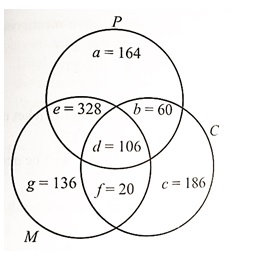
Passage :
information given below and answer the question that follow.
The result of an exam is given below. Out of 1000 students who appeared
(i) 658 failed in Physics
(ii) 166 failed in Physics and Chemistry
(iii) 372 failed in Chemistry, 434 failed in Physics and Maths
(iv) 590 failed in Maths, 126 failed in Maths & Chemistry
Find the number of people who failed in (assuming that none is passed in all subjects.
We have the following equations:
a+ b + c + d + e + f + g = 1000
a + b + d + e = 658, b + d = 166
b + d + c + f = 372
d + e = 434 as in the figure.
d + e + f + g = 590, d + f = 126. Find the values
Chemistry but not in Physics.
A
318
B
198
C
213
D
206
Question 57Single Answer
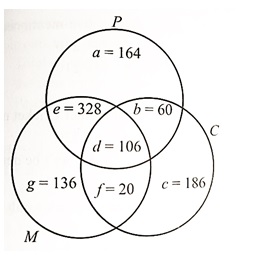
Passage :
Direction: information given below and answer the question that follow.
The result of an exam is given below. Out of 1000 students who appeared
(i) 658 failed in Physics
(ii) 166 failed in Physics and Chemistry
(iii) 372 failed in Chemistry, 434 failed in Physics and Maths
(iv) 590 failed in Maths, 126 failed in Maths & Chemistry
Find the number of people who failed in (assuming that none is passed in all subjects.
We have the following equations:
a+ b + c + d + e + f + g = 1000
a + b + d + e = 658, b + d = 166
b + d + c + f = 372
d + e = 434 as in the figure.
d + e + f + g = 590, d + f = 126. Find the values
Physics or Maths but not in Chemistry.
A
558
B
718
C
628
D
None of these
Question 58Single Answer
Passage :
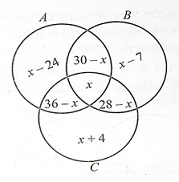
For the next four question that follow:
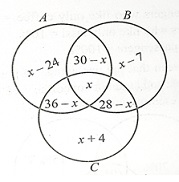
In a city, three daily newspapers A, B, C are published, 42% read A; 51% read B; 68% read C; 30% read A and B; 28% read B and C; 36% read A and C; 8% do not read any of the three newspapers.
Let x% people read all the three newspapers.
Since 8% people do not read any newspapers.
(x – 24) + (x – 7) + (x + 4) + (30 – x) + (36 – x) + (28 – x) + x = 92
→ x + 98 – 31 = 92
→ x = 92 – 67 = 25
What is the percentage of persons who read all the three papers ?
A
20%
B
25%
C
30%
D
40%
Question 59Single Answer
Passage :
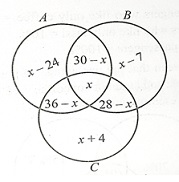
For the next four : question that follow :
In a city, three daily newspapers A, B, C are published, 42% read A; 51% read B; 68% read C; 30% read A and B; 28% read B and C; 36% read A and C; 8% do not read any of the three newspapers.
Let x% people read all the three newspapers.
Since 8% people do not read any newspapers.
(x – 24) + (x – 7) + (x + 4) + (30 – x) + (36 – x) + (28 – x) + x = 92
→ x + 98 – 31 = 92
→ x = 92 – 67 = 25
What is the percentage of persons who read only two papers?
A
19%
B
31%
C
44%
D
None of these
Question 60Single Answer
Passage :
For the next four : question that follow :
In a city, three daily newspapers A, B, C are published, 42% read A; 51% read B; 68% read C; 30% read A and B; 28% read B and C; 36% read A and C; 8% do not read any of the three newspapers.
Let x% people read all the three newspapers.
Since 8% people do not read any newspapers.
(x – 24) + (x – 7) + (x + 4) + (30 – x) + (36 – x) + (28 – x) + x = 92
→ x + 98 – 31 = 92
→ x = 92 – 67 = 25
What is the percentage of persons who read only one paper ?
A
38%
B
48%
C
51%
D
None of these
Hindi Language & Comprehension
Question 61Single Answer
शुद्ध वर्तनी का चयन कीजिए
A
अधम्र
B
अध्रम
C
अधर्म
D
अध्रिम
Question 62Single Answer
शुद्ध वर्तनी का चयन कीजिए
A
स्थायि
B
स्थायी
C
स्थाई
D
स्थाइ
Question 63Single Answer
वर्तनी की दृष्टि से सही शब्द है?
A
महत्व
B
महतव
C
महत्तव
D
महतत्व
Question 64Single Answer
निम्नलिखित में से शुद्ध छांटिए?
A
आयुष्मान
B
आयुश्मान
C
आयुशमान
D
आयुश्यमान
Question 65Single Answer
शुद्ध शब्द नहीं हैं?
A
कवियत्री
B
कौसल्या
C
एश्वर्य
D
श्रृंगार
Question 66Single Answer
शुद्ध वर्तनी है -
A
पूज
B
पुजय
C
पूज्य
D
पुज्य
Question 67Single Answer
शुद्ध वर्तनी है -
A
अनुसरण
B
अनूशरणन
C
अनुशरण
D
अणुशर
Question 68Single Answer
किस क्रमांक में सभी शुद्ध हैं?
A
एक्य,साप्ताहिक
B
आजीविका,आशीर्वाद
C
आर्शिवाद ,अनूकूल
D
निरिक्षण ,कृपालु
Question 69Single Answer
'उज्वल' शब्द का शुद्ध रूप है ?
A
उज्जव
B
उज्ज्ल
C
उज्ज्वल
D
उजवल
Question 70Single Answer
निम्नलिखित प्रश्न में चार वैकल्पिक वर्तनियाॅ दी गई है?
A
जागृत
B
जाग्रति
C
जाग्रित
D
जाग्रत
Question 71Single Answer
निम्नलिखित प्रश्न में चार वैकल्पिक वर्तनियाॅ दी गई है?
A
उन्नति
B
उनति
C
उन्ती
D
उनती
Question 72Single Answer
निम्नलिखित प्रश्न मे चार वैकल्पिक वर्तनियाॅ दी गई है?
A
अनुशहरण
B
अनोसरण
C
अनुसरन
D
अनुसरण
Question 73Single Answer
'पृथ्वीराज रासो' किस काल की रचना है ?
A
आदिकाल
B
रीतिकाल
C
भक्तिकाल
D
आधुनिक काल
Question 74Single Answer
हिन्दी की उत्पत्ति किस भाषा से हुई है?
A
प्राकृत
B
संस्कृत
C
शौरसैनी अपभ्रंश
D
मागधी
Question 75Single Answer
राजभाषा आयोग के प्रथम अध्यक्ष थे ?
A
बी. जी. खरे
B
राजा लक्ष्मण सिंह
C
प्रताप नारायण मिश्र
D
इंशाअल्ला खा
Question 76Single Answer
निम्नलिखित बोलियों में से कौन - सी बोली उत्तर प्रदेश में नहीं बाली जाती?
A
मैथिली
B
अवधी
C
ब्रज
D
खड़ी बोली
Question 77Single Answer
भारत की प्रथम देशज भाषा कौन-सी है?
A
पालि
B
प्राकृत
C
संस्कृत
D
इसमें से कोई नहीं
Question 78Single Answer
भारतेन्दु ने किस पत्रिका का संपादन किया?
A
हिन्दी प्रदीप
B
इन्दु
C
कविवचन सुधा
D
भारतबन्धु
Question 79Single Answer
पूर्वी हिन्दी विकसित हुई है?
A
पैशाची अपभ्रंश
B
अर्धमागधी अपभ्रंश
C
शौरसैनी अपभ्रंश
D
मागधी अपभ्रंश
Question 80Single Answer
मानक हिन्दी का आधार क्या है?
A
खड़ी बोली
B
अपभ्रंश
C
पूर्वी हिन्दी
D
परिनिष्ठ हिन्दी
English Language & Comprehension
Question 81Single Answer
I go to Madurai by —– Vaigai Express
A
a
B
an
C
some
D
the
Question 82Single Answer
Have the car stolen!
A
Steal the car
B
You should have the stolen car
C
Get someone to steal the car
D
They have stolen the car
Question 83Single Answer
The payment was collected by the hardworking salesman.
A
The hardworking salesman collected the payment.
B
the salesman who worked heard was able to collect the payment.
C
to collect the payment the salesman had to work hard.
D
The hardworking salesman was able to collect the payment.
Question 84Single Answer
I had to stop all my work to complete this project.
A
All other work had to be stopped to complete this project by me
B
For completing this project all other work must be stopped
C
For completing this project I had to stop all my work
D
To complete this project all other work had been stopped by me
Question 85Single Answer
They have published the names of all the successful candidates.
A
The candidates who have succeeded their names they had published.
B
The names of all the successful candidates have been published by them
C
The candidates who have succeeded their names have been published by them.
D
The names of all the successful candidate were published by them.
Question 86Single Answer
The online shopping site lowered the prices.
A
Lowering of the prices was done by the online shopping site
B
The prices were lowered by the online shopping site
C
The prices had been lowered by the online shopping site
D
The prices have been lowered by the online shopping site
Question 87Single Answer
Who taught you to drive a truck ?
A
To drive a truck by whom were you taught?
B
Driving a truck by who were you taught?
C
Driving a truck by who were you being taught?
D
By whom were you taught to drive a truck?
Question 88Single Answer
We shall invite Suresh.
A
Suresh would be invited by us
B
Suresh would have been invited by us
C
Suresh will be invited by us
D
Suresh will have been invited by us
Question 89Single Answer
Passage :
Direction : Question below has two blanks, each blank indicting that some thing has been omitted. Choose the word for each blank which best fits the meaning of the sentence as a whole.
The Finance Department has ……………a centralized online databank system for all statutory government bodies to …………an eye on their assets and liabilities.
A
presented , stay
B
introduced , keep
C
announce , make
D
created , let
E
proclaimed , hold
Question 90Single Answer
Passage :
Direction : The five items in this section consists of a word or group of words followed by four words as (a), (b), (c) and (d). Select the word which is nearly opposite to the meaning of the original word or group of words and mark your response as (a), (b), (c) and (d), as the case may be, in your Answer Sheet.
Assets
A
liabilities
B
responsibilities
C
estates
D
profits
Question 91Single Answer
Passage :
Direction : In the question, out of the four alternatives, choose the word which is opposite in meaning to the given word and click the button corresponding to it
Affidavit
A
Affirmation
B
Slander
C
Oath
D
Testimony
Question 92Single Answer
Passage :
Direction: In the following question, out of the four alternatives, choose the word which is opposite in meaning to the given word and click the button corresponding to it
Hollow
A
Alveolate
B
Cleft
C
Cavernous
D
Solid
Question 93Single Answer
Passage :
Directions: In the following question, out of the four alternatives, choose the word which is opposite in meaning to the given word and click the button corresponding to it
Cosset
A
Ignoreb
B
Close
C
Caress
D
Fondle
Question 94Single Answer
Passage :
Directions: In the following question, out of the four alternatives, choose the word which is opposite in meaning to the given word and click the button corresponding to it
Ogle
A
Leer
B
Gaze
C
Ignore
D
Gawk
Question 95Single Answer
Passage :
Directions:In the following question, out of the four alternatives, choose the word which is opposite in meaning to the given word and click the button corresponding to it
Intrinsic
A
Elemental
B
Innate
C
Connate
D
Acquired
Question 96Single Answer
Passage :
Direction : In the following question, out of the four alternatives, choose the word which is opposite in meaning to the given word and click the button corresponding to it
Coalesce
A
Separate
B
Adhere
C
Cleave
D
Amalgamate
Question 97Single Answer
Passage :
Directions: In the following question, out of the four alternatives, choose the word which is opposite in meaning to the given word and click the button corresponding to it
Loiter
A
lag
B
Hasten
C
Amble
D
Loii
Question 98Single Answer
Passage :
Direction : Question below has two blanks, blank indicating that something has been omitted. Choose the set of words for blank which best fits the meaning of the sentence as a whole.
The protests were......... at ......... awareness among the elite and the educated.
A
held, generating
B
aimed, creating
C
targeted, awakening
D
focused, building
E
concentrated, producing
Question 99Single Answer
Passage :
Directions:In the following question, out of the four alternatives, choose the word which is opposite in meaning to the given word and click the button corresponding to it
Deep-seated
A
Chronic
B
Temporary
C
inbred
D
Subconscious
Question 100Single Answer
Passage :
Directions: In the following question, out of the four alternatives, choose the word which is opposite in meaning to the given word and click the button corresponding to it
Vibrant
A
Drab
B
Gaudy
C
Jazzy
D
Vivid
Special Education Teacher
Question 101Single Answer
Human development is best described as:
A
Only physical growth
B
Increase in body weight only
C
A continuous process involving qualitative and quantitative changes
D
Development after adolescence only
Question 102Single Answer
Growth primarily refers to:
A
Quantitative changes in the body
B
Moral development
C
Emotional maturity
D
Social adjustment
Question 103Single Answer
Development generally proceeds from:
A
Specific to general
B
Complex to simple
C
General to specific
D
Random to systematic
Question 104Single Answer
The cephalocaudal principle of development means development proceeds from:
A
Centre to extremities
B
Outside to inside
C
Toe to head
D
Head to toe
Question 105Single Answer
The proximodistal principle states that development proceeds from:
A
Centre of the body toward the extremities
B
General to specific
C
Head to foot
D
Extremities toward the centre
Question 106Single Answer
According to Piaget, the sensorimotor stage extends approximately from:
A
Birth to 2 years
B
2 to 7 years
C
7 to 11 years
D
11 to 15 years
Question 107Single Answer
Object permanence develops mainly during Piaget's:
A
Preoperational stage
B
Formal operational stage
C
Concrete operational stage
D
Sensorimotor stage
Question 108Single Answer
Egocentrism is most characteristic of Piaget's:
A
Preoperational stage
B
Sensorimotor stage
C
Concrete operational stage
D
Formal operational stage
Question 109Single Answer
Conservation develops mainly during the:
A
Sensorimotor stage
B
Preoperational stage
C
Concrete operational stage
D
Infancy stage
Question 110Single Answer
Abstract and hypothetical reasoning is characteristic of Piaget's:
A
Formal operational stage
B
Preoperational stage
C
Concrete operational stage
D
Sensorimotor stage
Question 111Single Answer
Vygotsky's Zone of Proximal Development refers to:
A
What a learner can never achieve
B
Difference between mental age and chronological age
C
Difference between independent performance and performance with assistance
D
Physical development during adolescence
Question 112Single Answer
Temporary support given to a learner to complete a task is called:
A
Reinforcement
B
Conditioning
C
Scaffolding
D
Punishment
Question 113Single Answer
According to Erikson, the major psychosocial conflict during infancy is:
A
Initiative versus guilt
B
Industry versus inferiority
C
Trust versus mistrust
D
Identity versus role confusion
Question 114Single Answer
Erikson associated adolescence mainly with:
A
Trust versus mistrust
B
Identity versus role confusion
C
Autonomy versus shame
D
Integrity versus despair
Question 115Single Answer
Kohlberg's theory is primarily concerned with:
A
Language development
B
Motor development
C
Moral development
D
Physical development
Question 116Single Answer
Individual differences among learners imply that teachers should:
A
Use one method for everyone
B
Ignore learner diversity
C
Provide varied learning opportunities
D
Compare all learners continuously
Question 117Single Answer
The period of rapid physical and sexual maturation is called:
A
Infancy
B
Adulthood
C
Middle childhood
D
Adolescence
Question 118Single Answer
Maturation refers primarily to:
A
Biologically programmed developmental changes
B
Learning through practice
C
Classroom teaching
D
Environmental punishment
Question 119Single Answer
Heredity and environment in development are generally understood as:
A
Mutually exclusive
B
Interacting influences
C
Unrelated
D
Completely identical
Question 120Single Answer
Play contributes to a child's:
A
Physical, social, emotional and cognitive development
B
Social development only
C
Cognitive development only
D
Physical development only
Question 121Single Answer
The constitutional provision relating to the Right to Education is:
A
Article 14
B
Article 32
C
Article 21A
D
Article 51
Question 122Single Answer
Article 21A provides free and compulsory education to children in the age group of:
A
3–6 years
B
5–10 years
C
6–14 years
D
14–18 years
Question 123Single Answer
The Right of Children to Free and Compulsory Education Act was enacted in:
A
2005
B
2009
C
2007
D
2012
Question 124Single Answer
Education is included in the:
A
Union List only
B
State List only
C
Concurrent List
D
Residuary List
Question 125Single Answer
Equality of educational opportunity mainly aims to:
A
Provide identical textbooks only
B
Eliminate unfair barriers to education
C
Give education only to high achievers
D
Restrict access to schools
Question 126Single Answer
A democratic classroom is characterized by:
A
Fear and punishment
B
Teacher monopoly
C
Student participation and respect
D
Rigid silence
Question 127Single Answer
Inclusive education supports:
A
Separation of children with disabilities
B
Only gifted children
C
Institutionalization of every child with disability
D
Participation of diverse learners in common learning environments
Question 128Single Answer
The primary objective of education for social justice is to:
A
Maintain inequalities
B
Promote competition only
C
Eliminate diversity
D
Provide equitable opportunities
Question 129Single Answer
A major purpose of constitutional values in education is to promote:
A
Equality, liberty and fraternity
B
Discrimination
C
Social exclusion
D
Cultural isolation
Question 130Single Answer
Gender-sensitive education seeks to:
A
Provide equal learning opportunities irrespective of gender
B
Reinforce stereotypes
C
Separate all learners by gender
D
Restrict girls to selected subjects
Question 131Single Answer
A multilingual classroom should ideally:
A
Treat home languages as obstacles
B
Prohibit all languages except one
C
Use learners' linguistic resources constructively
D
Discourage communication
Question 132Single Answer
The hidden curriculum refers to:
A
Deleted textbook chapters
B
Optional subjects
C
Secret examinations
D
Unwritten values and norms learned through school experiences
Question 133Single Answer
Socialization through school includes learning:
A
Social norms, cooperation and responsibilities
B
Only academic facts
C
Only handwriting
D
Only examination techniques
Question 134Single Answer
Equity in education means:
A
Providing exactly the same support to everyone
B
Teaching only high achievers
C
Removing all assessment
D
Providing support according to learners' needs
Question 135Single Answer
A barrier-free school environment is especially important for:
A
Accessibility and participation
B
Exclusion
C
Segregation
D
Competitive ranking
Question 136Single Answer
Learning is generally defined as a relatively permanent change in:
A
Height only
B
Behaviour or knowledge resulting from experience
C
Genetic composition
D
Eye colour
Question 137Single Answer
Classical conditioning is associated with:
D
F. Skinner
Question 138Single Answer
Operant conditioning is most closely associated with:
A
Skinner
B
Freud
C
Piaget
D
Chomsky
Question 139Single Answer
In operant conditioning, reinforcement is used to:
A
Decrease all behaviour
B
Produce maturation
C
Eliminate learning
D
Increase the likelihood of a behaviour
Question 140Single Answer
Positive reinforcement involves:
A
Adding a desirable consequence after a behaviour
B
Removing all rewards
C
Administering punishment
D
Ignoring every response
Question 141Single Answer
Learning through observation and imitation was emphasized by:
A
Bandura
B
Thorndike
C
Pavlov
D
Freud
Question 142Single Answer
Thorndike's Law of Effect states that responses followed by satisfying consequences are:
A
Weakened
B
Forgotten immediately
C
More likely to recur
D
Unrelated to learning
Question 143Single Answer
Intrinsic motivation occurs when a learner performs an activity because:
A
Of external punishment
B
The activity itself is satisfying
C
A prize is compulsory
D
Parents force the learner
Question 144Single Answer
Formative assessment is mainly used:
A
During instruction to improve learning
B
Only at the end of a course
C
Only for certification
D
Only for ranking schools
Question 145Single Answer
Summative assessment is usually conducted:
A
Before teaching begins
B
At the end of a unit or course
C
During every learning activity only
D
Only informally
Question 146Single Answer
Diagnostic assessment helps a teacher to identify:
A
School fees
B
Learners' specific strengths and difficulties
C
Furniture needs
D
Teacher attendance
Question 147Single Answer
Assessment for learning primarily refers to:
A
Formative use of assessment
B
Certification only
C
Final board examination
D
Intelligence testing only
Question 148Single Answer
Assessment of learning generally refers to:
A
Summative judgment of achievement
B
Formative feedback
C
Peer tutoring
D
Classroom seating
Question 149Single Answer
A rubric is:
A
A scoring guide containing criteria and performance levels
B
A punishment schedule
C
A timetable
D
A seating plan
Question 150Single Answer
Reliability of a test refers to its:
A
Difficulty only
B
Length
C
Consistency of measurement
D
Colour
Question 151Single Answer
Validity refers to the extent to which an assessment:
A
Produces colourful reports
B
Measures what it intends to measure
C
Has many questions
D
Is difficult
Question 152Single Answer
An achievement test primarily measures:
A
Physical growth
B
Personality only
C
What a learner has learned
D
Family income
Question 153Single Answer
Peer assessment involves:
A
Teachers assessing themselves
B
Parents preparing examination papers
C
Learners assessing one another's work
D
Principals assessing schools only
Question 154Single Answer
Self-assessment encourages learners to:
A
Reflect on their own learning
B
Depend completely on teachers
C
Avoid responsibility
D
Stop setting goals
Question 155Single Answer
Constructivist teaching emphasizes:
A
Passive memorization
B
Punishment
C
Active construction of knowledge
D
Repetition without understanding
Question 156Single Answer
A major objective of science teaching is to develop:
A
Scientific temper and inquiry skills
B
Rote memorization only
C
Fear of experimentation
D
Dependence on textbooks alone
Question 157Single Answer
The inquiry approach in science begins mainly with:
A
Final answers
B
Questions or problems
C
Punishment
D
Dictation
Question 158Single Answer
Laboratory work in science is important because it:
A
Replaces conceptual understanding
B
Encourages memorization only
C
Eliminates discussion
D
Provides opportunities for observation and experimentation
Question 159Single Answer
A hypothesis is:
A
A testable tentative explanation
B
A permanently established law
C
An irrelevant statement
D
A final conclusion before investigation
Question 160Single Answer
Science teaching should preferably connect concepts with:
A
Memorization alone
B
Daily life and real-world experiences
C
Unrelated facts
D
Examination tricks only
Question 161Single Answer
The demonstration method is particularly useful when:
A
Equipment is limited or an experiment may be hazardous
B
Students should never observe experiments
C
No teaching objective exists
D
Discussion is prohibited
Question 162Single Answer
Concept mapping in science helps learners to:
A
Memorize isolated definitions only
B
Avoid understanding concepts
C
Show relationships among concepts
D
Replace all experiments
Question 163Single Answer
Science process skills include:
A
Observing, classifying and inferring
B
Only handwriting
C
Only memorization
D
Only copying diagrams
Question 164Single Answer
When students predict an outcome before an experiment, they are practicing:
A
Scientific inquiry
B
Punishment
C
Mechanical copying
D
Drill only
Question 165Single Answer
A science teacher should treat students' misconceptions as:
A
Behaviours requiring punishment
B
Reasons for exclusion
C
Evidence that teaching is impossible
D
Opportunities for conceptual change
Question 166Single Answer
Mathematics teaching should emphasize:
A
Copying solutions only
B
Memorizing procedures without understanding
C
Reasoning and problem solving
D
Avoiding practical situations
Question 167Single Answer
Manipulatives in mathematics are particularly useful for:
A
Preventing exploration
B
Making abstract ideas more concrete
C
Eliminating reasoning
D
Increasing rote learning
Question 168Single Answer
Error analysis in mathematics helps a teacher to:
A
Rank students only
B
Punish every incorrect answer
C
Ignore learning difficulties
D
Identify learners' misconceptions
Question 169Single Answer
Word problems are useful because they:
A
Eliminate mathematical reasoning
B
Connect mathematics with meaningful contexts
C
Should never be used
D
Test handwriting only
Question 170Single Answer
A child-centered mathematics classroom encourages:
A
Silent copying
B
Only one rigid method
C
Multiple strategies for solving problems
D
Fear of mistakes
Question 171Single Answer
Dyscalculia mainly affects:
A
Vision only
B
Hearing
C
Mathematical learning and number processing
D
Gross motor skills only
Question 172Single Answer
Concrete–representational–abstract instruction means teaching through:
A
Punishment followed by practice
B
Symbols only
C
Lectures only
D
Objects, representations and symbols progressively
Question 173Single Answer
An open-ended mathematics question may have:
A
No solution under any condition
B
No relationship with learning
C
Only one memorized sentence
D
More than one acceptable strategy or response
Question 174Single Answer
Mathematical reasoning includes the ability to:
A
Guess randomly
B
Memorize without comprehension
C
Avoid explanations
D
Justify conclusions logically
Question 175Single Answer
Continuous assessment in mathematics should focus on:
A
Final marks only
B
Both process and product of learning
C
Speed only
D
Handwriting only
Question 176Single Answer
भाषा शिक्षण का प्रमुख उद्देश्य है:
A
केवल व्याकरण याद कराना
B
केवल परीक्षा की तैयारी कराना
C
सुनने, बोलने, पढ़ने और लिखने के कौशल विकसित करना
D
केवल पाठ याद कराना
Question 177Single Answer
भाषा सीखने का सबसे स्वाभाविक आधार है:
A
केवल रटना
B
दंड
C
अर्थपूर्ण संप्रेषण
D
केवल लिखित परीक्षा
Question 178Single Answer
पढ़ने की समझ का अर्थ है:
A
शब्दों को केवल जोर से पढ़ना
B
केवल वर्तनी याद करना
C
पाठ के अर्थ को समझना
D
पुस्तक के पृष्ठ गिनना
Question 179Single Answer
भाषा कक्षा में बच्चों की त्रुटियों को शिक्षक को:
A
बच्चे को कक्षा से निकालने का आधार बनाना चाहिए
B
हमेशा दंडित करना चाहिए
C
पूरी तरह अनदेखा करना चाहिए
D
सीखने की प्रक्रिया का स्वाभाविक हिस्सा मानना चाहिए
Question 180Single Answer
बहुभाषी कक्षा में शिक्षक को:
A
केवल लिखित कार्य कराना चाहिए
B
सभी घरेलू भाषाओं पर प्रतिबंध लगाना चाहिए
C
बच्चों की घरेलू भाषाओं का उपयोग संसाधन के रूप में करना चाहिए
D
बातचीत रोकनी चाहिए
Question 181Single Answer
The four major language skills are:
A
Grammar, vocabulary, testing and homework
B
Reading, counting, drawing and writing
C
Listening, calculating, speaking and drawing
D
Listening, speaking, reading and writing
Question 182Single Answer
Communicative Language Teaching primarily focuses on:
A
Meaningful communication
B
Translation only
C
Memorizing grammar rules only
D
Silent copying
Question 183Single Answer
Extensive reading involves:
A
Avoiding books
B
Reading one sentence repeatedly
C
Memorizing a dictionary
D
Reading larger amounts for general understanding and enjoyment
Question 184Single Answer
Phonemic awareness refers to awareness of:
A
Handwriting
B
Paragraph structure only
C
Individual sounds in spoken words
D
Grammar rules only
Question 185Single Answer
In language teaching, vocabulary is best developed through:
A
Meaningful contexts and repeated exposure
B
Punishment
C
Isolated copying alone
D
Avoiding communication
Question 186Single Answer
Inclusive education means educating learners with and without disabilities:
A
In completely separate systems
B
Together with appropriate support
C
Only at home
D
Only in special residential institutions
Question 187Single Answer
The principle of inclusion emphasizes:
A
Labelling
B
Segregation
C
Participation and belonging
D
Isolation
Question 188Single Answer
Universal Design for Learning aims to provide:
A
Separate curriculum for every child
B
One rigid teaching method
C
One assessment method only
D
Multiple means of engagement, representation and action/expression
Question 189Single Answer
Reasonable accommodation refers to:
A
Necessary and appropriate modifications to promote equal participation
B
Lowering every educational expectation
C
Excluding learners from assessment
D
Providing no support
Question 190Single Answer
An Individualized Education Plan is developed primarily to:
A
Address the unique educational needs of a learner
B
Compare schools
C
Set teacher salary
D
Replace classroom instruction completely
Question 191Single Answer
A multidisciplinary team may include:
A
Only the principal
B
Teachers, therapists, psychologists and family members
C
Only classmates
D
Only examination officers
Question 192Single Answer
Peer-mediated learning can support inclusion by:
A
Preventing communication
B
Isolating learners with disabilities
C
Replacing teachers permanently
D
Promoting interaction and mutual assistance
Question 193Single Answer
Curriculum adaptation may involve modification of:
A
Teacher salary only
B
School name only
C
Content, teaching process, materials or assessment
D
Building colour only
Question 194Single Answer
Accessibility includes:
A
Physical access only
B
Physical, curricular, communication and digital access
C
Examination access only
D
Transport only
Question 195Single Answer
Inclusive assessment should primarily:
A
Penalize disability-related limitations
B
Use identical conditions regardless of need
C
Exclude assistive technology
D
Allow learners appropriate ways to demonstrate learning
Question 196Single Answer
Sensory disabilities primarily affect:
A
Vision, hearing or other sensory functioning
B
Intelligence in every case
C
Motivation only
D
Personality only
Question 197Single Answer
Visual impairment includes:
A
Autism only
B
Hearing loss only
C
Intellectual disability only
D
Blindness and low vision
Question 198Single Answer
A learner with low vision:
A
Cannot read any material
B
Has no vision under any circumstance
C
May use residual vision with appropriate aids and adaptations