📚 Exam by Category
▾
Objective Questions

Latest ECL Mining Sirdar Exam Question (Objective Questions), MCQ in English

Subjects : Aptitude Test, Mental Ability

Question Bank ECL Mining Sirdar Exam - English
Back to Exam

Aptitude Test

Question 1Single Answer
The cash difference between the selling prices of an article at a profit of 4% and 6% is Rs. 3. The ratio of the two selling prices is:__________ ?
  1. A
    51:52
  2. B
    52:53
  3. C
    51:53
  4. D
    52:55
Question 2Single Answer
Which of the following numbers is irrational ?
  1. A
    √49
  2. B
    0.125
  3. C
    √2
  4. D
    22/7
Question 3Single Answer
356 x 936 – 356 x 836 = ?
  1. A
    35600  
  2. B
    34500
  3. C
    9630
  4. D
    93600
Question 4Single Answer
Arrange in descending order: 5/8, 7/10, 3/4
  1. A
    3/4 > 7/10 > 5/8
  2. B
    7/10 > 3/4 > 5/8
  3. C
    3/4 > 5/8 > 7/10
  4. D
    5/8 > 7/10 > 3/4
Question 5Single Answer
What is (3^{4} times 9^{2}) ?
  1. A
    36
  2. B
    38
  3. C
    310
  4. D
    96
     
Question 6Single Answer
If 34X-2 = 729, then find the value of X.
  1. A
    4     
  2. B
    3
  3. C
    2 
  4. D
    5
Question 7Single Answer
Convert 0.6 into fraction ?
  1. A
    3/5
  2. B
    2/3
  3. C
    4/5
Question 8Single Answer
The no. plate of a bus had peculiarity. The bus number was a perfect square. It was also a perfect square when the plate numbers were reversed. The bus company had only five hundred buses numbered from 1 to 500. What was the number ?
  1. A
    169  
  2. B
    36
  3. C
    196 
  4. D
    Can not say
Question 9Single Answer
If a and b are positive integers, such that ab = 125, then (a-b)a+b-4 = ?
  1. A
    16   
  2. B
    25
  3. C
    28  
  4. D
    30
Question 10Single Answer
If x*y = x2 + y2 – xy, then value of 9*11 is
  1. A
    93     
  2. B
    103
  3. C
    60.5
  4. D
    121
Question 11Single Answer
Which is greater ?
  1. A
    15/16
  2. B
    17/18
  3. C
    Equal
  4. D
    Cannot compare
Question 12Single Answer
If sum of two numbers is 42 and their product is 437, then find their difference.
  1. A
    3 
  2. B
    4
  3. C
    5    
  4. D
    7
Question 13Single Answer
Write the 44000 in Roman numerals
  1. A
    XLI 
  2. B
    XLVI
  3. C
    XLIV 
  4. D
    XLVIC
Question 14Single Answer
Convert 0.0909… into fraction ?
  1. A
    1/11
  2. B
    9/11
  3. C
    1/9
  4. D
    9/10
Question 15Single Answer
What is (98 times 102) ?
  1. A
    9996
  2. B
    10000
  3. C
    10096
  4. D
    10196
Question 16Single Answer
Which is smaller ?
  1. A
    9/11
  2. B
    7/9
  3. C
    Equal
  4. D
    Cannot compare
Question 17Single Answer
Convert 0.5777… into fraction ?
  1. A
    26/45
  2. B
    52/90
  3. C
    13/22
  4. D
    5/9
Question 18Single Answer
Convert 0.81 into fraction ?
  1. A
    81/100
  2. B
    9/10
  3. C
    8/9
  4. D
    9/11
Question 19Single Answer
(63)2 – (12)2 =?
  1. A
    3528 
  2. B
    3852
  3. C
    3582  
  4. D
    3825
Question 20Single Answer
Which is greater ?
  1. A
    13/17
  2. B
    11/14
  3. C
    Equal
  4. D
    Cannot compare
Question 21Single Answer
16.928 + 24.7582  5.015 =?
  1. A
    20   
  2. B
    24
  3. C
    22
  4. D
    26
Question 22Single Answer
Convert 0.75 into fraction ?
  1. A
    3/4
  2. B
    2/3
  3. C
    4/5
  4. D
    5/8
Question 23Single Answer
Which is greater ?
  1. A
    11/13
  2. B
    12/15
  3. C
    Equal
  4. D
    Cannot compare
Question 24Single Answer
Two numbers are co-prime if their HCF is ?
  1. A
    0
  2. B
    1
  3. C
    Same
  4. D
    Prime
Question 25Single Answer
Product of all factors of 10 is ?
  1. A
    10
  2. B
    100
  3. C
    1000
  4. D
    10000
Question 26Single Answer
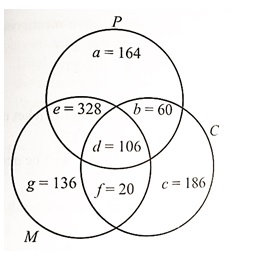
Passage :
information given below and answer the question that follow.
The result of an exam is given below. Out of 1000 students who appeared
(i) 658 failed in Physics
(ii) 166 failed in Physics and Chemistry
(iii) 372 failed in Chemistry, 434 failed in Physics and Maths
(iv) 590 failed in Maths, 126 failed in Maths & Chemistry
Find the number of people who failed in (assuming that none is passed in all subjects.

We have the following equations:
a+ b + c + d + e + f + g = 1000
a + b + d + e = 658, b + d = 166
b + d + c + f = 372
d + e = 434 as in the figure.
d + e + f + g = 590, d + f = 126. Find the values
Chemistry but not in Physics.
  1. A
    318
  2. B
    198
  3. C
    213 
  4. D
    206
Question 27Single Answer
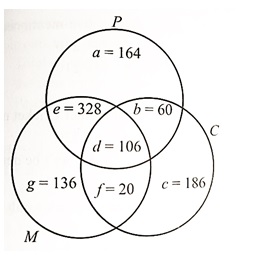
Passage :
Direction: information given below and answer the question that follow.
The result of an exam is given below. Out of 1000 students who appeared
(i) 658 failed in Physics
(ii) 166 failed in Physics and Chemistry
(iii) 372 failed in Chemistry, 434 failed in Physics and Maths
(iv) 590 failed in Maths, 126 failed in Maths & Chemistry
Find the number of people who failed in (assuming that none is passed in all subjects.

We have the following equations:
a+ b + c + d + e + f + g = 1000
a + b + d + e = 658, b + d = 166
b + d + c + f = 372
d + e = 434 as in the figure.
d + e + f + g = 590, d + f = 126. Find the values
Physics or Maths but not in Chemistry.
  1. A
    558   
  2. B
    718
  3. C
    628  
  4. D
    None of these
Question 28Single Answer
Passage :
For the next four question that follow:
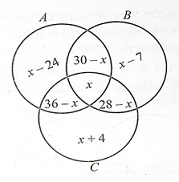
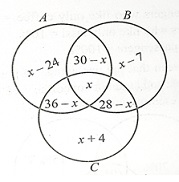
In a city, three daily newspapers A, B, C are published, 42% read A; 51% read B; 68% read C; 30% read A and B; 28% read B and C; 36% read A and C; 8% do not read any of the three newspapers.

Let x% people read all the three newspapers.
Since 8% people do not read any newspapers.
 (x – 24) + (x – 7) + (x + 4) + (30 – x) + (36 – x) + (28 – x) + x = 92
→ x + 98 – 31 = 92
→ x = 92 – 67 = 25
What is the percentage of persons who read all the three papers ?
  1. A
    20%  
  2. B
    25%
  3. C
    30%  
  4. D
    40%
Question 29Single Answer
Passage :
For the next four : question that follow :
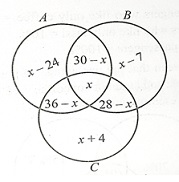
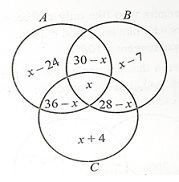
In a city, three daily newspapers A, B, C are published, 42% read A; 51% read B; 68% read C; 30% read A and B; 28% read B and C; 36% read A and C; 8% do not read any of the three newspapers.

Let x% people read all the three newspapers.
Since 8% people do not read any newspapers.
 (x – 24) + (x – 7) + (x + 4) + (30 – x) + (36 – x) + (28 – x) + x = 92
→ x + 98 – 31 = 92
→ x = 92 – 67 = 25
What is the percentage of persons who read only two papers?
  1. A
    19%  
  2. B
    31%
  3. C
    44%
  4. D
    None of these
Question 30Single Answer
Passage :
For the next four : question that follow :
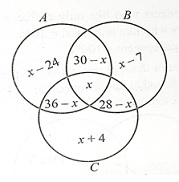
In a city, three daily newspapers A, B, C are published, 42% read A; 51% read B; 68% read C; 30% read A and B; 28% read B and C; 36% read A and C; 8% do not read any of the three newspapers.

Let x% people read all the three newspapers.
Since 8% people do not read any newspapers.
(x – 24) + (x – 7) + (x + 4) + (30 – x) + (36 – x) + (28 – x) + x = 92
→ x + 98 – 31 = 92
→ x = 92 – 67 = 25
What is the percentage of persons who read only one paper ?
  1. A
    38% 
  2. B
    48%
  3. C
    51%  
  4. D
    None of these
Question 31Single Answer
Passage :
For the next four : question that follow:
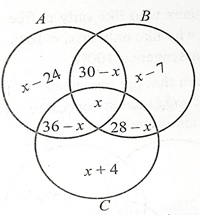
In a city, three daily newspapers A, B, C are published, 42% read A; 51% read B; 68% read C; 30% read A and B; 28% read B and C; 36% read A and C; 8% do not read any of the three newspapers.

Let x% people read all the three newspapers.
Since 8% people do not read any newspapers.
 (x – 24) + (x – 7) + (x + 4) + (30 – x) + (36 – x) + (28 – x) + x = 92
→ x + 98 – 31 = 92
→ x = 92 – 67 = 25
What is the percentage of persons who read only A but neither B nor C ?
  1. A
    4%
  2. B
    3%
  3. C
    1%  
  4. D
    None of these
Question 32Single Answer
Passage :
For the next four : question that follow:
In a city, three daily newspapers A, B, C are published, 42% read A; 51% read B; 68% read C; 30% read A and B; 28% read B and C; 36% read A and C; 8% do not read any of the three newspapers.

Let x% people read all the three newspapers.
Since 8% people do not read any newspapers.
 (x – 24) + (x – 7) + (x + 4) + (30 – x) + (36 – x) + (28 – x) + x = 92
→ x + 98 – 31 = 92
→ x = 92 – 67 = 25
If A and B are any two sets, then what is A ᴖ (A ᴗ B) equal to ?
  1. A
    Complement of A 
  2. B
    Complement of B
  3. C
    B   
  4. D
    A
Question 33Single Answer
Passage :
For the next four : question that follow:
In a city, three daily newspapers A, B, C are published, 42% read A; 51% read B; 68% read C; 30% read A and B; 28% read B and C; 36% read A and C; 8% do not read any of the three newspapers.

Let x% people read all the three newspapers.
Since 8% people do not read any newspapers.
 (x – 24) + (x – 7) + (x + 4) + (30 – x) + (36 – x) + (28 – x) + x = 92
→ x + 98 – 31 = 92
→ x = 92 – 67 = 25
40% of the people read newspaper X, 50% read newspaper Y and 10% read both the papers. What percentage of the people read neither newspaper ?
  1. A
    10%    
  2. B
    15%
  3. C
    20%  
  4. D
    25%
Question 34Single Answer
Passage :
Read the passage below and solve the question based on it.
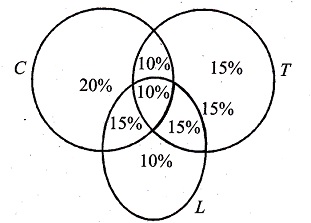
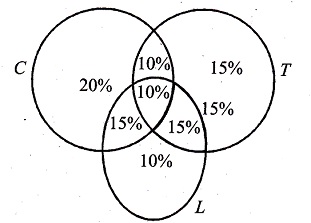
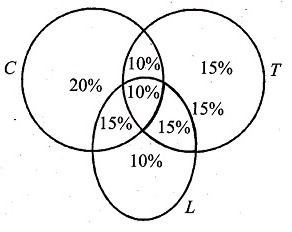
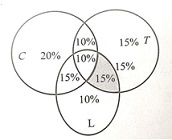
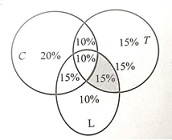
5% of the passengers do not like coffee, tea and lassi and 10% like all the three, 20% like coffee and tea, 25% like lassi and coffee and 25% like lassi and tea. 55% like coffee, 50% like tea, and 50% like lassi.

Where C = Coffee, T = Tea and L =Lassi
The passengers who like only coffee is greater than the passengers who like only lassi by
  1. A
    25%   
  2. B
    100%
  3. C
    75%   
  4. D
    0%
Question 35Single Answer
Passage :
Read the passage below and solve the question based on it.
5% of the passengers do not like coffee, tea and lassi and 10% like all the three, 20% like coffee and tea, 25% like lassi and coffee and 25% like lassi and tea. 55% like coffee, 50% like tea, and 50% like lassi.

Where C = Coffee, T = Tea and L =Lassi
The percentage of passengers who like both tea and lassi but not coffee, is
  1. A
    15 
  2. B
    25
  3. C
    40 
  4. D
    75
Question 36Single Answer
Passage :
Read the passage below and solve the question based on it.
5% of the passengers do not like coffee, tea and lassi and 10% like all the three, 20% like coffee and tea, 25% like lassi and coffee and 25% like lassi and tea. 55% like coffee, 50% like tea, and 50% like lassi.

Where C = Coffee, T = Tea and L =Lassi
The percentage passengers who like at least 2 of the coffee, tea and lassi, is
  1. A
    30 
  2. B
    45
  3. C
    50
  4. D
    60
Question 37Single Answer
Passage :
Read the passage below and solve the question based on it.
5% of the passengers do not like coffee, tea and lassi and 10% like all the three, 20% like coffee and tea, 25% like lassi and coffee and 25% like lassi and tea. 55% like coffee, 50% like tea, and 50% like lassi.

Where C = Coffee, T = Tea and L =Lassi
If the number of passengers is 180, then the number of passengers who like lassi only, is
  1. A
    10       
  2. B
    18
  3. C
    27
  4. D
    36
Question 38Single Answer
Passage :
Read the passage below and solve the question based on it.
5% of the passengers do not like coffee, tea and lassi and 10% like all the three, 20% like coffee and tea, 25% like lassi and coffee and 25% like lassi and tea. 55% like coffee, 50% like tea, and 50% like lassi.

Where C = Coffee, T = Tea and L =Lassi
In a town three newspapers A, B and C are published. 42% of the people in that town read A, 68% read B, 51% read C, 30% read A and B, 28% read B and C, 36% A and C and 18% do not read any paper. Find the % of the population of town that reads all the three.
  1. A
    15% 
  2. B
    25%
  3. C
    20% 
  4. D
    35%
Question 39Single Answer
Passage :
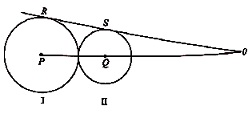
In the adjoining figure, I and II are circles with ceners P and Q respectively. The two circle touch each other and have a common tangent that touches them  at points R and S respectively. This common tangent meets the line joining P and Q at O. The diameters of I and II are in the ratio 4 : 3. It is also known that the length of PO is 28 cm.
What is the ratio of the length of PQ to that of QO?
  1. A
    1 : 4
  2. B
    1 : 3
  3. C
    3 : 8
  4. D
    3 : 4
Question 40Single Answer
In the adjoining figure, I and II are circles with ceners P and Q respectively. The two circle touch each other and have a common tangent that touches them  at points R and S respectively. This common tangent meets the line joining P and Q at O. The diameters of I and II are in the ratio 4 : 3. It is also known that the length of PO is 28 cm.

The length of SO is
  1. A
  2. B
  3. C
  4. D
Question 41Single Answer
Passage :
A committee of five members is to be formed out of 5 Males, 6 Females and 3 Children. In how many different ways can it be done if ?
The committee should consist of 2 Males, 2 Females and 1 child ?
  1. A
    450  
  2. B
    225
  3. C
    55    
  4. D
    90
Question 42Single Answer
Passage :
A committee of five members is to be formed out of 5 Males, 6 Females and 3 Children. In how many different ways can it be done if ?
The committee should include all the 3 Childs?
  1. A
    90 
  2. B
    180
  3. C
    21 
  4. D
    55
Question 43Single Answer
Passage :
A committee of five members is to be formed out of 5 Males, 6 Females and 3 Children. In how many different ways can it be done if ?
In how many different ways can 4 boys and 3 girls be arranged in a row such that all the boys stand together and all the girls stand together ?
  1. A
    75  
  2. B
    576
  3. C
    288    
  4. D
    24
Question 44Single Answer
Passage :
An urn contains 4 green, 5 blue, 2 red and 3 yellow marbles.
If four marbles are drawn at random, what is the probability that two are blue and two are red ?
  1. A
  2. B
  3. C
  4. D
Question 45Single Answer
Passage :
An urn contains 4 green, 5 blue, 2 red and 3 yellow marbles.
If eight marbles are drawn at random, what is the probability that there are equal number of marbles of each other ?
  1. A
  2. B
  3. C
  4. D
Question 46Single Answer
Passage :
An urn contains 4 green, 5 blue, 2 red and 3 yellow marbles.
If two marbles are drawn at random, what is the probability that both are red or at least one is red ?
  1. A
  2. B
  3. C
  4. D
  5. E
    None of these
Question 47Single Answer
Passage :
There are three bags A, B and C. In each bag there are three types of colored balls Yellow, Green and Black. In bag A, no. of Yellow colored balls are y and no. of green colored balls are g. Number of green colored balls are 4 more than the number of yellow colored balls. When one ball is picked at random then the probability of getting black color ball is The value of y  is less than g. In bag B, number of yellow colored balls is   more than that of bag A. If two balls are picked at random from bag B then the probability of getting both green color ball is . Total number of balls in bag B is 75.
In bag C, the ratio of number of green colored balls and number of black colored balls is 7 : 5. Total number of green and black colored balls is 36. If one ball is picked at random then the probability of getting one yellow ball is 
If x number of yellow balls from bag B are taken and placed into bag A and 20% of black balls from bag A are taken and placed into in bag B. If we pick one ball from bag B then the probability that the ball is of black color is . Then find the value of x ?
  1. A
    5    
  2. B
    6
  3. C
    3      
  4. D
    2
Question 48Single Answer
Passage :
There are three bags A, B and C. In each bag there are three types of colored balls Yellow, Green and Black. In bag A, no. of Yellow colored balls are y and no. of green colored balls are g. Number of green colored balls are 4 more than the number of yellow colored balls. When one ball is picked at random then the probability of getting black color ball is The value of y  is less than g. In bag B, number of yellow colored balls is   more than that of bag A. If two balls are picked at random from bag B then the probability of getting both green color ball is . Total number of balls in bag B is 75.
In bag C, the ratio of number of green colored balls and number of black colored balls is 7 : 5. Total number of green and black colored balls is 36. If one ball is picked at random then the probability of getting one yellow ball is 
If one ball picked at random from each of the bag A and bag B then find the probability that both of the balls are of the same color ?
  1. A
  2. B
  3. C
  4. D
    Can’t be determined 
Question 49Single Answer
Passage :
There are three bags A, B and C. In each bag there are three types of colored balls Yellow, Green and Black. In bag A, no. of Yellow colored balls are y and no. of green colored balls are g. Number of green colored balls are 4 more than the number of yellow colored balls. When one ball is picked at random then the probability of getting black color ball is The value of y  is less than g. In bag B, number of yellow colored balls is   more than that of bag A. If two balls are picked at random from bag B then the probability of getting both green color ball is . Total number of balls in bag B is 75.
In bag C, the ratio of number of green colored balls and number of black colored balls is 7 : 5. Total number of green and black colored balls is 36. If one ball is picked at random then the probability of getting one yellow ball is 
Difference between the number of green balls in bag A and bag C is how much percent more/less than the sum of the number of black balls in bag A and bag C together ?
  1. A
    100%   
  2. B
    95%
  3. C
    97.5%  
  4. D
    102.5%
Question 50Single Answer
Passage :
There are three bags A, B and C. In each bag there are three types of colored balls Yellow, Green and Black. In bag A, no. of Yellow colored balls are y and no. of green colored balls are g. Number of green colored balls are 4 more than the number of yellow colored balls. When one ball is picked at random then the probability of getting black color ball is The value of y  is less than g. In bag B, number of yellow colored balls is   more than that of bag A. If two balls are picked at random from bag B then the probability of getting both green color ball is . Total number of balls in bag B is 75.
In bag C, the ratio of number of green colored balls and number of black colored balls is 7 : 5. Total number of green and black colored balls is 36. If one ball is picked at random then the probability of getting one yellow ball is 
Panas has 15 yellow, pink and white balls in his bag. Number of each balls is different in the bag. Difference between yellow ball and pink ball is same as difference between pink ball and white ball. Probability of selecting one while ball from the bag is greater than 0.2, then number of while balls in the bag can be
(A) 3              (B) 4
(C) 5              (D) 7
(E) 9
  1. A
    Only B, C, D and E 
  2. B
    Only B, D, E
  3. C
    All A, B, C, D and E        
  4. D
    Only C, D, E
Important Questions Package

ECL Mining Sirdar Exam Online Question Bank Package

Buy ECL Mining Sirdar Important Questions, MCQ, question answer in Hindi & English. It will help you to score high marks in ECL Mining Sirdar question bank 2026 in Online, PDF & Print study material.

+ Free Monthly Current Affairs, GK & more PDF Download
Sr.Package NameAmount
1.ECL Mining Sirdar Exam - English
Description : 1000 Question with Answers.
₹181 [₹500]
2.ECL Mining Sirdar Exam - Hindi
Description : 1000 Question with Answers.
₹181 [₹500]
Back to Exam
Question for ECL Mining Sirdar 2026 - Quiz / Questions / MCQ - Toppersexam