📚 Exam by Category
▾
Objective Questions

Latest GATE ECE Exam Question (Objective Questions), MCQ in English

Subjects : General Aptitude, Engineering Mathematics, Electronics & Communication Engineering

Question Bank GATE Electronics & Communication Engineering Exam (Only MCQ) - English

Back to Exam

General Aptitude

Question 1Single Answer
Inhaling the smoke from a burning _____ could _____ you quickly.
  1. A
    tire/tier
  2. B
    tire/tyre
  3. C
    tyre/tire
  4. D
    tyre/tier
Question 2Single Answer
Rice, a versatile and inexpensive source of carbohydrate, is a critical component of diet worldwide. Climate change, causing extreme weather, poses a threat to sustained availability of rice. Scientists are working on developing Green Super Rice (GSR), which is resilient under extreme weather conditions yet gives higher yields sustainably.
Which one of the following is the CORRECT logical inference based on the information given in the above passage ?
  1. A
    GSR is an alternative to regular rice, but it grows only in an extreme weather
  2. B
    GSR be used in future in response to adverse effects of climate change
  3. C
    GSR grows in an extreme weather, but the quantity of produce is lesser than regular rice
  4. D
    Regular rice will continue to provide good yields even in extreme weather
Question 3Single Answer
The cost price of 20 articles is the same as the selling price of x articles. If the profit is 25%, then the value of x is :
  1. A
    15
  2. B
    16
  3. C
    18
  4. D
    25
Question 4Single Answer
Pipes P and Q can fill a storage tank full of water in 10 and 6 minutes, respectively. Pipe R draws the water out from the storage tank at a rate of 34 litres per minute. P, Q and R operate at a constant rate. If it takes one hour to completely empty a full storage tank with all the pipes operating simultaneously, what is the capacity of the storage tank (in litres) ? 
  1. A
    26.8 
  2. B
    60.0 
  3. C
    120.0
  4. D
    127.5
Question 5Single Answer
Choose the grammatically correct sentence?
  1. A
    Neither of the robots are functioning properly
  2. B
    Neither robots is functioning properly
  3. C
    Neither of the robot are functioning properly
  4. D
    Neither of the robots is functioning properly

Engineering Mathematics

Question 6Single Answer
Consider the following expression :
where z, y, and t are variables, and   is a complex number. The partial differential equation derived from the above expression is
  1. A
  2. B
  3. C
  4. D
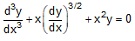
Question 7Single Answer
For the equation
the correct description is
  1. A
    an ordinary differential equation of order 3 and degree 2 
  2. B
    an ordinary differential equation of order 3 and degree 3 
  3. C
    an ordinary differential equation of order 2 and degree 3 
  4. D
    an ordinary differential equation of order 3 and degree 
Question 8Single Answer
The value of (1 + i)12, where  , is.
  1. A
    – 64 i 
  2. B
    64 i
  3. C
    64 
  4. D
    – 64
Question 9Single Answer
If (A=\begin{bmatrix}1&2\3&4\end{bmatrix}), what is (\det(A))?
  1. A
    2
  2. B
    (-2)
  3. C
    5
  4. D
    10
Question 10Single Answer
If (A) is a (3\times3) matrix with (\det(A)=5), what is (\det(2A))?
  1. A
    10
  2. B
    40
  3. C
    20
  4. D
    80

Electronics & Communication Engineering

Question 11Single Answer
Nodal analysis is fundamentally based on:
  1. A
    Kirchhoff’s Voltage Law
  2. B
    Coulomb’s law
  3. C
    Faraday’s law
  4. D
    Kirchhoff’s Current Law
Question 12Single Answer
The main unknowns in nodal analysis are:
  1. A
    Branch powers
  2. B
    Loop resistances
  3. C
    Node voltages
  4. D
    Mesh currents
Question 13Single Answer
Node voltages are measured with respect to a:
  1. A
    Dependent source
  2. B
    Current source
  3. C
    Supermesh
  4. D
    Reference node
Question 14Single Answer
The reference node in nodal analysis is usually assigned a voltage of:
  1. A
    Unity
  2. B
    Infinity
  3. C
    Zero
  4. D
    Source voltage
Question 15Single Answer
A supernode occurs when an ideal voltage source is connected between:
  1. A
    Two non-reference nodes
  2. B
    Two meshes
  3. C
    Two current sources
  4. D
    Two resistors in series
Question 16Single Answer
In supernode analysis, KCL is written around:
  1. A
    The entire supernode
  2. B
    Only the voltage source
  3. C
    Only the reference node
  4. D
    Each resistor separately
Question 17Single Answer
Mesh analysis is principally based on:
  1. A
    KVL
  2. B
    Superposition
  3. C
    KCL
  4. D
    Millman’s theorem
Question 18Single Answer
The basic unknowns in mesh analysis are:
  1. A
    Mesh currents
  2. B
    Node voltages
  3. C
    Branch admittances
  4. D
    Element powers
Question 19Single Answer
Conventional mesh analysis is directly applicable to:
  1. A
    Only non-linear circuits
  2. B
    Non-planar circuits only
  3. C
    Only AC circuits
  4. D
    Planar circuits
Question 20Single Answer
A supermesh is generally formed when a current source lies between:
  1. A
    Two nodes
  2. B
    A node and ground
  3. C
    Two adjacent meshes
  4. D
    Two voltage sources
Question 21Single Answer
In a supermesh, the branch containing the common current source is generally:
  1. A
    Replaced by an inductor
  2. B
    Excluded from the KVL path
  3. C
    Converted to ground
  4. D
    Permanently shorted
Question 22Single Answer
Nodal analysis is especially convenient for networks containing several:
  1. A
    Current sources
  2. B
    Transformers
  3. C
    Voltage-controlled switches
  4. D
    Series voltage sources only
Question 23Single Answer
Mesh analysis is often especially convenient when a circuit contains many:
  1. A
    Parallel current sources
  2. B
    Voltage sources
  3. C
    Open circuits
  4. D
    Grounded capacitors only
Question 24Single Answer
In AC nodal analysis, passive elements are conveniently represented by their:
  1. A
    Energies
  2. B
    Time constants only
  3. C
    Admittances
  4. D
    Charge densities
Question 25Single Answer
In AC mesh analysis, passive elements are commonly represented by:
  1. A
    Fourier coefficients
  2. B
    Conductivities
  3. C
    Charge densities
  4. D
    Impedances
Question 26Single Answer
Phasor-domain nodal and mesh analysis applies primarily to:
  1. A
    Arbitrary non-periodic switching signals
  2. B
    Digital logic only
  3. C
    Sinusoidal steady-state circuits
  4. D
    Static magnetic systems
Question 27Single Answer
Kirchhoff’s Current Law expresses conservation of:
  1. A
    Energy
  2. B
    Charge
  3. C
    Momentum
  4. D
    Magnetic flux
Question 28Single Answer
Kirchhoff’s Voltage Law is closely associated with conservation of:
  1. A
    Mass
  2. B
    Energy
  3. C
    Charge only
  4. D
    Frequency
Question 29Single Answer
A branch is a portion of a circuit connecting:
  1. A
    Three meshes
  2. B
    Two nodes
  3. C
    Two reference nodes necessarily
  4. D
    Two current sources only
Question 30Single Answer
A loop is defined as a:
  1. A
    Closed path through a network
  2. B
    Single branch
  3. C
    Reference node
  4. D
    Parallel source combination
Question 31Single Answer
A mesh is a loop that:
  1. A
    Contains no other loop inside it
  2. B
    Contains a current source
  3. C
    Must contain a voltage source
  4. D
    Must contain three nodes
Question 32Single Answer
A circuit node is a point where:
  1. A
    Only one element terminates
  2. B
    Current must be zero
  3. C
    Voltage must be zero
  4. D
    Two or more circuit elements are interconnected
Question 33Single Answer
A voltage source connected between a node and the reference node makes the node voltage:
  1. A
    Infinite
  2. B
    Always zero
  3. C
    Impossible to determine
  4. D
    Directly known
Question 34Single Answer
An ideal current source located exclusively in one mesh can directly specify the:
  1. A
    Node voltage
  2. B
    Mesh current
  3. C
    Mesh impedance
  4. D
    Thevenin voltage
Question 35Single Answer
The superposition theorem applies to:
  1. A
    Saturated magnetic circuits only
  2. B
    Non-linear networks only
  3. C
    Linear networks
  4. D
    Diodes under arbitrary operation only
Question 36Single Answer
Superposition states that the total response in a linear circuit is the:
  1. A
    Product of individual responses
  2. B
    Sum of individual source responses
  3. C
    Largest individual response
  4. D
    Average of all responses
Question 37Single Answer
While using superposition, an independent ideal voltage source being deactivated is replaced by a:
  1. A
    Capacitor
  2. B
    Short circuit
  3. C
    Current source
  4. D
    Large resistor
Question 38Single Answer
While using superposition, an independent ideal current source being deactivated is replaced by an:
  1. A
    Ideal voltage source
  2. B
    Open circuit
  3. C
    Inductor
  4. D
    Short circuit
Question 39Single Answer
During superposition analysis, dependent sources are:
  1. A
    Kept active
  2. B
    Removed
  3. C
    Replaced by resistors
  4. D
    Shorted in every case
Question 40Single Answer
Superposition can be applied directly to:
  1. A
    Voltage and current
  2. B
    Power only
  3. C
    Energy only
  4. D
    Resistance only
Question 41Single Answer
Superposition is not directly applied to power because power is generally:
  1. A
    Independent of current
  2. B
    Defined only in AC circuits
  3. C
    Always zero
  4. D
    A non-linear function of voltage or current
Question 42Single Answer
If several independent sinusoidal sources have different frequencies, superposition should analyze them:
  1. A
    As one single phasor
  2. B
    Only at DC
  3. C
    Only at the highest frequency
  4. D
    Frequency by frequency
Question 43Single Answer
Thevenin’s theorem replaces a linear two-terminal network by an ideal voltage source in series with an equivalent:
  1. A
    Current source
  2. B
    Open circuit
  3. C
    Capacitor only
  4. D
    Impedance
Question 44Single Answer
The Thevenin voltage equals the:
  1. A
    Short-circuit current
  2. B
    Internal voltage drop only
  3. C
    Maximum load current
  4. D
    Open-circuit terminal voltage
Question 45Single Answer
While determining Thevenin voltage, the external load is normally:
  1. A
    Replaced by a current source
  2. B
    Short-circuited
  3. C
    Doubled
  4. D
    Removed
Question 46Single Answer
For a network containing only independent sources, Thevenin resistance can be found after:
  1. A
    Increasing all sources
  2. B
    Removing all resistors
  3. C
    Deactivating independent sources
  4. D
    Shorting every terminal
Question 47Single Answer
When finding Thevenin resistance, an independent voltage source is replaced by its internal ideal resistance, which is:
  1. A
    Infinite
  2. B
    Zero
  3. C
    Unity
  4. D
    Frequency-dependent
Question 48Single Answer
When finding Thevenin resistance, an independent current source is replaced by an:
  1. A
    Inductor
  2. B
    Short circuit
  3. C
    Voltage source
  4. D
    Open circuit
Question 49Single Answer
If dependent sources are present, a convenient way of finding Thevenin resistance is to apply a:
  1. A
    Fuse
  2. B
    Test source
  3. C
    Transformer
  4. D
    Resonant source
Question 50Single Answer
Norton’s theorem represents a linear two-terminal network by a current source in parallel with an equivalent:
  1. A
    Voltage source
  2. B
    Impedance
  3. C
    Inductor only
  4. D
    Short circuit only
Important Questions Package

GATE ECE Exam Online Question Bank Package

Buy GATE ECE Important Questions, MCQ, question answer in Hindi & English. It will help you to score high marks in GATE ECE question bank 2026 in Online, PDF & Print study material.

+ Free Monthly Current Affairs, GK & more PDF Download
Sr.Package NameAmount
1.GATE Electronics & Communication Engineering Exam (Only MCQ) - English
Description : 1000 Question With Answer
₹101 [₹500]
2.GATE Electronics & Communication Engineering Exam (Only MCQ) - English
Description : 2000 Question With Answer
₹151 [₹500]
3.GATE Electronics & Communication Engineering Exam (Only MCQ) - English
Description : 3000 Question With Answer
₹181 [₹500]
4.GATE Electronics & Communication Engineering Exam (Only MCQ) - English
Description : 4000 Question With Answer
₹210 [₹500]
5.GATE Electronics & Communication Engineering Exam (Only MCQ) - English
Description : 1000 Question & Answer Download in PDF (Send by Email)
₹151 [₹550]
6.GATE Electronics & Communication Engineering Exam (Only MCQ) Question Bank Book - English
Description : 1000 Question with Answer (Printed Material)
₹390 [₹650]
7.GATE Electronics & Communication Engineering Exam - English (old)
Description : 1100 Question With Answer
₹51 [₹500]
Back to Exam