
📚 Exam by Category
▾
Objective Questions

Latest GATE Metallurgical Engineering Exam Question (Objective Questions), MCQ in English

Subjects : General Aptitude, Engineering Mathematics, Metallurgical Engineering

Question Bank GATE Metallurgical Engineering Exam (Only MCQ ) - English

Back to Exam

General Aptitude

Question 1Single Answer
Inhaling the smoke from a burning _____ could _____ you quickly.
  1. Atire/tier
  2. Btire/tyre
  3. Ctyre/tire
  4. Dtyre/tier
Question 2Single Answer
Rice, a versatile and inexpensive source of carbohydrate, is a critical component of diet worldwide. Climate change, causing extreme weather, poses a threat to sustained availability of rice. Scientists are working on developing Green Super Rice (GSR), which is resilient under extreme weather conditions yet gives higher yields sustainably.
Which one of the following is the CORRECT logical inference based on the information given in the above passage ?
  1. AGSR is an alternative to regular rice, but it grows only in an extreme weather
  2. BGSR be used in future in response to adverse effects of climate change
  3. CGSR grows in an extreme weather, but the quantity of produce is lesser than regular rice
  4. DRegular rice will continue to provide good yields even in extreme weather
Question 3Single Answer
The cost price of 20 articles is the same as the selling price of x articles. If the profit is 25%, then the value of x is :
  1. A15
  2. B16
  3. C18
  4. D25
Question 4Single Answer
Pipes P and Q can fill a storage tank full of water in 10 and 6 minutes, respectively. Pipe R draws the water out from the storage tank at a rate of 34 litres per minute. P, Q and R operate at a constant rate. If it takes one hour to completely empty a full storage tank with all the pipes operating simultaneously, what is the capacity of the storage tank (in litres) ? 
  1. A26.8 
  2. B60.0 
  3. C120.0
  4. D127.5
Question 5Single Answer
Choose the grammatically correct sentence?
  1. ANeither of the robots are functioning properly
  2. BNeither robots is functioning properly
  3. CNeither of the robot are functioning properly
  4. DNeither of the robots is functioning properly

Engineering Mathematics

Question 6Single Answer
Consider the following expression :
where z, y, and t are variables, and   is a complex number. The partial differential equation derived from the above expression is
    Question 7Single Answer
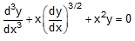
    For the equation
    the correct description is
    1. A
      an ordinary differential equation of order 3 and degree 2 
    2. B
      an ordinary differential equation of order 3 and degree 3 
    3. C
      an ordinary differential equation of order 2 and degree 3 
    4. Dan ordinary differential equation of order 3 and degree â€‹
    Question 8Single Answer
    The value of (1 + i)12, where â€‹ , is.
    1. A
      – 64 i 
    2. B
      64 i
    3. C64 
    4. D– 64
    Question 9Single Answer
    If (A=\begin{bmatrix}1&2\3&4\end{bmatrix}), what is (\det(A))?
    1. A2
    2. B(-2)
    3. C5
    4. D10
    Question 10Single Answer
    If (A) is a (3\times3) matrix with (\det(A)=5), what is (\det(2A))?
    1. A10
    2. B40
    3. C20
    4. D80

    Metallurgical Engineering

    Question 11Single Answer
    According to the First Law of Thermodynamics, what is conserved in an isolated system?
    1. AEntropy
    2. BInternal energy
    3. CGibbs free energy
    4. DEnthalpy
    Question 12Single Answer
    The Second Law of Thermodynamics implies that:
    1. AEnergy can be created in a closed system
    2. BEntropy of an isolated system never decreases
    3. CHeat flows from cold to hot spontaneously
    4. DEnthalpy remains constant in all processes
    Question 13Single Answer
    In an irreversible process, the entropy change of the universe is:
    1. AZero
    2. BPositive
    3. CNegative
    4. DEqual to the system’s entropy change
    Question 14Single Answer
    The Helmholtz free energy (A) is defined as:
    1. AA = U + TS
    2. BA = H + TS
    3. CA = U - TS
    4. DA = H - TS
    Question 15Single Answer
    For a reversible adiabatic process, which quantity remains constant?
    1. AEnthalpy
    2. BEntropy
    3. CGibbs free energy
    4. DInternal energy
    Question 16Single Answer
    In a metallurgical process, the spontaneity of a reaction at high temperature is primarily governed by:
    1. AEntropy change
    2. BEnthalpy change
    3. CInternal energy change
    4. DVolume change
    Question 17Single Answer
    In a metallurgical roasting process, the entropy change is typically positive due to:
    1. ADecrease in temperature
    2. BReduction in system volume
    3. CFormation of gaseous products
    4. DIncrease in internal energy
    Question 18Single Answer
    The Gibbs free energy (G) is defined as:
    1. AG = U + PV - TS
    2. BG = H + TS
    3. CG = H - TS
    4. DG = U - PV + TS
    Question 19Single Answer
    For a reversible isothermal compression of an ideal gas, the work done is:
    1. APositive
    2. BEqual to the heat transfer
    3. CZero
    4. DNegative
    Question 20Single Answer
    For a reaction at constant volume, the heat absorbed is equal to:
    1. AChange in internal energy
    2. BChange in Gibbs free energy
    3. CChange in enthalpy
    4. DChange in Helmholtz free energy
    Question 21Single Answer
    The spontaneity of a metallurgical process at low temperature is primarily driven by:
    1. AEntropy change
    2. BVolume change
    3. CInternal energy change
    4. DEnthalpy change
    Question 22Single Answer
    The First Law of Thermodynamics is a statement of:
    1. AEntropy conservation
    2. BEnergy conservation
    3. CEnthalpy conservation
    4. DGibbs free energy conservation
    Question 23Single Answer
    For a reversible adiabatic expansion of an ideal gas, the temperature:
    1. AIncreases
    2. BRemains constant
    3. CDecreases
    4. DEquals the surroundings
    Question 24Single Answer
    The Gibbs free energy change for a reaction at equilibrium is:
    1. APositive
    2. BZero
    3. CNegative
    4. DEqual to the enthalpy change
    Question 25Single Answer
    In a metallurgical process, the entropy change for the formation of a solid from a gas is typically:
    1. APositive
    2. BEqual to the enthalpy change
    3. CZero
    4. DNegative
    Question 26Single Answer
    The enthalpy of a system is defined as:
    1. AH = U + PV
    2. BH = U - PV
    3. CH = U + TS
    4. DH = U - TS
    Question 27Single Answer
    In a metallurgical oxidation reaction, the entropy change is typically:
    1. AEqual to the internal energy change
    2. BNegative due to gas consumption
    3. CZero due to constant temperature
    4. DPositive due to gas formation
    Question 28Single Answer
    The Second Law of Thermodynamics implies that in an isolated system:
    1. AEntropy increases
    2. BEnergy decreases
    3. CEnthalpy remains constant
    4. DGibbs free energy increases
    Question 29Single Answer
    The Gibbs free energy change for a non-spontaneous reaction is:
    1. APositive
    2. BNegative
    3. CZero
    4. DEqual to the entropy change
    Question 30Single Answer
    In a reversible isothermal expansion, the change in entropy of the system is:
    1. ANegative
    2. BEqual to the enthalpy change
    3. CZero
    4. DPositive
    Question 31Single Answer
    For a system at constant temperature and volume, the spontaneity is determined by:
    1. AGibbs free energy
    2. BHelmholtz free energy
    3. CEnthalpy
    4. DInternal energy
    Question 32Single Answer
    The entropy change for a reversible isothermal compression of an ideal gas is:
    1. APositive
    2. BZero
    3. CNegative
    4. DEqual to the work done
    Question 33Single Answer
    In a metallurgical process, the enthalpy change for an exothermic reaction is:
    1. APositive
    2. BNegative
    3. CZero
    4. DEqual to the entropy change
    Question 34Single Answer
    The Second Law of Thermodynamics prohibits:
    1. AEnergy conservation
    2. BGibbs free energy decrease
    3. CEnthalpy increase in a closed system
    4. DHeat flow from cold to hot without work
    Question 35Single Answer
    In a metallurgical roasting process, the entropy increase is primarily due to:
    1. AFormation of gaseous products
    2. BDecrease in system volume
    3. CReduction in temperature
    4. DIncrease in internal energy
    Question 36Single Answer
    For a closed system with work defined as positive when done by the system, the first law is:
    1. AdU = δQ + δW
    2. BdU = -δQ - δW
    3. CdU = δW - δQ
    4. DdU = δQ - δW
    Question 37Single Answer
    At constant volume, when only P-V work is possible, the heat supplied reversibly or irreversibly equals:
    1. AΔG
    2. BΔA
    3. CΔH
    4. DΔU
    Question 38Single Answer
    At constant pressure, when only P-V work is involved, heat exchanged equals:
    1. AΔU
    2. BTΔS only
    3. CΔG
    4. DΔH
    Question 39Single Answer
    Enthalpy is defined by:
    1. AH = U + PV
    2. BH = G - TS
    3. CH = U - PV
    4. DH = TS - PV
    Question 40Single Answer
    Helmholtz free energy is defined by:
    1. AA = U + TS
    2. BA = G + PV
    3. CA = H - TS
    4. DA = U - TS
    Question 41Single Answer
    Gibbs free energy is defined by:
    1. AG = H + TS
    2. BG = U - PV
    3. CG = A - PV
    4. DG = H - TS
    Question 42Single Answer
    For a simple compressible closed system of fixed composition, the fundamental relation for internal energy is:
    1. AdU = -S dT + V dP
    2. BdU = V dP - S dT
    3. CdU = T dS + P dV
    4. DdU = T dS - P dV
    Question 43Single Answer
    For a simple compressible closed system of fixed composition, the differential of enthalpy is:
    1. AdH = -S dT + V dP
    2. BdH = T dS + V dP
    3. CdH = T dS - V dP
    4. DdH = -P dV - S dT
    Question 44Single Answer
    For a simple compressible closed system of fixed composition, the differential of Helmholtz free energy is:
    1. AdA = -S dT + V dP
    2. BdA = T dS - P dV
    3. CdA = -S dT - P dV
    4. DdA = S dT - P dV
    Question 45Single Answer
    For a simple compressible closed system of fixed composition, the differential of Gibbs free energy is:
    1. AdG = -P dV - S dT
    2. BdG = -V dP - S dT
    3. CdG = T dS + V dP
    4. DdG = V dP - S dT
    Question 46Single Answer
    At constant temperature and pressure, the criterion for spontaneous change in a closed system is:
    1. AΔG < 0
    2. BΔG > 0
    3. CΔS_system < 0 always
    4. DΔA > 0
    Question 47Single Answer
    At constant temperature and volume, the appropriate potential that decreases in a spontaneous process is:
    1. AGibbs free energy
    2. BEnthalpy
    3. CInternal energy always
    4. DHelmholtz free energy
    Question 48Single Answer
    For an isolated system, the second law requires:
    1. AEnthalpy is constant and entropy decreases
    2. BEntropy cannot decrease
    3. CEntropy must decrease
    4. DGibbs energy must increase
    Question 49Single Answer
    The Clausius inequality for any cyclic process is:
    1. A∮δQ/T ≥ 0
    2. B∮δQ/T ≤ 0
    3. C∮δQ/T = 1
    4. D∮δQ/T = ΔG
    Question 50Single Answer
    For a reversible adiabatic process in a closed system, the entropy change is:
    1. AEqual to ΔH/T
    2. BNegative
    3. CZero
    4. DPositive
    Important Questions Package

    GATE Metallurgical Engineering Exam Online Question Bank Package

    Buy GATE Metallurgical Engineering Important Questions, MCQ, question answer in Hindi & English. It will help you to score high marks in GATE Metallurgical Engineering question bank 2026 in Online, PDF & Print study material.

    + Free Monthly Current Affairs, GK & more PDF Download
    Sr.Package NameAmount
    1.GATE Metallurgical Engineering Exam (Only MCQ ) - English
    Description : 1000 Question With Answer
    ₹101 [₹500]
    2.GATE Metallurgical Engineering Exam (Only MCQ ) - English
    Description : 2000 Question With Answer
    ₹151 [₹500]
    3.GATE Metallurgical Engineering Exam (Only MCQ ) - English
    Description : 3000 Question With Answer
    ₹181 [₹500]
    4.GATE Metallurgical Engineering Exam (Only MCQ ) - English
    Description : 4000 Question With Answer
    ₹210 [₹500]
    5.GATE Metallurgical Engineering Exam (Only MCQ ) - English
    Description : 5000 Question With Answer
    ₹221 [₹500]
    6.GATE Metallurgical Engineering Exam (Only MCQ ) - English
    Description : 1000 Question & Answer Download in PDF (Send by Email)
    ₹151 [₹550]
    7.GATE Metallurgical Engineering Exam (Only MCQ ) Question Bank Book - English
    Description : 1000 Question with Answer (Printed Material)
    ₹390 [₹650]
    Back to Exam