πŸ“š Exam by Category
β–Ύ
Objective Questions

Latest GATE Textile Engineering and Fibre Science Exam Question (Objective Questions), MCQ in English

Subjects : General Aptitude, Engineering Mathematics, Textile Engineering & Fibre Science

Question Bank GATE Textile Engineering & Fibre Science Exam (Only MCQ) - English

Back to Exam

General Aptitude

Question 1Single Answer
Inhaling the smoke from a burning _____ could _____ you quickly.
  1. Atire/tier
  2. Btire/tyre
  3. Ctyre/tire
  4. Dtyre/tier
Question 2Single Answer
Rice, a versatile and inexpensive source of carbohydrate, is a critical component of diet worldwide. Climate change, causing extreme weather, poses a threat to sustained availability of rice. Scientists are working on developing Green Super Rice (GSR), which is resilient under extreme weather conditions yet gives higher yields sustainably.
Which one of the following is the CORRECT logical inference based on the information given in the above passage ?
  1. AGSR is an alternative to regular rice, but it grows only in an extreme weather
  2. BGSR be used in future in response to adverse effects of climate change
  3. CGSR grows in an extreme weather, but the quantity of produce is lesser than regular rice
  4. DRegular rice will continue to provide good yields even in extreme weather
Question 3Single Answer
The cost price of 20 articles is the same as the selling price of x articles. If the profit is 25%, then the value of x is :
  1. A15
  2. B16
  3. C18
  4. D25
Question 4Single Answer
Pipes P and Q can fill a storage tank full of water in 10 and 6 minutes, respectively. Pipe R draws the water out from the storage tank at a rate of 34 litres per minute. P, Q and R operate at a constant rate. If it takes one hour to completely empty a full storage tank with all the pipes operating simultaneously, what is the capacity of the storage tank (in litres) ?Β 
  1. A26.8Β 
  2. B60.0Β 
  3. C120.0
  4. D127.5
Question 5Single Answer
Choose the grammatically correct sentence?
  1. ANeither of the robots are functioning properly
  2. BNeither robots is functioning properly
  3. CNeither of the robot are functioning properly
  4. DNeither of the robots is functioning properly

Engineering Mathematics

Question 6Single Answer
Consider the following expression :
where z, y, and t are variables, andΒ  Β is a complex number. The partial differential equation derived from the above expression is
  1. A
  2. B
  3. C
  4. D
Question 7Single Answer
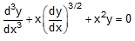
For the equation
the correct description is
  1. A
    an ordinary differential equation of order 3 and degree 2Β 
  2. B
    an ordinary differential equation of order 3 and degree 3Β 
  3. C
    an ordinary differential equation of order 2 and degree 3Β 
  4. Dan ordinary differential equation of order 3 and degree Ò€‹
Question 8Single Answer
The value of (1 + i)12, where Ò€‹ , is.
  1. A
    – 64 iΒ 
  2. B
    64 i
  3. C64Β 
  4. D– 64
Question 9Single Answer
If (A=\begin{bmatrix}1&2\3&4\end{bmatrix}), what is (\det(A))?
  1. A2
  2. B(-2)
  3. C5
  4. D10
Question 10Single Answer
If (A) is a (3\times3) matrix with (\det(A)=5), what is (\det(2A))?
  1. A10
  2. B40
  3. C20
  4. D80

Textile Engineering & Fibre Science

Question 11Single Answer
Which fibre is classified as a natural fibre?
  1. APolyester
  2. BCotton
  3. CNylon
  4. DAcrylic
Question 12Single Answer
What distinguishes man-made fibres from natural fibres?
  1. ADerived from plant sources
  2. BBiodegradable nature
  3. CSynthetically produced
  4. DCellulose-based structure
Question 13Single Answer
Which fibre is an example of a man-made fibre?
  1. AWool
  2. BSilk
  3. CViscose
  4. DJute
Question 14Single Answer
What is a primary characteristic of natural fibres?
  1. ASynthetic polymer base
  2. BUniform molecular weight
  3. CHigh thermal stability
  4. DDerived from natural sources
Question 15Single Answer
Which fibre is classified as a synthetic fibre?
  1. ACotton
  2. BPolypropylene
  3. CFlax
  4. DRamie
Question 16Single Answer
What is a key feature of natural fibres compared to man-made fibres?
  1. AUniform structure
  2. BSynthetic origin
  3. CBiodegradability
  4. DHigh melting point
Question 17Single Answer
Which fibre is a natural protein-based fibre?
  1. AJute
  2. BViscose
  3. CPolyester
  4. DSilk
Question 18Single Answer
What distinguishes man-made fibres?
  1. ADerived from animal sources
  2. BIrregular molecular structure
  3. CHigh cellulose content
  4. DControlled production process
Question 19Single Answer
Which fibre is an example of a natural fibre?
  1. ANylon
  2. BAcrylic
  3. CHemp
  4. DRayon
Question 20Single Answer
What is a primary source of natural fibres?
  1. APetrochemicals
  2. BPlants or animals
  3. CSynthetic polymers
  4. DInorganic compounds
Question 21Single Answer
Which fibre is classified as a man-made fibre?
  1. AWool
  2. BCotton
  3. CPolyamide
  4. DFlax
Question 22Single Answer
What is a key characteristic of man-made fibres?
  1. ASynthetic production
  2. BIrregular structure
  3. CHigh biodegradability
  4. DCellulose-based
Question 23Single Answer
Which fibre is a natural cellulose-based fibre?
  1. AJute
  2. BPolyester
  3. CNylon
  4. DAcrylic
Question 24Single Answer
What distinguishes natural fibres from man-made fibres?
  1. ANatural origin
  2. BHigh thermal stability
  3. CUniform molecular weight
  4. DSynthetic polymer base
Question 25Single Answer
Which fibre is an example of a synthetic fibre?
  1. ARamie
  2. BSilk
  3. CPolyethylene
  4. DHemp
Question 26Single Answer
What is a primary feature of natural fibres?
  1. ASynthetic origin
  2. BUniform structure
  3. CHigh melting point
  4. DBiodegradable nature
Question 27Single Answer
Which fibre is classified as a natural fibre?
  1. AViscose
  2. BNylon
  3. CPolyester
  4. DWool
Question 28Single Answer
What is a key feature of man-made fibres?
  1. ADerived from plants
  2. BIrregular structure
  3. CHigh cellulose content
  4. DControlled properties
Question 29Single Answer
Which fibre is a natural protein fibre?
  1. ACotton
  2. BAcrylic
  3. CRayon
  4. DSilk
Question 30Single Answer
What distinguishes man-made fibres from natural fibres?
  1. ASynthetic production
  2. BBiodegradable nature
  3. CCellulose-based structure
  4. DDerived from animals
Question 31Single Answer
Which fibre is classified as a natural fibre?
  1. APolyamide
  2. BFlax
  3. CPolyester
  4. DViscose
Question 32Single Answer
What is a primary characteristic of man-made fibres?
  1. ANatural origin
  2. BCellulose-based
  3. CHigh biodegradability
  4. DSynthetic polymers
Question 33Single Answer
What is a key feature of natural fibres?
  1. ASynthetic origin
  2. BHigh thermal stability
  3. CBiodegradability
  4. DUniform molecular weight
Question 34Single Answer
Which fibre is classified as an organic fibre?
  1. AGlass fibre
  2. BCarbon fibre
  3. CCotton
  4. DAsbestos
Question 35Single Answer
What is an example of an inorganic fibre?
  1. APolyester
  2. BGlass fibre
  3. CViscose
  4. DWool
Question 36Single Answer
Textile fibres are broadly classified as:
  1. AStaple and yarn only
  2. BOrganic and metallic only
  3. CNatural and man-made
  4. DWoven and knitted
Question 37Single Answer
Which is a natural cellulosic fibre?
  1. ANylon
  2. BAcrylic
  3. CCotton
  4. DPolyester
Question 38Single Answer
Wool is primarily composed of:
  1. ACellulose
  2. BKeratin
  3. CFibroin
  4. DLignin
Question 39Single Answer
Silk is classified as a:
  1. ASynthetic fibre
  2. BRegenerated cellulose fibre
  3. CNatural protein fibre
  4. DMineral fibre
Question 40Single Answer
Flax belongs to the group of:
  1. ASeed fibres
  2. BLeaf fibres
  3. CBast fibres
  4. DMineral fibres
Question 41Single Answer
Cotton fibre develops from the:
  1. AStem
  2. BLeaf
  3. CSeed epidermis
  4. DRoot
Question 42Single Answer
An essential feature of a fibre-forming polymer is:
  1. AVery low molecular weight
  2. BAdequate chain length
  3. CComplete crosslinking
  4. DHigh volatility
Question 43Single Answer
Fibre-forming polymers generally require:
  1. ALinear or moderately branched chains
  2. BHighly crosslinked chains only
  3. CVery short chains
  4. DVolatile molecules
Question 44Single Answer
High molecular orientation in a fibre generally improves its:
  1. ATensile strength
  2. BSolubility
  3. CVolatility
  4. DColour
Question 45Single Answer
The principal chemical constituent of cotton is:
  1. AProtein
  2. BCellulose
  3. CPolyamide
  4. DPolyester
Question 46Single Answer
Cotton is classified botanically as a:
  1. ABast fibre
  2. BLeaf fibre
  3. CSeed fibre
  4. DFruit fibre
Question 47Single Answer
The outermost layer of mature cotton fibre is the:
  1. ACuticle
  2. BLumen
  3. CSecondary wall
  4. DPrimary wall only
Question 48Single Answer
The central hollow region of cotton fibre is called the:
  1. ALumen
  2. BCortex
  3. CMedulla
  4. DScale
Question 49Single Answer
The characteristic convolutions of cotton are mainly observed in:
  1. AMolten cellulose
  2. BMature dried fibres
  3. CWet spinning dope
  4. DWool fibres
Question 50Single Answer
Cotton fibre has a cross-section that is commonly:
  1. ABean-shaped or kidney-shaped
  2. BCircular and solid
  3. CPerfectly triangular
  4. DHollow circular only
Important Questions Package

GATE Textile Engineering and Fibre Science Exam Online Question Bank Package

Buy GATE Textile Engineering and Fibre Science Important Questions, MCQ, question answer in Hindi & English. It will help you to score high marks in GATE Textile Engineering and Fibre Science question bank 2026 in Online, PDF & Print study material.

+ Free Monthly Current Affairs, GK & more PDF Download
Sr.Package NameAmount
1.GATE Textile Engineering & Fibre Science Exam (Only MCQ) - English
Description : 1000 Question With Answer
β‚Ή101 [β‚Ή500]
2.GATE Textile Engineering & Fibre Science Exam (Only MCQ) - English
Description : 2000 Question With Answer
β‚Ή151 [β‚Ή500]
3.GATE Textile Engineering & Fibre Science Exam (Only MCQ) - English
Description : 3000 Question With Answer
β‚Ή181 [β‚Ή500]
4.GATE Textile Engineering & Fibre Science Exam (Only MCQ) - English
Description : 4000 Question With Answer
β‚Ή210 [β‚Ή500]
5.GATE Textile Engineering & Fibre Science Exam (Only MCQ) - English
Description : 5000 Question With Answer
β‚Ή221 [β‚Ή500]
6.GATE Textile Engineering & Fibre Science Exam (Only MCQ) - English
Description : 6000 Question With Answer
β‚Ή341 [β‚Ή500]
7.GATE Textile Engineering & Fibre Science Exam (Only MCQ) - English
Description : 1000 Question & Answer Download in PDF (Send by Email)
β‚Ή151 [β‚Ή550]
8.GATE Textile Engineering & Fibre Science Exam (Only MCQ) Question Bank Book - English
Description : 1000 Question with Answer (Printed Material)
β‚Ή390 [β‚Ή650]
Back to Exam