A water supply distribution system for an averagely-populated township is to be designed for
A
Maximum daily demand
B
Maximum hourly demand and fire demand
C
Average demand
D
Maximum daily demand and fire demand or maximum hourly demand, whichever is higher
Question 2Single Answer
A combined sewerage system is more appropriate for developed areas where
A
Rainfall occurs for a very few days in a year
B
Rainfall occurs almost uniformly throughout the year
C
Air temperatures are nearly uniform throughout the year
D
Air temperatures through the year include extremes during certain runs of days
Question 3Single Answer
100 m3 of sludge holds a moisture content of 95%. If its moisture content chagnes to 90%, the volume of this sludge will then be
A
40.5m3
B
50m3
C
75m3
D
94.7m3
Question 4Single Answer
The design overflow rate of a sedimentation tank is chosen considering
A
Flow rate through the tank
B
Diameter of the particle intended to be removed
C
Volume of the sedimentation tank
D
Detention time in the tank
Question 5Single Answer
Consider the following statements in respect of flow equalization in a waste water treatment plant :
1. Biological treatment is enhanced because shock loadings are eliminated or minimized
2. Flow equalizations is an attractive option for upgrading the performance of overloaded treatment plants.
3. Inhibiting substances can be diluted and pH can be stabilized
4. Thickening performance of primary sedimentation tanks following grit removal is improved.
Which of the above statements are correct?
A
1, 2, 3 and 4
B
1, 2 and 3 only
C
1, 2 and 4 only
D
3 and 4 only
Question 6Single Answer
A drain carrying 5m3/s of wastewater with its BOD of 100mg/l joins a stream carrying 50 m3/ s flow with its BOD of 5mg/l. What will be the value of the BOD of the combined flow after complete mixing?
A
3.6 mg/l
B
13.6 mg/l
C
33.6 mg/l
D
53.6 mg/l
Question 7Single Answer
Consider the following statements in respect of aerated grit chamber:
1. The grit accumulates at the bottom in advancing spiral-flow aeration tanks, location ally preceded by grit chambers, led to the eventual development of aerated grit chambers.
2. The excessive wear on grit handling equipment is a major factor for the popularity of aerated grit chambers.
3. Aerated grit chambers are designed to provide detention period of 1 minute at maximum rate of flow.
4. Diffusers are located at 0.45 m to 0.6 m above the bottom of teh chamber.
Which of the above statements are correct?
A
1, 2 and 3 only
B
3 and 4 only
C
1, 2 and 4 only
D
1, 2, 3 and 4
Question 8Single Answer
Quick sand condition occurs when
A
the void ratio of the soil becomes 1.0
B
the upward seepage pressure in soil becomes zero
C
the upward seepage pressure in soil becones equal to the saturated unit weight of he soil
D
the upward seepage pressure in soil becomes equal to he submerged unit weight of the soil
Question 9Single Answer
The side of a square land was measured as 150 m and is in error by 0.05 m. What is the corresponding error in the computed area of the land.
A
5 m2
B
25 m2
C
10 m2
D
20 m2
Question 10Single Answer
Consider the following statements in respect of anaerobic sludge digester:
1. It is less expensive compared to several other methods available.
2. Processing of separable solids impacts the environment to a minimum
3. Quantity of separated solids requiring disposal is minimal
4. Digested sludge is very readily dewaterable.
Which of the above statements are correct?
A
1, 2, 3 and 4
B
1, 2 and 3 only
C
3 and 4 only
D
1, 2 and 4 only
Question 11Single Answer
Consider the following statements :
1. There will be no defects in select grade timbers.
2. The codal values for strength of grade-II timer without defects may be reduced by 37.5%.
3. For timber used as columns, the permissible stress in ungraded timbers is adopted with a multiplying factor of 0.50.
4. In case of wind force and earthquakes, a modification factor of 1.33 is adopted. Which of the above statements are correct ?
A
1 and 3 only
B
1 and 4 only
C
2 and 4 only
D
2 and 3 only
Question 12Single Answer
Consider the following statements regarding timber :
1. The strength of timber increases by Kiln seasoning.
2. Cutting of wood is to be done prior to treatment.
3. Water seasoning is good for prevention of warping.
4. ASCU treatment enhances the strength of wood. Which of the above statements are correct ?
A
1, 2 and 3 only
B
2, 3 and 4 only
C
1, 3 and 4 only
D
1, 2, 3 and 4
Question 13Single Answer
Gase(s) emitted during rotting or decomposition of timber is /are mainly
A
Methane and Hydrogen
B
Hydrogen Sulphide
C
Carbonic acid and Hydrogen
D
Ammonia
Question 14Single Answer
Efflorescence of bricks is due to
A
Excessive burning of bricks
B
High silt content in brick clay
C
High porosity of bricks
D
Soluble salts present in parent clay
Question 15Single Answer
Disintegration of bricks masonry walls is primarily due to
1. Efflorescence
2. Magnesium sulphate in brick
3. Calcined clay admixtures
4. Kankar nodules
Which of the a above statements are correct ?
A
1, 2 and 3 only
B
1, 2 and 4 only
C
3 and 4 only
D
1, 2, 3 and 4
Question 16Single Answer
Consider the following test :
1. Transverse strength test
2. Water absorption test
3. Impact test
4. Breaking strength test
Which of the above are relevant to testing of tiles ?
A
1, 2 and 3 only
B
1, 2 and 4 only
C
3 and 4 only
D
1, 2, 3 and 4
Question 17Single Answer
Which of the following statements is/are correct regarding the strength of cement ?
1. Particle sizes less than 3 m increases the viscous nature of the cement.
2. Finer particles in cement can be replaced by fly-ash to improve the strength.
A
1 only
B
2 only
C
Both 1 and 2
D
Neither 1 nor 2
Question 18Single Answer
The constituent compound in Portland cement which reacts immediately with water, and also sets earliest, is
A
Tricalcium silicate
B
Dicalcium silicate
C
Tricalcium aluminate
D
Tetracalcium aluminoferrite
Question 19Single Answer
Which of the following statements are correct with regard to cement mortar ?
1. Workability of cement mortar can be improved by addition of lime.
2. Fly-ash cement is economical in plastering jobs.
3. Addition of saw dust improves workability.
4. Sand in mortar can be replaced by finely crushed fire bricks.
A
1, 2, 3 and 4
B
1, 2 and 3 only
C
3 and 4 only
D
1, 2 and 4 only
Question 20Single Answer
In a concrete mix of proportion 1 : 3 : 6, the actual quantity of sand, which is judged to have undergone 15% bulking, per unit volume of cement, will be
A
3.00
B
3.45
C
4.50
D
6.00
Question 21Single Answer
Consider the following statements:
1. IS 3583 refers to Burnt Clay Paving Bricks.
2. IS 5779 refers to Burnt Clay Soling Bricks.
3. IS 3952 refers to Burnt Clay Hollow Bricks.
4. IS 2222 refers to Burnt Clay Lay Bricks.
Which of the above statements are correct?
A
1, 2 and 3 only
B
1, 2 and 4 only
C
3 and 4 only
D
1, 2, 3 and 4
Question 22Single Answer
Consider the following statements:
1. A high aggregate impact value indicates strong aggregates.
2. A low aggregate crushing value indicates high crushing strength of aggregates.
3. Aggregates having elongation index values greater than 15% are generally considered suitable for pavement construction.
4. Flakiness index of aggregates should not be less than 25% for use in road construction.
Which of the above statements are correct?
A
2 and 3 only
B
2 and 4 only
C
1 and 3 only
D
1 and 4 only
Question 23Single Answer
Consider the following statements regarding refractory bricks in furnaces:
1. The furnace is fired at temperatures more than 1700°C.
2. Silica content in the soil should be less than 40%.
3. Water absorption of bricks should not exceed 10%
4. Chrome bricks are known as basic bricks. Which of the above statements are correct?
A
1 and 2 only
B
2 and 4 only
C
1 and 3 only
D
3 and 4 only
Question 24Single Answer
Consider the following statements about lime:
1. Calcination of limestone results in quick lime.
2. Lime produced from pure variety of chalk is hydraulic lime.
3. Hydrated lime is obtained by treating quick lime with water.
Which of the above statements are correct?
A
1, 2 and 3
B
1 and 2 only
C
2 and 3 only
D
1 and 3 only
Question 25Single Answer
Consider the following statements:
1. If more water is added to concrete for increasing its workability, it results into concrete of low strength.
2. No slump is an indication of a good workable concrete.
3. Higher the slump of concrete, lower will be its workability.
4. Workability of concrete is affected by water content as well as water-cement ratio.
Which of the above statements are correct?
A
1 and 3 only
B
2 and 3 only
C
1 and 4 only
D
2 and 4 only
Question 26Single Answer
Pozzolana used as an admixture in concrete has the following advantages:
1. It improves workability with lesser amount of water.
2. It increases the heat of hydration and so lets the concrete set quickly.
3. It increases the resistance of concrete to attack by salts and sulphates.
4. It leaches out calcium hydroxide.
Select the correct answer using the codes given below:
A
1, 2 and 3 only
B
1, 2 and 4 only
C
1, 3 and 4 only
D
2, 3 and 4 only
Question 27Single Answer
Consider the following statements regarding Cyclopean Concrete:
1. Size of aggregate is more than 150 mm.
2. Size of aggregate is less than 150 mm.
3. High slump.
4. High temperature rise due to heat of hydration.
Which of the above statements are correct?
A
1 and 3 only
B
1 and 4 only
C
2 and 3 only
D
2 and 4 only
Question 28Single Answer
A chain, working a crane, has sectional area of 625 mm2 and transmits a load of 10 kN. When the load is being lowered at a uniform rate of 40 m/min, the chain gets jammed suddenly at which time the length of the chain unwound is 10m. Assuming E = 200 GPa, the stress induced in the chain due to this sudden jamming is
A
100.6 N/mm2
B
120.4 N/mm2
C
140.2 N/mm2
D
160.0 N/mm2
Question 29Single Answer
In mild steel specimens subjected to tensile test cycle, the elastic limit in tension is raised and the elastic limit in compression is lowered, This is called
A
Annealing effect
B
Bauschinger effect
C
Strain rate effect
D
Fatigue effect
Question 30Single Answer
Consider the following statements :
1. The shear stress distribution across the section of a circular shaft subjected to twisting varies parabolically.
2. The shear stress at the centre of a circular shaft under twisting moment is zero
3. The shear stress at the extreme fibres of a circular shaft under twisting moment is maximum.
Which of the above statements is/are correct?
A
1, 2 and 3
B
1 only
C
2 only
D
3 only
Question 31Single Answer
One bag of Portland cement, 50 kg in weight, would normally have a bulk volume of
A
30 l
B
35 l
C
40 l
D
45 l
Question 32Single Answer
AsCu, a preservative for wood, developed by the Forest Research Institute, Dehradun, comprises of chemicals:
A
1 : 1 : 1
B
1 : 2 : 3
C
1 : 2 : 4
D
1 : 3 : 4
Question 33Single Answer
Consider the following statements related to autoclave bricks:
1.Less water absorption compared to other bricks.
2.Noise reduction
3.It is cheap compared to other types of bricks.
4.Requirement of bulk volume of mortar in joints being relatively less compared to other types of brick masonry.
5.Not recommended for outer walls.
Which of the above statements are relevant to the use of ‘autoclave’ bricks?
A
1, 2 and 4
B
1, 3 and 5
C
2, 3 and 4
D
2, 4 and 5
Question 34Single Answer
The minimum number of annular rings to be seen in every 2.54 cm in the radial direction from the core for timber to be classified as ‘Dense’ is
A
10
B
20
C
25
D
30
Question 35Single Answer
If the actual thickness of a brick masonry wall is 19 cm, its effective length is 2.70 m, its effective height is 2.82 m and its code specified stiffening coefficient is 1.2 then, for design considerations, the slenderness ratio of the wall will be taken as
A
11.8
B
12.4
C
14.2
D
14.8
Question 36Single Answer
Consider the following forms of water in a hydrated cement paste:
1.Capillary water
2.Chemically combined water
3.Interlayer water
4.Adsorbed water
Which of the above forms of water will, on its/their removal, cause shrinkage of the paste?
A
1, 2 and 3
B
1, 2 and 4
C
2, 3 and 4
D
1, 3 and 4
Question 37Single Answer
Consider the following statements:High early strength of cement is obtained as a result of
1.Fine grinding.
2.Decreasing the lime content
3.Burning at higher temperature
4.Increasing the quality of gypsum.
Which of the above statements are correct?
A
1 and 2
B
1 and 3
C
2 and 3
D
3 and 4
Question 38Single Answer
Consider the following statements related to ‘composite mortar’:
1.Addition of lime to cement mortar improves its workability
2.Composite mortar is obtained by adding 10% by weight of cement and mixing with water.
3.Composite mortar is not preferred in tall buildings.
4.Mechanical grinding is essential for developing composite mortar.Which of the above statements are true in this case?
A
1, 2 and 3 only
B
1, 3 and 4 only
C
2, 3 and 4 only
D
1, 2, 3 and 4
Question 39Single Answer
Consider the following statements related to ‘non-destructive testing’ of concrete:
1.Indentation test is used to assess the quality of concrete.
2.Resonant Frequency Method is based on a laboratory test.
3.Compressive strength of concrete is estimated through Pulse Velocity Measurement.
4.Dynamic modulus of Elasticity is determined by a Sonometer Test.
5.Thickness of concrete can be estimated by in-situ Rebound Hammer Test.
Which of the above statements are correct?
A
1, 2 and 3 only
B
1, 2 and 5 only
C
1, 2, 3 and 4 only
D
1, 2, 3, 4 and 5
Question 40Single Answer
What is the amount of water required for a workable RC of mix 1 : 2: 4 by weight., when W/C is 0-60 and unit weight of concrete is 2400 kg/m3?
A
165 l
B
205 l
C
245 l
D
285 l
Question 41Single Answer
Which IS code is used for classification of timber for seasoning purposes?
A
IS : 4970-1973
B
IS : 1708-1969
C
IS : 1141-1958
D
IS : 399-1963
Question 42Single Answer
Consider the following with regard to the application of preservation of timber:
1.Increase in the life span of the member
2.Increase in the strength of the timber
3.Removal of moisture
4.Prevention of growth of fungi by killing them
Which of the above are correct?
A
1, 2, 3 and 4
B
2 and 4 only
C
1 and 4 only
D
2 and 3 only
Question 43Single Answer
The plies in plywood are so placed that the grains of each ply are
A
Parallel to each other
B
At right angle to one another
C
45° oblique to adjacent grain
D
Not constrained by any consideration
Question 44Single Answer
Which of the following is an ODD one as regards ‘requirement of good brick-earth’?
A
It must be free from lumps of lime
B
It should not be mixed with salty water
C
It must be non-homogeneous
D
It should not contain vegetable and organic matter
Question 45Single Answer
The compressive strength of heavy-duty bricks, as per IS : 2980-1962, should not be less than
A
440 kg/cm2
B
175 kg/cm2
C
100kg/cm2
D
75kg/cm2
Question 46Single Answer
Consider the following statements:
1.Brickwork will have high water tightness.
2.Brickwork is preferred for monument structures.
3.Bricks resist fire better than stones
4.Bricks of good quality shall have thin mortar bonds.
Which of the above statements are correct?
A
1 and 2
B
3 and 4
C
2 and 3
D
1 and 4
Question 47Single Answer
Consider the following statements:A good soil for making bricks should contain
1.30% alumina
2.10% lime nodules
3.Only small quantity of iron oxides
4.15% magnesia
Which of the above statements are correct?
A
1 and 2 only
B
1 and 3
C
1, 2 and 4
D
2, 3 and 4
Question 48Single Answer
Which compound of cement is responsible for strength of cement?
A
Magnesium oxide
B
Silica
C
Alumina
D
Calcium sulphate
Question 49Single Answer
Which type of cement is recommended in large mass concrete works such as a dam?
A
Ordinary Portland
B
High Alumina
C
Low-heat Portland
D
Portland Cement
Question 50Single Answer
Consider the following statements regarding ‘setting of cement’:
1.Low-heat cement sets faster than OPC.
2.Final setting time decides the strength of cement
3.Initial setting time of Portland Pozzollona is 30 minutes
4.Air-induced setting is observed when stored under damp conditions.
4.Addition of gypsum retards the setting time.
Which of the above statements are correct?
A
1, 2 and 3
B
2, 3 and 4
C
3, 4 and 5
D
2, 3 and 5
Important Questions Package
GPSC Deputy Executive Engineer Exam Online Question Bank Package
Buy GPSC Deputy Executive Engineer Important Questions, MCQ, question answer in Hindi & English. It will help you to score high marks in GPSC Deputy Executive Engineer question bank 2026 in Online, PDF & Print study material.
+ Free Monthly Current Affairs, GK & more PDF Download
Sr.
Package Name
Amount
1.
GPSC Deputy Executive Engineer Prelims Exam Paper 1 - English
Description : 1000 Question with Answer
₹101[₹500]
2.
GPSC Deputy Executive Engineer Prelims Exam Paper 1 - English
Description : 2000 Question with Answer
₹151[₹500]
3.
GPSC Deputy Executive Engineer (Civil) Prelims Exam Paper 2 - English
Description : 1000 Question with Answer
₹101[₹500]
4.
GPSC Deputy Executive Engineer (Civil) Prelims Exam Paper 2 - English
Description : 2000 Question with Answer
₹151[₹500]
5.
GPSC Deputy Executive Engineer (Civil) Prelims Exam Paper 2 - English
Description : 3000 Question with Answer
₹181[₹500]
6.
GPSC Deputy Executive Engineer Prelims Exam Paper 1 - English
Description : 1000 Question & Answer Download in PDF (Send by Email)
₹151[₹450]
7.
GPSC Deputy Executive Engineer (Civil) Prelims Exam Paper 2 - English
Description : 1000 Question & Answer Download in PDF (Send by Email)
₹151[₹450]
8.
GPSC Deputy Executive Engineer Prelims Exam Paper 1 Question Bank Book - English
Description : 1000 Question with Answer (Printed Material)
₹390[₹600]
9.
GPSC Deputy Executive Engineer (Civil) Prelims Exam Paper 2 Question Bank Book - English
Description : 1000 Question with Answer (Printed Material)
₹390[₹600]
Concerned Subject (Civil)
Question 51Single Answer
Consider the following statements regarding ‘strength of cement’:
1.Strength test on cement is made on cubes of cement-sand mix.
2.Water to be used for the paste is 0.25 P, where P is the water needed for normal consistency.
3.The normal consistency is determined on Le Chatelier’s principle.
4.Cubes are cast in two layers in leak-proof moulds further compacted in each layer by vibration on a machine.
Which of the above statements are correct?
A
1 and 2
B
2 and 3
C
1 and 4
D
3 and 4
Question 52Single Answer
Which of the following ingredients refer to binding material of mortar?
1.Cement
2.Lime
3.Sand
4.Ashes
Select the correct answer using the code given below.
A
1 and 4
B
3 and 4
C
1 and 2
D
2 and 3
Question 53Single Answer
Consider the following statements:
1.Bricks in masonry are bound by mortar.
2.Mortars make brick damp-proof.
3.Strength of brick in masonry is improved by plastering.
4.Addition of lime improves workability.
5.Marine construction needs sulphate-resistant cement mortar.
Which of the above statements are relevant for ‘cement mortar’?
A
1, 2 and 3
B
2, 3 and 4
C
1, 4 and 5
D
3, 4 and 5
Question 54Single Answer
Consider the following parameters of concrete:
1.Impermeability
2.Compactness
3.Durability
4.Desired consistency
5.Workability
Which of the above parameters are relevant for ‘water-cement ratio’?
A
4 and 5
B
1 and 2
C
2 and 4
D
3 and 5
Question 55Single Answer
Consider the following statements:Presence of Na2O and K2O in concrete leads to
1.Expansive reaction in concrete
2.Cracking of concrete
3.Disruption of concrete
4.Shrinkage of concrete
Which of the above statements are correct?
A
1 and 2 only
B
2 and 3 only
C
1, 2 and 3
D
3 and 4
Question 56Single Answer
The maximum total quantity of dry aggregate by mass per 50 kg of cement, to be taken as the sum of the individual masses of fine and coarse aggregates (kg), for M20 grade of concrete is
A
625
B
480
C
330
D
250
Question 57Single Answer
Absorption capacity of an aggregate refers to the difference expresses in appropriate proportion in water content between
A
A wet aggregate and a dry aggregate
B
A dry aggregate and a wet aggregate
C
A saturated surface-dry aggregate and a dry aggregate
D
A saturated surface-dry aggregate and an over dry aggregate
Question 58Single Answer
Consider the following statements concerning ‘elasticity of concrete’:
1.Stress-strain behavior of concrete is a straight line up to 10% ultimate stress.
2.Strain determination is obtained from tangent modulus.
3.Modulus of elasticity of concrete is also called as secant modulus.
Which of the above statements are correct?
A
1, 2 and 3
B
1 and 3 only
C
1 and 2 only
D
2 and 3 only
Question 59Single Answer
Consider the following statements :The addition of CaCl2 in concrete results in
1.Increased shrinkage
2.Decreased setting time
3.Decreased shrinkage
4.Increased setting time
Which of the above statements are correct?
A
1 only
B
2 and 3
C
3 and 4
D
1 and 2
Question 60Single Answer
Which of the following statements are correct ?
1.Knots in a tree affect the continuity of fibres.
2.Nail knots do not influence the strength of timber.
3.Druxiness of wood is not a defect.
4.Tall trees with twisted fibers give good timber for poles.
A
1, 2, 3 and 4
B
1, 2 and 4 only
C
1, 2 and 3 only
D
2, 3 and 4 only
Question 61Single Answer
Excrescences in wood are
1.Defects found in trees
2.Formed due to injuries inflicted on trees when they are growing
3.Defects which render wood suitable as firewood only
A
1, 2 and 3
B
1 and 2 only
C
1 and 3 only
D
2 and 3 only
Question 62Single Answer
What treatment is adopted for making timber fire-resistant?
A
ASCU treatment
B
Abel’s process
C
Creosoting
D
Tarring
Question 63Single Answer
Deterioration of structure of timber due to dry rot is:
1.Caused by fungi
2.Due to dry-spell after heavy rains
3.Due to attack of termites
4.ndicated by surface stripes on scantlings
A
1 and 2
B
3 and 4
C
2 and 3
D
1 and 4
Question 64Single Answer
Alternate wetting and drying of timber :
1.Results in shrinkage and swelling
2.Brings about wet rot onset
3.Increases the durability
4.Causes transmission of spores from germination
A
1, 2, 3 and 4
B
1, 2 and 4 only
C
1, 2 and 3 only
D
2, 3 and 4 only
Question 65Single Answer
As per I.S. classification, the minimum compressive strength of a first class brick should be
A
75 kg/cm3
B
100kg/cm3
C
125 kg/cm3
D
150 kg/cm3
Question 66Single Answer
When provided with alternating courses of (a) all headers and (b) all stretchers, the front elevation of such brick masonry is designated as
A
English bond
B
Single Flemish bond
C
Double Flemish bond
D
Rat-trap bond
Question 67Single Answer
I.S. code specifies that the compressive strength of brick shall be determined by keeping the brick:
1.On edge
2.On bed
3.After soaking in water for 2 hrs
4.After soaking in water for 24 hrs
A
1 and 2
B
2 and 3
C
3 and 4
D
2 and 4
Question 68Single Answer
Soundness test of cement is carried out to determine its
A
Alumina content
B
Iron oxide content
C
Free lime content
D
Durability under sea water
Question 69Single Answer
The objectives of producing cement include:
1.Incorporating industrial wastes
2.Increasing free lime
3.Increasing fineness
4.Saving energy needed in the process
A
1, 2, 3 and 4
B
1, 3 and 4 only
C
1, 2 and 4 only
D
2, 3 and 4 only
Question 70Single Answer
A mild steel rod tapers uniformly from 24 mm mm dia. over its length of 400 mm. The rod when held vertical is subjected to an axial tensile load of 12 kN. E = 2 × 10⁵ N/mm2. The extension of the rod in mm would be:
A
3
2
B
2
3
C
3
D
1
3
Question 71Single Answer
Two different liquids are flowing through different pipes of the same diameter. In the first pipe, the flow is laminar with centerline velocity,Vmax.1,Whereas in the second pipe, the flow is turbulent. For turbulent flow, the average velocity is 0.82 times the centerline velocity,vmax.2 . For equal volumetric flow rates in both the pipes, the ratio Vmax.1/Vmax.2(up to two decimal place) is_____.
A
1.64
B
2.45
C
0.25
D
1.44
Question 72Single Answer
Poisson’s ratio of a material is 0.3. Then the ratio of Young’s modulus to bulk modulus is
A
0.6
B
0.8
C
1.2
D
1.4
Question 73Single Answer
For a gas phase cracking reaction A→B+C at 300℃ , the Gibbs free energy of the reaction at this temperature is ∆G°= -2750J/mol . The pressure is 1 bar and the gas phase can be assumed to be ideal. The universal gas constant =8.314J/mol. K. The fractional molar conversion of A at equilibrium is________.
A
0.44
B
0.50
C
0.64
D
0.80
Question 74Single Answer
Which of the following statements are correct ?
1.In a ductile material elastic deformation is more predominant than plastic one.
2.Brittleness is not an absolute property of a metal.
3.Rate of loading has no influence in changing the behavior of a metal from ‘ductile’ to ‘brittle’ at low temperatures
4.Under hydrostatic compression, a brittle metal may change into a ductile one.
A
1 and 2
B
2 and 3
C
3 and 4
D
2 and 4
Question 75Single Answer
The total deflection of a structure when subjected simultaneously to different sets of loading is equal to the sum of the deflections under each such set of loads as if acting separately on the structure. Which one the following justifies this statement?
A
Elastic limit is not exceeded
B
Elastic limit including buckling is not exceeded
C
Limit state is not exceeded
D
Proportional limit without buckling is not exceeded
Question 76Single Answer
A rectangular bar of cross-sectional area a is subjected to an axial tensile load P. The maximum shear stress will occur on a plane at X° to any normal cross-section where X° is
A
90°
B
27°
C
180°
D
45°
Question 77Single Answer
A solid circular shaft has been subjected to a pure torsion moment. The ratio of maximum shear stress to maximum normal stress at any point would be
A
1 : 2
B
1 : 1
C
2 : 3
D
2 : 1
Question 78Single Answer
Which of the following statements are correct?
1.All load carrying members transmit load through basic modes of tension, compression, torsion and shear only.
2.Beams carry transverse loads.
3.Combined loading is a complicated loading.
4.Nature of internal forces decides the aspect of combines loading.
A
1 and 2
B
2 and 3
C
3 and 4
D
2 and 4
Question 79Single Answer
Identify the WRONG statement amongst the following:
A
steam distillation is used for mixtures that re immiscible with water.
B
Vacuum distillation is used for mixtures that are miscible with water.
C
Steam distillation is used for mixtures that are miscible with water.
D
vacuum distillation columns have larger diameter as compared to atmospheric columns for the same throughout
Question 80Single Answer
Which of the following statements are correct?
1.Experimental results on thin-walled tubes show that maximum normal stress theory is valid.
2.Normal-stress theory is valid in case of brittle materials.
3.In case of pure shear, St. Venant’s theory is more valid than other theories.
4.Tresca’s theory is very closely substantiated by experimental results.
5.In maximum stress theory, the yield locus is a hexagon.
A
1, 2 and 3
B
2, 4 and 5
C
1, 2 and 4
D
2, 3 and 4
Question 81Single Answer
A thin cylindrical shell made of mild steel plate is 1000 mm in diameter. It is to be subjected to an internal pressure of 2 N/mm2. If the material yields at 200N/mm2, the thickness of the plate in mm on the basis of Rankine’s theory of failure with assuming a factor of safety of 3 would be
A
10
B
12
C
15
D
18
Question 82Single Answer
Which of the following can change if only the catalyst is changed for a reaction system?
A
Enthalpy of reaction
B
Activation energy
C
Free Energy of the reaction
D
Equilibrium constant
Question 83Single Answer
Which of the following loads should be applied on a simply supported beam, so that the shear force is constant throughout its span?
A
U.D.L. over the entire span.
B
Two concentrated loads equally spaced in the span.
C
A central concentrated load and a U.D.L. over the entires pan.
D
A couple anywhere in the span.
Question 84Single Answer
A simply supported rolled steel joist of I-section has flange width 250 mm and overall depth 600 mm. Its moment of inertia IXX = 12 × 106 mm4. The steel joist is used as a beam over a simply supported span of 6m. It carries a load of 40 kN/m including its self weight throughout the span. The maximum stress induced in the beam in N/mm2 due to bending would be
A
30
B
90
C
45
D
60
Question 85Single Answer
Which of the following terms represents the torque that produces a twist of one radian in a shaft of unit length?
A
Torsional stress
B
Torsional rigidity
C
Flexural rigidity
D
Moment of resistance
Question 86Single Answer
A 60 mm dia. shaft is subjected to a torque of 6 kN-m. C = 8 × 10⁴ N/mm2. The maximum shear stress induced in the shaft in N/mm2will be
A
8000
92
B
4000
9
C
12000
9
D
16000
9
Question 87Single Answer
A water main 160 cm dia. contains water at a pressure head of 200m. Take weight of water to be 1000 kg/m3. The thickness of the metal shell required for the water main, given that the maximum permissible stress in the metal is 400kg/cm2, will be
A
1 cm
B
2 cm
C
3 cm
D
4 cm
Question 88Single Answer
The radial splits which are wider on the outside of the log and narrower towards the pith are known as
A
Star shakes
B
Annular rings
C
Cup shakes
D
Hear shakes
Question 89Single Answer
Consider the following distinguishing characteristics of hardwood:
1.They have distinct annular rings.
2.They are not resinous.
Which of these characteristics of hardwood is/are correct?
A
1 only
B
2 only
C
Both 1 and 2
D
Neither 1 nor 2
Question 90Single Answer
Consider the following statements on the specific gravity of wood:
1.It is always greater than 2.
2.It is less than 1.
3.It is not dependent upon temperature and equilibrium moisture content.
Which of these statements are correct?
A
1, 2, 3 and 4
B
1 and 3 only
C
2 and 3 only
D
2 and 4 only
Question 91Single Answer
The age of a log of timber can be estimated by
A
Diameter of pith
B
Thickness of bark
C
Number of annular rings
D
Number of medullary rays
Question 92Single Answer
Consider the following statements:Seasoning of timber results in
1.Increased strength
2.Increased durability
3.Reduced resilience
4.Increased dimensional stability
Which of these statements are correct?
A
1, 2 and 4
B
1, 2 and 3
C
1, 3 and 4
D
2, 3 and 4
Question 93Single Answer
Match List-I and List-II and select the correct answer using the code given below the lists: List-I List-II
Plywood 1. Furniture
Fiberboard 2. Cantilever arches
Laminated lumber 3. Insulation
Commercial blockboard 4. Lining of form-work in concrete Codes:
A
A B C D
1 2 3 4
B
4 3 2 1
C
4 2 3 1
D
4 2 3 1
Question 94Single Answer
Consider the following statements:Perforated bricks are preferred in construction since
1.They are lighter
2.They are stronger than class 1 bricks
3.They have heat-insulating properties
4.They are cheaper and need less mortar
Which of these statements are correct?
A
1, 2, 3 and 4
B
2 and 3 only
C
1 and 3 only
D
3 and 4 only
Question 95Single Answer
The standard size of a brick is
A
20 cm × 10 cm × 10 cm
B
19 cm × 9 cm × 9 cm
C
18 cm × 9 cm × 9 cm
D
18 cm × 10 cm × 10 cm
Question 96Single Answer
Consider the following statements:More than 6% magnesium oxide by weight in cement results in
1.High early strength and high heat generation
2.Less tendency towards volume change and formation of cracks
Which of these statements is/are correct?
A
1 only
B
2 only
C
Neither 1 nor 2
D
Both 1 and 2
Question 97Single Answer
Fineness if cement is measured in the units of
A
Volume/mass
B
Mass/volume
C
Area/mass
D
Mass/area
Question 98Single Answer
The initial setting time of cement depends most on
A
Tricalcium aluminate
B
Tricalciumaluminoferrite
C
Dicalcium silicate
D
Dicalcium silicate
Question 99Single Answer
Consider the following statements:Sand in cement mortar is used for
1.Increasing the strength
2.Reducing the shrinkage
3.Decreasing the surface area of the binding material
4.Decreasing the quantity of cement
Which of these statements are correct?
A
1, 2 and 4
B
1, 2 and 3
C
1, 3 and 4
D
2, 3 and 4
Question 100Single Answer
Consider the following statements:
1.The compressive strength of concrete decreases with increase in water-cement ratio of the concrete mixture.
2.Water is added to the concrete mix for hydration of cement and workability.
3.Creep and shrinkage of concrete are independent of the water-cement ratio in the concrete mix.
Which of these statements are correct?
A
1 and 4 only
B
1 and 3 only
C
2 and 3 only
D
1, 2 and 3
Question 101Single Answer
What will be the depth of penetration of the plunger in Vicat Apparatus (IS : 5513 - 1976) from the bottom of the Vicat Mould, when the cement paste is tested for standard consistency, according to IS 4031 – 1988 ?
A
11 to 15 mm
B
8 to 10 mm
C
15 to 17 mm
D
5 to 7 mm
Question 102Single Answer
Two sewer pipelines A and B (having the same diameter and made of the same material) are laid at a bed slope of 1 in 225 and 1 in 625, respectively. Determine the ratio of their carrying capacities (QA to QB) .
A
B
C
1
D
Question 103Single Answer
Select the correct statement with respect to an over - reinforced cement concrete section under the working stress method .
A
The compressive stress in steel reaches the allowable limit before the maximum tensile stress in concrete reaches the allowable limit
B
Tensile steel stress and maximum compressive stress in concrete simultaneously reach their allowable limits
C
The allowable limiting stress is reached in concrete before the steel stress reaches the limiting value
D
The tensile stress in steel reaches the allowable limit before the maximum compressive stress in concrete reaches the allowable limit
Question 104Single Answer
A cantilever beam of span L is built - in at the support. It is restrained against lateral deflection and torsion at the free end. The effective length of compression flange for the beam as per IS 800 : 2007 is
A
0.5 L
B
0.85 L
C
2 L
D
0.75 L
Question 105Single Answer
What is the principle of plane surveying ?
A
Working from part to whole
B
Working from point to area
C
Working from angle to volume
D
Working from whole to part
Question 106Single Answer
According is IS 5968 : 1987, the minimum radius of radius of curve to be provided in the alignment of unlined canals carrying a discharge of less than 30 cumecs up to 15 cumecs is :
A
100 m
B
1000 m
C
600 m
D
150 m
Question 107Single Answer
A Pelton wheel is to be designed for a pitch diameter of 1 m and jet diameter of 0.1 m. The number of buckets on the runner computed by Taygun’s formula is :
A
20
B
25
C
15
D
10
Question 108Single Answer
What is the effect of fly ash in concrete ?
A
Reduces the secondary hydration process
B
Increases the heat of hydration
C
Increases the amount of air entrainment
D
Reduces the heat of hydration
Question 109Single Answer
As per IS 456 : 2000, the minimum grade of concrete to be used for plain concrete and reinforced concrete, respectively, in concrete works exposed directly along the sea coast are :
A
M 20 and M 30
B
M 20 and M 25
C
M 22 and M 40
D
M 15 and M 25
Question 110Single Answer
Identify the property that changes as a function of the geometrical dimensions of a section in structural materials :
A
Mass density
B
Moment of inertia
C
Poission’s ratio
D
Modulus of elasticity
Question 111Single Answer
As per IRC (Indian Roads Congress) recommendation, what will be the designed stopping sight distance (in metres) at the vehicle speed of 80 km/h on a rural highway ?
A
120
B
140
C
70
D
60
Question 112Single Answer
No deduction is made in the quantity estimation for plastering work in cement mortar for openings having size up to :
A
0.5 m2
B
1.0 m2
C
3 m2
D
0.75 m2
Question 113Single Answer
What is the height of slump cone mould used for testing the workability of the concrete ?
A
20 cm
B
10 cm
C
30 cm
D
25 cm
Question 114Single Answer
Select the correct option with regard in the following statements (S1, S2) pertaining to pavements .
S1 : Present serviceability index is used for the functional evaluation of pavement surface condition
S2 : Rigid pavements are less affected by temperature variations than flexible pavements
A
Statements S1 is true and Statement S2 is false
B
Both statements S1 and S2 are false
C
Statements S1 is false and Statement S2 is true
D
Both statements S1 and S2 are true
Question 115Single Answer
If the quadrantal bearing of a line AB is S 31'35' E, then its whole circle bearing is equal in :
A
121o25'
B
148o25'
C
58o25'
D
211o25'
Question 116Single Answer
The overflowing sheet of water on a weir is called :
A
creek
B
crest
C
limp
D
nappe
Question 117Single Answer
According to IS 456 - 2000, what is the slump of a medium degree of workability of concrete if planed in heavily reinforced sections like slabs, beams, walls, columns ?
A
10 - 25 mm
B
25 - 50 mm
C
0 - 10 mm
D
50 - 100 mm
Question 118Single Answer
Which of the following is Kharif season in India ?
A
March / April to June / July
B
December / January to April / May
C
May / June to October / November
D
October / November to April / May
Question 119Single Answer
The estimated value of a built - up property at the end of its useful life without dismantled is called :
A
market value
B
book value
C
scrap value
D
salvage value
Question 120Single Answer
The amount of cement required for 100 m2 area, of damp proof course with 2.5 cm thinkness, in with proportion of 1: 2 : 4 (cement : sand : aggregate) will be :
A
2.5 m2
B
0.55 m2
C
1.10 m2
D
0.25 m2
Question 121Single Answer
Select the correct statement related to increasing the carbon content in steel from 0.2 to 0.9 percent .
A
Increasing the carbon content in steel decreases the yield stress and increases the ductility
B
Increasing the carbon content in steel increases the yield stress and reduces the ductility
C
Increasing the carbon content in steel decreases the yield stress and does not affect the ductility
D
Increasing the carbon content in steel does not have any effect on the yield stress or ductility
Question 122Single Answer
Which of the following laws states that pressure or intensity of pressure at a point is static fluid is equal in all directions ?
A
Newton's law
B
Pascal's law
C
Darcy's law
D
Hydrostatic law
Question 123Single Answer
The determination of plasticity index and the percentage by weight of clay mineral finer than 2 µ present in the soil were done for two soil samples A and B. The ratio of plasticity index to the percentage of clay size particle for the samples A and B are given in the table .
Soil sample Ratio of plasticity index to percentage of clay size particle
Sample A Less than 0.75
Sample B Greater than 1.25 The two soil sample A and B are classified as
A
Sample A : Inactive; Sample B : Active
B
Sample A : Active; Sample B : Normal
C
Sample A : Active; Sample B : Inactive
D
Sample A : Normal ; Sample B : Inactive
Question 124Single Answer
Which of the following compounds of cement is responsible for early strength ?
A
C4AF
B
C3S
C
C3A
D
C2A
Question 125Single Answer
According to SP : 27 - 1984, the thickness of slab or RC slab shall be measured to the nearest of :
A
0.0002 m
B
0.005 m
C
0.0001 m
D
0.01 m
Question 126Single Answer
Classify the following pollutants as primary pollutants (PP) and secondary pollutants (SP). Ozone, Carbon monoxide, Particulate matter, photochemical smog, Nitrogen oxides, Aerosol/mist, Hydrocarbons, Perory - Acetyl - Nitrate, Sulphur dioxide.
bulk unit weight of a soil when it is fully saturated
B
saturated bulk unit weight to total void
C
total void to saturated bulk unit weight
D
total void to saturated bulk unit weight
Question 128Single Answer
Identify the test to be conducted for the determination of the modulus of subgrade reaction in pavement design .
A
Plate bearing test
B
Triaxial test
C
CBR test
D
Direct shear test
Question 129Single Answer
In limit state design, the design bond stress for deformed bars (conforming to IS 1786) for M20 concrete mentioned in IS 456 : 2000 is (in N/mm2 units) :
A
1.2
B
1.8
C
1.68
D
1.92
Question 130Single Answer
Which of the following can be considered as a taking off point in road planning in India ?
A
Lucknow plan
B
Delhi plan
C
Bombay plan
D
Nagpur plan
Question 131Single Answer
The following two statements pertain to a simply supported under reinforced concrete beam. Select the correct option with regard is these statements .
1. The failure of the beam takes place due to the yielding of steel .
2. The moment of resistance of the beam is more than that of the balanced section of the beam .
A
Statement 1 is true but Statement 2 is false
B
Statement 1 is false but Statement 2 is true
C
Both statement 1 and 2 are true
D
Both statement 1 and 2 are false
Question 132Single Answer
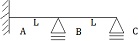
A continuous beam ABC with span AB = BC = L is shown in the figure. Support A is fixed type, and supports B and C are roller type. The kinematic indeterminacy of the beam is :
A
2
B
3
C
5
D
4
Question 133Single Answer
The soils transported and deposited by a river or a stream care called :
A
aeolian soils
B
alluvial soils
C
lacustrine soils
D
marine soils
Question 134Single Answer
What is the mechanical extra widening required for a two-lane pavement of width 7 m on a horizontal curve of radius 250 m, if the longest wheel base of a vehicle expected on the road is 5 m with a design speed of 70 km/h ?
A
0.155 m
B
0.225 m
C
0.100 m
D
0.552 m
Question 135Single Answer
The following are some of the errors that area associated with a total station survey work. Vertical collimation error, Centering error, Horizontal collimation error, Eccentricity error Categorize the given errors as those due to temporary adjustments (T) and permanent adjustments (P).
A
T : Vertical collimation error, Horizontal collimation error
P : Centering error, Eccentricity error
B
T : Centering error, Horizontal collimation error, Eccentricity error
P : Vertical collimation error
C
T : Eccentricity error, Horizontal collimation error
P : Centering error, Vertical collimation error, Eccentricity error
D
T : Centering error
P : Vertical collimation error, Horizontal collimation error, Eccentricity error
Question 136Single Answer
According to IS 800 : 2007, identify the property which is considered as a mechanical property of structural steel, important in design .
A
Unit mass
B
Maximum percent elongation on a standard gauge length
C
Co - efficient of thermal expansion
D
Poisson ration
Question 137Single Answer
Which of the following methods is NOT used for measuring air content in fresh concrete ?
A
Blaine air permeability method
B
Gravimetric method
C
Pressure method
D
Volumetric method
Question 138Single Answer
Which of the following methods is NOT used for the calculation of depreciation of a structure ?
A
Straight line method
B
Quantity survey method
C
Geometric projection method
D
Declining balance method
Question 139Single Answer
The failure of an over reinforced concrete beam is due to :
A
compression failure
B
mid failure
C
shear failure
D
tension failure
Question 140Single Answer
In which type of estimate is 'Court yard' NOT considered ?
A
Unit rate estimate
B
Plinth area estimate
C
Lump sum estimate
D
Cub rate estimate
Question 141Single Answer
Match the items in List 1 (name of quantities) with those in List 2 (unit of quantities in the SI system). Use codes in List for matching .
List 1 List 2
M. Dynamic viscosity 1. N/m
N. Kinematic viscosity 2. N.m
O. Surface tension 3. N.s/m2
P. Energy 4. m2/s
A
M-3, N-4, O-2, P-1
B
M-3, N-4, O-1, P-2
C
M-4, N-3, O-1, P-2
D
M-2, N-4, O-1, P-3
Question 142Single Answer
A reinforced concrete beam is subjected to the following bending moments .
Moment due to dead load = 50 kNm
Moment due to live load = 50 kNm
Moment due to seismic load = 20 kNm
The design bending moment for limit state of collapse is :
A
120 kNm
B
180 kNm
C
144 kNm
D
150 kNm
Question 143Single Answer
In a workshop shade, trusses are spaced at 4 m centre to centre. The purlins are spaced at 1.4 m centre to centre along the slope of 300. The (Dead Load + Live load) is 3 kNm2 and the wind load in 5 kNm2. The vertical and the inclined point loads, respectively, will be :
A
14.54 kN and 28 kN
B
17.8 kN and 48 kN
C
20 kN and 24 kN
D
18 kN and 21 kN
Question 144Single Answer
What will be the percentage of passing aggregate for the grading zone 1 of sieve size 1.18 mm ?
A
100%
B
10% - 20%
C
7% - 25%
D
30% - 70%
Question 145Single Answer
The annual or periodical payment for repayment of the capital amount invested on a property for a specified period is known as :
A
depreciation
B
obsolescence
C
amortization
D
annuity
Question 146Single Answer
Among the following river training works, which are aligned either parallel or at an angle to the banks, identify the one having a difference in alignment when compared to others :
A
Flood walls
B
Guide banks
C
Groynes
D
Levees
Question 147Single Answer
The test commonly to determine the grade of bitumen in terms of its hardness is :
A
the penetration test
B
the ductility test
C
the softening point test
D
the flash and fire point test
Question 148Single Answer
A level section has formation width of 10 m, side slope of 1 : 2 (vertical : horizontal) and central height of 2 m. Determine the quantity of earthwork required for a 1 km length of formation (in m3) .
A
24,000
B
20,000
C
18,000
D
28,000
Question 149Single Answer
Which type of odour characteristic is NOT used for classifying odour of a given water sample as per IS 3025 (part-5) 1983 ?
A
Degree of sweetness
B
Degree of turbidity
C
Degree of pungency
D
Degree of smokiness
Question 150Single Answer
The liquid limit and plastic limit of clay materials is 45% and 25% respectively, what is the activity of clay materials if 20% by weight of particles of size less than 2 microns ?
A
0
B
2
C
3
D
1
Question 151Single Answer
Among the following corrections applied for tape measurement, identify the correction which is NOT always negative in sign :
A
Sag
B
Slope of taype
C
Pull
D
Wrong alignment
Question 152Single Answer
A village has a population of 200 with as average rate of water demand as 100 litre per capita per day. A rapid sand filter having an average filtration rate of 100 litre/hour/m2 is to be designed for water treatment. The area of rapid sand filter required is : (Take the ratio of maximum demand to average demand as 1.5.)
A
8.00 m2
B
14.50 m2
C
10.00 m2
D
12.50 m2
Question 153Single Answer
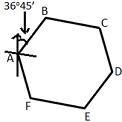
If the bearing of the side AB of a regular hexagon traverse ABCDFFA shown in the figure is 36o45', the bearing of the adjacent side BC of the traverse is :
A
216o15'
B
96o45'
C
83o15'
D
156o45'
Question 154Single Answer
Pigment volume concentration (PVC) of paint is defined as :
A
B
C
D
Question 155Single Answer
The Indian Roads Congress (IRC) was founded in the year :
A
1927
B
1934
C
1950
D
1982
Question 156Single Answer
In a leveling survey work, the first staff reading taken in a staff station after shifting the instrument and the last staff reading taken to a staff sation before the instrument in shifted are, respectively :
A
back sight and intermediate sight
B
intermediate sight and back sight
C
back sight and fore sight
D
fore sight and back sight
Question 157Single Answer
Which of the following Indian Standard Codes provides conservatively imposed loads for buildings and structures ?
A
IS 875 (part 4) – 1987
B
IS 875 (part 1) – 1987
C
IS 875 (part 3) – 1987
D
IS 875 (part 2) – 1987
Question 158Single Answer
Activity of soil is ratio of the plasticity index to :
A
percentage of compressive strength
B
percentage by weight of clay fraction
C
liquidity index
D
percentage of sensitivity
Question 159Single Answer
Kor watering in irrigation is defined as :
A
the first watering which is given to seeds sown in the plot for germination
B
the first watering which is given to a crop when the crop is a few centimeters high
C
the first watering which is given to a crop before transplanting
D
the first watering which is given to a plot when the crop is transplanted
Question 160Single Answer
What is a SI unit for dynamic viscosity ?
A
Pascal second
B
Pascal
C
Stoke
D
Newton
Question 161Single Answer
Arrange the following building materials in the increasing order of density of materials .
Granite, Steel, River sand, Water
A
Water, River sand, Steel, Granite
B
River sand, Granite, Water, Steel
C
River sand, Water, Granite, Steel
D
Water, River sand, Granite, Steel
Question 162Single Answer
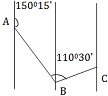
The bearing of a line AB is 150o15' and the angle ABC between line AB and BC is 110o30' as shown in the given figure . What is the bearing of line BC ?
A
440o45'
B
80o45'
C
79o15'
D
330o15'
Question 163Single Answer
Select the correct statement with respect to a slow sand filter :
A
The filtering medium has effective size 0.45 to 0.7 mm, uniformity coefficient 1.3 to 1.7, multiple graded layers of sand with bacteria and odour removal
B
The rate of filtration is in the range of 100 - 150 m3/m2/day
C
The effective size of sand particles shall be 0.15 to 0.3 mm, and their uniformity coefficient shall be preferably below 3
D
Backwashing daily or on alternate days is necessary for cleaning
Question 164Single Answer
What will be the carrying capacity of a horizontal rectangular channel 4 m wide, conveying a discharge of 1 cumecs per meter width of channel ?
A
4.000 m3/s
B
2.085 m3/s
C
1.000 m3/s
D
8.000 m3/s
Question 165Single Answer
Select the correct option with regard to the following statements (S1, S2) pertaining to consolidation in soils :
S1: A soil is termed as normally consolidated, if the present effective orver burden pressure is less than maximum to which the soil was ever been subjected to in the past .
S2: The large the value of co - efficient of consolidation, the shorter it takes for full consolidation to occur .
A
S1 is true and S2 is false
B
Both S1 and S2 are false
C
Both S1 and S2 are true
D
S1 is false and S2 is true
Question 166Single Answer
A real fluid in which the shear stress is directly proportional to the velocity gradient is known as :
A
non - newtonian fluid
B
newtonian fluid
C
ideal fluid
D
plastic fluid
Question 167Single Answer
An airport runway fill needs 8,50,000 m3 of soil compacted to void ratio of 0.7. The required soil is to be taken from a borrow pit having an in situ void ratio of 0.8. If the transportation cost is Rs.10 per m3, estimated cost for the filling work is (in Rs.) :
A
82,00,000
B
90,00,000
C
50,00,000
D
85,00,000
Question 168Single Answer
If p is internal pressure, d is diameter and t is thickness of wall for a thin cylindrical shell, then the value of hoop stress will be :
A
pt/4d
B
pd/4t
C
pd/2t
D
td/4p
Question 169Single Answer
As per IS 800 : 2007, in the design of beams/plate girders, when the web of a member acting alone is inadequate, different types of stiffeners are provided. Match the type of stiffeners provided in List 1 with the requirement to be satisfied by them in List 2 .
(Use the Code in the lists for matching)
List 1 List 2
B. Intermediate transverse wed stiffener 1. Provide local reinforcement to wed under shear and bearing
C. Load carrying stiffiener 2. Improve the buckling strength of a slender Web due to shear
D. Bearing stiffener 3. Prevent local buckling of web due to concentrated loading
E. Diagonal stiffener 4. Prevent local crushing of web due to concentrated loading
A
B - 3, C - 2, D - 4, E - 1
B
B - 4, C - 3, D - 1, E - 2
C
B - 2, C - 3, D - 4, E - 1
D
B - 4, C - 3, D - 2, E - 1
Question 170Single Answer
A canal was designed for a full supply discharge of 60 cumee. The average supply discharge in the canal is 40 cumee. The capacity factor of the cannal is :
A
6.0
B
4.00
C
0.67
D
0.45
Question 171Single Answer
Sewers must be checked for minimum velocities at their minimum hourly flows which is equal to :
A
1/4 average daily flows
B
1/2 average daily flows
C
average daily flows
D
1/3 average daily flows
Question 172Single Answer
What is the permissible limit of organic mater present in water for mixing concrete as per IS 456 - 2000 ?
A
200 mg/ l
B
3000 mg/ l
C
2000 mg/ l
D
400 mg/ l
Question 173Single Answer
A horizontal pipeline AB of diameter d cpmveus water, flowing from A to B. The U - tube manometer with mercury as manometric liquid can be used for the measurement of :
A
difference in the total energy between two points A and B
B
difference in the pressure head between two points A and B
C
difference in the velocity between the points A and B
D
difference in the kinetic head at the two points A and
Question 174Single Answer
A cantilever of beam span l is fixed at one end, the other end resting freely on the middle of a simply supported cross-beam of the same span and section. If the cantilever beam is now loaded with a uniform load of w per unit length, find the reaction at the free end offered by the cross beam.
A
B
C
D
Question 175Single Answer
Select the INCORRECT obstacle in chaining in a chain survey:
A
Obstracle to ranging only
B
Obstracle to chanining only
C
Obstracle to plotting
D
Obstracle to chanining and ranging
Question 176Single Answer
The basis for classification of ordinary Portland cement (OPC) as grade 33, 43 and 53 as per IS 10262 is :
A
28 days compressive strength
B
fineness value and setting time
C
soundness value
D
setting time
Question 177Single Answer
The mass of a chunk of moist soil is 20 kg and its dry density is 1500 kg/m3. What is the void ratio of the soil if the specific gravity is 2.50 and density of water is 10000 kg/m3
A
66.67%
B
72.35%
C
44.45%
D
56.67%
Question 178Single Answer
The maximum effective slenderness ratio for the compression flange of a steel beam against lateral torsional bucking as per IS 800 - 2007 is :
A
400
B
180
C
250
D
300
Question 179Single Answer
As old building has a future life of 15 years. The rate of interest on capital is 7%. If the coefficient of annual sinking fund is 0.43, then what will be value of year's purchase?
A
4
B
3
C
2.36
D
2
Question 180Single Answer
The value used for the prevention of reversal of flow in a pipeline is :
A
an air value
B
a check
C
a scour value
D
a butterfly value
Question 181Single Answer
In earthquake resistant design, response reduction factor (R) for steel special moment resisting frame (SMF) design as per IS 800 : 2000 is :
A
1.5
B
5.0
C
1.0
D
2.5
Question 182Single Answer
In mix design for M25 concrete, the assumed standard deviation for estimation of target mean strength of concrete mix, as recommended by IS 456 : 2000 is (in N/mm2) :
A
5.0
B
4.5
C
3.5
D
4.0
Question 183Single Answer
Which of the following CANNOT be considered as a hard surface lining of cannal ?
A
Boulder lining
B
Soil cement lining
C
Asphaltic concrete lining
D
Plaster lining
Question 184Single Answer
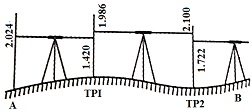
The following radings were obtained during differential leveling.
Reduced Level (RL) of point A is 240.000 m. The fore sight and back sight between points A and TPI in 1.420 m and 2.024 m, respectively. Fore sight and back sight between points TP1 and TP2 is 2.100 m and 1.986 m, respectively. The back sight from B is 1.722 m. These are marked on the givenfigure. What is the RL at turning point – 2 (TP2)? All values are in meteres.
A
242.024
B
241.202
C
240.604
D
240.490
Question 185Single Answer
Which of the following actions is NOT a permanent adjustment in case of trasit theodolite ?
A
Axis of the telescope levewl adjusted to paralled to the line of collimation
B
Axis of the plate level adjusted to perpendicular to vertical axis
C
Bringing the vertical axis of the theorolite exactly over the station mark
D
Horizontal axis is perpendicular to vertical axis when the instrument is levelled
Question 186Single Answer
Which of the following actions is NOT a permanent adjustment in case of trasit theodolite ?
A
Axis of the telescope levewl adjusted to paralled to the line of collimation
B
Axis of the plate level adjusted to perpendicular to vertical axis
C
Bringing the vertical axis of the theorolite exactly over the station mark
D
Horizontal axis is perpendicular to vertical axis when the instrument is levelled
Question 187Single Answer
The ability of a material in endure alternate wet and dry conditions for a long period without considerable deformation and loss of mechanical strength is called :
A
chemical resistance
B
fire resistance
C
weathering resistance
D
frost resistance
Question 188Single Answer
A newly built hose is let out for a rent of Rs. 1,000 per month inclusive of all taxes. If outgoings are at 20% of the gross rent and expected rate of return is 10%, what is the capital value by the rental method of valuation ?
A
Rs. 99,600
B
Rs. 1,12,300
C
Rs. 87,600
D
Rs. 96,000
Question 189Single Answer
What is the approximate composition of silicon dioxide (SiO2) present in ordinary Portland cement ?
A
60 - 67%
B
17 - 25%
C
40 - 50%
D
3 - 8%
Question 190Single Answer
The following statements (C1, C2, C3, C4) pertain in the characteristics of different type of canals. Which of the following statements is/are correct ?
C1 : A contour canal can irrigate command areas on both the banks.
C2 : If is possible to constract a contour canal with banks on one side only
C3 : In the case of a ridge canal, the number of cross drainage works are maximum.
C4 : Side slope canal is aligned roughly at right angles to the ground contours.
A
C1 only
B
C2 and C4 only
C
C1, C3 and C4 only
D
C1 and C3 only
Question 191Single Answer
In an incompressible static flaid column, the rate of increase of pressure in the vertical direction is equal to weight density of fluid at that point. Which of the following is the law for this statements.
A
Bernoulli's law
B
Viscosity law
C
Hydrostatic law
D
Pascal's law
Question 192Single Answer
A construction firm has estimate a net annual rent of Rs. 90,000 on a building, at the prevailing annual rate of interest of 9%. If the annual interest rate is revised to 5%, determine the increase in the capitalized value of the property.
A
Rs. 22,50,000
B
Rs. 8,00,000
C
Rs. 10,00,000
D
Rs. 18,00,000
Question 193Single Answer
. Which constituent in cemnt is to be kept minimum to avoid a sulphate attack ?
A
C2A
B
C3S
C
C3A
D
C2 AF
Question 194Single Answer
The saturation capacity, field capacity and the permanent wilting point of a soil are 47%, 27% and 14%, respectively. The available moisture for the crops grown in the soil is:
A
13%
B
27%
C
20%
D
33%
Question 195Single Answer
On a right angle two - lane road intersection with two-way traffic, the total number of potential conflict points are:
A
24
B
44
C
18
D
32
Question 196Single Answer
Which of the following methods is NOT used for finding deflection of beam ?
A
Moment area method
B
Castigliano's method
C
strain energy method
D
Moment distribution method
Question 197Single Answer
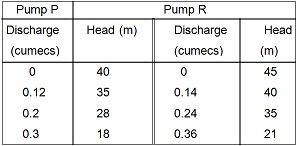
Two centrifugal pumps P and R are available for use in a pipe flow system and their head - discharge characteristics are as follows. The following statements (S1, S2 and S3) pertain to the head and discharge values during actual operation. Neglect looses in the system. Which of the following statements are correct ?
S1 : When the two pumps P and R are connected in paralled, the discharge is 0.36 cumecs corresponding to a head 35 m.
S2 : When the two pumps P and R are connected in paralled, the discharge is 0.36 cumecs corresponding to a head 70 m.
S3 : When the two pumps P and R are connected in series.
The discharge is 0.3 cumecs corresponding to a head 46 m.
A
S2 and S3
B
S2 only
C
S1 and S3
D
S1 and S2
Question 198Single Answer
As per IS 1742 - 1983 normally a sewer shall be designed for discharging ____ times the dry-weather flow flowing half-full with a minimum self-cleansing velocity of ____.
A
three; 0.75m/s
B
four; 1.75m/s
C
two; 0.5m/s
D
five; 2.4m/s
Question 199Single Answer
The determination of shear strength of a soft staturated clay deposit in the filed can be done by :
A
the tri - axial test
B
the vane shear test
C
the unconfined compression test
D
the direct shear test
Question 200Single Answer
The total unit weight of the glacial outwash soil is 5 kN/m3. The water content in the soil is 17%. Find dry unit weight :
A
4.27 kN/m3
B
0.29 kN/m3
C
3.40 kN/m3
D
6.27 kN/m3
Question 201Single Answer
What is the primary focus of kinematics in dynamics?
A
Forces causing motion
B
Motion without forces
C
Energy conservation
D
Momentum transfer
Question 202Single Answer
What is the primary purpose of evaluating bearing capacity in foundation design?
A
Ensure soil can support loads without failure
B
Minimize construction cost
C
Increase settlement
D
Enhance aesthetic appeal
Question 203Single Answer
Which bearing capacity theory is commonly used for shallow foundations?
A
Terzaghi’s theory
B
Rankine’s theory
C
Coulomb’s theory
D
Taylor’s theory
Question 204Single Answer
What field test is commonly used to estimate bearing capacity?
A
Standard Penetration Test (SPT)
B
Proctor test
C
Consolidation test
D
Triaxial test
Question 205Single Answer
What is the factor of safety for allowable bearing capacity?
A
2.5 to 3
B
1.5 to 2
C
4 to 5
D
1 to 1.5
Question 206Single Answer
What is immediate settlement in foundation design?
A
Elastic settlement occurring instantly
B
Settlement due to consolidation
C
Settlement due to shear failure
D
Settlement due to compaction
Question 207Single Answer
What is the allowable settlement for isolated footings on clay?
A
75 mm
B
50 mm
C
25 mm
D
100 mm
Question 208Single Answer
What is the allowable settlement for isolated footings on sand?
A
50 mm
B
75 mm
C
25 mm
D
100 mm
Question 209Single Answer
What is the primary purpose of proportioning shallow foundations?
A
Ensure uniform load distribution and stability
B
Minimize material usage
C
Increase settlement
D
Enhance aesthetic appeal
Question 210Single Answer
What is an isolated footing used for?
A
Support single column loads
B
Support multiple columns
C
Distribute load over large area
D
Support bridge piers
Question 211Single Answer
What is a combined footing used for?
A
Support two or more closely spaced columns
B
Support single column
C
Distribute load over weak soil
D
Support machine loads
Question 212Single Answer
What is a raft foundation used for?
A
Distribute load over large area in weak soils
B
Support single column
C
Minimize construction cost
D
Support deep foundations
Question 213Single Answer
What is a common type of pile foundation?
A
Driven precast pile
B
Spread footing
C
Strip footing
D
Mat foundation
Question 214Single Answer
What is the primary function of a pile foundation?
A
Transfer load to deeper, stronger soil
B
Distribute load over surface soil
C
Reduce settlement in firm soil
D
Increase soil permeability
Question 215Single Answer
What is the static formula for pile capacity based on?
A
Skin friction and end bearing
B
Soil permeability
C
Consolidation settlement
D
Shear strength only
Question 216Single Answer
What is a common dynamic formula for pile capacity?
A
Engineering News formula
B
Terzaghi’s formula
C
Meyerhof’s formula
D
Skempton’s formula
Question 217Single Answer
What is the formula for pile capacity using the Engineering News formula?
A
Q_u = (W h) / (s + C)
B
Q_u = (W h) / s
C
Q_u = (W h) / C
D
Q_u = (W h) / (s - C)
Question 218Single Answer
What is the primary consideration in pile group design?
A
Group efficiency and settlement
B
Individual pile capacity only
C
Soil permeability
D
Construction cost
Question 219Single Answer
What is the efficiency of a pile group?
A
Ratio of group capacity to sum of individual capacities
B
Ratio of individual capacity to group capacity
C
Ratio of settlement to load
D
Ratio of skin friction to end bearing
Question 220Single Answer
What is the purpose of a pile load test?
A
Verify pile capacity and settlement
B
Measure soil permeability
C
Calculate consolidation
D
Assess slope stability
Question 221Single Answer
What is the maximum test load in a pile load test as per IS 2911?
A
2.5 times design load
B
1.5 times design load
C
3 times design load
D
1 times design load
Question 222Single Answer
What is the settlement of a pile group primarily caused by?
A
Compression of soil below pile tips
B
Elastic deformation of piles
C
Shear failure of piles
D
Compaction of soil
Question 223Single Answer
What is the primary method for analyzing piles under lateral loads?
A
P-y curve method
B
Terzaghi’s method
C
Boussinesq’s method
D
Newmark’s method
Question 224Single Answer
What is a key consideration for pile foundations in bridge design?
A
Scour depth and lateral stability
B
Soil permeability only
C
Consolidation settlement
D
Construction cost only
Question 225Single Answer
What is the purpose of ground improvement techniques?
A
Enhance soil strength and reduce settlement
B
Increase soil permeability
C
Reduce soil density
D
Increase construction cost
Question 226Single Answer
What is the primary property of a fluid?
A
Inability to resist shear stress
B
High compressive strength
C
Fixed shape
D
High rigidity
Question 227Single Answer
What is the specific gravity of a fluid?
A
Ratio of fluid density to water density
B
Ratio of fluid viscosity to water viscosity
C
Ratio of fluid pressure to water pressure
D
Ratio of fluid volume to water volume
Question 228Single Answer
What is the total pressure force on a vertical plane surface submerged in a fluid?
A
F = p g h_c A
B
F = p g A
C
F = p h_c A
D
F = p g h_c / A
Question 229Single Answer
Where is the center of pressure located for a vertical plane surface?
A
Below the centroid
B
At the centroid
C
Above the centroid
D
At the surface
Question 230Single Answer
What is the force on a curved surface submerged in a fluid?
A
Sum of horizontal and vertical components
B
Horizontal component only
C
Vertical component only
D
No force
Question 231Single Answer
What is fluid kinematics concerned with?
A
Motion of fluid without considering forces
B
Forces causing fluid motion
C
Fluid properties at rest
D
Energy transfer in fluids
Question 232Single Answer
What is a streamline in fluid flow?
A
Path traced by a fluid particle tangent to velocity
B
Path perpendicular to velocity
C
Path of constant pressure
D
Path of constant density
Question 233Single Answer
What is the condition for irrotational flow?
A
Zero vorticity
B
Constant velocity
C
Zero velocity
D
Constant pressure
Question 234Single Answer
What is the velocity potential in fluid flow?
A
Scalar function whose gradient gives velocity
B
Vector function of pressure
C
Scalar function of density
D
Vector function of vorticity
Question 235Single Answer
What is the stream function used for?
A
Represent two-dimensional incompressible flow
B
Calculate pressure distribution
C
Measure vorticity
D
Determine fluid density
Question 236Single Answer
What is a flownet?
A
Grid of streamlines and equipotential lines
B
Grid of pressure lines
C
Grid of velocity lines
D
Grid of density lines
Question 237Single Answer
What is the property of a flownet?
A
Streamlines and equipotential lines are perpendicular
B
Streamlines are parallel
C
Equipotential lines are parallel
D
Streamlines and equipotential lines are parallel
Question 238Single Answer
What is a source in fluid flow?
A
Point where fluid flows radially outward
B
Point where fluid converges
C
Point of zero velocity
D
Point of constant pressure
Question 239Single Answer
What is a sink in fluid flow?
A
Point where fluid flows radially inward
B
Point where fluid flows outward
C
Point of zero vorticity
D
Point of constant velocity
Question 240Single Answer
What is flow separation in fluid flow?
A
Fluid detaching from a surface due to adverse pressure gradient
B
Fluid merging with a surface
C
Fluid maintaining constant velocity
D
Fluid becoming turbulent
Question 241Single Answer
What is a free vortex?
A
Rotational flow with constant angular velocity
B
Irrotational flow with velocity inversely proportional to radius
C
Flow with no vorticity
D
Flow with constant pressure
Question 242Single Answer
What is a forced vortex?
A
Rotational flow with constant angular velocity
B
Irrotational flow with constant velocity
C
Flow with no vorticity
D
Flow with constant pressure
Question 243Single Answer
What is fluid dynamics concerned with?
A
Forces and energy causing fluid motion
B
Fluid motion without forces
C
Fluid properties at rest
D
Fluid density only
Question 244Single Answer
What is the control volume approach used for?
A
Apply conservation laws to a fixed region
B
Measure fluid density
C
Calculate fluid viscosity
D
Determine fluid temperature
Question 245Single Answer
What is the momentum equation based on?
A
Newton second law
B
Newton first law
C
Newton third law
D
Bernoulli principle
Question 246Single Answer
What is the energy equation for steady flow?
A
Bernoulli equation
B
Continuity equation
C
Momentum equation
D
Navier-Stokes equation
Question 247Single Answer
What is the Navier-Stokes equation used for?
A
Describe motion of viscous fluids
B
Calculate fluid density
C
Measure fluid pressure
D
Determine fluid temperature
Question 248Single Answer
What is Euler equation of motion?
A
Simplified Navier-Stokes for inviscid flow
B
Equation for viscous flow
C
Equation for static fluids
D
Equation for compressible flow
Question 249Single Answer
What is the coefficient of discharge (C_d) for an orifice?
A
Ratio of actual to theoretical discharge
B
Ratio of theoretical to actual discharge
C
Ratio of velocity to pressure
D
Ratio of pressure to velocity
Question 250Single Answer
What is a Venturi meter used for?
A
Measure flow rate in pipes
B
Measure fluid density
C
Calculate fluid viscosity
D
Determine fluid temperature
Question 251Single Answer
What is runoff in hydrology defined as?
A
Water that infiltrates into the ground
B
Water that flows over the surface into streams
C
Water stored in reservoirs
D
Water evaporated from the surface
Question 252Single Answer
Which factor most significantly affects runoff estimation?
A
Soil permeability
B
Air temperature
C
Wind speed
D
Cloud cover
Question 253Single Answer
What is the primary purpose of runoff estimation in hydrology?
A
Determine groundwater recharge
B
Design hydraulic structures
C
Measure evaporation rates
D
Calculate soil moisture
Question 254Single Answer
Which method is commonly used for runoff estimation in small catchments?
A
Rational method
B
Unit hydrograph method
C
SCS curve number method
D
Muskingum method
Question 255Single Answer
What is the primary source of runoff in a catchment?
A
Groundwater flow
B
Precipitation
C
Evapotranspiration
D
Infiltration
Question 256Single Answer
Which soil type produces the highest runoff?
A
Sandy soil
B
Loamy soil
C
Clayey soil
D
Gravelly soil
Question 257Single Answer
What is the effect of urbanization on runoff?
A
Decreases runoff
B
Increases runoff
C
No effect
D
Reduces infiltration
Question 258Single Answer
Which parameter is critical for the Rational method of runoff estimation?
A
Time of concentration
B
Base flow
C
Evaporation rate
D
Groundwater storage
Question 259Single Answer
What is the primary purpose of the SCS curve number method?
A
Estimate peak discharge
B
Calculate direct runoff
C
Measure base flow
D
Analyze evaporation
Question 260Single Answer
What is the effect of vegetation cover on runoff?
A
Increases runoff
B
Decreases runoff
C
No effect
D
Increases evaporation
Question 261Single Answer
Which factor is used to estimate runoff in the Rational method?
A
Runoff coefficient
B
Curve number
C
Base flow
D
Hydraulic conductivity
Question 262Single Answer
What is the primary purpose of runoff estimation in flood control?
A
Design irrigation systems
B
Predict flood magnitude
C
Measure groundwater recharge
D
Calculate evaporation
Question 263Single Answer
Which method is used for runoff estimation in large catchments?
A
Rational method
B
SCS curve number method
C
Unit hydrograph method
D
Muskingum method
Question 264Single Answer
What is the effect of increasing rainfall intensity on runoff?
A
Decreases runoff
B
Increases runoff
C
No effect
D
Reduces infiltration
Question 265Single Answer
Which soil condition leads to the lowest runoff?
A
Saturated soil
B
Dry sandy soil
C
Compacted clay
D
Urban pavement
Question 266Single Answer
What is the primary purpose of the runoff coefficient in the Rational method?
A
Quantify runoff proportion
B
Measure infiltration
C
Calculate base flow
D
Estimate evaporation
Question 267Single Answer
Which factor is critical for the SCS curve number method?
A
Time of concentration
B
Base flow
C
Curve number
D
Hydraulic gradient
Question 268Single Answer
What is the effect of increasing slope on runoff?
A
Decreases runoff
B
Increases runoff
C
No effect
D
Reduces infiltration
Question 269Single Answer
Which method is used for runoff estimation in ungauged catchments?
A
Rational method
B
Unit hydrograph method
C
SCS curve number method
D
Muskingum method
Question 270Single Answer
What is the primary purpose of runoff estimation in reservoir design?
A
Calculate evaporation
B
Determine inflow volume
C
Measure groundwater recharge
D
Analyze soil moisture
Question 271Single Answer
What is a hydrograph defined as?
A
Graph of rainfall intensity over time
B
Graph of streamflow over time
C
Graph of infiltration rate over time
D
Graph of evaporation over time
Question 272Single Answer
What is the primary purpose of a unit hydrograph?
A
Estimate peak discharge from a unit rainfall
B
Calculate groundwater recharge
C
Measure evaporation rates
D
Analyze soil moisture
Question 273Single Answer
Which component of a hydrograph represents the initial flow before rainfall?
A
Peak discharge
B
Base flow
C
Direct runoff
D
Recession limb
Question 274Single Answer
What is the primary use of a hydrograph in flood forecasting?
A
Predict peak flood discharge
B
Calculate infiltration rates
C
Measure evaporation
D
Estimate soil moisture
Question 275Single Answer
Which parameter is critical for deriving a unit hydrograph?
A
Rainfall duration
B
Evaporation rate
C
Groundwater storage
D
Soil permeability
Question 276Single Answer
What is the degree of kinematic indeterminacy for a simply supported beam with an internal hinge?
A
1
B
2
C
3
D
4
Question 277Single Answer
What is the primary structural behavior of a frame under vertical loads?
A
Axial deformation
B
Bending deformation
C
Shear deformation
D
Torsional deformation
Question 278Single Answer
How many plastic hinges are required for collapse in a portal frame with fixed supports?
A
2
B
3
C
4
D
5
Question 279Single Answer
What is the effect of a point load at the crown of a three-hinged arch?
A
Increases horizontal thrust
B
Decreases horizontal thrust
C
No horizontal thrust
D
Causes shear failure
Question 280Single Answer
What is the purpose of special positional reinforcement in a reinforced concrete frame near joints?
A
Resist bending moment
B
Prevent shear failure
C
Increase compressive strength
D
Enhance aesthetic appeal
Question 281Single Answer
What is the degree of static indeterminacy for a two-hinged portal frame?
A
1
B
2
C
3
D
4
Question 282Single Answer
What is the collapse mechanism in a fixed beam under uniform load?
A
One plastic hinge
B
Two plastic hinges
C
Three plastic hinges
D
Four plastic hinges
Question 283Single Answer
What is the primary force in the tie of a tied arch?
A
Compression
B
Tension
C
Shear
D
Bending
Question 284Single Answer
What is the purpose of providing stirrups in a reinforced concrete frame?
A
Resist tensile forces
B
Resist shear forces
C
Increase compressive strength
D
Prevent cracking
Question 285Single Answer
What is the degree of kinematic indeterminacy for a two-hinged portal frame?
A
0
B
1
C
2
D
3
Question 286Single Answer
What is the bending moment at the support of a fixed portal frame under uniform load?
A
Zero
B
Maximum
C
Equal to shear force
D
Indeterminate
Question 287Single Answer
What is the number of plastic hinges required for collapse in a simply supported beam with an internal hinge?
A
1
B
2
C
3
D
4
Question 288Single Answer
What is the effect of unsymmetrical loading on a three-hinged arch?
A
No horizontal thrust
B
Increases horizontal thrust
C
Decreases horizontal thrust
D
Causes torsional failure
Question 289Single Answer
What is the role of bent-up bars in a reinforced concrete frame?
A
Resist tensile forces
B
Resist shear forces
C
Increase compressive strength
D
Prevent buckling
Question 290Single Answer
What is the degree of static indeterminacy for a planar frame with 3 members, 3 joints, and 6 reactions?
A
0
B
1
C
2
D
3
Question 291Single Answer
What is the primary load-carrying mechanism in a fixed arch?
A
Bending
B
Compression
C
Shear
D
Torsion
Question 292Single Answer
What is the collapse load of a propped cantilever beam compared to a simply supported beam?
A
Lower
B
Zero
C
Equal
D
Higher
Question 293Single Answer
What is the degree of kinematic indeterminacy for a fixed beam with an internal hinge?
A
0
B
1
C
2
D
3
Question 294Single Answer
What is the horizontal thrust in a two-hinged arch under uniform load?
A
Zero
B
Maximum at supports
C
Equal to vertical load
D
Indeterminate
Question 295Single Answer
What is the purpose of shear reinforcement in a reinforced concrete frame near supports?
A
Resist bending moment
B
Prevent shear cracks
C
Increase compressive strength
D
Enhance ductility
Question 296Single Answer
What is the degree of static indeterminacy for a simply supported beam with an internal hinge?
A
0
B
1
C
2
D
3
Question 297Single Answer
What is the primary structural behavior of an arch under vertical loads?
A
Axial compression
B
Bending deformation
C
Shear deformation
D
Torsional deformation
Question 298Single Answer
How many plastic hinges are required for collapse in a two-hinged portal frame?
A
2
B
3
C
4
D
5
Question 299Single Answer
What is the effect of temperature drop on a two-hinged arch?
A
Increases vertical deflection
B
Increases horizontal thrust
C
Decreases horizontal thrust
D
No effect
Question 300Single Answer
What is the role of diagonal reinforcement in a reinforced concrete frame near joints?