How many such pairs of letters are there in the word ‘CLEANLINESS’ each of the which has as many letters between them in the word as they have in the English alphabet, in the same sequence?
A
Two
B
Three
C
Five
D
Four
E
None of these
Question 2Single Answer
Team A has scored more goals than Team B
Team C has scored fewer goals than Team B
Team A has scored fewer goals than Team C .
If the first two statements are true, the third statement is
A
True
B
False
C
Uncertain
D
None
Question 3Single Answer
If it is possible to make only one meaningful word with the second, the third, the sixth and the eight letters of the word FRAGMENT using each only once, which of the following will be the third letter of that word ? If no such word can be formed, give ‘X’ as the answer and if more than one such word can be formed, give ‘Y’ as the answer.
A
A
B
E
C
T
D
X
E
Y
Question 4Single Answer
How many such letters are there in the word ORIENTAL each of which is as far away from the beginning of the word as when they are arranged alphabetically?
A
None
B
One
C
Two
D
Three
E
More than three
Question 5Single Answer
How many such pairs of letters in the word CREDIT each of which has as many letters between them in the word as in the English alphabet?
A
None
B
One
C
Two
D
Three
E
More than three
Question 6Single Answer
How many meaningful words can be made from the letters ‘LMEA’ using each letter only once in each word?
A
None
B
One
C
Two
D
Three
E
More than three
Question 7Single Answer
If it is possible to make only one meaningful word with the first, the second, the seventh and the eighth letters of the word TEMPORAL, which of the following will be the first letter of that word? If more than one such word can be made, give ‘Y’ as the answer and if no such word can be made, give ‘X’ as the answer.
A
T
B
L
C
E
D
Y
E
X
Question 8Single Answer
If the letters of the word HANDOVER are arranged alphabetically from left to right how many letters will remain at the same position?
A
None
B
One
C
Two
D
Three
E
More than three
Question 9Single Answer
How many such pairs of letters are there in the word EXCURSION, each of which has as many letters between them in the word as they have in the English alphabet?
A
None
B
One
C
Two
D
Three
E
More than three
Question 10Single Answer
If it is possible to make only one meaningful word with the first, the second, the third, the sixth and the eighth letters of the word DEVIATION first letter of that word is your answer? If more than one such word can be made formed your answer is ‘A’ and if no such word can be formed your answer is ‘B’.
A
V
B
T
C
E
D
A
E
B
Question 11Single Answer
Passage :
A B C D E F G H I J K L M N O P Q R S T U V W X Y Z .
Which letter in this alphabet is the eighth letter to the right of the letter and which is tenth letter to the left of the last but one letter of the alphabet ?
A
X
B
W
C
I
D
H
Question 12Single Answer
Passage :
Direction : The following question is based on the five words given below:
AND FOR THE BIG SUM (The new words formed after performing the mentioned operations may or may not necessarily the meaningful English words.)
If the third alphabet of each of the words is changed to the next alphabet in the English alphabetical series, which of the following will form a meaningful English word?
A
SUM
B
BIG
C
Both BIG and THE
D
FOR
E
Both FOR and BIG
Question 13Single Answer
Passage :
Direction : The following question is based on the five words given below:
AND FOR THE BIG SUM (The new words formed after performing the mentioned operations may or may not necessarily the meaningful English words.)
If the given words are arranged in the order as they would appear in a dictionary from left to right, which of the following will be second from the right ?
A
AND
B
FOR
C
THE
D
BIG
E
SUM
Question 14Single Answer
Passage :
Direction: The following question is based on the five words given below:
AND FOR THE BIG SUM (The new words formed after performing the mentioned operations may or may not necessarily the meaningful English words.)
If second alphabet in each of the words is changed to next alphabet in the English alphabetical order, how many words having two vowels (same or different vowels) will be formed ?
A
None
B
One
C
Two
D
Three
E
Four
Question 15Single Answer
Passage :
Direction : The following question is based on the five words given below:
AND FOR THE BIG SUM (The new words formed after performing the mentioned operations may or may not necessarily the meaningful English words.)
How many letters are there in the English alphabetical series between the second letter of the word which is second from the right and the second letter of the word which is second from the left of the given words?
A
Two
B
Five
C
Six
D
Nine
E
Three
Question 16Single Answer
Passage :
Direction: The following question is based on the five words given below:
AND FOR THE BIG SUM (The new words formed after performing the mentioned operations may or may not necessarily the meaningful English words.)
If in each of the given words, each of the consonant is changed to previous letter and each vowel is changed to next letter in the English alphabetical series, in how many words thus formed will no vowels appear?
A
None
B
One
C
Two
D
Three
E
More than three
Question 17Single Answer
Passage :
Direction : Following question is based on five words given below: BRU LEGINKCATOWN
(The new words formed after performing the mentioned operations may or may not necessarily be meaningful English words)
If the third alphabet in each of the words is changed to the next alphabet in the English alphabetical order, how many words having two vowels (same or different vowels) will be formed?
A
None
B
One
C
Two
D
Three
E
Four
Question 18Single Answer
Passage :
Direction : Following question is based on five words given below: BRU LEGINKCATOWN
(The new words formed after performing the mentioned operations may or may not necessarily be meaningful English words)
If the position of the first and the second alphabets of each of the words are interchanged, which of the following will form a meaningful English word?
A
Both CAT and OWN
B
Both BRU and INK
C
Only CAT
D
Only INK
E
Only LEG
Question 19Single Answer
Passage :
Direction: Following question is based on five words given below: BRU LEGINKCATOWN
(The new words formed after performing the mentioned operations may or may not necessarily be meaningful English words)
If the given words are arranged in the order as they would appear in a dictionary from left to right, which of the following will be exactly in the middle of the five words?
A
OWN
B
LEG
C
BRU
D
CAT
E
INK
Question 20Single Answer
Passage :
Direction: Following question is based on five words given below: BRU LEGINKCATOWN
(The new words formed after performing the mentioned operations may or may not necessarily be meaningful English words)
If in each of the given words, each of the consonants is changed to previous letter and each vowel is changed to next letter in the English alphabetical series, in how many words thus formed will the same alphabet appear twice?
A
None
B
One
C
Two
D
Three
E
More than three
Question 21Single Answer
Passage :
Find the missing number in the following series ?
3, 5, 5, 19, 7, 41, 9, ?
A
71
B
61
C
79
D
69
Question 22Single Answer
Passage :
Direction: following question is based on five words given below:
LAP BUT CAR SON HID
(The new words formed after performing the mentioned operations may or may not necessarily be meaningful English words.)
If the positions of the first and the third alphabets of each of the words are interchanged, which of the following would form meaningful words with the new arrangement?
A
HID
B
SON
C
Both LAP and BUT
D
CAR
E
Both CAR and LAP
Question 23Single Answer
Passage :
Direction: following question is based on five words given below:
LAP BUT CAR SON HID
(The new words formed after performing the mentioned operations may or may not necessarily be meaningful English words.)
If the given words are arranged in the order as they would appear in a dictionary from left to right, which of the following will be fourth from the left?
A
LAP
B
BUT
C
CAR
D
SON
E
HID
Question 24Single Answer
Passage :
Direction : following question is based on five words given below:
LAP BUT CAR SON HID
(The new words formed after performing the mentioned operations may or may not necessarily be meaningful English words.)
If in each of given words, each of the consonants is changed to previous letter and each vowel is changed to next letter in the English alphabetical series, in how many words thus formed will at least one vowel appear?
A
None
B
One
C
Two
D
Three
E
More than three
Question 25Single Answer
Passage :
Direction : following question is based on five words given below:
LAP BUT CAR SON HID
(The new words formed after performing the mentioned operations may or may not necessarily be meaningful English words.)
How many letters are there in the English alphabetical series between the third letter of the word which is third from the right and the first letter of the word which is first from the left of the given word?
A
Two
B
Five
C
Six
D
Nine
E
Three
Question 26Single Answer
Passage :
Direction : Each of the questions below consists of a question and two statements numbered (I) and (II) given below it. You have to decide whether the data provided in the statements are sufficient to answer the question. Read both the statements and give answer :
How many employees of bank ‘X’ opted for VRS ?
(I) 18% of the 950 officer cadre employees and 6% of the 1100 of all other cadre employees opted for VRS. (II) 28% of the employees in the age group of 51 to 56 and 17% of the employees in all other age groups opted for VRS.
A
Statement (I) ALONE is sufficient, but statement (II) alone is not sufficient
B
Statement (II) ALONE is sufficient, but statement (I) alone is not sufficient
C
BOTH statements TOGETHER are sufficient, but NEITHER statement alone is sufficient
D
EACH statement ALONE is sufficient
Question 27Single Answer
Passage :
Direction : Each of the questions below consists of a question and two statements numbered (I) and (II) given below it. You have to decide whether the data provided in the statements are sufficient to answer the question. Read both the statements and give answer :
The area of a playground is 1600 square meters. What is its perimeter ?
(I) It is a perfect square playground
(II) It costs Rs.3200 to put a fence around the playground at the rate of Rs.20 per meter.
A
Statement (I) ALONE is sufficient, but statement (II) alone is not sufficient
B
Statement (II) ALONE is sufficient, but statement (I) alone is not sufficient
C
BOTH statements TOGETHER are sufficient, but NEITHER statement alone is sufficient
D
EACH statement ALONE is sufficient
Question 28Single Answer
Passage :
Direction : Each of the questions below consists of a question and two statements numbered (I) and (II) given below it. You have to decide whether the data provided in the statements are sufficient to answer the question. Read both the statements and give answer :
What is the value of m – n ÷ 37 ?
(I) m is the largest possible six-digit number and n is the smallest possible six-digit number.
(II) The difference between m and n is known.
A
Statement (I) ALONE is sufficient, but statement (II) alone is not sufficient
B
Statement (II) ALONE is sufficient, but statement (I) alone is not sufficient
C
BOTH statements TOGETHER are sufficient, but NEITHER statement alone is sufficient
D
EACH statement ALONE is sufficient
Question 29Single Answer
Passage :
Direction : Each of the questions below consists of a question and two statements numbered (I) and (II) given below it. You have to decide whether the data provided in the statements are sufficient to answer the question. Read both the statements and give answer :
What is the value of x ?
(I) If 10 is added to x, the result is 34.
(II) If x is multiplied by y, the result is 38.
A
Statement (I) ALONE is sufficient, but statement (II) alone is not sufficient
B
Statement (II) ALONE is sufficient, but statement (I) alone is not sufficient
C
BOTH statements TOGETHER are sufficient, but NEITHER statement alone is sufficient
D
EACH statement ALONE is sufficient
Question 30Single Answer
Passage :
Direction : Each of the questions below consists of a question and two statements numbered (I) and (II) given below it. You have to decide whether the data provided in the statements are sufficient to answer the question. Read both the statements and give answer :
What was the total compound interest on a sum after three years ?
(I) The interest after one year was Rs. 100 and the sum after was Rs.1000.
(II) The difference between simple and compound interest on a sum of Rs.1000 at the end of two years was Rs.10.
A
Statement (I) ALONE is sufficient, but statement (II) alone is not sufficient
B
Statement (II) ALONE is sufficient, but statement (I) alone is not sufficient
C
BOTH statements TOGETHER are sufficient, but NEITHER statement alone is sufficient
D
EACH statement ALONE is sufficient
Quantitative Aptitude
Question 31Single Answer
The cash difference between the selling prices of an article at a profit of 4% and 6% is Rs. 3. The ratio of the two selling prices is:__________ ?
A
51:52
B
52:53
C
51:53
D
52:55
Question 32Single Answer
Which of the following numbers is irrational ?
A
√49
B
0.125
C
√2
D
22/7
Question 33Single Answer
356 x 936 – 356 x 836 = ?
A
35600
B
34500
C
9630
D
93600
Question 34Single Answer
Arrange in descending order: 5/8, 7/10, 3/4
A
3/4 > 7/10 > 5/8
B
7/10 > 3/4 > 5/8
C
3/4 > 5/8 > 7/10
D
5/8 > 7/10 > 3/4
Question 35Single Answer
What is (3^{4} times 9^{2}) ?
A
36
B
38
C
310
D
96
Question 36Single Answer
If 34X-2 = 729, then find the value of X.
A
4
B
3
C
2
D
5
Question 37Single Answer
Convert 0.6 into fraction ?
A
3/5
B
2/3
C
4/5
Question 38Single Answer
The no. plate of a bus had peculiarity. The bus number was a perfect square. It was also a perfect square when the plate numbers were reversed. The bus company had only five hundred buses numbered from 1 to 500. What was the number ?
A
169
B
36
C
196
D
Can not say
Question 39Single Answer
If a and b are positive integers, such that ab = 125, then (a-b)a+b-4 = ?
A
16
B
25
C
28
D
30
Question 40Single Answer
If x*y = x2 + y2 – xy, then value of 9*11 is
A
93
B
103
C
60.5
D
121
Question 41Single Answer
Which is greater ?
A
15/16
B
17/18
C
Equal
D
Cannot compare
Question 42Single Answer
If sum of two numbers is 42 and their product is 437, then find their difference.
A
3
B
4
C
5
D
7
Question 43Single Answer
Write the 44000 in Roman numerals
A
XLI
B
XLVI
C
XLIV
D
XLVIC
Question 44Single Answer
Convert 0.0909… into fraction ?
A
1/11
B
9/11
C
1/9
D
9/10
Question 45Single Answer
What is (98 times 102) ?
A
9996
B
10000
C
10096
D
10196
Question 46Single Answer
Which is smaller ?
A
9/11
B
7/9
C
Equal
D
Cannot compare
Question 47Single Answer
Convert 0.5777… into fraction ?
A
26/45
B
52/90
C
13/22
D
5/9
Question 48Single Answer
Convert 0.81 into fraction ?
A
81/100
B
9/10
C
8/9
D
9/11
Question 49Single Answer
(63)2 – (12)2 =?
A
3528
B
3852
C
3582
D
3825
Question 50Single Answer
Which is greater ?
A
13/17
B
11/14
C
Equal
D
Cannot compare
Important Questions Package
GSSSB Supervisor Instructor Fabrication Exam Online Question Bank Package
Buy GSSSB Supervisor Instructor Fabrication Important Questions, MCQ, question answer in Hindi & English. It will help you to score high marks in GSSSB Supervisor Instructor Fabrication question bank 2026 in Online, PDF & Print study material.
+ Free Monthly Current Affairs, GK & more PDF Download
Sr.
Package Name
Amount
1.
GSSSB Supervisor Instructor (Fabrication) Exam - English
Description : 1000 Question with Answer
₹101[₹500]
2.
GSSSB Supervisor Instructor (Fabrication) Exam - English
Description : 2000 Question with Answer
₹151[₹500]
3.
GSSSB Supervisor Instructor (Fabrication) Exam - English
Description : 3000 Question with Answer
₹181[₹500]
4.
GSSSB Supervisor Instructor (Fabrication) Exam - English
Description : 4000 Question with Answer
₹201[₹500]
5.
GSSSB Supervisor Instructor (Fabrication) Exam - English
Description : 1000 Question & Answer Download in PDF (Send by Email)
₹151[₹450]
6.
GSSSB Supervisor Instructor (Fabrication) Exam Question Bank Book - English
Description : 1000 Question with Answer (Printed Material)
₹390[₹600]
Quantitative Aptitude
Question 51Single Answer
16.928 + 24.7582 5.015 =?
A
20
B
24
C
22
D
26
Question 52Single Answer
Convert 0.75 into fraction ?
A
3/4
B
2/3
C
4/5
D
5/8
Question 53Single Answer
Passage :
information given below and answer the question that follow.
The result of an exam is given below. Out of 1000 students who appeared
(i) 658 failed in Physics
(ii) 166 failed in Physics and Chemistry
(iii) 372 failed in Chemistry, 434 failed in Physics and Maths
(iv) 590 failed in Maths, 126 failed in Maths & Chemistry
Find the number of people who failed in (assuming that none is passed in all subjects.
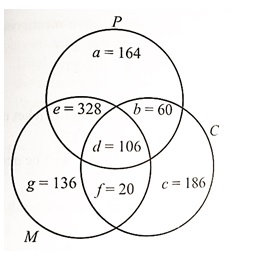
We have the following equations:
a+ b + c + d + e + f + g = 1000
a + b + d + e = 658, b + d = 166
b + d + c + f = 372
d + e = 434 as in the figure.
d + e + f + g = 590, d + f = 126. Find the values
Chemistry but not in Physics.
A
318
B
198
C
213
D
206
Question 54Single Answer
Passage :
Direction: information given below and answer the question that follow.
The result of an exam is given below. Out of 1000 students who appeared
(i) 658 failed in Physics
(ii) 166 failed in Physics and Chemistry
(iii) 372 failed in Chemistry, 434 failed in Physics and Maths
(iv) 590 failed in Maths, 126 failed in Maths & Chemistry
Find the number of people who failed in (assuming that none is passed in all subjects.
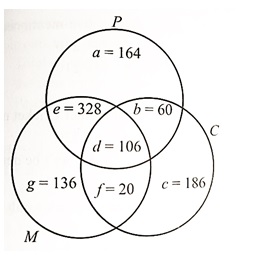
We have the following equations:
a+ b + c + d + e + f + g = 1000
a + b + d + e = 658, b + d = 166
b + d + c + f = 372
d + e = 434 as in the figure.
d + e + f + g = 590, d + f = 126. Find the values
Physics or Maths but not in Chemistry.
A
558
B
718
C
628
D
None of these
Question 55Single Answer
Passage :
For the next four question that follow:
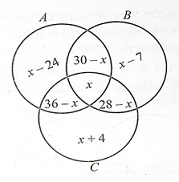
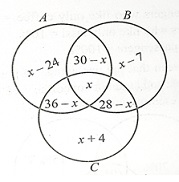
In a city, three daily newspapers A, B, C are published, 42% read A; 51% read B; 68% read C; 30% read A and B; 28% read B and C; 36% read A and C; 8% do not read any of the three newspapers.
Let x% people read all the three newspapers.
Since 8% people do not read any newspapers.
(x – 24) + (x – 7) + (x + 4) + (30 – x) + (36 – x) + (28 – x) + x = 92
→ x + 98 – 31 = 92
→ x = 92 – 67 = 25
What is the percentage of persons who read all the three papers ?
A
20%
B
25%
C
30%
D
40%
Question 56Single Answer
Passage :
For the next four : question that follow :
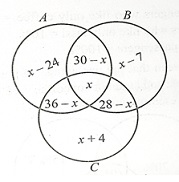
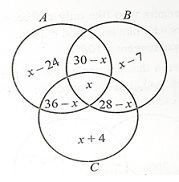
In a city, three daily newspapers A, B, C are published, 42% read A; 51% read B; 68% read C; 30% read A and B; 28% read B and C; 36% read A and C; 8% do not read any of the three newspapers.
Let x% people read all the three newspapers.
Since 8% people do not read any newspapers.
(x – 24) + (x – 7) + (x + 4) + (30 – x) + (36 – x) + (28 – x) + x = 92
→ x + 98 – 31 = 92
→ x = 92 – 67 = 25
What is the percentage of persons who read only two papers?
A
19%
B
31%
C
44%
D
None of these
Question 57Single Answer
Passage :
For the next four : question that follow :
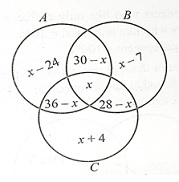
In a city, three daily newspapers A, B, C are published, 42% read A; 51% read B; 68% read C; 30% read A and B; 28% read B and C; 36% read A and C; 8% do not read any of the three newspapers.
Let x% people read all the three newspapers.
Since 8% people do not read any newspapers.
(x – 24) + (x – 7) + (x + 4) + (30 – x) + (36 – x) + (28 – x) + x = 92
→ x + 98 – 31 = 92
→ x = 92 – 67 = 25
What is the percentage of persons who read only one paper ?
A
38%
B
48%
C
51%
D
None of these
Question 58Single Answer
Passage :
For the next four : question that follow:
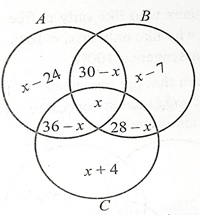
In a city, three daily newspapers A, B, C are published, 42% read A; 51% read B; 68% read C; 30% read A and B; 28% read B and C; 36% read A and C; 8% do not read any of the three newspapers.
Let x% people read all the three newspapers.
Since 8% people do not read any newspapers.
(x – 24) + (x – 7) + (x + 4) + (30 – x) + (36 – x) + (28 – x) + x = 92
→ x + 98 – 31 = 92
→ x = 92 – 67 = 25
What is the percentage of persons who read only A but neither B nor C ?
A
4%
B
3%
C
1%
D
None of these
Question 59Single Answer
Passage :
For the next four : question that follow:
In a city, three daily newspapers A, B, C are published, 42% read A; 51% read B; 68% read C; 30% read A and B; 28% read B and C; 36% read A and C; 8% do not read any of the three newspapers.
Let x% people read all the three newspapers.
Since 8% people do not read any newspapers.
(x – 24) + (x – 7) + (x + 4) + (30 – x) + (36 – x) + (28 – x) + x = 92
→ x + 98 – 31 = 92
→ x = 92 – 67 = 25
If A and B are any two sets, then what is A ᴖ (A ᴗ B) equal to ?
A
Complement of A
B
Complement of B
C
B
D
A
Question 60Single Answer
Passage :
For the next four : question that follow:
In a city, three daily newspapers A, B, C are published, 42% read A; 51% read B; 68% read C; 30% read A and B; 28% read B and C; 36% read A and C; 8% do not read any of the three newspapers.
Let x% people read all the three newspapers.
Since 8% people do not read any newspapers.
(x – 24) + (x – 7) + (x + 4) + (30 – x) + (36 – x) + (28 – x) + x = 92
→ x + 98 – 31 = 92
→ x = 92 – 67 = 25
40% of the people read newspaper X, 50% read newspaper Y and 10% read both the papers. What percentage of the people read neither newspaper ?
A
10%
B
15%
C
20%
D
25%
Constitution of India, Current Affairs, Comprehension
Question 61Single Answer
I go to Madurai by —– Vaigai Express
A
a
B
an
C
some
D
the
Question 62Single Answer
Have the car stolen!
A
Steal the car
B
You should have the stolen car
C
Get someone to steal the car
D
They have stolen the car
Question 63Single Answer
Passage :
Direction : Question below has two blanks, each blank indicting that some thing has been omitted. Choose the word for each blank which best fits the meaning of the sentence as a whole.
The Finance Department has ……………a centralized online databank system for all statutory government bodies to …………an eye on their assets and liabilities.
A
presented , stay
B
introduced , keep
C
announce , make
D
created , let
E
proclaimed , hold
Question 64Single Answer
Passage :
Direction : The five items in this section consists of a word or group of words followed by four words as (a), (b), (c) and (d). Select the word which is nearly opposite to the meaning of the original word or group of words and mark your response as (a), (b), (c) and (d), as the case may be, in your Answer Sheet.
Assets
A
liabilities
B
responsibilities
C
estates
D
profits
Question 65Single Answer
Passage :
Direction : In the question, out of the four alternatives, choose the word which is opposite in meaning to the given word and click the button corresponding to it
Affidavit
A
Affirmation
B
Slander
C
Oath
D
Testimony
Question 66Single Answer
"શાંતિ" શબ્દનો અર્થ શું છે ?
A
વાતચીત
B
આક્રમણ
C
ખેડૂત
D
ધમાધમ
Question 67Single Answer
"વ્યક્તિ" શબ્દનો વિલોમ શબ્દ શું છે ?
A
સંગઠન
B
વ્યવસ્થા
C
સંવિદાન
D
અનવરત
Question 68Single Answer
"વિકાસ" શબ્દનું અર્થ શું છે ?
A
અભિવૃદ્ધિ
B
વિઘટન
C
વિદ્યા
D
આકર્ષણ
Question 69Single Answer
"સ્થાન" શબ્દનું વિરોધી શબ્દ શું છે ?
A
ધૂપ
B
દૂર
C
જગ્યા
D
આવેશ
Question 70Single Answer
"મંજિલ" શબ્દનો વ્યાપારિક અર્થ શું છે ?
A
ગોલ
B
ધબ્બુ
C
સાંજ
D
ઉદ્દેશ
Question 71Single Answer
Which Act gave separate electorate rights to Muslims in India ?
A
The Indian Councils Act, 1909
B
The Government of India Act, 1915
C
The Government of India Act, 1919
D
The Government of India Act, 1935
Question 72Single Answer
Which one of the following made the Indian Legislature bicameral ?
A
The Indian Councils Act, 1909
B
Government of India Act, 1919
C
Government of India Act, 1935
D
Indian Independence Act, 1947
Question 73Single Answer
'Diarchy' was established in India by which of the following ?
A
The Indian Councils Act, 1909
B
The Government of India Act, 1935
C
The Government of India Act, 1919
D
None of the above
Question 74Single Answer
Which one of the following aimed at providing a federal structure for India ?
A
Indian Councils Act, 1909
B
Government of India Act, 1919
C
Government of India Act, 1935
D
Indian Independence Act, 1947
Question 75Single Answer
As a guardian of the government of India Act, 1935 a Court was constituted which was called.
A
Privy Council
B
Supreme Court
C
High Court
D
Federal Court
Question 76Single Answer
Under the Government of India Act 1935, the Federal court had -
A
Original jurisdiction only
B
Appellate jurisdiction only
C
Advisory jurisdiction only
D
Original, appellate and advisory jurisdiction
Question 77Single Answer
Under the Government of India's Act 1935, how many Governors and Chief Commissioners provinces constituted in British India ?
A
14 and 7
B
11 and 7
C
15 and 9
D
None of the above
Question 78Single Answer
The Mountbaten plan led to the enactment of :
A
Government of India Act, 1919
B
Government of India Act, 1935
C
The Indian Independence Act, 1947
D
None of the above
Question 79Single Answer
The plan of Lord Mountbatten was excepted by the congress and the muslim league. The British Parliament enacted the Indian Independence act, 1947 which got Royal assistant on -
A
3 June, 1947
B
4 July, 1947
C
15 July, 1947
D
18 July, 1947
Question 80Single Answer
Which one of the following relates to transfer of power to the Indians and partition of the country ?
A
Simon Commission
B
Cripps Mission
C
Cabinet Mission Plan
D
The Mountbatten plan
Question 81Single Answer
Which platform was launched by the Gujarat government in partnership with Meta to provide citizen services through WhatsApp?
A
Jan Seva Connect
B
Gujarat Digital Mitra
C
Smart Gujarat Portal
D
WhatsApp Governance Services
Question 82Single Answer
How many citizen-centric services were initially made available through the Gujarat government–Meta initiative?
A
20
B
15
C
10
D
25
Question 83Single Answer
Which city remained the administrative center of major government announcements in Gujarat during May 2026?
A
Gandhinagar
B
Rajkot
C
Vadodara
D
Surat
Question 84Single Answer
Which sector received a major boost through new state-level policy initiatives in May 2026?
A
Fisheries
B
Education Infrastructure
C
Aviation
D
Mining
Question 85Single Answer
What amount was approved by the Gujarat government for new schools and educational infrastructure?
A
₹150 crore
B
₹330 crore
C
₹220 crore
D
₹500 crore
Question 86Single Answer
What is the name of the next phase of India’s semiconductor programme notified by the Government in August 2026?
A
Chip India 3.0
B
India Chip Mission
C
Semicon 2.0
D
Semiconductor Bharat
Question 87Single Answer
Which country conferred its highest honour for foreign leaders, the ‘Oliy Darajali Do‘stlik Order’, on Prime Minister Narendra Modi?
A
Kazakhstan
B
Kyrgyzstan
C
Uzbekistan
D
Tajikistan
Question 88Single Answer
Where was the 2026 SCO Leaders’ Summit held?
A
Tashkent
B
Bishkek
C
Dushanbe
D
Astana
Question 89Single Answer
India and Uzbekistan recently upgraded their bilateral relationship to which level?
A
Strategic Partnership
B
Economic Partnership
C
Comprehensive Strategic Partnership
D
Defence Partnership
Question 90Single Answer
Which two organisations signed an MoU to promote smart domestic PNG meters?
A
ONGC and IOCL
B
GAIL and NTPC
C
PNGRB and EESL
D
HPCL and BPCL
Technical Subject
Question 91Single Answer
One of the major current trends in welding fabrication is increased use of:
A
Hand riveting only
B
Manual filing only
C
Robotic automation
D
Sand moulding only
Question 92Single Answer
Robotic welding is particularly suitable for:
A
Random one-off manual tasks only
B
Repetitive production
C
Hand marking only
D
Material testing only
Question 93Single Answer
A major advantage of robotic welding is improved:
A
Manual handling
B
Random variation
C
Repeatability
D
Electrode moisture
Question 94Single Answer
An industrial welding robot commonly controls the:
A
Alloy composition automatically
B
Torch path
C
Plate chemistry
D
Material density
Question 95Single Answer
A collaborative robot is commonly called a:
A
PLC
B
CNC
C
Cobot
D
CMM
Question 96Single Answer
The primary purpose of welding inspection is to:
A
Verify compliance with specified requirements
B
Increase welding current
C
Reduce plate thickness
D
Select workshop colour
Question 97Single Answer
A welding inspector should primarily be familiar with:
A
Drawings, specifications, codes and welding procedures
B
Accounting only
C
Marketing only
D
Machine painting only
Question 98Single Answer
AWS stands for:
A
American Welding Society
B
American Work Standard
C
Automatic Welding System
D
Association of Welded Steel
Question 99Single Answer
AWS D1.1 is principally associated with:
A
Electrical wiring
B
Pressure-vessel operation only
C
Plastic welding only
D
Structural welding of steel
Question 100Single Answer
AWS D1.1 includes requirements associated with:
A
Welding qualification, fabrication and inspection
B
Only painting
C
Only material purchasing
D
Only machining
Question 101Single Answer
ASME stands for:
A
Association of Structural Mechanical Engineers
B
American Standard of Metal Engineering
C
American Society of Mechanical Engineers
D
American Society of Manufacturing Examiners
Question 102Single Answer
ASME BPVC Section V primarily addresses:
A
Structural design only
B
Material pricing
C
Welding symbols only
D
Nondestructive examination
Question 103Single Answer
ASME BPVC Section VIII is associated primarily with:
A
Pressure vessels
B
Structural bridges
C
Machine tools
D
Electrical installations
Question 104Single Answer
ASME Section VIII Division 1 includes requirements relating to pressure-vessel:
A
Transportation only
B
Marketing only
C
Painting only
D
Design, fabrication, inspection and testing
Question 105Single Answer
ASME BPVC Section IX is primarily concerned with:
A
Painting specifications
B
Visual inspection only
C
Welding and brazing qualifications
D
Pipe supports
Question 106Single Answer
API stands for:
A
Association of Piping Inspectors
B
American Pressure Institute
C
American Petroleum Institute
D
Applied Petroleum Inspection
Question 107Single Answer
API 1104 is principally associated with welding of:
A
Plastic tanks only
B
Aircraft structures only
C
Railway coaches only
D
Pipelines and related facilities
Question 108Single Answer
API 510 is a code for in-service inspection of:
A
Electrical motors
B
Pressure vessels
C
Structural bridges
D
Welding transformers
Question 109Single Answer
API 570 is associated mainly with in-service inspection of:
A
Structural steel buildings
B
Pressure vessels only
C
Piping systems
D
Welding electrodes
Question 110Single Answer
ASTM International is widely involved in:
A
Structural design only
B
Welding-machine manufacture only
C
Development of material and testing standards
D
Plant operation only
Question 111Single Answer
A welding defect is generally defined as:
A
Any weld reinforcement
B
Any visible weld bead
C
Any heat-affected zone
D
An imperfection exceeding specified acceptance limits
Question 112Single Answer
A crack in a weld is considered a:
A
Desirable feature
B
Serious discontinuity
C
Surface finish
D
Welding symbol
Question 113Single Answer
Cracks that form while the weld metal is still at high temperature are called:
A
Grinding cracks
B
Cold cracks
C
Fatigue cracks only
D
Hot cracks
Question 114Single Answer
Hydrogen-assisted cracks that develop after cooling are commonly called:
A
Hot cracks
B
Cold cracks
C
Crater pores
D
Slag lines
Question 115Single Answer
A crack occurring at the end of a weld bead is known as a:
A
Undercut
B
Root pore
C
Crater crack
D
Overlap
Question 116Single Answer
The main purpose of an engineering fabrication drawing is to:
A
Determine workshop colour
B
Record worker attendance
C
Calculate electricity bills
D
Provide manufacturing and assembly information
Question 117Single Answer
A welding drawing primarily communicates:
A
Only machine speed
B
Only plate colour
C
Only material price
D
Weld location, type and requirements
Question 118Single Answer
IS 696:1972 is titled:
A
Boiler Construction Code
B
Code of Practice for General Engineering Drawings
C
Pressure Vessel Inspection Code
D
Structural Steel Welding Code
Question 119Single Answer
A welding symbol is used on a drawing to specify:
A
Heat-treatment furnace size only
B
Welding requirements
C
Machine-tool speed
D
Material price only
Question 120Single Answer
The principal components of a welding-symbol system commonly include a reference line, arrow and:
A
Circle only
B
Tail when required
C
Dimension line only
D
Centre line only
Question 121Single Answer
The reference line of a welding symbol is used to:
A
Carry weld information
B
Measure plate thickness physically
C
Replace the drawing border
D
Show material density
Question 122Single Answer
The arrow in a welding symbol points toward the:
A
Drawing title
B
Joint or location to be welded
C
Material list only
D
Revision block
Question 123Single Answer
The tail of a welding symbol may contain:
A
Plate thickness only
B
Process, specification or other reference information
C
Drawing scale only
D
Material weight only
Question 124Single Answer
The basic weld symbol normally indicates the:
A
Type of weld required
B
Cost of welding
C
Welder's salary
D
Workshop location
Question 125Single Answer
Supplementary welding symbols give:
A
Only material grade
B
Additional information about the weld
C
Only drawing scale
D
Only equipment number
Question 126Single Answer
Physical metallurgy mainly deals with the relationship between:
A
Voltage and current only
B
Cost and colour of metals
C
Machine speed and feed
D
Structure, processing and properties of metals
Question 127Single Answer
A phase is a portion of a material having:
A
Zero density
B
Random properties only
C
No definite structure
D
Uniform structure and composition
Question 128Single Answer
A phase diagram shows stable phases as functions mainly of:
A
Temperature and composition
B
Speed and feed
C
Stress and strain only
D
Voltage and current
Question 129Single Answer
A binary phase diagram contains:
A
Three components
B
Two components
C
Four components
D
One component only
Question 130Single Answer
The liquidus line separates the:
A
All-liquid region from liquid-plus-solid region
B
All-solid region from gas region
C
Two solid phases only
D
Austenite and martensite only
Question 131Single Answer
The solidus line separates the:
A
Austenite from martensite
B
Liquid region from gas region
C
All-solid region from liquid-plus-solid region
D
Ferrite from pearlite only
Question 132Single Answer
A solid solution contains:
A
Solute atoms dissolved in a solid solvent
B
Only liquid components
C
Only gaseous atoms
D
No alloying elements
Question 133Single Answer
In a substitutional solid solution, solute atoms:
A
Replace solvent atoms
B
Occupy only grain boundaries
C
Occupy only vacancies
D
Form gas pores
Question 134Single Answer
In an interstitial solid solution, solute atoms occupy:
A
Spaces between solvent atoms
B
Only grain boundaries
C
Normal lattice positions by replacement
D
Surface cracks
Question 135Single Answer
Carbon in ferrite is mainly an:
A
Inclusion only
B
Substitutional solute
C
Surface coating
D
Interstitial solute
Question 136Single Answer
Ferrite has a:
A
BCC structure
B
FCC structure
C
HCP structure
D
Amorphous structure
Question 137Single Answer
Austenite has a:
A
FCC structure
B
BCC structure
C
HCP structure
D
Simple cubic structure
Question 138Single Answer
Delta ferrite in iron has a:
A
BCC structure
B
FCC structure
C
HCP structure
D
Tetragonal structure
Question 139Single Answer
A grain is:
A
A crack
B
A gas cavity
C
A non-metallic inclusion
D
A single crystal region in a polycrystalline material
Question 140Single Answer
Grain boundaries separate regions having different:
A
Temperatures only
B
Chemical elements necessarily
C
Crystal orientations
D
Densities only
Question 141Single Answer
Smaller grain size generally improves:
A
Segregation
B
Porosity
C
Strength and toughness
D
Hydrogen content
Question 142Single Answer
Grain growth generally occurs when a metal is held at:
A
Room temperature always
B
Cryogenic temperature only
C
Elevated temperature
D
Zero kelvin
Question 143Single Answer
Welding is primarily a process used for:
A
Separating metals
B
Measuring metals
C
Joining materials permanently
D
Heat treatment only
Question 144Single Answer
A permanent joining process among the following is:
A
Welding
B
Nut and bolt fastening
C
Cotter joint
D
Key joint
Question 145Single Answer
Which is generally considered a temporary joining method?
A
Brazing
B
Welding
C
Bolting
D
Soldering
Question 146Single Answer
Which is a mechanical joining process?
A
Arc welding
B
Riveting
C
Gas welding
D
Brazing
Question 147Single Answer
Brazing joins metals using a filler metal whose melting point is:
A
Above the base-metal melting point
B
Below the base-metal melting point
C
Equal to the base-metal melting point always
D
Zero
Question 148Single Answer
In brazing, the base metals normally:
A
Do not melt
B
Melt completely
C
Vaporize
D
Become plastic
Question 149Single Answer
Soldering differs from brazing mainly in the:
A
Colour of filler
B
Filler-metal melting temperature
C
Joint type only
D
Welding position
Question 150Single Answer
Soldering generally uses filler metal melting below approximately:
A
450°C
B
1000°C
C
1500°C
D
2000°C
Question 151Single Answer
Brazing filler metals generally melt above:
A
50°C
B
450°C
C
100°C
D
150°C
Question 152Single Answer
Adhesive bonding joins components by using:
A
Adhesive material
B
Arc current only
C
Mechanical cutting
D
Forging pressure only
Question 153Single Answer
Riveting is widely used for joining:
A
Sheet and structural components
B
Liquid metals only
C
Gases only
D
Ceramics only
Question 154Single Answer
Welding may be performed:
A
With or without filler metal
B
Only with filler metal
C
Only without heat
D
Only under water
Question 155Single Answer
Fusion welding involves:
A
No heating
B
Melting of the base metal at the joint
C
Only mechanical fastening
D
Only adhesive action
Question 156Single Answer
Solid-state welding generally occurs:
A
Without melting the base metal
B
Only after complete melting
C
Only with brazing filler
D
Only with solder
Question 157Single Answer
Forge welding is an example of:
A
Brazing
B
Arc welding
C
Gas cutting
D
Solid-state welding
Question 158Single Answer
Friction welding is classified mainly as:
A
Brazing
B
Fusion welding
C
Soldering
D
Solid-state welding
Question 159Single Answer
Diffusion welding joins materials mainly through:
A
Atomic diffusion under pressure and temperature
B
Arc melting only
C
Mechanical fasteners
D
Adhesive curing
Question 160Single Answer
Ultrasonic welding is commonly classified as:
A
Fusion welding
B
Solid-state welding
C
Gas welding
D
Brazing
Question 161Single Answer
Manufacturing is the process of converting raw material into:
A
Drawings only
B
Waste only
C
Energy only
D
Finished or semi-finished products
Question 162Single Answer
Which of the following is a primary shaping process?
A
Lapping
B
Grinding
C
Honing
D
Casting
Question 163Single Answer
In casting, molten metal is poured into a:
A
Chuck
B
Cutting tool
C
Mould cavity
D
Fixture
Question 164Single Answer
The pattern in sand casting is used to produce the:
A
Cutting edge
B
Mould cavity
C
Machine spindle
D
Gauge surface
Question 165Single Answer
A core in casting is mainly used to produce:
A
External threads
B
Internal cavities
C
Surface finish only
D
Cutting force
Question 166Single Answer
The passage through which molten metal enters the mould cavity is called the:
A
Pattern allowance
B
Core
C
Chaplet
D
Gate
Question 167Single Answer
A riser in casting is provided mainly to:
A
Compensate for solidification shrinkage
B
Increase cutting speed
C
Measure dimensions
D
Reduce mould size
Question 168Single Answer
The vertical passage carrying molten metal downward in a mould is the:
A
Sprue
B
Riser
C
Core print
D
Parting line
Question 169Single Answer
The horizontal passage distributing molten metal from the sprue is called the:
A
Vent
B
Core
C
Runner
D
Flask
Question 170Single Answer
Green sand moulding sand contains:
A
Only metal powder
B
No moisture
C
Only cement
D
Moisture
Question 171Single Answer
Materials science deals primarily with the relationship between:
A
Structure, properties, processing and performance
B
Force and velocity only
C
Heat and pressure only
D
Cost and colour only
Question 172Single Answer
A solid having a regular repeating atomic arrangement is called:
A
Crystalline solid
B
Amorphous solid
C
Liquid crystal only
D
Polymer solution
Question 173Single Answer
A solid without long-range regular atomic arrangement is called:
A
Amorphous solid
B
Crystalline solid
C
Metallic crystal
D
Ionic crystal only
Question 174Single Answer
The smallest repeating structural unit of a crystal is called the:
A
Unit cell
B
Grain boundary
C
Phase
D
Inclusion
Question 175Single Answer
Which is a common crystal structure of metals?
A
Molecular chain only
B
Hexagonal glass only
C
Random amorphous network only
D
BCC
Question 176Single Answer
BCC stands for:
A
Base-Centred Crystal
B
Body-Centred Cubic
C
Binary Crystal Cubic
D
Body-Closed Cell
Question 177Single Answer
FCC stands for:
A
Face-Centred Cubic
B
Fully Closed Crystal
C
Face-Circular Cell
D
Ferrite-Cementite Crystal
Question 178Single Answer
HCP stands for:
A
Hexagonal Close-Packed
B
High Carbon Phase
C
Heat-Controlled Process
D
Hardened Crystal Plane
Question 179Single Answer
Alpha iron at room temperature has a:
A
BCC structure
B
FCC structure
C
HCP structure
D
Amorphous structure
Question 180Single Answer
Gamma iron has a:
A
HCP structure
B
BCC structure
C
FCC structure
D
Tetragonal structure only
Question 181Single Answer
Heat conduction is the transfer of thermal energy mainly due to:
A
Bulk fluid motion
B
Electromagnetic waves only
C
Molecular interaction and temperature gradient
D
Mass flow only
Question 182Single Answer
Fourier's law of heat conduction relates heat flow to:
A
Pressure gradient
B
Density gradient
C
Velocity gradient
D
Temperature gradient
Question 183Single Answer
For one-dimensional steady conduction through a plane wall, Fourier's law is:
A
Q = hAΔT
B
Q = kAΔT/L
C
Q = σAT⁴
D
Q = mCpΔT
Question 184Single Answer
In Fourier's law, k represents:
A
Convective coefficient
B
Thermal conductivity
C
Mass diffusivity
D
Emissivity
Question 185Single Answer
The SI unit of thermal conductivity is:
A
W/m²
B
W/(m·K)
C
J/kg·K
D
W/K²
Question 186Single Answer
Thermodynamics primarily deals with the relationship between:
A
Heat, work and energy
B
Force and momentum only
C
Length and area only
D
Speed and acceleration only
Question 187Single Answer
A thermodynamic system is defined as:
A
Only a heat engine
B
Only a solid body
C
Only a gas-filled vessel
D
A specified quantity of matter or region selected for study
Question 188Single Answer
Everything outside a thermodynamic system is called the:
A
Boundary
B
Process
C
Property
D
Surroundings
Question 189Single Answer
The real or imaginary surface separating a system from its surroundings is called the:
A
State
B
Boundary
C
Phase
D
Cycle
Question 190Single Answer
A thermodynamic boundary may be:
A
Only movable
B
Only fixed
C
Fixed or movable
D
Only circular
Question 191Single Answer
Which instrument is commonly used for direct measurement of external and internal dimensions?
A
Pyrometer
B
Bevel protractor
C
Vernier caliper
D
Barometer
Question 192Single Answer
The least count of a typical metric vernier caliper is commonly:
A
1 mm
B
0.5 mm
C
2 mm
D
0.02 mm
Question 193Single Answer
The least count of an instrument indicates its:
A
Smallest measurable value
B
Maximum capacity
C
Weight
D
Measuring range only
Question 194Single Answer
Which part of a vernier caliper is used to measure internal dimensions?
A
Outside jaws
B
Inside jaws
C
Depth rod only
D
Main scale edge
Question 195Single Answer
The depth rod of a vernier caliper is used to measure:
A
External diameter
B
Depth of holes and slots
C
Internal diameter
D
Angles
Question 196Single Answer
A prime mover is a machine that converts:
A
Mechanical energy into heat only
B
Mechanical energy into electrical energy only
C
Energy from a natural source into mechanical energy
D
Pressure into temperature only
Question 197Single Answer
Which of the following is a prime mover?
A
Lathe
B
Drill machine
C
Steam turbine
D
Shaper
Question 198Single Answer
A steam turbine converts the energy of steam mainly into:
A
Chemical energy
B
Solar energy
C
Nuclear energy
D
Mechanical energy
Question 199Single Answer
A hydraulic turbine obtains energy from:
A
Coal
B
Steam only
C
Petrol
D
Flowing or falling water
Question 200Single Answer
A wind turbine uses the energy of:
A
Water
B
Coal
C
Moving air
D
Steam
Question 201Single Answer
Which of the following is a renewable source of energy?
A
Coal
B
Petroleum
C
Natural gas
D
Solar energy
Question 202Single Answer
Which of the following is a non-renewable source of energy?
A
Wind
B
Solar
C
Coal
D
Tidal
Question 203Single Answer
Petroleum is classified as a:
A
Renewable fuel
B
Solar fuel
C
Nuclear fuel
D
Fossil fuel
Question 204Single Answer
Coal, petroleum and natural gas are collectively called:
A
Biomass fuels
B
Fossil fuels
C
Nuclear fuels
D
Secondary fuels
Question 205Single Answer
Which source directly utilizes radiation from the Sun?
A
Geothermal energy
B
Solar energy
C
Tidal energy
D
Nuclear energy
Question 206Single Answer
The main purpose of an engineering drawing is to:
A
Decorate a component
B
Calculate only the weight of a component
C
Communicate technical information clearly
D
Record only material cost
Question 207Single Answer
Which instrument is commonly used for drawing horizontal parallel lines on a drawing board?
A
Divider
B
T-square
C
Compass
D
Protractor
Question 208Single Answer
Which instrument is used for drawing circles and arcs?
A
French curve
B
Set square
C
Scale
D
Compass
Question 209Single Answer
A divider is mainly used to:
A
Transfer and divide distances
B
Draw horizontal lines
C
Draw lettering
D
Measure angles directly
Question 210Single Answer
Which set square is commonly used for drawing 30°, 60° and 90° angles?


 5.015 =?