The payment was collected by the hardworking salesman.
A
The hardworking salesman collected the payment.
B
the salesman who worked heard was able to collect the payment.
C
to collect the payment the salesman had to work hard.
D
The hardworking salesman was able to collect the payment.
Question 4Single Answer
I had to stop all my work to complete this project.
A
All other work had to be stopped to complete this project by me
B
For completing this project all other work must be stopped
C
For completing this project I had to stop all my work
D
To complete this project all other work had been stopped by me
Question 5Single Answer
They have published the names of all the successful candidates.
A
The candidates who have succeeded their names they had published.
B
The names of all the successful candidates have been published by them
C
The candidates who have succeeded their names have been published by them.
D
The names of all the successful candidate were published by them.
Question 6Single Answer
The online shopping site lowered the prices.
A
Lowering of the prices was done by the online shopping site
B
The prices were lowered by the online shopping site
C
The prices had been lowered by the online shopping site
D
The prices have been lowered by the online shopping site
Question 7Single Answer
Passage :
Direction : Question below has two blanks, each blank indicting that some thing has been omitted. Choose the word for each blank which best fits the meaning of the sentence as a whole.
The Finance Department has ……………a centralized online databank system for all statutory government bodies to …………an eye on their assets and liabilities.
A
presented , stay
B
introduced , keep
C
announce , make
D
created , let
E
proclaimed , hold
Question 8Single Answer
Passage :
Direction : The five items in this section consists of a word or group of words followed by four words as (a), (b), (c) and (d). Select the word which is nearly opposite to the meaning of the original word or group of words and mark your response as (a), (b), (c) and (d), as the case may be, in your Answer Sheet.
Assets
A
liabilities
B
responsibilities
C
estates
D
profits
Question 9Single Answer
Passage :
Direction : In the question, out of the four alternatives, choose the word which is opposite in meaning to the given word and click the button corresponding to it
Affidavit
A
Affirmation
B
Slander
C
Oath
D
Testimony
Question 10Single Answer
Passage :
Direction: In the following question, out of the four alternatives, choose the word which is opposite in meaning to the given word and click the button corresponding to it
Hollow
A
Alveolate
B
Cleft
C
Cavernous
D
Solid
Question 11Single Answer
Passage :
Directions: In the following question, out of the four alternatives, choose the word which is opposite in meaning to the given word and click the button corresponding to it
Cosset
A
Ignoreb
B
Close
C
Caress
D
Fondle
Question 12Single Answer
Passage :
Directions: In the following question, out of the four alternatives, choose the word which is opposite in meaning to the given word and click the button corresponding to it
Ogle
A
Leer
B
Gaze
C
Ignore
D
Gawk
Question 13Single Answer
Passage :
Directions:In the following question, out of the four alternatives, choose the word which is opposite in meaning to the given word and click the button corresponding to it
Intrinsic
A
Elemental
B
Innate
C
Connate
D
Acquired
Question 14Single Answer
Passage :
Direction : In the following question, out of the four alternatives, choose the word which is opposite in meaning to the given word and click the button corresponding to it
Coalesce
A
Separate
B
Adhere
C
Cleave
D
Amalgamate
Question 15Single Answer
Passage :
Directions: In the following question, out of the four alternatives, choose the word which is opposite in meaning to the given word and click the button corresponding to it
Loiter
A
lag
B
Hasten
C
Amble
D
Loii
Question 16Single Answer
Read sentence to find out whether there is any grammatical error in it. The sentences are In three separate parts and each one is labelled (a), (b), (c) and (d). In that case, letter (d) will signify a ‘No error’ response.
A
He was in the temper
B
and refused
C
discuss the matter again
D
No error
Question 17Single Answer
Read sentence to find out whether there is any grammatical error in it. The sentences are In three separate parts and each one is labelled (a), (b), (c) and (d). In that case, letter (d) will signify a ‘No error’ response.
A
A flower makes no garland
B
so we must do a thing together
C
in a unit for a good result
D
No error
Question 18Single Answer
Read sentence to find out whether there is any grammatical error in it. The sentences are In three separate parts and each one is labelled (a), (b), (c) and (d). In that case, letter (d) will signify a ‘No error’ response.
A
My friend is a software engineer
B
and his wife is doctor
C
so they don’t have enough time for each other
D
No error
Question 19Single Answer
Read sentence to find out whether there is any grammatical error in it. The sentences are In three separate parts and each one is labelled (a), (b), (c) and (d). In that case, letter (d) will signify a ‘No error’ response.
A
I don’t have much time that
B
I hear you in detail with verbosity
C
tell everything in nutshell
D
No error
Question 20Single Answer
Read sentence to find out whether there is any grammatical error in it. The sentences are In three separate parts and each one is labelled (a), (b), (c) and (d). In that case, letter (d) will signify a ‘No error’ response.
A
The atmosphere is changing
B
so I have severe pain in my body
C
if you have any painkiller, please give it to me
D
No error
Question 21Single Answer
Read sentence to find out whether there is any grammatical error in it. The sentences are In three separate parts and each one is labelled (a), (b), (c) and (d). In that case, letter (d) will signify a ‘No error’ response.
A
No one is without fault
B
because no one is God
C
and only God is fault free
D
No error
Question 22Single Answer
Read sentence to find out whether there is any grammatical error in it. The sentences are In three separate parts and each one is labelled (a), (b), (c) and (d). In that case, letter (d) will signify a ‘No error’ response.
A
Your
B
clock is
C
one hour fast
D
No error
Question 23Single Answer
Read sentence to find out whether there is any grammatical error in it. The sentences are In three separate parts and each one is labelled (a), (b), (c) and (d). In that case, letter (d) will signify a ‘No error’ response.
A
The lose of jobs
B
is regarded by some as an necessary evil
C
in the fight against infliation
D
No error
Question 24Single Answer
Read sentence to find out whether there is any grammatical error in it. The sentences are In three separate parts and each one is labelled (a), (b), (c) and (d). In that case, letter (d) will signify a ‘No error’ response.
A
In science, the credit goes to a man
B
who convinces the world
C
not to the man to whom the idea first occurs
D
No error
Question 25Single Answer
Read sentence to find out whether there is any grammatical error in it. The sentences are In three separate parts and each one is labelled (a), (b), (c) and (d). In that case, letter (d) will signify a ‘No error’ response.
A
It is only after
B
the match is over
C
that people realize how exciting it is
D
No error
Quantitative Aptitude Test
Question 26Single Answer
The cash difference between the selling prices of an article at a profit of 4% and 6% is Rs. 3. The ratio of the two selling prices is:__________ ?
A
51:52
B
52:53
C
51:53
D
52:55
Question 27Single Answer
Which of the following numbers is irrational ?
A
√49
B
0.125
C
√2
D
22/7
Question 28Single Answer
356 x 936 – 356 x 836 = ?
A
35600
B
34500
C
9630
D
93600
Question 29Single Answer
Arrange in descending order: 5/8, 7/10, 3/4
A
3/4 > 7/10 > 5/8
B
7/10 > 3/4 > 5/8
C
3/4 > 5/8 > 7/10
D
5/8 > 7/10 > 3/4
Question 30Single Answer
What is (3^{4} times 9^{2}) ?
A
36
B
38
C
310
D
96
Question 31Single Answer
If 34X-2 = 729, then find the value of X.
A
4
B
3
C
2
D
5
Question 32Single Answer
Convert 0.6 into fraction ?
A
3/5
B
2/3
C
4/5
Question 33Single Answer
The no. plate of a bus had peculiarity. The bus number was a perfect square. It was also a perfect square when the plate numbers were reversed. The bus company had only five hundred buses numbered from 1 to 500. What was the number ?
A
169
B
36
C
196
D
Can not say
Question 34Single Answer
If a and b are positive integers, such that ab = 125, then (a-b)a+b-4 = ?
A
16
B
25
C
28
D
30
Question 35Single Answer
If x*y = x2 + y2 – xy, then value of 9*11 is
A
93
B
103
C
60.5
D
121
Question 36Single Answer
Which is greater ?
A
15/16
B
17/18
C
Equal
D
Cannot compare
Question 37Single Answer
If sum of two numbers is 42 and their product is 437, then find their difference.
A
3
B
4
C
5
D
7
Question 38Single Answer
Write the 44000 in Roman numerals
A
XLI
B
XLVI
C
XLIV
D
XLVIC
Question 39Single Answer
Convert 0.0909… into fraction ?
A
1/11
B
9/11
C
1/9
D
9/10
Question 40Single Answer
What is (98 times 102) ?
A
9996
B
10000
C
10096
D
10196
Question 41Single Answer
Which is smaller ?
A
9/11
B
7/9
C
Equal
D
Cannot compare
Question 42Single Answer
Convert 0.5777… into fraction ?
A
26/45
B
52/90
C
13/22
D
5/9
Question 43Single Answer
Convert 0.81 into fraction ?
A
81/100
B
9/10
C
8/9
D
9/11
Question 44Single Answer
(63)2 – (12)2 =?
A
3528
B
3852
C
3582
D
3825
Question 45Single Answer
Which is greater ?
A
13/17
B
11/14
C
Equal
D
Cannot compare
Question 46Single Answer
16.928 + 24.7582 5.015 =?
A
20
B
24
C
22
D
26
Question 47Single Answer
Convert 0.75 into fraction ?
A
3/4
B
2/3
C
4/5
D
5/8
Question 48Single Answer
Passage :
information given below and answer the question that follow.
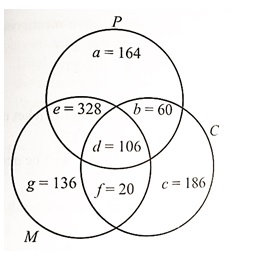
The result of an exam is given below. Out of 1000 students who appeared
(i) 658 failed in Physics
(ii) 166 failed in Physics and Chemistry
(iii) 372 failed in Chemistry, 434 failed in Physics and Maths
(iv) 590 failed in Maths, 126 failed in Maths & Chemistry
Find the number of people who failed in (assuming that none is passed in all subjects.
We have the following equations:
a+ b + c + d + e + f + g = 1000
a + b + d + e = 658, b + d = 166
b + d + c + f = 372
d + e = 434 as in the figure.
d + e + f + g = 590, d + f = 126. Find the values
Chemistry but not in Physics.
A
318
B
198
C
213
D
206
Question 49Single Answer
Passage :
Direction: information given below and answer the question that follow.
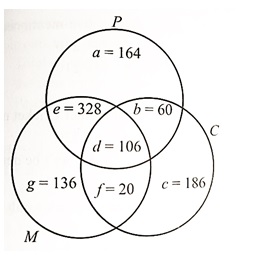
The result of an exam is given below. Out of 1000 students who appeared
(i) 658 failed in Physics
(ii) 166 failed in Physics and Chemistry
(iii) 372 failed in Chemistry, 434 failed in Physics and Maths
(iv) 590 failed in Maths, 126 failed in Maths & Chemistry
Find the number of people who failed in (assuming that none is passed in all subjects.
We have the following equations:
a+ b + c + d + e + f + g = 1000
a + b + d + e = 658, b + d = 166
b + d + c + f = 372
d + e = 434 as in the figure.
d + e + f + g = 590, d + f = 126. Find the values
Physics or Maths but not in Chemistry.
A
558
B
718
C
628
D
None of these
Question 50Single Answer
Passage :
For the next four question that follow:
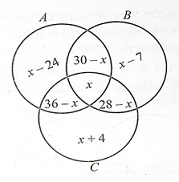
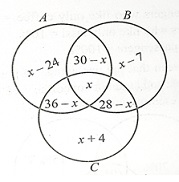
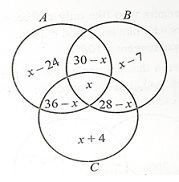
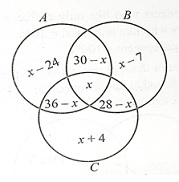
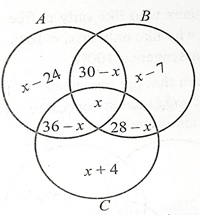
In a city, three daily newspapers A, B, C are published, 42% read A; 51% read B; 68% read C; 30% read A and B; 28% read B and C; 36% read A and C; 8% do not read any of the three newspapers.
Let x% people read all the three newspapers.
Since 8% people do not read any newspapers.
(x – 24) + (x – 7) + (x + 4) + (30 – x) + (36 – x) + (28 – x) + x = 92
→ x + 98 – 31 = 92
→ x = 92 – 67 = 25
What is the percentage of persons who read all the three papers ?
A
20%
B
25%
C
30%
D
40%
Important Questions Package
HPCL Junior Executive Chemical Exam Online Question Bank Package
Buy HPCL Junior Executive Chemical Important Questions, MCQ, question answer in Hindi & English. It will help you to score high marks in HPCL Junior Executive Chemical question bank 2026 in Online, PDF & Print study material.
+ Free Monthly Current Affairs, GK & more PDF Download
Sr.
Package Name
Amount
1.
HPCL Junior Executive (Chemical) Exam - Hindi
Description : 1000 Question with Answer
₹101[₹500]
2.
HPCL Junior Executive (Chemical) Exam - Hindi
Description : 2000 Question with Answer
₹151[₹500]
3.
HPCL Junior Executive (Chemical) Exam - Hindi
Description : 3000 Question with Answer
₹181[₹500]
4.
HPCL Junior Executive (Chemical) Exam - Hindi
Description : 4000 Question with Answer
₹201[₹500]
5.
HPCL Junior Executive (Chemical) Exam - English
Description : 1000 Question with Answer
₹101[₹500]
6.
HPCL Junior Executive (Chemical) Exam - English
Description : 2000 Question with Answer
₹151[₹500]
7.
HPCL Junior Executive (Chemical) Exam - English
Description : 3000 Question with Answer
₹181[₹500]
8.
HPCL Junior Executive (Chemical) Exam - English
Description : 4000 Question with Answer
₹201[₹500]
9.
HPCL Junior Executive (Chemical) Exam - Hindi
Description : 1000 Question & Answer Download in PDF (Send by Email)
₹151[₹450]
10.
HPCL Junior Executive (Chemical) Exam - English
Description : 1000 Question & Answer Download in PDF (Send by Email)
₹151[₹450]
11.
HPCL Junior Executive (Chemical) Exam Question Bank Book - Hindi
Description : 1000 Question with Answer (Printed Material)
₹450[₹800]
12.
HPCL Junior Executive (Chemical) Exam Question Bank Book - English
Description : 1000 Question with Answer (Printed Material)
₹390[₹600]
13.
HPCL Junior Executive (Chemical) Exam - English (Old)
Description : 2000 Question with Answer
₹151[₹500]
14.
HPCL Junior Executive (Chemical) Exam - English (Old)
Description : 1000 Question with Answer
₹101[₹500]
Quantitative Aptitude Test
Question 51Single Answer
Passage :
For the next four : question that follow :
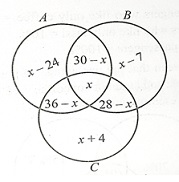
In a city, three daily newspapers A, B, C are published, 42% read A; 51% read B; 68% read C; 30% read A and B; 28% read B and C; 36% read A and C; 8% do not read any of the three newspapers.
Let x% people read all the three newspapers.
Since 8% people do not read any newspapers.
(x – 24) + (x – 7) + (x + 4) + (30 – x) + (36 – x) + (28 – x) + x = 92
→ x + 98 – 31 = 92
→ x = 92 – 67 = 25
What is the percentage of persons who read only two papers?
A
19%
B
31%
C
44%
D
None of these
Question 52Single Answer
Passage :
For the next four : question that follow :
In a city, three daily newspapers A, B, C are published, 42% read A; 51% read B; 68% read C; 30% read A and B; 28% read B and C; 36% read A and C; 8% do not read any of the three newspapers.
Let x% people read all the three newspapers.
Since 8% people do not read any newspapers.
(x – 24) + (x – 7) + (x + 4) + (30 – x) + (36 – x) + (28 – x) + x = 92
→ x + 98 – 31 = 92
→ x = 92 – 67 = 25
What is the percentage of persons who read only one paper ?
A
38%
B
48%
C
51%
D
None of these
Question 53Single Answer
Passage :
For the next four : question that follow:
In a city, three daily newspapers A, B, C are published, 42% read A; 51% read B; 68% read C; 30% read A and B; 28% read B and C; 36% read A and C; 8% do not read any of the three newspapers.
Let x% people read all the three newspapers.
Since 8% people do not read any newspapers.
(x – 24) + (x – 7) + (x + 4) + (30 – x) + (36 – x) + (28 – x) + x = 92
→ x + 98 – 31 = 92
→ x = 92 – 67 = 25
What is the percentage of persons who read only A but neither B nor C ?
A
4%
B
3%
C
1%
D
None of these
Question 54Single Answer
Passage :
For the next four : question that follow:
In a city, three daily newspapers A, B, C are published, 42% read A; 51% read B; 68% read C; 30% read A and B; 28% read B and C; 36% read A and C; 8% do not read any of the three newspapers.
Let x% people read all the three newspapers.
Since 8% people do not read any newspapers.
(x – 24) + (x – 7) + (x + 4) + (30 – x) + (36 – x) + (28 – x) + x = 92
→ x + 98 – 31 = 92
→ x = 92 – 67 = 25
If A and B are any two sets, then what is A ᴖ (A ᴗ B) equal to ?
A
Complement of A
B
Complement of B
C
B
D
A
Question 55Single Answer
Passage :
For the next four : question that follow:
In a city, three daily newspapers A, B, C are published, 42% read A; 51% read B; 68% read C; 30% read A and B; 28% read B and C; 36% read A and C; 8% do not read any of the three newspapers.
Let x% people read all the three newspapers.
Since 8% people do not read any newspapers.
(x – 24) + (x – 7) + (x + 4) + (30 – x) + (36 – x) + (28 – x) + x = 92
→ x + 98 – 31 = 92
→ x = 92 – 67 = 25
40% of the people read newspaper X, 50% read newspaper Y and 10% read both the papers. What percentage of the people read neither newspaper ?
A
10%
B
15%
C
20%
D
25%
Technical Subject (Chemical)
Question 56Single Answer
The equilibrium constant (K) for a reaction is related to the Gibbs free energy change (ΔG) by:
A
ΔG = -RT ln(K)
B
ΔG = RT ln(K)
C
ΔG = -RT/ln(K)
D
ΔG = RT/ln(K)
Question 57Single Answer
The first law of thermodynamics states that:
A
Entropy of an isolated system always increases
B
Energy can neither be created nor destroyed
C
Enthalpy remains constant in an adiabatic process
D
Heat transfer is irreversible
Question 58Single Answer
Which thermodynamic property is a measure of the disorder of a system?
A
Enthalpy
B
Gibbs free energy
C
Entropy
D
Internal energy
Question 59Single Answer
The Gibbs phase rule is used to determine:
A
The rate of a chemical reaction
B
The number of degrees of freedom in a system
C
The heat transfer coefficient
D
The mass transfer rate
Question 60Single Answer
What is the term for a system in which there is no transfer of heat with the surroundings?
A
Isothermal
B
Isobaric
C
Adiabatic
D
Isochoric
Question 61Single Answer
The Clapeyron equation is used to calculate:
A
Vapor pressure as a function of temperature
B
Heat capacity
C
Reaction rate
D
Mass transfer coefficient
Question 62Single Answer
Fugacity is a measure of:
A
The ideal gas pressure
B
The "escaping tendency" of a substance from a phase
C
The reaction rate
D
The heat transfer rate
Question 63Single Answer
The rate of a homogeneous reaction is usually expressed as a function of:
A
Temperature and pressure only
B
Temperature and concentration
C
Pressure and flow rate
D
Flow rate and volume
Question 64Single Answer
A batch reactor is characterized by:
A
Continuous flow of reactants and products
B
No flow of reactants or products during the reaction
C
Constant volume and temperature
D
Constant pressure and temperature
Question 65Single Answer
A continuous stirred-tank reactor (CSTR) is assumed to be:
A
Plug flow
B
Perfectly mixed
C
Laminar flow
D
Turbulent flow
Question 66Single Answer
The space time in a plug flow reactor (PFR) is equal to:
A
The residence time
B
The reaction rate
C
The heat transfer rate
D
The mass transfer rate
Question 67Single Answer
Catalysts increase the rate of a reaction by:
A
Increasing the temperature
B
Lowering the activation energy
C
Increasing the pressure
D
Changing the equilibrium constant
Question 68Single Answer
What type of reactor is used for heterogeneous catalytic reactions where a solid catalyst is fluidized by the reacting fluid?
A
Batch reactor
B
CSTR
C
Fluidized bed reactor
D
Packed bed reactor
Question 69Single Answer
The Arrhenius equation describes the temperature dependence of:
A
Reaction rate constant
B
Heat transfer coefficient
C
Mass transfer coefficient
D
Equilibrium constant
Question 70Single Answer
Distillation is used to separate components based on differences in:
A
Density
B
Boiling points
C
Viscosity
D
Particle size
Question 71Single Answer
Absorption is a mass transfer operation in which a gas is dissolved in a:
A
Solid
B
Liquid
C
Another gas
D
Vacuum
Question 72Single Answer
Extraction is a separation process based on differences in:
A
Solubility
B
Density
C
Boiling point
D
Viscosity
Question 73Single Answer
Drying involves the removal of:
A
Solutes from a solution
B
Moisture from a solid
C
Gases from a mixture
D
Heat from a system
Question 74Single Answer
Reverse osmosis is an example of a:
A
Distillation process
B
Absorption process
C
Membrane separation process
D
Drying process
Question 75Single Answer
The Fick's law describes:
A
Heat conduction
B
Mass diffusion
C
Fluid flow
D
Chemical reaction rates
Question 76Single Answer
The overall mass transfer coefficient is influenced by:
A
Liquid-phase resistance only
B
Gas-phase resistance only
C
Both liquid-phase and gas-phase resistances
D
Neither liquid nor gas phase resistances
Question 77Single Answer
Conduction is the transfer of heat through:
A
Fluid motion
B
Electromagnetic waves
C
Molecular vibrations
D
Phase change
Question 78Single Answer
Convection involves heat transfer by:
A
Electromagnetic waves
B
Fluid motion
C
Molecular vibrations
D
Phase change
Question 79Single Answer
Radiation is heat transfer by:
A
Fluid motion
B
Electromagnetic waves
C
Molecular vibrations
D
Phase change
Question 80Single Answer
A heat exchanger is used to:
A
Increase reaction rate
B
Transfer heat between two fluids
C
Separate components
D
Dry solids
Question 81Single Answer
What is the term for heat transfer in a fluid due to bulk movement of the fluid?
A
Conduction
B
Convection
C
Radiation
D
Evaporation
Question 82Single Answer
The Fourier's law describes:
A
Heat conduction
B
Mass diffusion
C
Fluid flow
D
Chemical reaction rates
Question 83Single Answer
The Stefan-Boltzmann law describes:
A
Heat conduction
B
Heat radiation
C
Heat convection
D
Heat transfer in heat exchangers
Question 84Single Answer
The Nusselt number is a dimensionless number used in:
A
Mass transfer
B
Heat transfer
C
Reaction kinetics
D
Thermodynamics
Question 85Single Answer
What type of heat exchanger consists of concentric pipes?
A
Shell and tube
B
Double pipe
C
Plate
D
Finned tube
Question 86Single Answer
The overall heat transfer coefficient in a heat exchanger is affected by:
A
Fluid velocities and thermal conductivities
B
Only fluid velocities
C
Only thermal conductivities
D
Neither fluid velocities nor thermal conductivities
Question 87Single Answer
In a counter-current heat exchanger, the fluids flow:
A
In the same direction
B
In opposite directions
C
Perpendicular to each other
D
In a circular pattern
Question 88Single Answer
The logarithmic mean temperature difference (LMTD) is used to calculate:
A
Heat transfer rate
B
Mass transfer rate
C
Reaction rate
D
Fluid flow rate
Question 89Single Answer
The Prandtl number is a dimensionless number that relates:
A
Momentum diffusivity and thermal diffusivity
B
Mass diffusivity and thermal diffusivity
C
Momentum diffusivity and mass diffusivity
D
Fluid velocity and pressure
Question 90Single Answer
Fins are used in heat exchangers to:
A
Increase the heat transfer surface area
B
Decrease the fluid velocity
C
Increase the pressure drop
D
Decrease the thermal conductivity
Question 91Single Answer
Forced convection occurs when fluid motion is caused by:
A
Density differences
B
External means like pumps or fans
C
Molecular vibrations
D
Electromagnetic waves
Question 92Single Answer
Natural convection occurs when fluid motion is caused by:
A
External means like pumps or fans
B
Density differences
C
Molecular vibrations
D
Electromagnetic waves
Question 93Single Answer
The effectiveness of a heat exchanger is defined as:
A
The ratio of actual heat transfer to maximum possible heat transfer
B
The ratio of fluid velocities
C
The ratio of thermal conductivities
D
The ratio of pressure drops
Question 94Single Answer
Scaling in heat exchangers refers to:
A
The formation of deposits on heat transfer surfaces
B
The increase in heat transfer rate
C
The decrease in fluid velocity
D
The increase in pressure drop
Question 95Single Answer
Pascal's law states that pressure applied to an enclosed fluid is:
A
Diminished throughout the fluid
B
Transmitted undiminished to every point in the fluid
C
Increased in the direction of flow
D
Decreased in the direction of flow
Question 96Single Answer
The Reynolds number is used to determine:
A
Fluid density
B
Flow regime (laminar or turbulent)
C
Fluid viscosity
D
Fluid pressure
Question 97Single Answer
A centrifugal pump operates based on:
A
Positive displacement
B
Centrifugal force
C
Gravity
D
Vacuum
Question 98Single Answer
Size reduction of solids is accomplished by:
A
Filtration
B
Crushing and grinding
C
Sedimentation
D
Distillation
Question 99Single Answer
Filtration is a process used to separate:
A
Liquids from gases
B
Solids from liquids
C
Gases from gases
D
Solids from solids
Question 100Single Answer
Sedimentation is a process based on:
A
Density differences
B
Boiling point differences
C
Solubility differences
D
Viscosity differences
Question 101Single Answer
Ideal gas law is represented as?
A
PV = nR
B
PV = nRT
C
P/V = nRT
D
PV = RT/n
Question 102Single Answer
In material balance without chemical reaction, accumulation is?
A
Zero
B
Equal to input
C
Equal to output
D
None of these
Question 103Single Answer
For a single component system, material balance equation is?
Bernoulli’s equation is derived from conservation of?
A
Energy
B
Momentum
C
Mass
D
Entropy
Question 140Single Answer
Bernoulli’s equation is valid for?
A
Viscous flow
B
Compressible flow
C
Unsteady flow
D
Inviscid steady flow
Intellectual Potential test
Question 141Single Answer
How many such pairs of letters are there in the word ‘CLEANLINESS’ each of the which has as many letters between them in the word as they have in the English alphabet, in the same sequence?
A
Two
B
Three
C
Five
D
Four
E
None of these
Question 142Single Answer
Team A has scored more goals than Team B
Team C has scored fewer goals than Team B
Team A has scored fewer goals than Team C .
If the first two statements are true, the third statement is
A
True
B
False
C
Uncertain
D
None
Question 143Single Answer
If it is possible to make only one meaningful word with the second, the third, the sixth and the eight letters of the word FRAGMENT using each only once, which of the following will be the third letter of that word ? If no such word can be formed, give ‘X’ as the answer and if more than one such word can be formed, give ‘Y’ as the answer.
A
A
B
E
C
T
D
X
E
Y
Question 144Single Answer
How many such letters are there in the word ORIENTAL each of which is as far away from the beginning of the word as when they are arranged alphabetically?
A
None
B
One
C
Two
D
Three
E
More than three
Question 145Single Answer
How many such pairs of letters in the word CREDIT each of which has as many letters between them in the word as in the English alphabet?
A
None
B
One
C
Two
D
Three
E
More than three
Question 146Single Answer
How many meaningful words can be made from the letters ‘LMEA’ using each letter only once in each word?
A
None
B
One
C
Two
D
Three
E
More than three
Question 147Single Answer
If it is possible to make only one meaningful word with the first, the second, the seventh and the eighth letters of the word TEMPORAL, which of the following will be the first letter of that word? If more than one such word can be made, give ‘Y’ as the answer and if no such word can be made, give ‘X’ as the answer.
A
T
B
L
C
E
D
Y
E
X
Question 148Single Answer
If the letters of the word HANDOVER are arranged alphabetically from left to right how many letters will remain at the same position?
A
None
B
One
C
Two
D
Three
E
More than three
Question 149Single Answer
How many such pairs of letters are there in the word EXCURSION, each of which has as many letters between them in the word as they have in the English alphabet?
A
None
B
One
C
Two
D
Three
E
More than three
Question 150Single Answer
If it is possible to make only one meaningful word with the first, the second, the third, the sixth and the eighth letters of the word DEVIATION first letter of that word is your answer? If more than one such word can be made formed your answer is ‘A’ and if no such word can be formed your answer is ‘B’.
A
V
B
T
C
E
D
A
E
B
Question 151Single Answer
If each alternate letter beginning with the first in the word WORKING is replaced by the next letter in the English alphabet and each of the remaining letters is replaced by the previous letter in the English alphabet, which of the following will be the fourth from the right and after the replacement ?
A
N
B
Q
C
J
D
M
E
None of these
Question 152Single Answer
How many pairs of letters are there in the word ‘SHIFTED’ each of which has as many letters between its two letters as there are between in the English alphabet?
A
None
B
One
C
Two
D
Three
E
None of these
Question 153Single Answer
Passage :
A B C D E F G H I J K L M N O P Q R S T U V W X Y Z .
Which letter in this alphabet is the eighth letter to the right of the letter and which is tenth letter to the left of the last but one letter of the alphabet ?
A
X
B
W
C
I
D
H
Question 154Single Answer
Passage :
Direction : The following question is based on the five words given below:
AND FOR THE BIG SUM (The new words formed after performing the mentioned operations may or may not necessarily the meaningful English words.)
If the third alphabet of each of the words is changed to the next alphabet in the English alphabetical series, which of the following will form a meaningful English word?
A
SUM
B
BIG
C
Both BIG and THE
D
FOR
E
Both FOR and BIG
Question 155Single Answer
Passage :
Direction : The following question is based on the five words given below:
AND FOR THE BIG SUM (The new words formed after performing the mentioned operations may or may not necessarily the meaningful English words.)
If the given words are arranged in the order as they would appear in a dictionary from left to right, which of the following will be second from the right ?
A
AND
B
FOR
C
THE
D
BIG
E
SUM
Question 156Single Answer
Passage :
Direction: The following question is based on the five words given below:
AND FOR THE BIG SUM (The new words formed after performing the mentioned operations may or may not necessarily the meaningful English words.)
If second alphabet in each of the words is changed to next alphabet in the English alphabetical order, how many words having two vowels (same or different vowels) will be formed ?
A
None
B
One
C
Two
D
Three
E
Four
Question 157Single Answer
Passage :
Direction : The following question is based on the five words given below:
AND FOR THE BIG SUM (The new words formed after performing the mentioned operations may or may not necessarily the meaningful English words.)
How many letters are there in the English alphabetical series between the second letter of the word which is second from the right and the second letter of the word which is second from the left of the given words?
A
Two
B
Five
C
Six
D
Nine
E
Three
Question 158Single Answer
Passage :
Direction: The following question is based on the five words given below:
AND FOR THE BIG SUM (The new words formed after performing the mentioned operations may or may not necessarily the meaningful English words.)
If in each of the given words, each of the consonant is changed to previous letter and each vowel is changed to next letter in the English alphabetical series, in how many words thus formed will no vowels appear?
A
None
B
One
C
Two
D
Three
E
More than three
Question 159Single Answer
Passage :
Direction : Following question is based on five words given below: BRU LEGINKCATOWN
(The new words formed after performing the mentioned operations may or may not necessarily be meaningful English words)
If the third alphabet in each of the words is changed to the next alphabet in the English alphabetical order, how many words having two vowels (same or different vowels) will be formed?
A
None
B
One
C
Two
D
Three
E
Four
Question 160Single Answer
Passage :
Direction : Following question is based on five words given below: BRU LEGINKCATOWN
(The new words formed after performing the mentioned operations may or may not necessarily be meaningful English words)
If the position of the first and the second alphabets of each of the words are interchanged, which of the following will form a meaningful English word?
A
Both CAT and OWN
B
Both BRU and INK
C
Only CAT
D
Only INK
E
Only LEG
Question 161Single Answer
Passage :
Direction: Following question is based on five words given below: BRU LEGINKCATOWN
(The new words formed after performing the mentioned operations may or may not necessarily be meaningful English words)
If the given words are arranged in the order as they would appear in a dictionary from left to right, which of the following will be exactly in the middle of the five words?
A
OWN
B
LEG
C
BRU
D
CAT
E
INK
Question 162Single Answer
Passage :
Direction: Following question is based on five words given below: BRU LEGINKCATOWN
(The new words formed after performing the mentioned operations may or may not necessarily be meaningful English words)
If in each of the given words, each of the consonants is changed to previous letter and each vowel is changed to next letter in the English alphabetical series, in how many words thus formed will the same alphabet appear twice?
A
None
B
One
C
Two
D
Three
E
More than three
Question 163Single Answer
Passage :
Find the missing number in the following series ?
3, 5, 5, 19, 7, 41, 9, ?
A
71
B
61
C
79
D
69
Question 164Single Answer
Passage :
Direction: following question is based on five words given below:
LAP BUT CAR SON HID
(The new words formed after performing the mentioned operations may or may not necessarily be meaningful English words.)
If the positions of the first and the third alphabets of each of the words are interchanged, which of the following would form meaningful words with the new arrangement?
A
HID
B
SON
C
Both LAP and BUT
D
CAR
E
Both CAR and LAP
Question 165Single Answer
Passage :
Direction: following question is based on five words given below:
LAP BUT CAR SON HID
(The new words formed after performing the mentioned operations may or may not necessarily be meaningful English words.)
If the given words are arranged in the order as they would appear in a dictionary from left to right, which of the following will be fourth from the left?
A
LAP
B
BUT
C
CAR
D
SON
E
HID
Question 166Single Answer
Passage :
Direction : following question is based on five words given below:
LAP BUT CAR SON HID
(The new words formed after performing the mentioned operations may or may not necessarily be meaningful English words.)
If in each of given words, each of the consonants is changed to previous letter and each vowel is changed to next letter in the English alphabetical series, in how many words thus formed will at least one vowel appear?
A
None
B
One
C
Two
D
Three
E
More than three
Question 167Single Answer
Passage :
Direction : following question is based on five words given below:
LAP BUT CAR SON HID
(The new words formed after performing the mentioned operations may or may not necessarily be meaningful English words.)
How many letters are there in the English alphabetical series between the third letter of the word which is third from the right and the first letter of the word which is first from the left of the given word?
A
Two
B
Five
C
Six
D
Nine
E
Three
Question 168Single Answer
Passage :
Direction: following question is based on five words given below:
LAP BUT CAR SON HID
(The new words formed after performing the mentioned operations may or may not necessarily be meaningful English words.)
If second alphabet in each of the words is changed to next alphabet in the English alphabetical order, how many words having no vowels will be formed?
A
None
B
One
C
Two
D
Three
E
More than three
Question 169Single Answer
Passage :
Direction: following letter is based on the five three letter words given below:
PIN ROD DEN SAT FUN
(Note: The words formed after performing the given operations may or may not be meaningful English words.)
If all the letters in each of the words are arranged alphabetically (within the word), how many words will remain unchanged?
A
One
B
Two
C
Three
D
More than three
E
None
Question 170Single Answer
Passage :
Direction: following letter is based on the five three letter words given below:
PIN ROD DEN SAT FUN (Note: The words formed after performing the given operations may or may not be meaningful English words.)
According to the English alphabetical series how many letters are there between the first letter of the third word and the first letter of the fifth word?


 5.015 =?