

📚 Exam by Category
▾
Objective Questions

Latest HRRL Junior Executive Exam Question (Objective Questions), MCQ in English

Subjects : English Language, Logical Reasoning and Data Interpretation, Quantitative Aptitude, Chemical

Question Bank HRRL Junior Executive (Chemical) Exam - English
Back to Exam

English Language

Question 1Single Answer
I go to Madurai by —– Vaigai Express
  1. A
    a
  2. B
    an
  3. C
    some
  4. D
    the
Question 2Single Answer
Have the car stolen!
  1. A
    Steal the car
  2. B
    You should have the stolen car
  3. C
    Get someone to steal the car
  4. D
    They have stolen the car
Question 3Single Answer
The payment was collected by the hardworking salesman.
  1. A
    The hardworking salesman collected the payment.
  2. B
    the salesman who worked heard was able to collect the payment.
  3. C
    to collect the payment the salesman had to work hard.
  4. D
    The hardworking salesman was able to collect the payment.
Question 4Single Answer
I had to stop all my work to complete this project.
  1. A
    All other work had to be stopped to complete this project by me
  2. B
    For completing this project all other work must be stopped
  3. C
    For completing this project I had to stop all my work
  4. D
    To complete this project all other work had been stopped by me
Question 5Single Answer
They have published the names of all the successful candidates.
  1. A
    The candidates who have succeeded their names they had published.
  2. B
    The names of all the successful candidates have been published by them
  3. C
    The candidates who have succeeded their names have been published by them.
  4. D
    The names of all the successful candidate were published by them. 
Question 6Single Answer
Passage :
Direction :  Question below has two blanks, each blank indicting that some thing has been omitted. Choose the word for each blank which best fits the meaning of the sentence as a whole.
The Finance Department has ……………a centralized online databank system for all statutory government bodies to …………an eye on their assets and liabilities.
  1. A
     presented , stay
  2. B
    introduced , keep
  3. C
    announce , make
  4. D
    created , let
  5. E
    proclaimed , hold
Question 7Single Answer
Passage :
Direction : The five items in this section consists of a word or group of words followed by four words as (a), (b), (c) and (d). Select the word which is nearly opposite to the meaning of the original word or group of words and mark your response as (a), (b), (c) and (d), as the case may be, in your Answer Sheet.
Assets
  1. A
    liabilities
  2. B
    responsibilities
  3. C
    estates
  4. D
    profits
Question 8Single Answer
Passage :
Direction : In the question, out of the four alternatives, choose the word which is opposite in meaning to the given word and click the button corresponding to it
Affidavit
  1. A
     Affirmation
  2. B
    Slander
  3. C
    Oath
  4. D
    Testimony
Question 9Single Answer
Passage :
Direction: In the following question, out of the four alternatives, choose the word which is opposite in meaning to the given word and click the button corresponding to it
Hollow
  1. A
    Alveolate
  2. B
    Cleft
  3. C
     Cavernous
  4. D
    Solid
Question 10Single Answer
Passage :
Directions: In the following question, out of the four alternatives, choose the word which is opposite in meaning to the given word and click the button corresponding to it
Cosset 
  1. A
    Ignoreb
  2. B
    Close
  3. C
    Caress
  4. D
    Fondle

Logical Reasoning and Data Interpretation

Question 11Single Answer
How many such pairs of letters are there in the word ‘CLEANLINESS’ each of the which has as many letters between them in the word as they have in the English alphabet, in the same sequence?
  1. A
    Two
  2. B
    Three
  3. C
    Five
  4. D
    Four
  5. E
    None of these
Question 12Single Answer
Team A has scored more goals than Team B
Team C has scored fewer goals than Team B
Team A has scored fewer goals than Team C .
If the first two statements are true, the third statement is
  1. A
    True
  2. B
    False
  3. C
    Uncertain
  4. D
    None
Question 13Single Answer
If it is possible to make only one meaningful word with the second, the third, the sixth and the eight letters of the word FRAGMENT using each only once, which of the following will be the third letter of that word ? If no such word can be formed, give ‘X’ as the answer and if more than one such word can be formed, give ‘Y’ as the answer.
  1. A
    A
  2. B
    E
  3. C
    T
  4. D
    X
  5. E
    Y
Question 14Single Answer
How many such letters are there in the word ORIENTAL each of which is as far away from the beginning of the word as when they are arranged alphabetically?
  1. A
    None            
  2. B
    One         
  3. C
    Two       
  4. D
    Three        
  5. E
    More than three
Question 15Single Answer
How many such pairs of letters in the word CREDIT each of which has as many letters between them in the word as in the English alphabet?
  1. A
    None
  2. B
    One
  3. C
    Two
  4. D
    Three
  5. E
    More than three
Question 16Single Answer
Passage :
Direction : Each of the questions below consists of a question and two statements numbered (I) and (II) given below it. You have to decide whether the data provided in the statements are sufficient to answer the question. Read both the statements and give answer  :
How many employees of bank ‘X’ opted for VRS ?
(I) 18% of the 950 officer cadre employees and 6% of the 1100 of all other cadre employees opted for VRS.
(II) 28% of the employees in the age group of 51 to 56 and 17% of the employees in all other age groups opted for VRS.
  1. A
    Statement (I) ALONE is sufficient, but statement (II) alone is not sufficient
  2. B
    Statement (II) ALONE is sufficient, but statement (I) alone is not sufficient
  3. C
    BOTH statements TOGETHER are sufficient, but NEITHER statement alone is sufficient
  4. D
    EACH statement ALONE is sufficient
Question 17Single Answer
Passage :
Direction : Each of the questions below consists of a question and two statements numbered (I) and (II) given below it. You have to decide whether the data provided in the statements are sufficient to answer the question. Read both the statements and give answer  :
The area of a playground is 1600 square meters. What is its perimeter ?
(I) It is a perfect square playground
(II) It costs Rs.3200 to put a fence around the playground at the rate of Rs.20 per meter.
  1. A
    Statement (I) ALONE is sufficient, but statement (II) alone is not sufficient
  2. B
    Statement (II) ALONE is sufficient, but statement (I) alone is not sufficient
  3. C
    BOTH statements TOGETHER are sufficient, but NEITHER statement alone is sufficient
  4. D
    EACH statement ALONE is sufficient
Question 18Single Answer
Passage :
Direction : Each of the questions below consists of a question and two statements numbered (I) and (II) given below it. You have to decide whether the data provided in the statements are sufficient to answer the question. Read both the statements and give answer  :
What is the value of m – n ÷ 37 ?
(I) m is the largest possible six-digit number and n is the smallest possible six-digit number.
(II) The difference between m and n is known.
  1. A
    Statement (I) ALONE is sufficient, but statement (II) alone is not sufficient
  2. B
    Statement (II) ALONE is sufficient, but statement (I) alone is not sufficient
  3. C
    BOTH statements TOGETHER are sufficient, but NEITHER statement alone is sufficient
  4. D
    EACH statement ALONE is sufficient
Question 19Single Answer
Passage :
Direction : Each of the questions below consists of a question and two statements numbered (I) and (II) given below it. You have to decide whether the data provided in the statements are sufficient to answer the question. Read both the statements and give answer  :
What is the value of x  ?
(I) If 10 is added to x, the result is 34.
(II) If x is multiplied by y, the result is 38.
  1. A
    Statement (I) ALONE is sufficient, but statement (II) alone is not sufficient
  2. B
    Statement (II) ALONE is sufficient, but statement (I) alone is not sufficient
  3. C
    BOTH statements TOGETHER are sufficient, but NEITHER statement alone is sufficient
  4. D
    EACH statement ALONE is sufficient
Question 20Single Answer
Passage :
Direction : Each of the questions below consists of a question and two statements numbered (I) and (II) given below it. You have to decide whether the data provided in the statements are sufficient to answer the question. Read both the statements and give answer  :
What was the total compound interest on a sum after three years  ?
(I) The interest after one year was Rs. 100 and the sum after was Rs.1000.
(II) The difference between simple and compound interest on a sum of Rs.1000 at the end of two years was Rs.10.
  1. A
    Statement (I) ALONE is sufficient, but statement (II) alone is not sufficient
  2. B
    Statement (II) ALONE is sufficient, but statement (I) alone is not sufficient
  3. C
    BOTH statements TOGETHER are sufficient, but NEITHER statement alone is sufficient
  4. D
    EACH statement ALONE is sufficient

Quantitative Aptitude

Question 21Single Answer
The cash difference between the selling prices of an article at a profit of 4% and 6% is Rs. 3. The ratio of the two selling prices is:__________ ?
  1. A
    51:52
  2. B
    52:53
  3. C
    51:53
  4. D
    52:55
Question 22Single Answer
Which of the following numbers is irrational ?
  1. A
    √49
  2. B
    0.125
  3. C
    √2
  4. D
    22/7
Question 23Single Answer
356 x 936 – 356 x 836 = ?
  1. A
    35600  
  2. B
    34500
  3. C
    9630
  4. D
    93600
Question 24Single Answer
Arrange in descending order: 5/8, 7/10, 3/4
  1. A
    3/4 > 7/10 > 5/8
  2. B
    7/10 > 3/4 > 5/8
  3. C
    3/4 > 5/8 > 7/10
  4. D
    5/8 > 7/10 > 3/4
Question 25Single Answer
What is (3^{4} times 9^{2}) ?
  1. A
    36
  2. B
    38
  3. C
    310
  4. D
    96
     
Question 26Single Answer
Passage :
information given below and answer the question that follow.
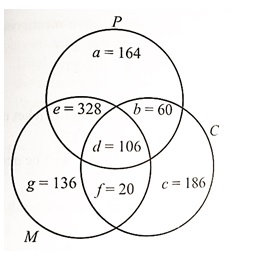
The result of an exam is given below. Out of 1000 students who appeared
(i) 658 failed in Physics
(ii) 166 failed in Physics and Chemistry
(iii) 372 failed in Chemistry, 434 failed in Physics and Maths
(iv) 590 failed in Maths, 126 failed in Maths & Chemistry
Find the number of people who failed in (assuming that none is passed in all subjects.

We have the following equations:
a+ b + c + d + e + f + g = 1000
a + b + d + e = 658, b + d = 166
b + d + c + f = 372
d + e = 434 as in the figure.
d + e + f + g = 590, d + f = 126. Find the values
Chemistry but not in Physics.
  1. A
    318
  2. B
    198
  3. C
    213 
  4. D
    206
Question 27Single Answer
Passage :
Direction: information given below and answer the question that follow.
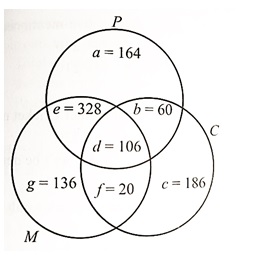
The result of an exam is given below. Out of 1000 students who appeared
(i) 658 failed in Physics
(ii) 166 failed in Physics and Chemistry
(iii) 372 failed in Chemistry, 434 failed in Physics and Maths
(iv) 590 failed in Maths, 126 failed in Maths & Chemistry
Find the number of people who failed in (assuming that none is passed in all subjects.

We have the following equations:
a+ b + c + d + e + f + g = 1000
a + b + d + e = 658, b + d = 166
b + d + c + f = 372
d + e = 434 as in the figure.
d + e + f + g = 590, d + f = 126. Find the values
Physics or Maths but not in Chemistry.
  1. A
    558   
  2. B
    718
  3. C
    628  
  4. D
    None of these
Question 28Single Answer
Passage :
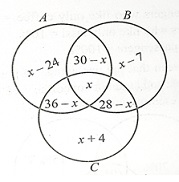
For the next four question that follow:
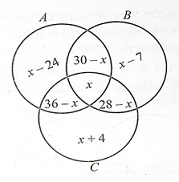
In a city, three daily newspapers A, B, C are published, 42% read A; 51% read B; 68% read C; 30% read A and B; 28% read B and C; 36% read A and C; 8% do not read any of the three newspapers.

Let x% people read all the three newspapers.
Since 8% people do not read any newspapers.
 (x – 24) + (x – 7) + (x + 4) + (30 – x) + (36 – x) + (28 – x) + x = 92
→ x + 98 – 31 = 92
→ x = 92 – 67 = 25
What is the percentage of persons who read all the three papers ?
  1. A
    20%  
  2. B
    25%
  3. C
    30%  
  4. D
    40%
Question 29Single Answer
Passage :
For the next four : question that follow :
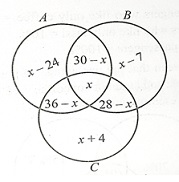
In a city, three daily newspapers A, B, C are published, 42% read A; 51% read B; 68% read C; 30% read A and B; 28% read B and C; 36% read A and C; 8% do not read any of the three newspapers.

Let x% people read all the three newspapers.
Since 8% people do not read any newspapers.
 (x – 24) + (x – 7) + (x + 4) + (30 – x) + (36 – x) + (28 – x) + x = 92
→ x + 98 – 31 = 92
→ x = 92 – 67 = 25
What is the percentage of persons who read only two papers?
  1. A
    19%  
  2. B
    31%
  3. C
    44%
  4. D
    None of these
Question 30Single Answer
Passage :
For the next four : question that follow :
In a city, three daily newspapers A, B, C are published, 42% read A; 51% read B; 68% read C; 30% read A and B; 28% read B and C; 36% read A and C; 8% do not read any of the three newspapers.

Let x% people read all the three newspapers.
Since 8% people do not read any newspapers.
(x – 24) + (x – 7) + (x + 4) + (30 – x) + (36 – x) + (28 – x) + x = 92
→ x + 98 – 31 = 92
→ x = 92 – 67 = 25
What is the percentage of persons who read only one paper ?
  1. A
    38% 
  2. B
    48%
  3. C
    51%  
  4. D
    None of these

Chemical

Question 31Single Answer
The equilibrium constant (K) for a reaction is related to the Gibbs free energy change (ΔG) by:
  1. A
    ΔG = -RT ln(K)
  2. B
    ΔG = RT ln(K)
  3. C
    ΔG = -RT/ln(K)
  4. D
    ΔG = RT/ln(K)
Question 32Single Answer
The first law of thermodynamics states that:
  1. A
    Entropy of an isolated system always increases
  2. B
    Energy can neither be created nor destroyed
  3. C
    Enthalpy remains constant in an adiabatic process
  4. D
    Heat transfer is irreversible
Question 33Single Answer
Which thermodynamic property is a measure of the disorder of a system?
  1. A
    Enthalpy
  2. B
    Gibbs free energy
  3. C
    Entropy
  4. D
    Internal energy
Question 34Single Answer
The Gibbs phase rule is used to determine:
  1. A
    The rate of a chemical reaction
  2. B
    The number of degrees of freedom in a system
  3. C
    The heat transfer coefficient
  4. D
    The mass transfer rate
Question 35Single Answer
What is the term for a system in which there is no transfer of heat with the surroundings?
  1. A
    Isothermal
  2. B
    Isobaric
  3. C
    Adiabatic
  4. D
    Isochoric
Question 36Single Answer
The Clapeyron equation is used to calculate:
  1. A
    Vapor pressure as a function of temperature
  2. B
    Heat capacity
  3. C
    Reaction rate
  4. D
    Mass transfer coefficient
Question 37Single Answer
Fugacity is a measure of:
  1. A
    The ideal gas pressure
  2. B
    The "escaping tendency" of a substance from a phase
  3. C
    The reaction rate
  4. D
    The heat transfer rate
Question 38Single Answer
The rate of a homogeneous reaction is usually expressed as a function of:
  1. A
    Temperature and pressure only
  2. B
    Temperature and concentration
  3. C
    Pressure and flow rate
  4. D
    Flow rate and volume
Question 39Single Answer
A batch reactor is characterized by:
  1. A
    Continuous flow of reactants and products
  2. B
    No flow of reactants or products during the reaction
  3. C
    Constant volume and temperature
  4. D
    Constant pressure and temperature
Question 40Single Answer
A continuous stirred-tank reactor (CSTR) is assumed to be:
  1. A
    Plug flow
  2. B
    Perfectly mixed
  3. C
    Laminar flow
  4. D
    Turbulent flow
Question 41Single Answer
The space time in a plug flow reactor (PFR) is equal to:
  1. A
    The residence time
  2. B
    The reaction rate
  3. C
    The heat transfer rate
  4. D
    The mass transfer rate
Question 42Single Answer
Catalysts increase the rate of a reaction by:
  1. A
    Increasing the temperature
  2. B
    Lowering the activation energy
  3. C
    Increasing the pressure
  4. D
    Changing the equilibrium constant
Question 43Single Answer
What type of reactor is used for heterogeneous catalytic reactions where a solid catalyst is fluidized by the reacting fluid?
  1. A
    Batch reactor
  2. B
    CSTR
  3. C
    Fluidized bed reactor
  4. D
    Packed bed reactor
Question 44Single Answer
The Arrhenius equation describes the temperature dependence of:
  1. A
    Reaction rate constant
  2. B
    Heat transfer coefficient
  3. C
    Mass transfer coefficient
  4. D
    Equilibrium constant
Question 45Single Answer
Distillation is used to separate components based on differences in:
  1. A
    Density
  2. B
    Boiling points
  3. C
    Viscosity
  4. D
    Particle size
Question 46Single Answer
Absorption is a mass transfer operation in which a gas is dissolved in a:
  1. A
    Solid
  2. B
    Liquid
  3. C
    Another gas
  4. D
    Vacuum
Question 47Single Answer
Extraction is a separation process based on differences in:
  1. A
    Solubility
  2. B
    Density
  3. C
    Boiling point
  4. D
    Viscosity
Question 48Single Answer
Drying involves the removal of:
  1. A
    Solutes from a solution
  2. B
    Moisture from a solid
  3. C
    Gases from a mixture
  4. D
    Heat from a system
Question 49Single Answer
Reverse osmosis is an example of a:
  1. A
    Distillation process
  2. B
    Absorption process
  3. C
    Membrane separation process
  4. D
    Drying process
Question 50Single Answer
The Fick's law describes:
  1. A
    Heat conduction
  2. B
    Mass diffusion
  3. C
    Fluid flow
  4. D
    Chemical reaction rates
Important Questions Package

HRRL Junior Executive Exam Online Question Bank Package

Buy HRRL Junior Executive Important Questions, MCQ, question answer in Hindi & English. It will help you to score high marks in HRRL Junior Executive question bank 2026 in Online, PDF & Print study material.

+ Free Monthly Current Affairs, GK & more PDF Download
Sr.Package NameAmount
1.HRRL Junior Executive (Chemical) Exam - English
Description : 1000 Question With Answer
₹101 [₹500]
2.HRRL Junior Executive (Chemical) Exam - English
Description : 2000 Question With Answer
₹151 [₹500]
3.HRRL Junior Executive (Chemical) Exam - English
Description : 1000 Question & Answer Download in PDF (Send by Email)
₹151 [₹550]
4.HRRL Junior Executive (Chemical) Exam Question Bank Book - English
Description : 1000 Question with Answer (Printed Material)
₹390 [₹650]
Back to Exam