Which of the following is not the aspects of child development?
A
Physical development
B
Social development
C
Cognitive development
D
Maturity
Question 2Single Answer
Development can be described as growth in
A
cognitive state
B
physical state
C
social state
D
All of the above
Question 3Single Answer
Which of the following is not correct about meaning of development?
A
It is a series of changes as a result of maturity
B
It is a series of changes as a result of experience
C
It is a mere progressive series of changes
D
None of the above
Question 4Single Answer
Development sequence starts with ...... and ends with ......
A
ovum-sperm, zygote
B
ovum - sperm, blastocyst
C
blastocyst, zygote
D
ovum - sperm, fertilisation
Question 5Single Answer
The feeling of shame and pride develops in ........ stage.
A
infancy
B
childhood
C
adolescence
D
adulthood
Question 6Single Answer
The major difference about the concept of development between JE Anderson and E Hurlock is that Anderson considers it as ......... and Hurlock considers it as ...
A
growth and behavioural changes, processes for maturing an organism
B
growth and behavioural changes, growth and changes relating to maturity
C
growth and changes relating to maturity processes for maturing an organism
D
None of the above
Question 7Single Answer
Which of the given statement is partially correct about the characteristics of development?
A
Each phase of development has its own variable
B
Development is a process that is continuous predictable and has individual differences
C
Each phase of development is with its own characteristic behaviour
D
Development is affected by cultural changes to a certain extent
Question 8Single Answer
Consider the statement about development in human beings
I. Upto adolescence.
II. Upto adulthood.
III. Throughout life.
Which of the statement(s) given above is correct?
A
Only I
B
Only II
C
Only III
D
None of these
Question 9Single Answer
Consider the given statement(s)
I. Mental development states that sensation is a gateway of knowledge.
II. Motor development accounts for the strength and speed.
III. Change in the individual behaviour due to maturation is learning.
Which of the statement(s) given above is/are correct?
A
Only I
B
Only Il
C
Only III
D
All of these
Question 10Single Answer
Choose the incorrect matching with the help of given codes
I. Physical nervous system and development endocrine glands
II. Adolescence love for exploration.
III. Early childhood : sensitive language development period.
A
Codes
l is incorrect matching
B
Both I, II are incorrect matching
C
Both II, III are incorrect matching
D
None of the above
Question 11Single Answer
Early childhood period is
A
sensitive to language development
B
crucial for maturity level
C
meant for learning through the forced behaviour
D
is complex in terms of growth and development cognitively
Question 12Single Answer
The age group 6 to 11 years falls under
A
early childhood
B
pre-natal age
C
later childhood
D
None of these
Question 13Single Answer
Consider the following statement(s)
I. Physical health and mental abilities are influencer of emotional development.
II. Fulfilling social expectations comes under social development.
Which of the statement(s) given above is/are correct?
A
Only I
B
Only II
C
Neither I nor II
D
Both I and II
Question 14Single Answer
In which of the following stages do children become active members of their peer group?
A
Adolescence
B
Adulthood
C
Early childhood
D
Childhood
Question 15Single Answer
Which of the following statements is not correct about development?
A
Each phase of the development has hazards
B
Development is not aided by stimulation
C
Development is affected by cultural changes
D
Each phase of the development has characteristic behavior
Question 16Single Answer
What is meant by development?
A
Temporary change in behavior
B
Sudden change in personality
C
Increase only in height and weight
D
Continuous and progressive change in an individual
Question 17Single Answer
Which of the following is a characteristic of development?
A
It stops in childhood
B
It is random
C
It occurs only physically
D
It is continuous
Question 18Single Answer
Development generally proceeds from?
A
General to specific
B
Specific to general
C
Complex to simple
D
Random to systematic
Question 19Single Answer
Which principle states that development follows an orderly pattern?
A
Principle of integration
B
Principle of continuity
C
Principle of sequence
D
Principle of heredity
Question 20Single Answer
Development is influenced by?
A
Both heredity and environment
B
Environment only
C
Heredity only
D
Neither heredity nor environment
Question 21Single Answer
Which stage comes immediately after infancy?
A
Early childhood
B
Prenatal stage
C
Adolescence
D
Late childhood
Question 22Single Answer
The period from conception to birth is called?
A
Adolescence
B
Infancy
C
Prenatal stage
D
Early childhood
Question 23Single Answer
Which stage is also known as the neonatal stage?
A
Ages 12 to 18 years
B
First six years of life
C
Ages 6 to 12 years
D
First four weeks after birth
Question 24Single Answer
Infancy generally covers the age period of?
A
12 to 18 years
B
2 to 6 years
C
6 to 12 years
D
Birth to 2 years
Question 25Single Answer
Early childhood usually includes children between?
A
0–2 years
B
6–12 years
C
2–6 years
D
12–18 years
Question 26Single Answer
Late childhood generally covers the age group of?
A
2–6 years
B
12–15 years
C
6–12 years
D
15–18 years
Question 27Single Answer
Adolescence is generally considered the period from?
A
6–10 years
B
8–12 years
C
12–18 years
D
18–25 years
Question 28Single Answer
Which stage is often called the "storm and stress" period?
A
Infancy
B
Early childhood
C
Adolescence
D
Late childhood
Question 29Single Answer
The term growth refers to?
A
Qualitative changes
B
Quantitative changes in body size
C
Emotional maturity
D
Moral development
Question 30Single Answer
Development refers to?
A
Increase in height only
B
Increase in weight only
C
Qualitative and quantitative changes
D
Temporary changes
Language - Hindi
Question 31Single Answer
शुद्ध वर्तनी का चयन कीजिए
A
अधम्र
B
अध्रम
C
अधर्म
D
अध्रिम
Question 32Single Answer
शुद्ध वर्तनी का चयन कीजिए
A
स्थायि
B
स्थायी
C
स्थाई
D
स्थाइ
Question 33Single Answer
वर्तनी की दृष्टि से सही शब्द है?
A
महत्व
B
महतव
C
महत्तव
D
महतत्व
Question 34Single Answer
निम्नलिखित में से शुद्ध छांटिए?
A
आयुष्मान
B
आयुश्मान
C
आयुशमान
D
आयुश्यमान
Question 35Single Answer
शुद्ध शब्द नहीं हैं?
A
कवियत्री
B
कौसल्या
C
एश्वर्य
D
श्रृंगार
Question 36Single Answer
शुद्ध वर्तनी है -
A
पूज
B
पुजय
C
पूज्य
D
पुज्य
Question 37Single Answer
शुद्ध वर्तनी है -
A
अनुसरण
B
अनूशरणन
C
अनुशरण
D
अणुशर
Question 38Single Answer
किस क्रमांक में सभी शुद्ध हैं?
A
एक्य,साप्ताहिक
B
आजीविका,आशीर्वाद
C
आर्शिवाद ,अनूकूल
D
निरिक्षण ,कृपालु
Question 39Single Answer
'उज्वल' शब्द का शुद्ध रूप है ?
A
उज्जव
B
उज्ज्ल
C
उज्ज्वल
D
उजवल
Question 40Single Answer
निम्नलिखित प्रश्न में चार वैकल्पिक वर्तनियाॅ दी गई है?
A
जागृत
B
जाग्रति
C
जाग्रित
D
जाग्रत
Question 41Single Answer
निम्नलिखित प्रश्न में चार वैकल्पिक वर्तनियाॅ दी गई है?
A
उन्नति
B
उनति
C
उन्ती
D
उनती
Question 42Single Answer
निम्नलिखित प्रश्न मे चार वैकल्पिक वर्तनियाॅ दी गई है?
A
अनुशहरण
B
अनोसरण
C
अनुसरन
D
अनुसरण
Question 43Single Answer
'पृथ्वीराज रासो' किस काल की रचना है ?
A
आदिकाल
B
रीतिकाल
C
भक्तिकाल
D
आधुनिक काल
Question 44Single Answer
हिन्दी की उत्पत्ति किस भाषा से हुई है?
A
प्राकृत
B
संस्कृत
C
शौरसैनी अपभ्रंश
D
मागधी
Question 45Single Answer
राजभाषा आयोग के प्रथम अध्यक्ष थे ?
A
बी. जी. खरे
B
राजा लक्ष्मण सिंह
C
प्रताप नारायण मिश्र
D
इंशाअल्ला खा
Language - English
Question 46Single Answer
Read sentence to find out whether there is any grammatical error in it. The sentences are In three separate parts and each one is labelled (a), (b), (c) and (d). In that case, letter (d) will signify a ‘No error’ response.
A
He was in the temper
B
and refused
C
discuss the matter again
D
No error
Question 47Single Answer
Read sentence to find out whether there is any grammatical error in it. The sentences are In three separate parts and each one is labelled (a), (b), (c) and (d). In that case, letter (d) will signify a ‘No error’ response.
A
A flower makes no garland
B
so we must do a thing together
C
in a unit for a good result
D
No error
Question 48Single Answer
Read sentence to find out whether there is any grammatical error in it. The sentences are In three separate parts and each one is labelled (a), (b), (c) and (d). In that case, letter (d) will signify a ‘No error’ response.
A
My friend is a software engineer
B
and his wife is doctor
C
so they don’t have enough time for each other
D
No error
Question 49Single Answer
Read sentence to find out whether there is any grammatical error in it. The sentences are In three separate parts and each one is labelled (a), (b), (c) and (d). In that case, letter (d) will signify a ‘No error’ response.
A
I don’t have much time that
B
I hear you in detail with verbosity
C
tell everything in nutshell
D
No error
Question 50Single Answer
Read sentence to find out whether there is any grammatical error in it. The sentences are In three separate parts and each one is labelled (a), (b), (c) and (d). In that case, letter (d) will signify a ‘No error’ response.
A
The atmosphere is changing
B
so I have severe pain in my body
C
if you have any painkiller, please give it to me
D
No error
Important Questions Package
HTET PGT Mathematics Exam Online Question Bank Package
Buy HTET PGT Mathematics Important Questions, MCQ, question answer in Hindi & English. It will help you to score high marks in HTET PGT Mathematics question bank 2026 in Online, PDF & Print study material.
+ Free Monthly Current Affairs, GK & more PDF Download
Sr.
Package Name
Amount
1.
HTET PGT Mathematics Exam - Hindi
Description : 1000 Question with Answer.
₹101[₹500]
2.
HTET PGT Mathematics Exam - Hindi
Description : 2000 Question with Answer.
₹151[₹500]
3.
HTET PGT Mathematics Exam - Hindi
Description : 3000 Question with Answer.
₹151[₹500]
4.
HTET PGT Mathematics Exam - English
Description : 1000 Question with Answer.
₹101[₹500]
5.
HTET PGT Mathematics Exam - English
Description : 2000 Question with Answer.
₹151[₹500]
6.
HTET PGT Mathematics Exam - English
Description : 3000 Question with Answer.
₹181[₹500]
7.
HTET PGT Mathematics Exam - Hindi
Description : 1000 Question & Answer Download in PDF (Send by Email)
₹151[₹450]
8.
HTET PGT Mathematics Exam - English
Description : 1000 Question & Answer Download in PDF (Send by Email)
₹151[₹450]
9.
HTET PGT Mathematics Exam Question Bank Book - Hindi
Description : 1000 Question with Answer (Printed Material)
₹450[₹800]
10.
HTET PGT Mathematics Exam Question Bank Book - English
Description : 1000 Question with Answer (Printed Material)
₹390[₹600]
Language - English
Question 51Single Answer
Read sentence to find out whether there is any grammatical error in it. The sentences are In three separate parts and each one is labelled (a), (b), (c) and (d). In that case, letter (d) will signify a ‘No error’ response.
A
No one is without fault
B
because no one is God
C
and only God is fault free
D
No error
Question 52Single Answer
Read sentence to find out whether there is any grammatical error in it. The sentences are In three separate parts and each one is labelled (a), (b), (c) and (d). In that case, letter (d) will signify a ‘No error’ response.
A
Your
B
clock is
C
one hour fast
D
No error
Question 53Single Answer
Read sentence to find out whether there is any grammatical error in it. The sentences are In three separate parts and each one is labelled (a), (b), (c) and (d). In that case, letter (d) will signify a ‘No error’ response.
A
The lose of jobs
B
is regarded by some as an necessary evil
C
in the fight against infliation
D
No error
Question 54Single Answer
Read sentence to find out whether there is any grammatical error in it. The sentences are In three separate parts and each one is labelled (a), (b), (c) and (d). In that case, letter (d) will signify a ‘No error’ response.
A
In science, the credit goes to a man
B
who convinces the world
C
not to the man to whom the idea first occurs
D
No error
Question 55Single Answer
Read sentence to find out whether there is any grammatical error in it. The sentences are In three separate parts and each one is labelled (a), (b), (c) and (d). In that case, letter (d) will signify a ‘No error’ response.
A
It is only after
B
the match is over
C
that people realize how exciting it is
D
No error
Question 56Single Answer
Passage :
In the following question, out of the four alternatives, select the alternative which best expresses the meaning of the idiom/phrase.
To sleep with the fishes
A
Always be in a dream world
B
To make absurd excuses
C
To sleep peacefully
D
To be dead
Question 57Single Answer
Passage :
In the following question, out of the four alternatives, select the alternative which best expresses the meaning of the idiom/phrase.
To free someone or something form a constraint or difficulty.
A
To exterminate
B
To expurgate
C
To intricate
D
To extricate
Question 58Single Answer
Passage :
In the following question, out of the four alternatives, select the alternative which best expresses the meaning of the idiom/phrase.
Liquids forming a homogeneous mixture when added together
A
Irascible
B
Crucible
C
Miscible
D
Risible
Question 59Single Answer
Passage :
In the following question, out of the four alternatives, select the alternative which best expresses the meaning of the idiom/phrase.
Shooting fish in a barrel
A
To do random acts of stupidity
B
To behave in a cruel manner
C
Ridiculously easy
D
To escape through a narrow opening
Question 60Single Answer
Passage :
In the following question, out of the four alternatives, select the alternative which best expresses the meaning of the idiom/phrase.
What does the phrase ‘knew no bounds’ mean ?
A
was bounded by
B
was limitless
C
was limited
D
was bound to
Quantitative Aptitude
Question 61Single Answer
The cash difference between the selling prices of an article at a profit of 4% and 6% is Rs. 3. The ratio of the two selling prices is:__________ ?
A
51:52
B
52:53
C
51:53
D
52:55
Question 62Single Answer
Which of the following numbers is irrational ?
A
√49
B
0.125
C
√2
D
22/7
Question 63Single Answer
356 x 936 – 356 x 836 = ?
A
35600
B
34500
C
9630
D
93600
Question 64Single Answer
Arrange in descending order: 5/8, 7/10, 3/4
A
3/4 > 7/10 > 5/8
B
7/10 > 3/4 > 5/8
C
3/4 > 5/8 > 7/10
D
5/8 > 7/10 > 3/4
Question 65Single Answer
What is (3^{4} times 9^{2}) ?
A
36
B
38
C
310
D
96
Question 66Single Answer
If 34X-2 = 729, then find the value of X.
A
4
B
3
C
2
D
5
Question 67Single Answer
Convert 0.6 into fraction ?
A
3/5
B
2/3
C
4/5
Question 68Single Answer
The no. plate of a bus had peculiarity. The bus number was a perfect square. It was also a perfect square when the plate numbers were reversed. The bus company had only five hundred buses numbered from 1 to 500. What was the number ?
A
169
B
36
C
196
D
Can not say
Question 69Single Answer
If a and b are positive integers, such that ab = 125, then (a-b)a+b-4 = ?
A
16
B
25
C
28
D
30
Question 70Single Answer
If x*y = x2 + y2 – xy, then value of 9*11 is
A
93
B
103
C
60.5
D
121
Reasoning
Question 71Single Answer
How many such pairs of letters are there in the word ‘CLEANLINESS’ each of the which has as many letters between them in the word as they have in the English alphabet, in the same sequence?
A
Two
B
Three
C
Five
D
Four
E
None of these
Question 72Single Answer
Team A has scored more goals than Team B
Team C has scored fewer goals than Team B
Team A has scored fewer goals than Team C .
If the first two statements are true, the third statement is
A
True
B
False
C
Uncertain
D
None
Question 73Single Answer
If it is possible to make only one meaningful word with the second, the third, the sixth and the eight letters of the word FRAGMENT using each only once, which of the following will be the third letter of that word ? If no such word can be formed, give ‘X’ as the answer and if more than one such word can be formed, give ‘Y’ as the answer.
A
A
B
E
C
T
D
X
E
Y
Question 74Single Answer
How many such letters are there in the word ORIENTAL each of which is as far away from the beginning of the word as when they are arranged alphabetically?
A
None
B
One
C
Two
D
Three
E
More than three
Question 75Single Answer
How many such pairs of letters in the word CREDIT each of which has as many letters between them in the word as in the English alphabet?
A
None
B
One
C
Two
D
Three
E
More than three
Haryana GK
Question 76Single Answer
Haryana was formed as a separate state on?
A
1 November 1966
B
15 August 1947
C
26 January 1950
D
1 November 1956
Question 77Single Answer
Haryana was carved out from which state?
A
Punjab
B
Uttar Pradesh
C
Rajasthan
D
Himachal Pradesh
Question 78Single Answer
The formation of Haryana took place under which Act?
A
States Reorganisation Act, 1956
B
Government of India Act, 1935
C
Punjab Reorganisation Act, 1966
D
Indian Independence Act, 1947
Question 79Single Answer
Haryana came into existence on the recommendation of which commission?
A
Shah Commission
B
Sarkaria Commission
C
Kothari Commission
D
Mandal Commission
Question 80Single Answer
Which date is celebrated as Haryana Day?
A
2 October
B
15 August
C
26 January
D
1 November
Question 81Single Answer
Haryana became the ___ state of India after its formation?
A
15th
B
17th
C
16th
D
18th
Question 82Single Answer
Before 1966, Haryana was a part of?
A
Delhi State
B
PEPSU only
C
Rajasthan State
D
Punjab State
Question 83Single Answer
The capital of Haryana at the time of formation was?
A
Chandigarh
B
Ambala
C
Rohtak
D
Hisar
Question 84Single Answer
Haryana was formed mainly on the basis of?
A
Religion
B
Economy
C
Language
D
Geography
Question 85Single Answer
Haryana was officially inaugurated by?
A
Dr. Rajendra Prasad
B
Indira Gandhi
C
Jawaharlal Nehru
D
Bhagwat Dayal Sharma
Mathematics
Question 86Single Answer
The elements of the set {x : x is an integer, x2 : 4} can be represent as .....Z..... . Here, Z refers to
A
{–2, 2}
B
{–1, 0, 1}
C
{–2, –1, 0, 1, 2}
D
{0, 1, 2}
Question 87Single Answer
A
B
C
D
None of these
Question 88Single Answer
If Y = {x : x is a positive factor of the number 2p – 1(2p – 1), where 2p – 1 is a prime number}, then Y can be represent in roster form as
A
{2}
B
{1, 2}
C
{1, 2, 22, ....., 2p – 1}
D
{1, 2, 22, 23,.... 2p – 1, (2p – 1)}
Question 89Single Answer
The set {x : x is a positive integer less than 6 and 3x – 1 is an even number} in roster form is
A
{1, 2, 3, 4, 5}
B
{1, 2, 3, 4, 5, 6}
C
{2, 4, 6}
D
{1, 3, 5}
Question 90Single Answer
If A B and A B, then
A
A is called a proper subset of B
B
A is called a super set of B
C
A is not a subset of B
D
B is a subset of A
Question 91Single Answer
The number of non-empty subsets of the set{1, 2, 3, 4} is
A
15
B
14
C
16
D
17
Question 92Single Answer
The number of elements of the power set of a set containing m elements is
A
2m – 1
B
m
C
m2
D
2m
Question 93Single Answer
If A = {x : x = n2, n = 1, 2, 3}, then number of proper subsets is
A
3
B
8
C
7
D
None of these
Question 94Single Answer
If A = {x : x = 4n + 1, 2 £ n £ 5},then number of subsets of A is
A
16
B
15
C
4
D
None of these
Question 95Single Answer
Let A and B be two non-empty subsets of a set X such that A is not a subset of B, then
A
A is always a subset of the complement of B
B
B is always a subset of A
C
A and B are always disjoint
D
A and the complement of B are always non-disjoint
Question 96Single Answer
Which of the following is/are empty set?
A = {x : x2 + x + 1 = 0 and x Î Z} B = {x : x is a prime number and 19 < x < 23}
A
A
B
B
C
Both A and B
D
None of the above
Question 97Single Answer
The set {x : x4 = 1 and x R} is .....X.... set. Here, X refers to
A
empty
B
finite
C
infinite
D
singleton
Question 98Single Answer
The universal set for the sets
A = {x : x2 – 5x + 6 = 0} and
B = {x : x2 – 3x + 2 = 0} having least number of elements is
A
{1, 2}
B
{1, 3}
C
{1, 2, 3}
D
{0, 1, 2, 3}
Question 99Single Answer
If A = {1, 2, 3}, B = {x € R : x2 – 2x + 1 = 0},
C = {1, 2, 2, 3} and
D = {x € R : x3 – 6x2 + 11x – 6 = 0}, then the equal sets are
A
A and B
B
A and C
C
A, B and C
D
A, C and D
Question 100Single Answer
If A = (–3, 5) and B = [–7, 9], then
A
A = B
B
A B
C
B A
D
None of these
Question 101Single Answer
Two finite sets have m and n elements, respectively. The total number of subsets of first set is 56 more than the total number of subsets of the second set. The value of m and n respectively are
A
7, 6
B
5, 1
C
6, 3
D
8, 7
Question 102Single Answer
Combine terms: 12a + 26b - 4b – 16a .
A
4a + 22b
B
-28a + 30b
C
-4a + 22b
D
28a + 30b
Question 103Single Answer
The average of first 50 natural numbers is ………… .
A
25.30
B
25.5
C
25.00
D
12.25
Question 104Single Answer
60 Times of 8 Equals to
A
480
B
300
C
250
D
400
Question 105Single Answer
Consider the sets
A = {x : x is a real number and x2 + 1 = 0}
B = {x : x is a real number and x2 – 16 = 0}
C = {x : x is a real number and x2 = x + 2}
Which of the following is are null set ?
A
A
B
A and B
C
A and C
D
A, B and C
Question 106Single Answer
If X = {4n – 3n – 1: n Î N} and Y = {9(n – 1): n Î N}; where N is the set of natural numbers, then X È Y is equal to
A
N
B
Y – X
C
X
D
Y
Question 107Single Answer
Which of the following is / are correct?
I. {2, 3, 4} {1, 2, 3, 4, 5}
II. {a, b, c} {b, c, d}
III. {x : x is an equilateral triangle in a plane} Ì {x : x is a triangle in the same plane}
IV. {x : x is an even natural number} {x : x is an integer}
A
I and III are correct
B
II and III are correct
C
Only IV is correct
D
All above are correct
Question 108Single Answer
A
B
C
D
Question 109Single Answer
Consider the following statements :
1. The set of all irrational numbers between √2 and √5 is an infinite set .
2. The set of all odd integers less than 100 is a finite set .
Which of the statements given above is/are correct ?
A
1 only
B
2 only
C
Both 1 and 2
D
Neither 1 nor 2
Question 110Single Answer
What is the Next Prime Number after 7 ?
A
13
B
12
C
14
D
11
Question 111Single Answer
If A and B are two given sets, then A (A B)C is equal to
A
A
B
B
C
D
Question 112Single Answer
121 Divided by 11 is
A
11
B
10
C
19
D
18
Question 113Single Answer
Let X be the universal set for sets A and B, if n(A) = 200, n(B) = 300 and n = 100, then n is equal to 300 provided n(X) is equal to
A
600
B
700
C
800
D
900
Question 114Single Answer
A
{3, 4, 10}
B
{2, 8, 10}
C
{4, 5, 6}
D
{3, 5, 14}
Question 115Single Answer
Let A = {x : x is a prime factor of 240} B = {x : x is the sum of any two prime factors of 240}, then
A
B
C
D
Question 116Single Answer
If A = {x : x is a multiple of 4 and x N} and B = {x : x is a multiple of 6 and x N}, then A B consists of all multiples of
A
16
B
12
C
8
D
4
Question 117Single Answer
A
A = B
B
B = C
C
A = C
D
None of these
Question 118Single Answer
A
equal
B
disjoint
C
either equal or disjoint
D
none of the above
Question 119Single Answer
A
{–i, i}
B
{–1, 1}
C
{–1, 1, i, –i}
D
None of these
Question 120Single Answer
If A = {x : f(x)= 0} and
B = {x : g(x) = 0}, then A B will be
A
[f(x)]2 + [g(x)]2 = 0
B
C
D
None of the above
Question 121Single Answer
In a group of 400 people, 250 can speak Hindi and 200 can speak English. Then, people who can speak both Hindi and English are
A
60
B
80
C
50
D
45
Question 122Single Answer
20 teachers of a school either teach Mathematics or Physics. 12 of them teach Mathematics while 4 teach both the subjects. The number of teacher teaching Physics only, is
A
12
B
8
C
16
D
20
Question 123Single Answer
In a class of 100 students, 70 have taken Science, 60 have taken Mathematics, 40 have taken both Science and Mathematics. The number of students who have not taken Science or Mathematics or both Science and Mathematics, is equal to
A
90
B
10
C
30
D
20
Question 124Single Answer
A market research group conducted a survey of 1000 consumers and reported that 720 consumers like product A and 450 consumers like the product B, then least number that must have like both products, is
A
730
B
170
C
180
D
1270
Question 125Single Answer
If there are three athletic teams in a school, 21 are in the basketball team, 26 in hockey team and 29 in the football team. 14 play hockey and basketball, 15 play hockey and football, 12 play football and basketball and 8 play all the games. The total number of members is
A
42
B
43
C
45
D
None of these
Question 126Single Answer
In experiential pedagogy, students primarily learn by?
A
Memorisation
B
Listening to lectures
C
Active participation
D
Copying notes
Question 127Single Answer
Paper folding to explore properties of shapes is an example of?
A
Constructivist activity
B
Teacher-centred method
C
Lecture method
D
Rote learning
Question 128Single Answer
Which approach encourages students to build their own understanding?
A
Behaviourist
B
Revision-based
C
Drill-based
D
Constructivist
Question 129Single Answer
A maths lab activity primarily supports?
A
Passive learning
B
Experiential learning
C
Dictation-based learning
D
Repetition-based learning
Question 130Single Answer
Manipulatives like blocks help students learn by?
A
Listening
B
Memorising
C
Doing
D
Dictating
Question 131Single Answer
If A = {1,2,3} and B = {3,4,5}, then A ∩ B is?
A
{1,2,3,4,5}
B
{1,2}
C
{3}
D
{4,5}
Question 132Single Answer
If A = {1,2,3} and B = {3,4,5}, then A ∪ B is?
A
{1,2,4,5}
B
{3}
C
{1,2,3,4,5}
D
{1,2,3}
Question 133Single Answer
The number of subsets of a set having 5 elements is?
A
64
B
25
C
10
D
32
Question 134Single Answer
The number of proper subsets of a set having 4 elements is?
A
16
B
15
C
14
D
8
Question 135Single Answer
If A ⊆ B, then A ∩ B equals?
A
B
B
∅
C
A
D
A ∪ B
Question 136Single Answer
If A ⊆ B, then A ∪ B equals?
A
A
B
B
C
A ∩ B
D
∅
Question 137Single Answer
For any set A, A ∪ ∅ equals?
A
U
B
A′
C
A
D
∅
Question 138Single Answer
For any set A, A ∩ ∅ equals?
A
∅
B
A
C
U
D
A′
Question 139Single Answer
A set has 2 elements. How many subsets does it have?
A
0
B
1
C
4
D
3
Question 140Single Answer
A set has 3 elements. How many subsets does it have?
A
7
B
8
C
9
D
6
Question 141Single Answer
A set has 4 elements. How many subsets does it have?
A
16
B
8
C
0
D
15
Question 142Single Answer
A set has 5 elements. How many subsets does it have?
A
10
B
32
C
25
D
31
Question 143Single Answer
A set has 6 elements. How many subsets does it have?
A
12
B
63
C
36
D
64
Question 144Single Answer
A set has 7 elements. How many subsets does it have?
A
49
B
127
C
128
D
14
Question 145Single Answer
A set has 8 elements. How many subsets does it have?






 B and A
 B, then
 R} is .....X.... set. Here, X refers to
 B
 A





 (A


 = 100, then n
 is equal to 300 provided n(X) is equal to
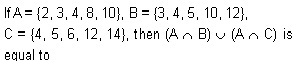


 N} and B = {x : x is a multiple of 6 and x
 N}, then A
 B consists of all multiples of

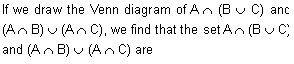

 B will be

