📚 Exam by Category
▾
Objective Questions

Latest NCR Commercial cum Ticket Clerk Exam Question (Objective Questions), MCQ in English

Subjects : Mathematics, General Awareness, General Intelligence & Reasoning

Question Bank NCR Commercial cum Ticket Clerk Exam - English
Back to Exam

Mathematics

Question 1Single Answer
The cash difference between the selling prices of an article at a profit of 4% and 6% is Rs. 3. The ratio of the two selling prices is:__________ ?
  1. A
    51:52
  2. B
    52:53
  3. C
    51:53
  4. D
    52:55
Question 2Single Answer
Which of the following numbers is irrational ?
  1. A
    √49
  2. B
    0.125
  3. C
    √2
  4. D
    22/7
Question 3Single Answer
356 x 936 – 356 x 836 = ?
  1. A
    35600  
  2. B
    34500
  3. C
    9630
  4. D
    93600
Question 4Single Answer
Arrange in descending order: 5/8, 7/10, 3/4
  1. A
    3/4 > 7/10 > 5/8
  2. B
    7/10 > 3/4 > 5/8
  3. C
    3/4 > 5/8 > 7/10
  4. D
    5/8 > 7/10 > 3/4
Question 5Single Answer
What is (3^{4} times 9^{2}) ?
  1. A
    36
  2. B
    38
  3. C
    310
  4. D
    96
     
Question 6Single Answer
If 34X-2 = 729, then find the value of X.
  1. A
    4     
  2. B
    3
  3. C
    2 
  4. D
    5
Question 7Single Answer
Convert 0.6 into fraction ?
  1. A
    3/5
  2. B
    2/3
  3. C
    4/5
Question 8Single Answer
The no. plate of a bus had peculiarity. The bus number was a perfect square. It was also a perfect square when the plate numbers were reversed. The bus company had only five hundred buses numbered from 1 to 500. What was the number ?
  1. A
    169  
  2. B
    36
  3. C
    196 
  4. D
    Can not say
Question 9Single Answer
If a and b are positive integers, such that ab = 125, then (a-b)a+b-4 = ?
  1. A
    16   
  2. B
    25
  3. C
    28  
  4. D
    30
Question 10Single Answer
If x*y = x2 + y2 – xy, then value of 9*11 is
  1. A
    93     
  2. B
    103
  3. C
    60.5
  4. D
    121
Question 11Single Answer
Which is greater ?
  1. A
    15/16
  2. B
    17/18
  3. C
    Equal
  4. D
    Cannot compare
Question 12Single Answer
If sum of two numbers is 42 and their product is 437, then find their difference.
  1. A
    3 
  2. B
    4
  3. C
    5    
  4. D
    7
Question 13Single Answer
Write the 44000 in Roman numerals
  1. A
    XLI 
  2. B
    XLVI
  3. C
    XLIV 
  4. D
    XLVIC
Question 14Single Answer
Convert 0.0909… into fraction ?
  1. A
    1/11
  2. B
    9/11
  3. C
    1/9
  4. D
    9/10
Question 15Single Answer
What is (98 times 102) ?
  1. A
    9996
  2. B
    10000
  3. C
    10096
  4. D
    10196
Question 16Single Answer
Passage :
information given below and answer the question that follow.
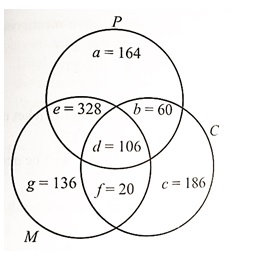
The result of an exam is given below. Out of 1000 students who appeared
(i) 658 failed in Physics
(ii) 166 failed in Physics and Chemistry
(iii) 372 failed in Chemistry, 434 failed in Physics and Maths
(iv) 590 failed in Maths, 126 failed in Maths & Chemistry
Find the number of people who failed in (assuming that none is passed in all subjects.

We have the following equations:
a+ b + c + d + e + f + g = 1000
a + b + d + e = 658, b + d = 166
b + d + c + f = 372
d + e = 434 as in the figure.
d + e + f + g = 590, d + f = 126. Find the values
Chemistry but not in Physics.
  1. A
    318
  2. B
    198
  3. C
    213 
  4. D
    206
Question 17Single Answer
Passage :
Direction: information given below and answer the question that follow.
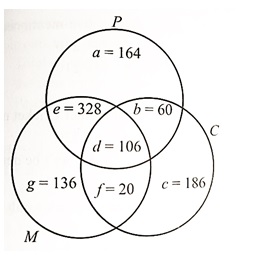
The result of an exam is given below. Out of 1000 students who appeared
(i) 658 failed in Physics
(ii) 166 failed in Physics and Chemistry
(iii) 372 failed in Chemistry, 434 failed in Physics and Maths
(iv) 590 failed in Maths, 126 failed in Maths & Chemistry
Find the number of people who failed in (assuming that none is passed in all subjects.

We have the following equations:
a+ b + c + d + e + f + g = 1000
a + b + d + e = 658, b + d = 166
b + d + c + f = 372
d + e = 434 as in the figure.
d + e + f + g = 590, d + f = 126. Find the values
Physics or Maths but not in Chemistry.
  1. A
    558   
  2. B
    718
  3. C
    628  
  4. D
    None of these
Question 18Single Answer
Passage :
For the next four question that follow:
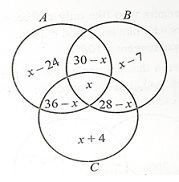
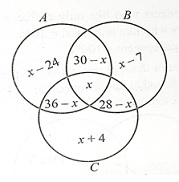
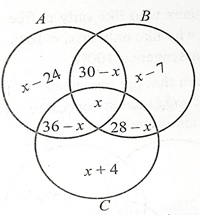
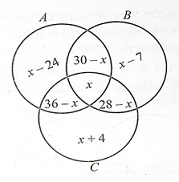
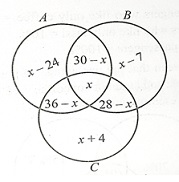
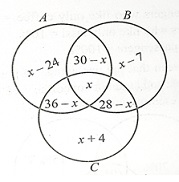
In a city, three daily newspapers A, B, C are published, 42% read A; 51% read B; 68% read C; 30% read A and B; 28% read B and C; 36% read A and C; 8% do not read any of the three newspapers.

Let x% people read all the three newspapers.
Since 8% people do not read any newspapers.
 (x – 24) + (x – 7) + (x + 4) + (30 – x) + (36 – x) + (28 – x) + x = 92
→ x + 98 – 31 = 92
→ x = 92 – 67 = 25
What is the percentage of persons who read all the three papers ?
  1. A
    20%  
  2. B
    25%
  3. C
    30%  
  4. D
    40%
Question 19Single Answer
Passage :
For the next four : question that follow :
In a city, three daily newspapers A, B, C are published, 42% read A; 51% read B; 68% read C; 30% read A and B; 28% read B and C; 36% read A and C; 8% do not read any of the three newspapers.

Let x% people read all the three newspapers.
Since 8% people do not read any newspapers.
 (x – 24) + (x – 7) + (x + 4) + (30 – x) + (36 – x) + (28 – x) + x = 92
→ x + 98 – 31 = 92
→ x = 92 – 67 = 25
What is the percentage of persons who read only two papers?
  1. A
    19%  
  2. B
    31%
  3. C
    44%
  4. D
    None of these
Question 20Single Answer
Passage :
For the next four : question that follow :
In a city, three daily newspapers A, B, C are published, 42% read A; 51% read B; 68% read C; 30% read A and B; 28% read B and C; 36% read A and C; 8% do not read any of the three newspapers.

Let x% people read all the three newspapers.
Since 8% people do not read any newspapers.
(x – 24) + (x – 7) + (x + 4) + (30 – x) + (36 – x) + (28 – x) + x = 92
→ x + 98 – 31 = 92
→ x = 92 – 67 = 25
What is the percentage of persons who read only one paper ?
  1. A
    38% 
  2. B
    48%
  3. C
    51%  
  4. D
    None of these
Question 21Single Answer
Passage :
For the next four : question that follow:
In a city, three daily newspapers A, B, C are published, 42% read A; 51% read B; 68% read C; 30% read A and B; 28% read B and C; 36% read A and C; 8% do not read any of the three newspapers.

Let x% people read all the three newspapers.
Since 8% people do not read any newspapers.
 (x – 24) + (x – 7) + (x + 4) + (30 – x) + (36 – x) + (28 – x) + x = 92
→ x + 98 – 31 = 92
→ x = 92 – 67 = 25
What is the percentage of persons who read only A but neither B nor C ?
  1. A
    4%
  2. B
    3%
  3. C
    1%  
  4. D
    None of these
Question 22Single Answer
Passage :
For the next four : question that follow:
In a city, three daily newspapers A, B, C are published, 42% read A; 51% read B; 68% read C; 30% read A and B; 28% read B and C; 36% read A and C; 8% do not read any of the three newspapers.

Let x% people read all the three newspapers.
Since 8% people do not read any newspapers.
 (x – 24) + (x – 7) + (x + 4) + (30 – x) + (36 – x) + (28 – x) + x = 92
→ x + 98 – 31 = 92
→ x = 92 – 67 = 25
If A and B are any two sets, then what is A ᴖ (A ᴗ B) equal to ?
  1. A
    Complement of A 
  2. B
    Complement of B
  3. C
    B   
  4. D
    A
Question 23Single Answer
Passage :
For the next four : question that follow:
In a city, three daily newspapers A, B, C are published, 42% read A; 51% read B; 68% read C; 30% read A and B; 28% read B and C; 36% read A and C; 8% do not read any of the three newspapers.

Let x% people read all the three newspapers.
Since 8% people do not read any newspapers.
 (x – 24) + (x – 7) + (x + 4) + (30 – x) + (36 – x) + (28 – x) + x = 92
→ x + 98 – 31 = 92
→ x = 92 – 67 = 25
40% of the people read newspaper X, 50% read newspaper Y and 10% read both the papers. What percentage of the people read neither newspaper ?
  1. A
    10%    
  2. B
    15%
  3. C
    20%  
  4. D
    25%
Question 24Single Answer
Passage :
Read the passage below and solve the question based on it.
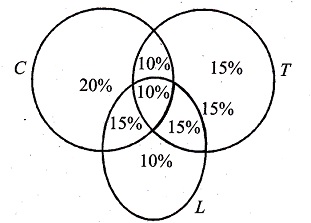
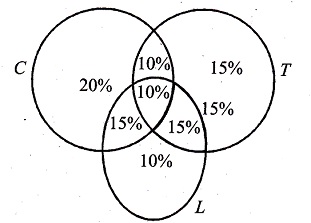
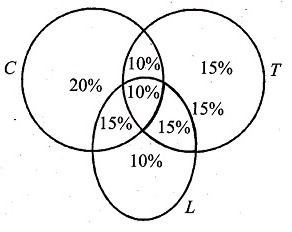
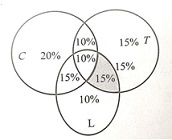
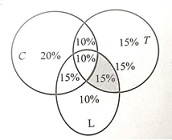
5% of the passengers do not like coffee, tea and lassi and 10% like all the three, 20% like coffee and tea, 25% like lassi and coffee and 25% like lassi and tea. 55% like coffee, 50% like tea, and 50% like lassi.

Where C = Coffee, T = Tea and L =Lassi
The passengers who like only coffee is greater than the passengers who like only lassi by
  1. A
    25%   
  2. B
    100%
  3. C
    75%   
  4. D
    0%
Question 25Single Answer
Passage :
Read the passage below and solve the question based on it.
5% of the passengers do not like coffee, tea and lassi and 10% like all the three, 20% like coffee and tea, 25% like lassi and coffee and 25% like lassi and tea. 55% like coffee, 50% like tea, and 50% like lassi.

Where C = Coffee, T = Tea and L =Lassi
The percentage of passengers who like both tea and lassi but not coffee, is
  1. A
    15 
  2. B
    25
  3. C
    40 
  4. D
    75
Question 26Single Answer
Passage :
Read the passage below and solve the question based on it.
5% of the passengers do not like coffee, tea and lassi and 10% like all the three, 20% like coffee and tea, 25% like lassi and coffee and 25% like lassi and tea. 55% like coffee, 50% like tea, and 50% like lassi.

Where C = Coffee, T = Tea and L =Lassi
The percentage passengers who like at least 2 of the coffee, tea and lassi, is
  1. A
    30 
  2. B
    45
  3. C
    50
  4. D
    60
Question 27Single Answer
Passage :
Read the passage below and solve the question based on it.
5% of the passengers do not like coffee, tea and lassi and 10% like all the three, 20% like coffee and tea, 25% like lassi and coffee and 25% like lassi and tea. 55% like coffee, 50% like tea, and 50% like lassi.

Where C = Coffee, T = Tea and L =Lassi
If the number of passengers is 180, then the number of passengers who like lassi only, is
  1. A
    10       
  2. B
    18
  3. C
    27
  4. D
    36
Question 28Single Answer
Passage :
Read the passage below and solve the question based on it.
5% of the passengers do not like coffee, tea and lassi and 10% like all the three, 20% like coffee and tea, 25% like lassi and coffee and 25% like lassi and tea. 55% like coffee, 50% like tea, and 50% like lassi.

Where C = Coffee, T = Tea and L =Lassi
In a town three newspapers A, B and C are published. 42% of the people in that town read A, 68% read B, 51% read C, 30% read A and B, 28% read B and C, 36% A and C and 18% do not read any paper. Find the % of the population of town that reads all the three.
  1. A
    15% 
  2. B
    25%
  3. C
    20% 
  4. D
    35%
Question 29Single Answer
Passage :
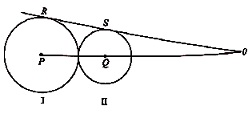
In the adjoining figure, I and II are circles with ceners P and Q respectively. The two circle touch each other and have a common tangent that touches them  at points R and S respectively. This common tangent meets the line joining P and Q at O. The diameters of I and II are in the ratio 4 : 3. It is also known that the length of PO is 28 cm.
What is the ratio of the length of PQ to that of QO?
  1. A
    1 : 4
  2. B
    1 : 3
  3. C
    3 : 8
  4. D
    3 : 4
Question 30Single Answer
Passage :
A committee of five members is to be formed out of 5 Males, 6 Females and 3 Children. In how many different ways can it be done if ?
The committee should consist of 2 Males, 2 Females and 1 child ?
  1. A
    450  
  2. B
    225
  3. C
    55    
  4. D
    90

General Awareness

Question 31Single Answer
Yojna a weekly journal
  1. A
    Ministry of Finance        
  2. B
    Ministry of Information and Broadcastin
  3. C
    Ministry of Rural Development
  4. D
    Planning Commission
Question 32Single Answer
Kurukshetra a journal on rural development is published by
  1. A
    Ministry of Finance 
  2. B
    Ministry of Information and Broadcastin
  3. C
    Ministry of Rural Development
  4. D
    Planning Commission
Question 33Single Answer
Devaluation of a currency means
  1. A
    Fixing the value of the currency in conjuction with the movement in the value of a basket of predetermined currencies
  2. B
    Reduction in the value of a currency vis-à-vis major internationally traded currencies
  3. C
    Fixing the value of currency in multilateral consultaion with the IMF the World Bank and major trading partners
  4. D
    Permitting the currency to seek its worth in the international market
Question 34Single Answer
In India rural incomes are generally lower than the urban incomes, which of the following reasons account for this
            1. a large number of farmers are illiterate and know little about scientific agriculture
            2. prices of primary products are lower than those of manufactured products
            3. Investments in agriculture has been low when compared to investment in industry
  1. A
    1 and 3
  2. B
    2 and 3
  3. C
    1 and 2
  4. D
    1,2 and 3
Question 35Single Answer
Which of the following programmes aims at the promotion of savings among rural women
  1. A
    Rashtriya Mahila Kosh
  2. B
    Indira Mahila Yojna
  3. C
    Jawahar Rozgar Yojna
  4. D
    Mahila Samridhi Yojna
Question 36Single Answer
What is Net National Product
  1. A
    the money value of final goods and services produced annually in the economy
  2. B
    the money value of annual service generation in the economy
  3. C
    the money value of tangible goods produced annually in the economy
  4. D
    The money value of tangible goods available in the economy
Question 37Single Answer
National income is the 
  1. A
    net national product at market price
  2. B
    net national product at factor cost
  3. C
    net domestic product at market price
  4. D
    net domestic product at factor cost
Question 38Single Answer
Chelliah Committee of 1992 deals with the overhauling of our
  1. A
    financial system            
  2. B
    tax system
  3. C
    patents and copyrights  
  4. D
    Public sector undertakings
Question 39Single Answer
During which Five Year Plan was the annual growth rate of National Income the lowest
  1. A
    2nd plan
  2. B
    3rd plan
  3. C
    5th plan
  4. D
    6th plan
Question 40Single Answer
Which of the following taxes is a progressive tax
  1. A
    sales tax           
  2. B
    custom tax
  3. C
    excise tax         
  4. D
    income tax
Question 41Single Answer
Which of the following estimates the National Income in India
  1. A
    National Income Committee
  2. B
    Planning Commission
  3. C
    Reserve Bank Of India
  4. D
    Central Statistical Organisation
Question 42Single Answer
India changed over to the decimal system, coinage in
  1. A
    April 1951         
  2. B
    April 1955
  3. C
    April 1957         
  4. D
    April 1978
Question 43Single Answer
11th Five Year Plan aim at achieving 10% rural tele density in India from the present 1.9% by the year
  1. A
    2008     
  2. B
    2009
  3. C
    2010     
  4. D
    2012
Question 44Single Answer
Which one of the following statements Monitorable Socio Economic Target of the 11th Five Year Plan under the head Environment is not correct
  1. A
    treat urban waste water by 2011-12
  2. B
    Increase energy efficiency by 20% points by 2016-17
  3. C
    attain WHO standards of air quality in all major cities by 2011-12
  4. D
    increase forest and tree cover by 15% points
Question 45Single Answer
Who is the ex-officio chairman of Planning commission and National Development Council
  1. A
    President
  2. B
    Prime Minister
  3. C
    Finance Minister
  4. D
    Commerce Minister
Question 46Single Answer
Persons below the poverty line in Indian are classified as such based on wheather
  1. A
    they belong to agriculture labourer household and the scheduled caste/trive social group
  2. B
    they get work for a prescribed minimum number of days in a year
  3. C
    they are entitled to a minimum prescribed food basket
  4. D
    their daily waged fall below the prescribed minimum wages
Question 47Single Answer
Which of the following Committee’s recommendations are being followed for estimating proverty line in India
  1. A
    Dutt committee
  2. B
    Lakdawala committee
  3. C
    Cheliah Committee
  4. D
    Chakravorty Committee
Question 48Single Answer
In which year India adopeted liberal and free market principles
  1. A
    1975                 
  2. B
    1981
  3. C
    1991                 
  4. D
    2000
Question 49Single Answer
Consider the following statements
1. There is persistent investment over time only in select locals
2. some areas are agro climatically less conductive to development
3. some areas continue to face little or no agrarian transformation and the consequent lack of social and
4. some areas have faced continous political instability
            Which of the above statements are correct
  1. A
    1,2 and 3          
  2. B
    1,2 and 4
  3. C
    1,3 and 4          
  4. D
    2,3 and 4
Question 50Single Answer
When was first human development report of India issued
  1. A
    April 2001         
  2. B
    March 2000
  3. C
    June 2002
  4. D
    April 2002
Important Questions Package

NCR Commercial cum Ticket Clerk Exam Online Question Bank Package

Buy NCR Commercial cum Ticket Clerk Important Questions, MCQ, question answer in Hindi & English. It will help you to score high marks in NCR Commercial cum Ticket Clerk question bank 2026 in Online, PDF & Print study material.

+ Free Monthly Current Affairs, GK & more PDF Download
Sr.Package NameAmount
1.NCR Commercial cum Ticket Clerk Exam - Hindi
Description : 1000 Question with Answer
₹101 [₹500]
2.NCR Commercial cum Ticket Clerk Exam - Hindi
Description : 1500 Question with Answer
₹131 [₹500]
3.NCR Commercial cum Ticket Clerk Exam - English
Description : 1000 Question with Answer
₹101 [₹500]
4.NCR Commercial cum Ticket Clerk Exam - English
Description : 1500 Question with Answer
₹131 [₹500]
5.NCR Commercial cum Ticket Clerk Exam - Hindi
Description : 1000 Question & Answer Download in PDF (Send by Email)
₹151 [₹450]
6.NCR Commercial cum Ticket Clerk Exam - English
Description : 1000 Question & Answer Download in PDF (Send by Email)
₹151 [₹450]
7.NCR Commercial cum Ticket Clerk Exam Question Bank Book - Hindi
Description : 1000 Question with Answer (Printed Material)
₹450 [₹800]
8.NCR Commercial cum Ticket Clerk Exam Question Bank Book - English
Description : 1000 Question with Answer (Printed Material)
₹390 [₹600]
Back to Exam
Question for NCR Commercial cum Ticket Clerk 2026 - Quiz / Questions / MCQ - Toppersexam