📚 Exam by Category
▾
Objective Questions

Latest Odisha LTR Teacher Sanskrit Teacher Exam Question (Objective Questions), MCQ in English

Subjects : General Studies, Arithmetic, Logical Reasoning & Analytical Ability, Computer/Internet Awareness, Current Affairs

Question Bank Odisha LTR Teacher Sanskrit Teacher Prelims Exam - English
Back to Exam

General Studies

Question 1Single Answer
Yojna a weekly journal
  1. A
    Ministry of Finance        
  2. B
    Ministry of Information and Broadcastin
  3. C
    Ministry of Rural Development
  4. D
    Planning Commission
Question 2Single Answer
Kurukshetra a journal on rural development is published by
  1. A
    Ministry of Finance 
  2. B
    Ministry of Information and Broadcastin
  3. C
    Ministry of Rural Development
  4. D
    Planning Commission
Question 3Single Answer
Devaluation of a currency means
  1. A
    Fixing the value of the currency in conjuction with the movement in the value of a basket of predetermined currencies
  2. B
    Reduction in the value of a currency vis-à-vis major internationally traded currencies
  3. C
    Fixing the value of currency in multilateral consultaion with the IMF the World Bank and major trading partners
  4. D
    Permitting the currency to seek its worth in the international market
Question 4Single Answer
In India rural incomes are generally lower than the urban incomes, which of the following reasons account for this
            1. a large number of farmers are illiterate and know little about scientific agriculture
            2. prices of primary products are lower than those of manufactured products
            3. Investments in agriculture has been low when compared to investment in industry
  1. A
    1 and 3
  2. B
    2 and 3
  3. C
    1 and 2
  4. D
    1,2 and 3
Question 5Single Answer
Which of the following programmes aims at the promotion of savings among rural women
  1. A
    Rashtriya Mahila Kosh
  2. B
    Indira Mahila Yojna
  3. C
    Jawahar Rozgar Yojna
  4. D
    Mahila Samridhi Yojna
Question 6Single Answer
It is said that Ashoka attacked Kalinga to get a Beautiful Girl of Fisherman Caste. Name the Girl
  1. A
    Lalita
  2. B
    Chandrika
  3. C
    Karubaki
  4. D
    Rupambika
Question 7Single Answer
In which year was the Kalinga War Fought
  1. A
    150 BC
  2. B
    261 BC
  3. C
    75 Dc
  4. D
    166 BC
Question 8Single Answer
In Odisha KingAshoka did set up two H.Q.One was at Bhubaneswar. Where was the Second H.Q
  1. A
    Jaugada
  2. B
    Lalitgiri
  3. C
    Mallechhmunda
  4. D
    Sonepur
Question 9Single Answer
Jaugada is in which district
  1. A
    Puri
  2. B
    Keonjhar
  3. C
    Ganjam
  4. D
    Koraput
Question 10Single Answer
Witnessing mindess' massaere in Kalinga Was Ashoka got repentant and embraced Bhddhism. From which Buddhist Guru. He took initiation and Wbcame Buddhist
  1. A
    Upagupta
  2. B
    Chankya
  3. C
    Panini
  4. D
    Harisen
Question 11Single Answer
Name the song and daughter of Ashoka who were sent to Srilanka for spread of Buddhism
  1. A
    Ram Deo and Damayanti
  2. B
    Devendra and Madhuri
  3. C
    Kumar Gupta and Kalavati
  4. D
    Mahendra and Sanghamitra
Question 12Single Answer
Before Ashoka King of which Dynasty of Magadha had attacked Odisha and taken away a statue of Jain Guru.
  1. A
    Maurya
  2. B
    Nanda
  3. C
    Sunga
  4. D
    Kanva
Question 13Single Answer
In which year the great king Kharbel of Chedi Dynasty had sat on the throne of Kalinga.
  1. A
    192 BC
  2. B
    160 BC   
  3. C
    244 BC
  4. D
    118 BC
Question 14Single Answer
Name the King of Magadha who was defeated by Kharbel and He Retrieved the Jain Guru Statue taken away by Nanda King.
  1. A
    Pushya Bhuti Sunga
  2. B
    Bikram Giri Mitra AI
  3. C
    Bachaspati Sunga
  4. D
    Brihaspati Mitra Sung
Question 15Single Answer
Name the Power of South India defeated by King Kharbel
  1. A
    Chola
  2. B
    Pandya
  3. C
    Shatkarni
  4. D
    Chalukya
Question 16Single Answer
Sattriya dance form is famous in which of these states ?
  1. A
    Assam
  2. B
    Himachal Pradesh
  3. C
    Punjab
  4. D
    Tamil Nadu
Question 17Single Answer
Which of the following statements is true ?
Statement I: Indian techniques such as Rasa and Bhawa in classical dances have their origins in Bharatmuni's Natyashastra.
Statement II: Bharatanatyam has its origin in Odisha.
  1. A
    Only Statement II is true
  2. B
    Both Statement I and Statement II are true
  3. C
    Neither Statement I nor Statement II is true
  4. D
    Only Statement I is true
Question 18Single Answer
Padma Bhushan, Guru Vempati Chinna Satyam is renowned for having trained hundreds of students in which of the following dance forms ?
  1. A
    Kuchipudi
  2. B
    Odissi
  3. C
    Bharatnatyam
  4. D
    Kathak
Question 19Single Answer
As an exponent of Khayal, Pandit Bhimsen Joshi belonged to which music Gharana ?
  1. A
    Agra
  2. B
    Benaras
  3. C
    Kirana
  4. D
    Gwalior
Question 20Single Answer
Which is the national game of Bhutan ?
  1. A
    badminton
  2. B
    basketball
  3. C
    football
  4. D
    archery
Question 21Single Answer
What is the national game of the United States of America ?
  1. A
    water polo
  2. B
    Rugby
  3. C
    Polo
  4. D
    baseball
Question 22Single Answer
What is considered the national game of India ?
  1. A
    Field hockey
  2. B
    cricket
  3. C
    Chess
  4. D
    Kabaddi
Question 23Single Answer
The national game of Türkiye is….
  1. A
    horse racing
  2. B
    wrestling
  3. C
    Handball
  4. D
    basketball
Question 24Single Answer
When was the Constituent Assembly of India formed?
  1. A
    1946
  2. B
    1947
  3. C
    1948
  4. D
    1950
Question 25Single Answer
Who was the Chairman of the Drafting Committee of the Indian Constitution?
  1. A
    Dr. Rajendra Prasad
  2. B
    Dr. B.R. Ambedkar
  3. C
    Jawaharlal Nehru
  4. D
    Sardar Vallabhbhai Patel
Question 26Single Answer
The idea of the Constituent Assembly was first put forward by:
  1. A
    Mahatma Gandhi
  2. B
    M.N. Roy
  3. C
    Jawaharlal Nehru
  4. D
    Sardar Vallabhbhai Patel
Question 27Single Answer
The Cabinet Mission Plan for India was proposed in:
  1. A
    1942
  2. B
    1945
  3. C
    1946
  4. D
    1947
Question 28Single Answer
Which is the longest river in India?
  1. A
    Yamuna
  2. B
    Ganges
  3. C
    Brahmaputra
  4. D
    Godavari
Question 29Single Answer
The Western Ghats are also known as:
  1. A
    Sahyadris
  2. B
    Vindhyas
  3. C
    Satpuras
  4. D
    Aravallis
Question 30Single Answer
Which river is known as the ‘Sorrow of Bihar’?
  1. A
    Ganges
  2. B
    Kosi
  3. C
    Son
  4. D
    Gandak

Arithmetic

Question 31Single Answer
The cash difference between the selling prices of an article at a profit of 4% and 6% is Rs. 3. The ratio of the two selling prices is:__________ ?
  1. A
    51:52
  2. B
    52:53
  3. C
    51:53
  4. D
    52:55
Question 32Single Answer
Which of the following numbers is irrational ?
  1. A
    √49
  2. B
    0.125
  3. C
    √2
  4. D
    22/7
Question 33Single Answer
356 x 936 – 356 x 836 = ?
  1. A
    35600  
  2. B
    34500
  3. C
    9630
  4. D
    93600
Question 34Single Answer
Arrange in descending order: 5/8, 7/10, 3/4
  1. A
    3/4 > 7/10 > 5/8
  2. B
    7/10 > 3/4 > 5/8
  3. C
    3/4 > 5/8 > 7/10
  4. D
    5/8 > 7/10 > 3/4
Question 35Single Answer
What is (3^{4} times 9^{2}) ?
  1. A
    36
  2. B
    38
  3. C
    310
  4. D
    96
     
Question 36Single Answer
If 34X-2 = 729, then find the value of X.
  1. A
    4     
  2. B
    3
  3. C
    2 
  4. D
    5
Question 37Single Answer
Convert 0.6 into fraction ?
  1. A
    3/5
  2. B
    2/3
  3. C
    4/5
Question 38Single Answer
The no. plate of a bus had peculiarity. The bus number was a perfect square. It was also a perfect square when the plate numbers were reversed. The bus company had only five hundred buses numbered from 1 to 500. What was the number ?
  1. A
    169  
  2. B
    36
  3. C
    196 
  4. D
    Can not say
Question 39Single Answer
If a and b are positive integers, such that ab = 125, then (a-b)a+b-4 = ?
  1. A
    16   
  2. B
    25
  3. C
    28  
  4. D
    30
Question 40Single Answer
If x*y = x2 + y2 – xy, then value of 9*11 is
  1. A
    93     
  2. B
    103
  3. C
    60.5
  4. D
    121
Question 41Single Answer
Passage :
information given below and answer the question that follow.
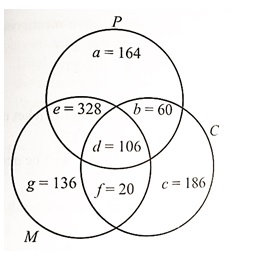
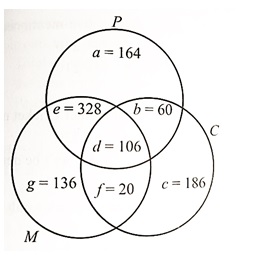
The result of an exam is given below. Out of 1000 students who appeared
(i) 658 failed in Physics
(ii) 166 failed in Physics and Chemistry
(iii) 372 failed in Chemistry, 434 failed in Physics and Maths
(iv) 590 failed in Maths, 126 failed in Maths & Chemistry
Find the number of people who failed in (assuming that none is passed in all subjects.

We have the following equations:
a+ b + c + d + e + f + g = 1000
a + b + d + e = 658, b + d = 166
b + d + c + f = 372
d + e = 434 as in the figure.
d + e + f + g = 590, d + f = 126. Find the values
Chemistry but not in Physics.
  1. A
    318
  2. B
    198
  3. C
    213 
  4. D
    206
Question 42Single Answer
Passage :
Direction: information given below and answer the question that follow.
The result of an exam is given below. Out of 1000 students who appeared
(i) 658 failed in Physics
(ii) 166 failed in Physics and Chemistry
(iii) 372 failed in Chemistry, 434 failed in Physics and Maths
(iv) 590 failed in Maths, 126 failed in Maths & Chemistry
Find the number of people who failed in (assuming that none is passed in all subjects.

We have the following equations:
a+ b + c + d + e + f + g = 1000
a + b + d + e = 658, b + d = 166
b + d + c + f = 372
d + e = 434 as in the figure.
d + e + f + g = 590, d + f = 126. Find the values
Physics or Maths but not in Chemistry.
  1. A
    558   
  2. B
    718
  3. C
    628  
  4. D
    None of these
Question 43Single Answer
Passage :
For the next four question that follow:
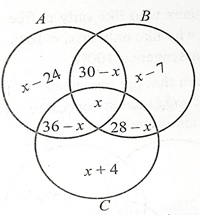
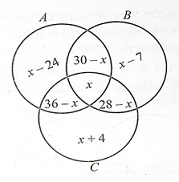
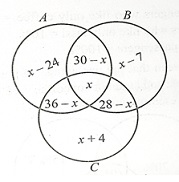
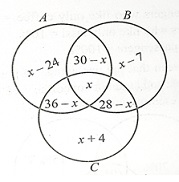
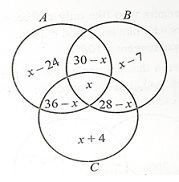
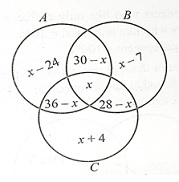
In a city, three daily newspapers A, B, C are published, 42% read A; 51% read B; 68% read C; 30% read A and B; 28% read B and C; 36% read A and C; 8% do not read any of the three newspapers.

Let x% people read all the three newspapers.
Since 8% people do not read any newspapers.
 (x – 24) + (x – 7) + (x + 4) + (30 – x) + (36 – x) + (28 – x) + x = 92
→ x + 98 – 31 = 92
→ x = 92 – 67 = 25
What is the percentage of persons who read all the three papers ?
  1. A
    20%  
  2. B
    25%
  3. C
    30%  
  4. D
    40%
Question 44Single Answer
Passage :
For the next four : question that follow :
In a city, three daily newspapers A, B, C are published, 42% read A; 51% read B; 68% read C; 30% read A and B; 28% read B and C; 36% read A and C; 8% do not read any of the three newspapers.

Let x% people read all the three newspapers.
Since 8% people do not read any newspapers.
 (x – 24) + (x – 7) + (x + 4) + (30 – x) + (36 – x) + (28 – x) + x = 92
→ x + 98 – 31 = 92
→ x = 92 – 67 = 25
What is the percentage of persons who read only two papers?
  1. A
    19%  
  2. B
    31%
  3. C
    44%
  4. D
    None of these
Question 45Single Answer
Passage :
For the next four : question that follow :
In a city, three daily newspapers A, B, C are published, 42% read A; 51% read B; 68% read C; 30% read A and B; 28% read B and C; 36% read A and C; 8% do not read any of the three newspapers.

Let x% people read all the three newspapers.
Since 8% people do not read any newspapers.
(x – 24) + (x – 7) + (x + 4) + (30 – x) + (36 – x) + (28 – x) + x = 92
→ x + 98 – 31 = 92
→ x = 92 – 67 = 25
What is the percentage of persons who read only one paper ?
  1. A
    38% 
  2. B
    48%
  3. C
    51%  
  4. D
    None of these
Question 46Single Answer
Passage :
For the next four : question that follow:
In a city, three daily newspapers A, B, C are published, 42% read A; 51% read B; 68% read C; 30% read A and B; 28% read B and C; 36% read A and C; 8% do not read any of the three newspapers.

Let x% people read all the three newspapers.
Since 8% people do not read any newspapers.
 (x – 24) + (x – 7) + (x + 4) + (30 – x) + (36 – x) + (28 – x) + x = 92
→ x + 98 – 31 = 92
→ x = 92 – 67 = 25
What is the percentage of persons who read only A but neither B nor C ?
  1. A
    4%
  2. B
    3%
  3. C
    1%  
  4. D
    None of these
Question 47Single Answer
Passage :
For the next four : question that follow:
In a city, three daily newspapers A, B, C are published, 42% read A; 51% read B; 68% read C; 30% read A and B; 28% read B and C; 36% read A and C; 8% do not read any of the three newspapers.

Let x% people read all the three newspapers.
Since 8% people do not read any newspapers.
 (x – 24) + (x – 7) + (x + 4) + (30 – x) + (36 – x) + (28 – x) + x = 92
→ x + 98 – 31 = 92
→ x = 92 – 67 = 25
If A and B are any two sets, then what is A ᴖ (A ᴗ B) equal to ?
  1. A
    Complement of A 
  2. B
    Complement of B
  3. C
    B   
  4. D
    A
Question 48Single Answer
Passage :
For the next four : question that follow:
In a city, three daily newspapers A, B, C are published, 42% read A; 51% read B; 68% read C; 30% read A and B; 28% read B and C; 36% read A and C; 8% do not read any of the three newspapers.

Let x% people read all the three newspapers.
Since 8% people do not read any newspapers.
 (x – 24) + (x – 7) + (x + 4) + (30 – x) + (36 – x) + (28 – x) + x = 92
→ x + 98 – 31 = 92
→ x = 92 – 67 = 25
40% of the people read newspaper X, 50% read newspaper Y and 10% read both the papers. What percentage of the people read neither newspaper ?
  1. A
    10%    
  2. B
    15%
  3. C
    20%  
  4. D
    25%
Question 49Single Answer
Passage :
Read the passage below and solve the question based on it.
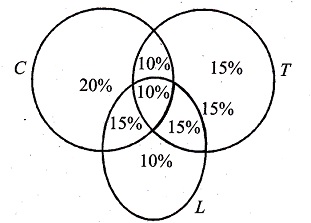
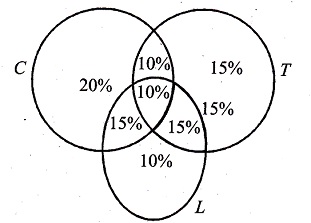
5% of the passengers do not like coffee, tea and lassi and 10% like all the three, 20% like coffee and tea, 25% like lassi and coffee and 25% like lassi and tea. 55% like coffee, 50% like tea, and 50% like lassi.

Where C = Coffee, T = Tea and L =Lassi
The passengers who like only coffee is greater than the passengers who like only lassi by
  1. A
    25%   
  2. B
    100%
  3. C
    75%   
  4. D
    0%
Question 50Single Answer
Passage :
Read the passage below and solve the question based on it.
5% of the passengers do not like coffee, tea and lassi and 10% like all the three, 20% like coffee and tea, 25% like lassi and coffee and 25% like lassi and tea. 55% like coffee, 50% like tea, and 50% like lassi.

Where C = Coffee, T = Tea and L =Lassi
The percentage of passengers who like both tea and lassi but not coffee, is
  1. A
    15 
  2. B
    25
  3. C
    40 
  4. D
    75
Important Questions Package

Odisha LTR Teacher Sanskrit Teacher Exam Online Question Bank Package

Buy Odisha LTR Teacher Sanskrit Teacher Important Questions, MCQ, question answer in Hindi & English. It will help you to score high marks in Odisha LTR Teacher Sanskrit Teacher question bank 2026 in Online, PDF & Print study material.

+ Free Monthly Current Affairs, GK & more PDF Download
Sr.Package NameAmount
1.Odisha LTR Teacher Sanskrit Teacher Prelims Exam - English
Description : 1000 Question with Answer
₹101 [₹500]
2.Odisha LTR Teacher Sanskrit Teacher Prelims Exam - English
Description : 2000 Question with Answer
₹151 [₹500]
3.Odisha LTR Teacher Sanskrit Teacher Prelims Exam - English
Description : 3000 Question with Answer
₹181 [₹500]
4.Odisha LTR Teacher Sanskrit Teacher Prelims Exam - English
Description : 4000 Question with Answer
₹201 [₹500]
5.Odisha LTR Teacher Sanskrit Teacher Mains Exam - English
Description : 1000 Question with Answer
₹101 [₹500]
6.Odisha LTR Teacher Sanskrit Teacher Mains Exam - English
Description : 2000 Question with Answer
₹151 [₹500]
7.Odisha LTR Teacher Sanskrit Teacher Prelims Exam - English
Description : 1000 Question & Answer Download in PDF (Send by Email)
₹151 [₹450]
8.Odisha LTR Teacher Sanskrit Teacher Mains Exam - English
Description : 1000 Question & Answer Download in PDF (Send by Email)
₹151 [₹450]
9.Odisha LTR Teacher Sanskrit Teacher Prelims Exam Question Bank Book - English
Description : 1000 Question with Answer (Printed Material)
₹390 [₹600]
10.Odisha LTR Teacher Sanskrit Teacher Mains Exam Question Bank Book - English
Description : 1000 Question with Answer (Printed Material)
₹390 [₹600]
Back to Exam