📚 Exam by Category
▾
Objective Questions

Latest Puducherry Home Guard Exam Question (Objective Questions), MCQ in English

Subjects : Mathematics and General Science, History, Geography & Civics, General Knowledge & Current Events

Question Bank Puducherry Home Guard Exam - English
Back to Exam

Mathematics and General Science

Question 1Single Answer
In ruby laser, the stimulated emission is due to transition from
  1. A
    metastable state to any lower state
  2. B
    any higher state of lower state
  3. C
    metastable state to ground state
  4. D
    any higher state to ground state
Question 2Single Answer
A direct current I flows along the length of an infinitely long straight thin walled pipe, then the magnetic field is
  1. A
    uniform throughout the pipe not zero
  2. B
    zero only along the axis of the pipe
  3. C
    zero at any point inside the pipe
  4. D
    maximum at the centre and minimum at the edge
Question 3Single Answer
convex lens made of glass has focal length 0.15m in air. If the refractive index of glass is 3/2, and that of water is 4/3 the focal length of lens when immersed in water is
  1. A
    0.45 m    
  2. B
    0.15 m
  3. C
    0.30 m       
  4. D
    0.6 m
Question 4Single Answer
Two sources are said to be coherent if they produce waves
  1. A
    having a constant phase difference
  2. B
    of equal wavelength
  3. C
    of equal speed
  4. D
    having same shape of wavefront
Question 5Single Answer
10-6 M NaOH is diluted 100 times. The pH of the diluted base is
  1. A
    between 7 and 8
  2. B
    between 5 and 6
  3. C
    between 6 and 7
  4. D
    between 10 and 11
Question 6Single Answer
In the electrolysis of acidulated water, it is desired to obtain 1.12 cc of hydrogen per second under STP condition. The current to be passed is
  1. A
    1.93 A         
  2. B
    9.65 A
  3. C
    19.3 A        
  4. D
    0.965 A
Question 7Single Answer
The one which decreases with dilution is
  1. A
    molar conductance
  2. B
    conductance
  3. C
    specific conductance
  4. D
    equivalent conductance
Question 8Single Answer
The respiratory quotient during cellular respiration would depend on
  1. A
    the nature of enzymes involved
  2. B
    the nature of the substrate
  3. C
    the amount of carbon dioxide released
  4. D
    the amount of oxygen utilised
Question 9Single Answer
Which of the following is not a green - house gas ?
  1. A
    Water vapour
  2. B
    Carbon monoxide
  3. C
    Methane
  4. D
    Oxygen
Question 10Single Answer
Both husband and wife have normal vision though their fathers were colorblind and mothers did not have any gene for colorblindness. The probability of their daughters becoming colorblind is
  1. A
    50%          
  2. B
    75%
  3. C
    0% 
  4. D
    25%
Question 11Single Answer
Identify the correct sequence of energy flow through various levels of an ecosystem
  1. A
    Sun’s energy→ Primary producers →Carnivores
  2. B
    Sun’s energy→ Primary producers →Carnivores→ Herbivores
  3. C
    Sun’s energy →Herbivores→ Primary producers
  4. D
    Sun’ senergy→ Primary producers →Herbivores →Carnivores
Question 12Single Answer
When environmental lapse rate is more than dry adiabatic lapse rate, the atmosphere is said to be in
  1. A
    Stable state
  2. B
    Unstable state
  3. C
    Neutral state
  4. D
    Conditionally stable state
Question 13Single Answer
Which of the following accounts for nearly 75% of the available fresh water in the world?
  1. A
    Groundwater
  2. B
    Glaciers
  3. C
    River water
  4. D
    Lakes
Question 14Single Answer
The cash difference between the selling prices of an article at a profit of 4% and 6% is Rs. 3. The ratio of the two selling prices is:__________ ?
  1. A
    51:52
  2. B
    52:53
  3. C
    51:53
  4. D
    52:55
Question 15Single Answer
Which of the following numbers is irrational ?
  1. A
    √49
  2. B
    0.125
  3. C
    √2
  4. D
    22/7
Question 16Single Answer
356 x 936 – 356 x 836 = ?
  1. A
    35600  
  2. B
    34500
  3. C
    9630
  4. D
    93600
Question 17Single Answer
Arrange in descending order: 5/8, 7/10, 3/4
  1. A
    3/4 > 7/10 > 5/8
  2. B
    7/10 > 3/4 > 5/8
  3. C
    3/4 > 5/8 > 7/10
  4. D
    5/8 > 7/10 > 3/4
Question 18Single Answer
What is (3^{4} times 9^{2}) ?
  1. A
    36
  2. B
    38
  3. C
    310
  4. D
    96
     
Question 19Single Answer
If 34X-2 = 729, then find the value of X.
  1. A
    4     
  2. B
    3
  3. C
    2 
  4. D
    5
Question 20Single Answer
Passage :
information given below and answer the question that follow.
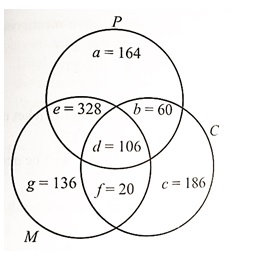
The result of an exam is given below. Out of 1000 students who appeared
(i) 658 failed in Physics
(ii) 166 failed in Physics and Chemistry
(iii) 372 failed in Chemistry, 434 failed in Physics and Maths
(iv) 590 failed in Maths, 126 failed in Maths & Chemistry
Find the number of people who failed in (assuming that none is passed in all subjects.

We have the following equations:
a+ b + c + d + e + f + g = 1000
a + b + d + e = 658, b + d = 166
b + d + c + f = 372
d + e = 434 as in the figure.
d + e + f + g = 590, d + f = 126. Find the values
Chemistry but not in Physics.
  1. A
    318
  2. B
    198
  3. C
    213 
  4. D
    206
Question 21Single Answer
Passage :
Direction: information given below and answer the question that follow.
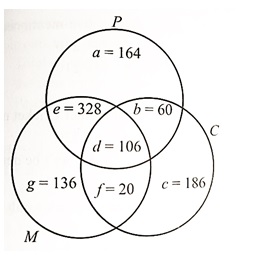
The result of an exam is given below. Out of 1000 students who appeared
(i) 658 failed in Physics
(ii) 166 failed in Physics and Chemistry
(iii) 372 failed in Chemistry, 434 failed in Physics and Maths
(iv) 590 failed in Maths, 126 failed in Maths & Chemistry
Find the number of people who failed in (assuming that none is passed in all subjects.

We have the following equations:
a+ b + c + d + e + f + g = 1000
a + b + d + e = 658, b + d = 166
b + d + c + f = 372
d + e = 434 as in the figure.
d + e + f + g = 590, d + f = 126. Find the values
Physics or Maths but not in Chemistry.
  1. A
    558   
  2. B
    718
  3. C
    628  
  4. D
    None of these
Question 22Single Answer
Passage :
For the next four question that follow:
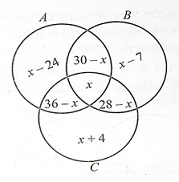
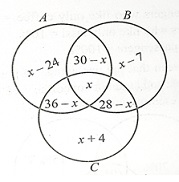
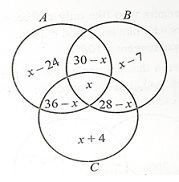
In a city, three daily newspapers A, B, C are published, 42% read A; 51% read B; 68% read C; 30% read A and B; 28% read B and C; 36% read A and C; 8% do not read any of the three newspapers.

Let x% people read all the three newspapers.
Since 8% people do not read any newspapers.
 (x – 24) + (x – 7) + (x + 4) + (30 – x) + (36 – x) + (28 – x) + x = 92
→ x + 98 – 31 = 92
→ x = 92 – 67 = 25
What is the percentage of persons who read all the three papers ?
  1. A
    20%  
  2. B
    25%
  3. C
    30%  
  4. D
    40%
Question 23Single Answer
Passage :
For the next four : question that follow :
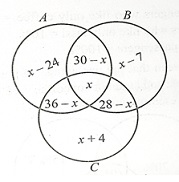
In a city, three daily newspapers A, B, C are published, 42% read A; 51% read B; 68% read C; 30% read A and B; 28% read B and C; 36% read A and C; 8% do not read any of the three newspapers.

Let x% people read all the three newspapers.
Since 8% people do not read any newspapers.
 (x – 24) + (x – 7) + (x + 4) + (30 – x) + (36 – x) + (28 – x) + x = 92
→ x + 98 – 31 = 92
→ x = 92 – 67 = 25
What is the percentage of persons who read only two papers?
  1. A
    19%  
  2. B
    31%
  3. C
    44%
  4. D
    None of these
Question 24Single Answer
Passage :
For the next four : question that follow :
In a city, three daily newspapers A, B, C are published, 42% read A; 51% read B; 68% read C; 30% read A and B; 28% read B and C; 36% read A and C; 8% do not read any of the three newspapers.

Let x% people read all the three newspapers.
Since 8% people do not read any newspapers.
(x – 24) + (x – 7) + (x + 4) + (30 – x) + (36 – x) + (28 – x) + x = 92
→ x + 98 – 31 = 92
→ x = 92 – 67 = 25
What is the percentage of persons who read only one paper ?
  1. A
    38% 
  2. B
    48%
  3. C
    51%  
  4. D
    None of these
Question 25Single Answer
Passage :
For the next four : question that follow:
In a city, three daily newspapers A, B, C are published, 42% read A; 51% read B; 68% read C; 30% read A and B; 28% read B and C; 36% read A and C; 8% do not read any of the three newspapers.

Let x% people read all the three newspapers.
Since 8% people do not read any newspapers.
 (x – 24) + (x – 7) + (x + 4) + (30 – x) + (36 – x) + (28 – x) + x = 92
→ x + 98 – 31 = 92
→ x = 92 – 67 = 25
What is the percentage of persons who read only A but neither B nor C ?
  1. A
    4%
  2. B
    3%
  3. C
    1%  
  4. D
    None of these

History, Geography & Civics

Question 26Single Answer
The earlist manuscripts were written on 
  1. A
    palm leaves
  2. B
    paper 
  3. C
    wood 
  4. D
    stones
Question 27Single Answer
What does BC and AD stands for?
  1. A
    Anno Domini and Before Common
  2. B
    Before Christ and Anno Domini 
  3. C
    Anno Domini and Before Christ
  4. D
    None of the above
Question 28Single Answer
Which of the following is/are characteristic(s) of a manuscript?
(A) It is written on a hard surface such as a stone or a metal.
(B) It is an old book written by hand.
(C) It is written on palm leaf or on specially prepared bark of the birch tree.
  1. A
    Only A 
  2. B
    B and C
  3. C
    Only B 
  4. D
    All of these
Question 29Single Answer
Which one of the following statements is false?
  1. A
    History is about changes that over time, about finding out how things were in the past and how things have changed 
  2. B
    In the histories narrated by British historians about India, the rule of each Governor-General was important 
  3. C
    James Mill divided Indian History into three periods Hindu, Muslim and Christian
  4. D
    The British in India believed that surveys were important for effective administration
Question 30Single Answer
Which is the criteria to decide that a particular date is important in history?
  1. A
    They are the date of birth of a king or emperor 
  2. B
    A particular event or set of events has occurred on or around that date 
  3. C
    It is the date of coronation of a king
  4. D
    All of the above
Question 31Single Answer
Which of the following are incorrect statements?
(A) The archaeological evidence is obtained by the systematic examination of building monumentas and work of art.
(B) The credit for excavating the Pre-Aryan past goes to Sir William Jones.
(C) The Asiatic Society of Bengal established on 1786.
(D) James Mill is known as the 'Father of Indian Archaeology'. 
  1. A
    A and B
  2. B
    C and D 
  3. C
    B and D 
  4. D
    B, C and D
Question 32Single Answer
Consider the following statements A and B and choose the correct option
(A) Inscriptions are the most reliable evidence and their study is called epigraphy.
(B) James Princep, the secretary of the Asiatic Society of Bengal succeeded for the first time in deciphering the Brahmi script.
  1. A
    Both A and B are true 
  2. B
    A is false and B is true
  3. C
    A and B are false 
  4. D
    A is true and B is false
Question 33Single Answer
Consider the following statements A and B on the study of coins and choose the correct option
(A) The study of coins is known as numismatics
(B) The coins give us an idea about the socio-political aspect of that period.
  1. A
    Both A and B are true
  2. B
    A is false and B is true
  3. C
    A and B are false 
  4. D
    A is true and B is false
Question 34Single Answer
Which of the following are correct statements?
(A) Literaiy sources includes manuscripts.
(B) These writings were written by hands.
(C) It gives a reliable glimpses of culture and civilisation of the age
(D) Raj Tarangini was written by Banbhatta. 
  1. A
    A, B and C
  2. B
    B,C and D 
  3. C
    A, B and D 
  4. D
    All of these
Question 35Single Answer
Which objects can archaeologists find which may be made of stone? 
  1. A
    Remains of buildings, paintings and sculpture
  2. B
    Tools, weapons and ornaments found by excavation 
  3. C
    Coins, pots and pans found beneath the surface of the Earth 
  4. D
    All ot the above
Question 36Single Answer
On what subjects were books not written in ancient days?
  1. A
    Murder mysteries 
  2. B
    Religious beliefs and practices 
  3. C
    Lives of the kings
  4. D
    Epics, poems and plays
Question 37Single Answer
What is the meaning of ‘periodisation’ in history? 
  1. A
    Deciding the period of time for which an age like neolithic or paleolithic age lasts 
  2. B
    Dividing the earlier times into fixed periods of 100 years each 
  3. C
    Demarcating of time into different unequal periods based on the occurrence of some significant events 
  4. D
    None of the above
Question 38Single Answer
Which of the following gives the correct meaning of ‘colonisation’ in history? 
  1. A
    When one country conquers another, it brings about changes in its society 
  2. B
    When a country ‘colonises’ another, it imposes its religion on the colonised country completely 
  3. C
    Colonisation implies intermarrying of the colonised people with the colonisers 
  4. D
    All of the above
Question 39Single Answer
What can a historian not derive from surveys? 
  1. A
    We can collect the right data, figures and information regarding a subject 
  2. B
    We can find out past behaviour and structure of society
  3. C
    We can find out the culture, habits and means of livelihood of the people
  4. D
    All of the above
Question 40Single Answer
In the middle of the 19th century, British historians divided history of Indin into three periods-Hindu India, Muslim India and British India. What is the basis of this division?
  1. A
    It was based on the idea that religion of the rulers was an important historical change 
  2. B
    History of England is also written in a similar way
  3. C
    Britishers felt they were more knowledge-able at that point of time in history and so used this division
  4. D
    It was convenient and easy to remember
Question 41Single Answer
Which of the following statement about ‘ancient manuscript’ is not correct? 
  1. A
    They were usually written on Palm leaves
  2. B
    They are primary source of the period they reflected
  3. C
    They were handwritten and then printed 
  4. D
    Some manuscript were engraved on stone or metal
Question 42Single Answer
What is ‘Common Era'? 
  1. A
    A new era developed by amalgamation of Hindu Era and Islamic Era
  2. B
    A new era to study historical events 
  3. C
    Christian Era which is now accepted in major parts of the world 
  4. D
    Indian Era accepted by the government to issue notices
Question 43Single Answer
The year ‘2012 can also be written as
  1. A
    AD 2012
  2. B
    AP 2012 
  3. C
    BC 2012 
  4. D
    EC 2012
Question 44Single Answer
The division of the period of Indian History into ‘Ancient’, ‘Medieval’ and ‘Modern’ also has problems. Which of the following is one of the problems in it? 
  1. A
    Tripartite division reflects gradual growth of the Indian state 
  2. B
    Three periods are insufficient to describe Indian History
  3. C
    The concept has been borrowed from the West where modem period was associated with science, reason, democracy, liberty and equality 
  4. D
    Indian history seems to have diear lines of distinction between ‘Ancient and Medieval’ and ‘Medieval and Modern’ period
Question 45Single Answer
Why would you ask question on historical imagination? Choose the most appropriate option from the following. 
  1. A
    It encourages comparison of the present with the past 
  2. B
    It evaluates a student’s ability to identify sources
  3. C
    It is fun-way to remember dates and events 
  4. D
    It shows how historians fill gaps in history with their imagination
Question 46Single Answer
An archive is a place where 
  1. A
    historical manuscripts and documents are kept
  2. B
    excavated bones of animals and birds are kept 
  3. C
    remains of the buildings made of stone and bricks, found by archaeologists are kept
  4. D
    sculptures found in excavations are kept
Question 47Single Answer
History will help you to
(A) understand how the present evolved.
(B) understand the working of our physical and social world. (C) compare the past with the present. Which of the above are correct? 
  1. A
    A, B and C
  2. B
    A and B 
  3. C
    B and C 
  4. D
    A and C
Question 48Single Answer
Consider the following two statements A and B regarding factors responsible for movement of earliest people and choose the correct answer.
(A) These hunter-gatherers moved from place to place in search of food.
(B) The water reservoir and season was not responsible for their movement. 
  1. A
    A and B are true 
  2. B
    A is false and B is true 
  3. C
    B is false and A is true
  4. D
    Both A and B are false
Question 49Single Answer
Which of the following are incorrect statements?
(A) Hallur is a Mesolithic site.
(B) Patne is a Neolithic site.
(C) Chirand is a Neolithic site.
(D) Kumool cave is a Mesolithic site.
  1. A
    A and B
  2. B
    C and D
  3. C
    A, B and D 
  4. D
    B and D
Question 50Single Answer
Consider the following two statements, A and B on the archaeological sites of India and choose the correct answer.
(A) Hunsgi is situated in Karnataka and it is a palaeolithicsite.
(B) Langnnaj (Gujarat) is a archaeological site present in Mesolithic age.
  1. A
    A and B are true
  2. B
    A is false and B is true
  3. C
    A and B are false
  4. D
    A is true and B is false
Important Questions Package

Puducherry Home Guard Exam Online Question Bank Package

Buy Puducherry Home Guard Important Questions, MCQ, question answer in Hindi & English. It will help you to score high marks in Puducherry Home Guard question bank 2026 in Online, PDF & Print study material.

+ Free Monthly Current Affairs, GK & more PDF Download
Sr.Package NameAmount
1.Puducherry Home Guard Exam - English
Description : 1000 Question with Answer
₹101 [₹500]
2.Puducherry Home Guard Exam - English
Description : 2000 Question with Answer
₹151 [₹500]
3.Puducherry Home Guard Exam - English
Description : 3000 Question with Answer
₹181 [₹500]
4.Puducherry Home Guard Exam - English
Description : 1000 Question & Answer Download in PDF (Send by Email)
₹151 [₹450]
5.Puducherry Home Guard Exam Question Bank Book - English
Description : 1000 Question with Answer (Printed Material)
₹390 [₹600]
Back to Exam
Question for Puducherry Home Guard 2026 - Quiz / Questions / MCQ - Toppersexam