The cash difference between the selling prices of an article at a profit of 4% and 6% is Rs. 3. The ratio of the two selling prices is:__________ ?
A
51:52
B
52:53
C
51:53
D
52:55
Question 2Single Answer
Which of the following numbers is irrational ?
A
√49
B
0.125
C
√2
D
22/7
Question 3Single Answer
356 x 936 – 356 x 836 = ?
A
35600
B
34500
C
9630
D
93600
Question 4Single Answer
Arrange in descending order: 5/8, 7/10, 3/4
A
3/4 > 7/10 > 5/8
B
7/10 > 3/4 > 5/8
C
3/4 > 5/8 > 7/10
D
5/8 > 7/10 > 3/4
Question 5Single Answer
What is (3^{4} times 9^{2}) ?
A
36
B
38
C
310
D
96
Question 6Single Answer
If 34X-2 = 729, then find the value of X.
A
4
B
3
C
2
D
5
Question 7Single Answer
Convert 0.6 into fraction ?
A
3/5
B
2/3
C
4/5
Question 8Single Answer
The no. plate of a bus had peculiarity. The bus number was a perfect square. It was also a perfect square when the plate numbers were reversed. The bus company had only five hundred buses numbered from 1 to 500. What was the number ?
A
169
B
36
C
196
D
Can not say
Question 9Single Answer
If a and b are positive integers, such that ab = 125, then (a-b)a+b-4 = ?
A
16
B
25
C
28
D
30
Question 10Single Answer
If x*y = x2 + y2 – xy, then value of 9*11 is
A
93
B
103
C
60.5
D
121
Question 11Single Answer
Which is greater ?
A
15/16
B
17/18
C
Equal
D
Cannot compare
Question 12Single Answer
If sum of two numbers is 42 and their product is 437, then find their difference.
A
3
B
4
C
5
D
7
Question 13Single Answer
Write the 44000 in Roman numerals
A
XLI
B
XLVI
C
XLIV
D
XLVIC
Question 14Single Answer
Convert 0.0909… into fraction ?
A
1/11
B
9/11
C
1/9
D
9/10
Question 15Single Answer
What is (98 times 102) ?
A
9996
B
10000
C
10096
D
10196
Question 16Single Answer
Which is smaller ?
A
9/11
B
7/9
C
Equal
D
Cannot compare
Question 17Single Answer
Convert 0.5777… into fraction ?
A
26/45
B
52/90
C
13/22
D
5/9
Question 18Single Answer
Convert 0.81 into fraction ?
A
81/100
B
9/10
C
8/9
D
9/11
Question 19Single Answer
(63)2 – (12)2 =?
A
3528
B
3852
C
3582
D
3825
Question 20Single Answer
Which is greater ?
A
13/17
B
11/14
C
Equal
D
Cannot compare
Question 21Single Answer
Passage :
information given below and answer the question that follow.
The result of an exam is given below. Out of 1000 students who appeared
(i) 658 failed in Physics
(ii) 166 failed in Physics and Chemistry
(iii) 372 failed in Chemistry, 434 failed in Physics and Maths
(iv) 590 failed in Maths, 126 failed in Maths & Chemistry
Find the number of people who failed in (assuming that none is passed in all subjects.
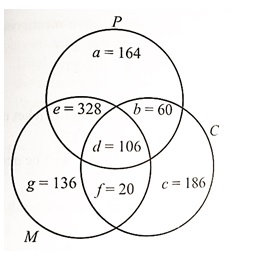
We have the following equations:
a+ b + c + d + e + f + g = 1000
a + b + d + e = 658, b + d = 166
b + d + c + f = 372
d + e = 434 as in the figure.
d + e + f + g = 590, d + f = 126. Find the values
Chemistry but not in Physics.
A
318
B
198
C
213
D
206
Question 22Single Answer
Passage :
Direction: information given below and answer the question that follow.
The result of an exam is given below. Out of 1000 students who appeared
(i) 658 failed in Physics
(ii) 166 failed in Physics and Chemistry
(iii) 372 failed in Chemistry, 434 failed in Physics and Maths
(iv) 590 failed in Maths, 126 failed in Maths & Chemistry
Find the number of people who failed in (assuming that none is passed in all subjects.
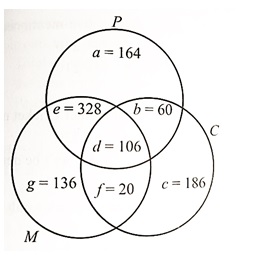
We have the following equations:
a+ b + c + d + e + f + g = 1000
a + b + d + e = 658, b + d = 166
b + d + c + f = 372
d + e = 434 as in the figure.
d + e + f + g = 590, d + f = 126. Find the values
Physics or Maths but not in Chemistry.
A
558
B
718
C
628
D
None of these
Question 23Single Answer
Passage :
For the next four question that follow:
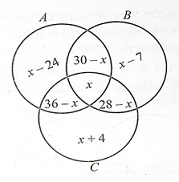
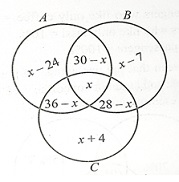
In a city, three daily newspapers A, B, C are published, 42% read A; 51% read B; 68% read C; 30% read A and B; 28% read B and C; 36% read A and C; 8% do not read any of the three newspapers.
Let x% people read all the three newspapers.
Since 8% people do not read any newspapers.
(x – 24) + (x – 7) + (x + 4) + (30 – x) + (36 – x) + (28 – x) + x = 92
→ x + 98 – 31 = 92
→ x = 92 – 67 = 25
What is the percentage of persons who read all the three papers ?
A
20%
B
25%
C
30%
D
40%
Question 24Single Answer
Passage :
For the next four : question that follow :
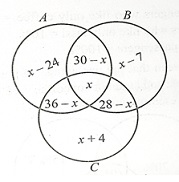
In a city, three daily newspapers A, B, C are published, 42% read A; 51% read B; 68% read C; 30% read A and B; 28% read B and C; 36% read A and C; 8% do not read any of the three newspapers.
Let x% people read all the three newspapers.
Since 8% people do not read any newspapers.
(x – 24) + (x – 7) + (x + 4) + (30 – x) + (36 – x) + (28 – x) + x = 92
→ x + 98 – 31 = 92
→ x = 92 – 67 = 25
What is the percentage of persons who read only two papers?
A
19%
B
31%
C
44%
D
None of these
Question 25Single Answer
Passage :
For the next four : question that follow :
In a city, three daily newspapers A, B, C are published, 42% read A; 51% read B; 68% read C; 30% read A and B; 28% read B and C; 36% read A and C; 8% do not read any of the three newspapers.
Let x% people read all the three newspapers.
Since 8% people do not read any newspapers.
(x – 24) + (x – 7) + (x + 4) + (30 – x) + (36 – x) + (28 – x) + x = 92
→ x + 98 – 31 = 92
→ x = 92 – 67 = 25
What is the percentage of persons who read only one paper ?
A
38%
B
48%
C
51%
D
None of these
General Intelligence and Reasoning
Question 26Single Answer
How many such pairs of letters are there in the word ‘CLEANLINESS’ each of the which has as many letters between them in the word as they have in the English alphabet, in the same sequence?
A
Two
B
Three
C
Five
D
Four
E
None of these
Question 27Single Answer
Team A has scored more goals than Team B
Team C has scored fewer goals than Team B
Team A has scored fewer goals than Team C .
If the first two statements are true, the third statement is
A
True
B
False
C
Uncertain
D
None
Question 28Single Answer
If it is possible to make only one meaningful word with the second, the third, the sixth and the eight letters of the word FRAGMENT using each only once, which of the following will be the third letter of that word ? If no such word can be formed, give ‘X’ as the answer and if more than one such word can be formed, give ‘Y’ as the answer.
A
A
B
E
C
T
D
X
E
Y
Question 29Single Answer
How many such letters are there in the word ORIENTAL each of which is as far away from the beginning of the word as when they are arranged alphabetically?
A
None
B
One
C
Two
D
Three
E
More than three
Question 30Single Answer
How many such pairs of letters in the word CREDIT each of which has as many letters between them in the word as in the English alphabet?
A
None
B
One
C
Two
D
Three
E
More than three
Question 31Single Answer
How many meaningful words can be made from the letters ‘LMEA’ using each letter only once in each word?
A
None
B
One
C
Two
D
Three
E
More than three
Question 32Single Answer
If it is possible to make only one meaningful word with the first, the second, the seventh and the eighth letters of the word TEMPORAL, which of the following will be the first letter of that word? If more than one such word can be made, give ‘Y’ as the answer and if no such word can be made, give ‘X’ as the answer.
A
T
B
L
C
E
D
Y
E
X
Question 33Single Answer
If the letters of the word HANDOVER are arranged alphabetically from left to right how many letters will remain at the same position?
A
None
B
One
C
Two
D
Three
E
More than three
Question 34Single Answer
Passage :
A B C D E F G H I J K L M N O P Q R S T U V W X Y Z .
Which letter in this alphabet is the eighth letter to the right of the letter and which is tenth letter to the left of the last but one letter of the alphabet ?
A
X
B
W
C
I
D
H
Question 35Single Answer
Passage :
Direction : The following question is based on the five words given below:
AND FOR THE BIG SUM (The new words formed after performing the mentioned operations may or may not necessarily the meaningful English words.)
If the third alphabet of each of the words is changed to the next alphabet in the English alphabetical series, which of the following will form a meaningful English word?
A
SUM
B
BIG
C
Both BIG and THE
D
FOR
E
Both FOR and BIG
Question 36Single Answer
Passage :
Direction : The following question is based on the five words given below:
AND FOR THE BIG SUM (The new words formed after performing the mentioned operations may or may not necessarily the meaningful English words.)
If the given words are arranged in the order as they would appear in a dictionary from left to right, which of the following will be second from the right ?
A
AND
B
FOR
C
THE
D
BIG
E
SUM
Question 37Single Answer
Passage :
Direction: The following question is based on the five words given below:
AND FOR THE BIG SUM (The new words formed after performing the mentioned operations may or may not necessarily the meaningful English words.)
If second alphabet in each of the words is changed to next alphabet in the English alphabetical order, how many words having two vowels (same or different vowels) will be formed ?
A
None
B
One
C
Two
D
Three
E
Four
Question 38Single Answer
Passage :
Direction : The following question is based on the five words given below:
AND FOR THE BIG SUM (The new words formed after performing the mentioned operations may or may not necessarily the meaningful English words.)
How many letters are there in the English alphabetical series between the second letter of the word which is second from the right and the second letter of the word which is second from the left of the given words?
A
Two
B
Five
C
Six
D
Nine
E
Three
Question 39Single Answer
Passage :
Direction: The following question is based on the five words given below:
AND FOR THE BIG SUM (The new words formed after performing the mentioned operations may or may not necessarily the meaningful English words.)
If in each of the given words, each of the consonant is changed to previous letter and each vowel is changed to next letter in the English alphabetical series, in how many words thus formed will no vowels appear?
A
None
B
One
C
Two
D
Three
E
More than three
Question 40Single Answer
Passage :
Direction : Following question is based on five words given below: BRU LEGINKCATOWN
(The new words formed after performing the mentioned operations may or may not necessarily be meaningful English words)
If the third alphabet in each of the words is changed to the next alphabet in the English alphabetical order, how many words having two vowels (same or different vowels) will be formed?
A
None
B
One
C
Two
D
Three
E
Four
Question 41Single Answer
Passage :
Direction : Following question is based on five words given below: BRU LEGINKCATOWN
(The new words formed after performing the mentioned operations may or may not necessarily be meaningful English words)
If the position of the first and the second alphabets of each of the words are interchanged, which of the following will form a meaningful English word?
A
Both CAT and OWN
B
Both BRU and INK
C
Only CAT
D
Only INK
E
Only LEG
Question 42Single Answer
Passage :
Direction: Following question is based on five words given below: BRU LEGINKCATOWN
(The new words formed after performing the mentioned operations may or may not necessarily be meaningful English words)
If the given words are arranged in the order as they would appear in a dictionary from left to right, which of the following will be exactly in the middle of the five words?
A
OWN
B
LEG
C
BRU
D
CAT
E
INK
Question 43Single Answer
Passage :
Direction: Following question is based on five words given below: BRU LEGINKCATOWN
(The new words formed after performing the mentioned operations may or may not necessarily be meaningful English words)
If in each of the given words, each of the consonants is changed to previous letter and each vowel is changed to next letter in the English alphabetical series, in how many words thus formed will the same alphabet appear twice?
A
None
B
One
C
Two
D
Three
E
More than three
Question 44Single Answer
Passage :
Find the missing number in the following series ?
3, 5, 5, 19, 7, 41, 9, ?
A
71
B
61
C
79
D
69
Question 45Single Answer
Passage :
Direction: following question is based on five words given below:
LAP BUT CAR SON HID
(The new words formed after performing the mentioned operations may or may not necessarily be meaningful English words.)
If the positions of the first and the third alphabets of each of the words are interchanged, which of the following would form meaningful words with the new arrangement?
A
HID
B
SON
C
Both LAP and BUT
D
CAR
E
Both CAR and LAP
Question 46Single Answer
Passage :
Direction : Each of the questions below consists of a question and two statements numbered (I) and (II) given below it. You have to decide whether the data provided in the statements are sufficient to answer the question. Read both the statements and give answer :
How many employees of bank ‘X’ opted for VRS ?
(I) 18% of the 950 officer cadre employees and 6% of the 1100 of all other cadre employees opted for VRS. (II) 28% of the employees in the age group of 51 to 56 and 17% of the employees in all other age groups opted for VRS.
A
Statement (I) ALONE is sufficient, but statement (II) alone is not sufficient
B
Statement (II) ALONE is sufficient, but statement (I) alone is not sufficient
C
BOTH statements TOGETHER are sufficient, but NEITHER statement alone is sufficient
D
EACH statement ALONE is sufficient
Question 47Single Answer
Passage :
Direction : Each of the questions below consists of a question and two statements numbered (I) and (II) given below it. You have to decide whether the data provided in the statements are sufficient to answer the question. Read both the statements and give answer :
The area of a playground is 1600 square meters. What is its perimeter ?
(I) It is a perfect square playground
(II) It costs Rs.3200 to put a fence around the playground at the rate of Rs.20 per meter.
A
Statement (I) ALONE is sufficient, but statement (II) alone is not sufficient
B
Statement (II) ALONE is sufficient, but statement (I) alone is not sufficient
C
BOTH statements TOGETHER are sufficient, but NEITHER statement alone is sufficient
D
EACH statement ALONE is sufficient
Question 48Single Answer
Passage :
Direction : Each of the questions below consists of a question and two statements numbered (I) and (II) given below it. You have to decide whether the data provided in the statements are sufficient to answer the question. Read both the statements and give answer :
What is the value of m – n ÷ 37 ?
(I) m is the largest possible six-digit number and n is the smallest possible six-digit number.
(II) The difference between m and n is known.
A
Statement (I) ALONE is sufficient, but statement (II) alone is not sufficient
B
Statement (II) ALONE is sufficient, but statement (I) alone is not sufficient
C
BOTH statements TOGETHER are sufficient, but NEITHER statement alone is sufficient
D
EACH statement ALONE is sufficient
Question 49Single Answer
Passage :
Direction : Each of the questions below consists of a question and two statements numbered (I) and (II) given below it. You have to decide whether the data provided in the statements are sufficient to answer the question. Read both the statements and give answer :
What is the value of x ?
(I) If 10 is added to x, the result is 34.
(II) If x is multiplied by y, the result is 38.
A
Statement (I) ALONE is sufficient, but statement (II) alone is not sufficient
B
Statement (II) ALONE is sufficient, but statement (I) alone is not sufficient
C
BOTH statements TOGETHER are sufficient, but NEITHER statement alone is sufficient
D
EACH statement ALONE is sufficient
Question 50Single Answer
Passage :
Direction : Each of the questions below consists of a question and two statements numbered (I) and (II) given below it. You have to decide whether the data provided in the statements are sufficient to answer the question. Read both the statements and give answer :
What was the total compound interest on a sum after three years ?
(I) The interest after one year was Rs. 100 and the sum after was Rs.1000.
(II) The difference between simple and compound interest on a sum of Rs.1000 at the end of two years was Rs.10.
A
Statement (I) ALONE is sufficient, but statement (II) alone is not sufficient
B
Statement (II) ALONE is sufficient, but statement (I) alone is not sufficient
C
BOTH statements TOGETHER are sufficient, but NEITHER statement alone is sufficient
D
EACH statement ALONE is sufficient
Important Questions Package
RRB ALP Mechanical Exam Online Question Bank Package
Buy RRB ALP Mechanical Important Questions, MCQ, question answer in Hindi & English. It will help you to score high marks in RRB ALP Mechanical question bank 2026 in Online, PDF & Print study material.
+ Free Monthly Current Affairs, GK & more PDF Download
Sr.
Package Name
Amount
1.
RRB ALP Mechanical Exam (CBT Stage 1) - Hindi
Description : 1000 Question with Answer
₹101[₹500]
2.
RRB ALP Mechanical Exam (CBT Stage 1) - Hindi
Description : 2000 Question with Answer
₹151[₹500]
3.
RRB ALP Mechanical Exam (CBT Stage 1) - Hindi
Description : 3000 Question with Answer
₹181[₹500]
4.
RRB ALP Mechanical Exam (CBT Stage 1) - Hindi
Description : 4000 Question with Answer
₹201[₹500]
5.
RRB ALP Mechanical Exam (CBT Stage 1) - English
Description : 1000 Question with Answer
₹101[₹500]
6.
RRB ALP Mechanical Exam (CBT Stage 1) - English
Description : 2000 Question with Answer
₹151[₹500]
7.
RRB ALP Mechanical Exam (CBT Stage 1) - English
Description : 3000 Question with Answer
₹181[₹500]
8.
RRB ALP Mechanical Exam (CBT Stage 1) - English
Description : 4000 Question with Answer
₹201[₹500]
9.
RRB ALP Mechanical Exam (CBT Stage 2) - Hindi
Description : 1000 Question with Answer
₹101[₹500]
10.
RRB ALP Mechanical Exam (CBT Stage 2) - Hindi
Description : 2000 Question with Answer
₹151[₹500]
11.
RRB ALP Mechanical Exam (CBT Stage 2) - Hindi
Description : 3000 Question with Answer
₹181[₹500]
12.
RRB ALP Mechanical Exam (CBT Stage 2) - Hindi
Description : 4000 Question with Answer
₹201[₹500]
13.
RRB ALP Mechanical Exam (CBT Stage 2) - English
Description : 1000 Question with Answer
₹101[₹500]
14.
RRB ALP Mechanical Exam (CBT Stage 2) - English
Description : 2000 Question with Answer
₹151[₹500]
15.
RRB ALP Mechanical Exam (CBT Stage 2) - English
Description : 3000 Question with Answer
₹181[₹500]
16.
RRB ALP Mechanical Exam (CBT Stage 2) - English
Description : 4000 Question with Answer
₹201[₹500]
17.
RRB ALP Mechanical Exam (CBT Stage 1) - Hindi
Description : 1000 Question & Answer Download in PDF (Send by Email)
₹151[₹450]
18.
RRB ALP Mechanical Exam (CBT Stage 1) - English
Description : 1000 Question & Answer Download in PDF (Send by Email)
₹151[₹450]
19.
RRB ALP Mechanical Exam (CBT Stage 2) - Hindi
Description : 1000 Question & Answer Download in PDF (Send by Email)
₹151[₹450]
20.
RRB ALP Mechanical Exam (CBT Stage 2) - English
Description : 1000 Question & Answer Download in PDF (Send by Email)
₹151[₹450]
21.
RRB ALP Mechanical Exam (CBT Stage 1) Question Bank Book - Hindi
Description : 1000 Question with Answer (Printed Material)
₹450[₹800]
22.
RRB ALP Mechanical Exam (CBT Stage 1) Question Bank Book - English
Description : 1000 Question with Answer (Printed Material)
₹390[₹600]
23.
RRB ALP Mechanical Exam (CBT Stage 2) Question Bank Book - Hindi
Description : 1000 Question with Answer (Printed Material)
₹450[₹800]
24.
RRB ALP Mechanical Exam (CBT Stage 2) Question Bank Book - English
Description : 1000 Question with Answer (Printed Material)
₹390[₹600]
Basic Science & Engineering
Question 51Single Answer
Which type of projection represents a 3D object on a 2D plane using multiple views?
A
Isometric projection
B
Orthographic projection
C
Perspective projection
D
Axonometric projection
Question 52Single Answer
In which projection are the three axes inclined at equal angles of 120°?
A
Orthographic projection
B
Isometric projection
C
Perspective projection
D
Oblique projection
Question 53Single Answer
Which projection is commonly used in architectural drawings to show depth and realism?
A
Orthographic projection
B
Isometric projection
C
Perspective projection
D
Sectional projection
Question 54Single Answer
What is the key characteristic of an orthographic projection?
A
It shows a 3D object in a single view
B
It requires multiple views to represent an object
C
It distorts proportions
D
It is only used for artistic drawings
Question 55Single Answer
In an isometric projection, how are the three principal axes oriented?
A
Perpendicular to each other
B
At 30° to the horizontal
C
At 45° to the vertical
D
Parallel to each other
Question 56Single Answer
The top view of an object is projected onto which plane?
A
Horizontal plane
B
Vertical plane
C
Profile plane
D
Perspective plane
Question 57Single Answer
The side view of an object is projected onto which plane?
A
Horizontal plane
B
Vertical plane
C
Profile plane
D
Isometric plane
Question 58Single Answer
Sectional views are used to:
A
Show the hidden details of an object
B
Reduce the complexity of a drawing
C
Remove unnecessary dimensions
D
Create artistic representations
Question 59Single Answer
The front view of an object is projected onto which plane?
A
Horizontal plane
B
Vertical plane
C
Profile plane
D
Oblique plane
Question 60Single Answer
Which type of sectional view is used to cut an object completely in half?
A
Half section
B
Full section
C
Partial section
D
Offset section
Question 61Single Answer
Which instrument is commonly used to draw horizontal parallel lines on a drawing board?
A
T-square
B
Divider
C
Compass
D
Protractor
Question 62Single Answer
Which instrument is used to draw circles and arcs?
A
Divider
B
Compass
C
Scale
D
Set square
Question 63Single Answer
A divider is mainly used for:
A
Drawing circles
B
Measuring angles
C
Transferring distances
D
Drawing horizontal lines
Question 64Single Answer
Which instrument is used to measure or construct angles?
A
T-square
B
Divider
C
French curve
D
Protractor
Question 65Single Answer
Which set square is normally used for drawing 45° lines?
A
30°–60° set square
B
45° set square
C
15° set square
D
75° set square
Question 66Single Answer
The standard angles of a 30°–60° set square are:
A
30°, 60°, 90°
B
30°, 45°, 90°
C
45°, 60°, 90°
D
15°, 75°, 90°
Question 67Single Answer
In engineering drawing, visible outlines are normally represented by:
A
Thin continuous lines
B
Dashed lines
C
Thick continuous lines
D
Chain lines
Question 68Single Answer
Hidden edges in an engineering drawing are represented by:
A
Dashed lines
B
Continuous thick lines
C
Chain lines
D
Freehand lines
Question 69Single Answer
A centre line is generally represented by:
A
Thick continuous line
B
Thin chain line
C
Thick dashed line
D
Zigzag line
Question 70Single Answer
Dimension lines are normally drawn as:
A
Freehand lines
B
Thick continuous lines
C
Thick chain lines
D
Thin continuous lines
Question 71Single Answer
In orthographic projection, the view seen from above is called the:
A
Front view
B
Side view
C
Top view
D
Auxiliary view
Question 72Single Answer
The view obtained by looking directly at the front of an object is called the:
A
Plan
B
Side elevation
C
Front elevation
D
Sectional view
Question 73Single Answer
In engineering drawing, the top view is also known as the:
A
Elevation
B
Plan
C
Profile
D
Perspective
Question 74Single Answer
Orthographic projection generally represents an object using:
A
Artistic sketches
B
Only perspective views
C
Photographic images
D
Two-dimensional views
Question 75Single Answer
Which projection gives a pictorial representation of an object with three dimensions visible?
A
Isometric projection
B
Orthographic projection
C
First-angle projection
D
Sectional projection
Question 76Single Answer
The angle between any two isometric axes is:
A
120°
B
90°
C
60°
D
180°
Question 77Single Answer
A circle drawn in isometric projection generally appears as a/an:
A
Circle
B
Ellipse
C
Square
D
Triangle
Question 78Single Answer
A polygon having three sides is called a:
A
Pentagon
B
Hexagon
C
Quadrilateral
D
Triangle
Question 79Single Answer
A polygon having five sides is called a:
A
Octagon
B
Hexagon
C
Heptagon
D
Pentagon
Question 80Single Answer
A regular hexagon has:
A
4 sides
B
5 sides
C
6 sides
D
8 sides
Question 81Single Answer
What is the SI unit of length?
A
Centimetre
B
Foot
C
Metre
D
Inch
Question 82Single Answer
What is the SI unit of mass?
A
Gram
B
Kilogram
C
Pound
D
Tonne
Question 83Single Answer
What is the SI unit of time?
A
Second
B
Hour
C
Minute
D
Day
Question 84Single Answer
The SI unit of force is:
A
Newton
B
Joule
C
Watt
D
Pascal
Question 85Single Answer
The SI unit of work is:
A
Watt
B
Joule
C
Newton
D
Ampere
Question 86Single Answer
The SI unit of power is:
A
Watt
B
Joule
C
Volt
D
Newton
Question 87Single Answer
The SI unit of pressure is:
A
Watt
B
Pascal
C
Joule
D
Ohm
Question 88Single Answer
The SI unit of electric current is:
A
Volt
B
Watt
C
Ohm
D
Ampere
Question 89Single Answer
The SI unit of electric potential difference is:
A
Ampere
B
Coulomb
C
Volt
D
Watt
Question 90Single Answer
One kilometre is equal to:
A
10 m
B
100 m
C
10,000 m
D
1000 m
Question 91Single Answer
One metre is equal to:
A
10 cm
B
1000 cm
C
100 cm
D
10,000 cm
Question 92Single Answer
One centimetre is equal to:
A
1 mm
B
10 mm
C
100 mm
D
1000 mm
Question 93Single Answer
The prefix "kilo" represents:
A
10
B
100
C
1000
D
10,000
Question 94Single Answer
The prefix "milli" represents:
A
10⁻³
B
10⁻²
C
10⁻¹
D
10⁻⁶
Question 95Single Answer
The prefix "micro" represents:
A
10⁻⁶
B
10⁻³
C
10⁻⁹
D
10⁻¹²
Question 96Single Answer
Which instrument is commonly used to measure the outside diameter of a shaft accurately?
A
Steel rule
B
Outside micrometer
C
Protractor
D
Try square
Question 97Single Answer
A vernier caliper can measure:
A
External, internal and depth dimensions
B
Only internal dimensions
C
Only external dimensions
D
Only angular dimensions
Question 98Single Answer
Which instrument is commonly used for checking a right angle?
A
Try square
B
Divider
C
Compass
D
Vernier caliper
Question 99Single Answer
A feeler gauge is used for measuring:
A
Large distances
B
Small gaps or clearances
C
Temperature
D
Electrical resistance
Question 100Single Answer
Which instrument is used to measure the pitch of screw threads?
A
Feeler gauge
B
Wire gauge
C
Radius gauge
D
Screw pitch gauge
Mechanical Engineer
Question 101Single Answer
Management is primarily concerned with:
A
Increasing machine weight
B
Achieving organizational objectives efficiently
C
Reducing material density
D
Increasing friction
Question 102Single Answer
Which is a basic function of management?
A
Casting
B
Planning
C
Forging
D
Welding
Question 103Single Answer
Planning means:
A
Increasing manpower randomly
B
Inspecting only finished products
C
Repairing machines
D
Deciding in advance what is to be done
Question 104Single Answer
Organizing involves:
A
Cutting metals
B
Heating materials
C
Measuring temperature
D
Arranging resources and activities
Question 105Single Answer
Staffing is related to:
A
Recruitment and placement of employees
B
Lubrication
C
Material testing
D
Heat treatment
Question 106Single Answer
Directing includes:
A
Only accounting
B
Guiding and motivating employees
C
Only machine inspection
D
Only purchasing
Question 107Single Answer
Controlling involves:
A
Comparing actual performance with planned performance
B
Increasing wages only
C
Reducing productivity
D
Increasing scrap
Question 108Single Answer
Coordination helps to:
A
Harmonize different organizational activities
B
Increase conflict
C
Reduce communication
D
Stop production
Question 109Single Answer
The process of assigning authority to subordinates is called:
A
Inspection
B
Delegation
C
Motivation
D
Recruitment
Question 110Single Answer
Authority refers to the:
A
Right to give orders
B
Ability to measure dimensions
C
Skill of welding
D
Power of a machine
Question 111Single Answer
Responsibility means:
A
Right to avoid work
B
Obligation to perform assigned duties
C
Right to ignore safety
D
Right to dismiss everyone
Question 112Single Answer
Unity of command means an employee should receive orders from:
A
One superior
B
Many superiors
C
Customers only
D
Suppliers only
Question 113Single Answer
Span of control refers to:
A
Number of subordinates supervised by a manager
B
Machine width
C
Factory area
D
Working pressure
Question 114Single Answer
Motivation is used to:
A
Reduce productivity
B
Encourage employees to perform better
C
Increase absenteeism
D
Reduce quality
Question 115Single Answer
Leadership is the ability to:
A
Influence people toward objectives
B
Measure pressure
C
Reduce energy
D
Cast components
Question 116Single Answer
Communication is the process of:
A
Measuring force
B
Cutting metal
C
Producing heat
D
Exchanging information
Question 117Single Answer
Feedback in communication helps to:
A
Stop communication
B
Increase noise
C
Reduce productivity
D
Confirm whether the message was understood
Question 118Single Answer
Productivity is generally expressed as:
A
Cost multiplied by time
B
Input divided by output
C
Output divided by input
D
Power divided by speed
Question 119Single Answer
Work study consists mainly of:
A
Casting and forging
B
Method study and work measurement
C
Welding and soldering
D
Heating and cooling
Question 120Single Answer
Method study aims to:
A
Reduce safety
B
Increase unnecessary motions
C
Increase idle time
D
Improve the method of doing a job
Question 121Single Answer
Time study is used to determine:
A
Standard time for a job
B
Melting point
C
Material density
D
Machine weight
Question 122Single Answer
Standard time normally includes:
A
Inspection time only
B
Setup time only
C
Machining time only
D
Normal time plus allowances
Question 123Single Answer
Inventory means:
A
Labour rate
B
Machine speed
C
Stock of materials and goods
D
Energy consumption
Question 124Single Answer
EOQ stands for:
A
Effective Order Quality
B
Estimated Output Quality
C
Energy Operating Quotient
D
Economic Order Quantity
Question 125Single Answer
ABC analysis is used in:
A
Heat treatment
B
Inventory control
C
Welding inspection
D
Turbo machinery
Question 126Single Answer
In ABC inventory analysis, A-items are generally:
A
High-value items requiring tight control
B
Low-value items requiring no control
C
Waste materials
D
Finished products only
Question 127Single Answer
JIT stands for:
A
Job Inspection Technique
B
Just In Time
C
Joint Industrial Testing
D
Justified Input Time
Question 128Single Answer
JIT aims mainly to reduce:
A
Communication
B
Productivity
C
Quality
D
Inventory and waste
Question 129Single Answer
Quality control is concerned with:
A
Increasing defects
B
Maintaining required product quality
C
Reducing standards
D
Increasing scrap
Question 130Single Answer
Quality assurance focuses on:
A
Ignoring customer requirements
B
Repairing every defect after production
C
Preventing defects through planned systems
D
Increasing inspection only
Question 131Single Answer
TQM stands for:
A
Technical Quantity Measurement
B
Total Quality Management
C
Total Quantity Maintenance
D
Time Quality Method
Question 132Single Answer
Kaizen refers to:
A
Continuous improvement
B
Mass production only
C
Machine breakdown
D
Inventory accumulation
Question 133Single Answer
5S is associated with:
A
Metal casting
B
Engine design
C
Workplace organization
D
Refrigeration
Question 134Single Answer
Preventive maintenance is performed:
A
Before breakdown occurs
B
Only after failure
C
Only during emergencies
D
Never on operating equipment
Question 135Single Answer
Breakdown maintenance is carried out:
A
Only during production planning
B
Before installation
C
Before every shift
D
After equipment failure
Question 136Single Answer
Predictive maintenance uses:
A
Random replacement
B
Condition monitoring
C
No inspection
D
Only visual painting
Question 137Single Answer
PERT stands for:
A
Program Evaluation and Review Technique
B
Production Energy Review Tool
C
Planning Equipment Repair Test
D
Process Evaluation Rate Technique
Question 138Single Answer
CPM stands for:
A
Critical Process Management
B
Control Production Machine
C
Cost Planning Method
D
Critical Path Method
Question 139Single Answer
The critical path in a project network is the:
A
Lowest-cost path always
B
Shortest-duration path
C
Longest-duration path
D
Safest path only
Question 140Single Answer
Activities on the critical path generally have:
A
Zero total float
B
Maximum float
C
Infinite float
D
Negative duration
Question 141Single Answer
Turbomachinery involves energy transfer between:
A
Two stationary plates
B
Fluid and rotating rotor
C
Two electrical wires
D
Solid blocks only
Question 142Single Answer
Which is a turbomachine?
A
Lathe bed
B
Bench vice
C
Centrifugal pump
D
Hand file
Question 143Single Answer
A turbine converts fluid energy into:
A
Mechanical energy
B
Chemical energy
C
Nuclear energy
D
Magnetic energy
Question 144Single Answer
A pump converts mechanical energy into:
A
Chemical energy
B
Nuclear energy
C
Fluid energy
D
Sound only
Question 145Single Answer
A compressor is used mainly to increase gas:
A
Temperature to absolute zero
B
Density to zero
C
Pressure
D
Volume always
Question 146Single Answer
A centrifugal pump is a:
A
Rotodynamic pump
B
Positive displacement pump only
C
Reciprocating engine
D
Heat exchanger
Question 147Single Answer
The rotating component of a centrifugal pump is called:
A
Casing
B
Impeller
C
Volute
D
Foot valve
Question 148Single Answer
The main function of a pump casing is to:
A
Measure pressure
B
Produce electricity
C
Cool the motor only
D
Collect and guide fluid leaving the impeller
Question 149Single Answer
Priming of a centrifugal pump means:
A
Draining all liquid
B
Filling suction line and casing with liquid
C
Increasing pump speed
D
Closing discharge permanently
Question 150Single Answer
Priming is necessary because a centrifugal pump:
A
Has no casing
B
Cannot pump water
C
Has no impeller
D
Cannot normally pump air effectively
Question 151Single Answer
Cavitation in a pump occurs when local pressure falls below:
A
Critical pressure of metal
B
Atmospheric pressure always
C
Discharge pressure always
D
Vapour pressure of liquid
Question 152Single Answer
Cavitation may cause:
A
Better performance
B
Increased efficiency always
C
Zero vibration
D
Noise and erosion
Question 153Single Answer
NPSH is associated with prevention of:
A
Overheating only
B
Corrosion only
C
Leakage only
D
Cavitation
Question 154Single Answer
In a centrifugal pump, liquid enters the impeller near the:
A
Eye
B
Outer tip only
C
Shaft end outside casing
D
Delivery pipe
Question 155Single Answer
In a centrifugal pump, fluid generally moves through the impeller:
A
Without direction change
B
Radially inward only
C
Axially backward only
D
Radially outward
Question 156Single Answer
A reciprocating pump is a:
A
Compressor only
B
Rotodynamic pump only
C
Turbine
D
Positive displacement pump
Question 157Single Answer
Reciprocating pumps are generally suitable for:
A
High head and low discharge
B
Very low head and very high discharge only
C
Gas compression only
D
Steam generation
Question 158Single Answer
A Pelton wheel is a:
A
Pump
B
Reaction turbine
C
Impulse turbine
D
Compressor
Question 159Single Answer
A Francis turbine is a:
A
Impulse turbine
B
Reaction turbine
C
Positive displacement pump
D
Compressor
Question 160Single Answer
A Kaplan turbine is a:
A
Axial-flow reaction turbine
B
Radial-flow impulse turbine
C
Reciprocating pump
D
Centrifugal compressor
Question 161Single Answer
Pelton turbines are best suited for:
A
Low head and high flow
B
High head and low flow
C
Medium head only
D
Zero head
Question 162Single Answer
Kaplan turbines are best suited for:
A
Low head and high flow
B
High head and low flow
C
Very high pressure gas
D
Steam only
Question 163Single Answer
Francis turbines are commonly used for:
A
Only extremely low heads
B
Only extremely high heads
C
Medium heads
D
Gas compression
Question 164Single Answer
A draft tube is used mainly in:
A
Pelton turbine nozzle only
B
Reaction turbines
C
Reciprocating pumps only
D
Air compressors only
Question 165Single Answer
The function of a draft tube is to:
A
Supply lubricating oil
B
Increase fuel flow
C
Reduce shaft speed to zero
D
Recover kinetic energy and discharge water
Question 166Single Answer
The nozzle in a Pelton turbine converts pressure energy into:
A
Heat only
B
Chemical energy
C
Electrical energy
D
Kinetic energy
Question 167Single Answer
Pelton buckets are split by a:
A
Guide vane only
B
Diffuser
C
Splitter
D
Draft tube
Question 168Single Answer
Guide vanes in a Francis turbine control:
A
Flow entering the runner
B
Lubrication only
C
Bearing temperature only
D
Generator voltage only
Question 169Single Answer
Runner is the rotating part of a:
A
Turbine
B
Heat exchanger
C
Boiler only
D
Condenser
Question 170Single Answer
Hydraulic turbine efficiency relates output mechanical power to:
A
Hydraulic power input
B
Electrical power only
C
Chemical power
D
Nuclear power
Question 171Single Answer
Specific speed of a turbine is mainly used for:
A
Measuring head only
B
Measuring actual RPM only
C
Turbine selection and comparison
D
Measuring torque only
Question 172Single Answer
A centrifugal compressor increases gas pressure mainly by:
A
Combustion
B
Dynamic action of a rotating impeller
C
Cooling alone
D
Gravity only
Question 173Single Answer
An axial-flow compressor moves air mainly:
A
Perpendicular to shaft only
B
Radially outward only
C
Parallel to the shaft
D
In random directions
Question 174Single Answer
Axial compressors are widely used in:
A
Gas turbines
B
Hand pumps
C
Hydraulic jacks
D
Refrigerators only
Question 175Single Answer
A gas turbine consists mainly of compressor, combustion chamber and: