The elements of the set {x : x is an integer, x2 : 4} can be represent as .....Z..... . Here, Z refers to
A
{–2, 2}
B
{–1, 0, 1}
C
{–2, –1, 0, 1, 2}
D
{0, 1, 2}
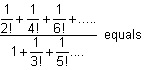
Question 2Single Answer
A
B
C
D
None of these
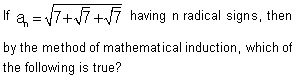
Question 3Single Answer
If Y = {x : x is a positive factor of the number 2p – 1(2p – 1), where 2p – 1 is a prime number}, then Y can be represent in roster form as
A
{2}
B
{1, 2}
C
{1, 2, 22, ....., 2p – 1}
D
{1, 2, 22, 23,.... 2p – 1, (2p – 1)}
Question 4Single Answer
The set {x : x is a positive integer less than 6 and 3x – 1 is an even number} in roster form is
A
{1, 2, 3, 4, 5}
B
{1, 2, 3, 4, 5, 6}
C
{2, 4, 6}
D
{1, 3, 5}
Question 5Single Answer
If A B and A B, then
A
A is called a proper subset of B
B
A is called a super set of B
C
A is not a subset of B
D
B is a subset of A
Question 6Single Answer
The number of non-empty subsets of the set{1, 2, 3, 4} is
A
15
B
14
C
16
D
17
Question 7Single Answer
The number of elements of the power set of a set containing m elements is
A
2m – 1
B
m
C
m2
D
2m
Question 8Single Answer
If A = {x : x = n2, n = 1, 2, 3}, then number of proper subsets is
A
3
B
8
C
7
D
None of these
Question 9Single Answer
If A = {x : x = 4n + 1, 2 £ n £ 5},then number of subsets of A is
A
16
B
15
C
4
D
None of these
Question 10Single Answer
Let A and B be two non-empty subsets of a set X such that A is not a subset of B, then
A
A is always a subset of the complement of B
B
B is always a subset of A
C
A and B are always disjoint
D
A and the complement of B are always non-disjoint
Question 11Single Answer
Which of the following is/are empty set?
A = {x : x2 + x + 1 = 0 and x Î Z} B = {x : x is a prime number and 19 < x < 23}
A
A
B
B
C
Both A and B
D
None of the above
Question 12Single Answer
The set {x : x4 = 1 and x R} is .....X.... set. Here, X refers to
A
empty
B
finite
C
infinite
D
singleton
Question 13Single Answer
The universal set for the sets
A = {x : x2 – 5x + 6 = 0} and
B = {x : x2 – 3x + 2 = 0} having least number of elements is
A
{1, 2}
B
{1, 3}
C
{1, 2, 3}
D
{0, 1, 2, 3}
Question 14Single Answer
If A = {1, 2, 3}, B = {x € R : x2 – 2x + 1 = 0},
C = {1, 2, 2, 3} and
D = {x € R : x3 – 6x2 + 11x – 6 = 0}, then the equal sets are
A
A and B
B
A and C
C
A, B and C
D
A, C and D
Question 15Single Answer
If A = (–3, 5) and B = [–7, 9], then
A
A = B
B
A B
C
B A
D
None of these
Question 16Single Answer
Two finite sets have m and n elements, respectively. The total number of subsets of first set is 56 more than the total number of subsets of the second set. The value of m and n respectively are
A
7, 6
B
5, 1
C
6, 3
D
8, 7
Question 17Single Answer
Combine terms: 12a + 26b - 4b – 16a .
A
4a + 22b
B
-28a + 30b
C
-4a + 22b
D
28a + 30b
Question 18Single Answer
The average of first 50 natural numbers is ………… .
A
25.30
B
25.5
C
25.00
D
12.25
Question 19Single Answer
60 Times of 8 Equals to
A
480
B
300
C
250
D
400
Question 20Single Answer
Consider the sets
A = {x : x is a real number and x2 + 1 = 0}
B = {x : x is a real number and x2 – 16 = 0}
C = {x : x is a real number and x2 = x + 2}
Which of the following is are null set ?
A
A
B
A and B
C
A and C
D
A, B and C
Question 21Single Answer
If X = {4n – 3n – 1: n Î N} and Y = {9(n – 1): n Î N}; where N is the set of natural numbers, then X È Y is equal to
A
N
B
Y – X
C
X
D
Y
Question 22Single Answer
Which of the following is / are correct?
I. {2, 3, 4} {1, 2, 3, 4, 5}
II. {a, b, c} {b, c, d}
III. {x : x is an equilateral triangle in a plane} Ì {x : x is a triangle in the same plane}
IV. {x : x is an even natural number} {x : x is an integer}
A
I and III are correct
B
II and III are correct
C
Only IV is correct
D
All above are correct
Question 23Single Answer
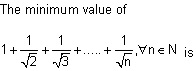
A
B
C
D
Question 24Single Answer
Consider the following statements :
1. The set of all irrational numbers between √2 and √5 is an infinite set .
2. The set of all odd integers less than 100 is a finite set .
Which of the statements given above is/are correct ?
A
1 only
B
2 only
C
Both 1 and 2
D
Neither 1 nor 2
Question 25Single Answer
What is the Next Prime Number after 7 ?
A
13
B
12
C
14
D
11
Question 26Single Answer
If A and B are two given sets, then A (A B)C is equal to
A
A
B
B
C
D
Question 27Single Answer
121 Divided by 11 is
A
11
B
10
C
19
D
18
Question 28Single Answer
Let X be the universal set for sets A and B, if n(A) = 200, n(B) = 300 and n = 100, then n is equal to 300 provided n(X) is equal to
A
600
B
700
C
800
D
900
Question 29Single Answer
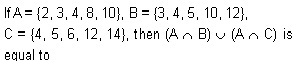
A
{3, 4, 10}
B
{2, 8, 10}
C
{4, 5, 6}
D
{3, 5, 14}
Question 30Single Answer
Let A = {x : x is a prime factor of 240} B = {x : x is the sum of any two prime factors of 240}, then
A
B
C
D
Question 31Single Answer
If A = {x : x is a multiple of 4 and x N} and B = {x : x is a multiple of 6 and x N}, then A B consists of all multiples of
A
16
B
12
C
8
D
4
Question 32Single Answer
A
A = B
B
B = C
C
A = C
D
None of these
Question 33Single Answer
A
equal
B
disjoint
C
either equal or disjoint
D
none of the above
Question 34Single Answer
A
{–i, i}
B
{–1, 1}
C
{–1, 1, i, –i}
D
None of these
Question 35Single Answer
If A = {x : f(x)= 0} and
B = {x : g(x) = 0}, then A B will be
A
[f(x)]2 + [g(x)]2 = 0
B
C
D
None of the above
Question 36Single Answer
In a group of 400 people, 250 can speak Hindi and 200 can speak English. Then, people who can speak both Hindi and English are
A
60
B
80
C
50
D
45
Question 37Single Answer
20 teachers of a school either teach Mathematics or Physics. 12 of them teach Mathematics while 4 teach both the subjects. The number of teacher teaching Physics only, is
A
12
B
8
C
16
D
20
Question 38Single Answer
In a class of 100 students, 70 have taken Science, 60 have taken Mathematics, 40 have taken both Science and Mathematics. The number of students who have not taken Science or Mathematics or both Science and Mathematics, is equal to
A
90
B
10
C
30
D
20
Question 39Single Answer
A market research group conducted a survey of 1000 consumers and reported that 720 consumers like product A and 450 consumers like the product B, then least number that must have like both products, is
A
730
B
170
C
180
D
1270
Question 40Single Answer
If there are three athletic teams in a school, 21 are in the basketball team, 26 in hockey team and 29 in the football team. 14 play hockey and basketball, 15 play hockey and football, 12 play football and basketball and 8 play all the games. The total number of members is
A
42
B
43
C
45
D
None of these
Question 41Single Answer
A college awarded 38 medals in football, 15 in basketball and 20 in cricket. If these medals went to a total of 58 men and only three men got medals in all the three sports, then number of men who received meal in exactly two of the three sports is
A
18
B
15
C
9
D
24
Question 42Single Answer
In the class of 175 students, the following data shows the number of students opting one or more subjects. Mathematics 100; Physics 70; Chemistry 40; Mathematics and Physics 30; Mathematics and Chemistry 28; Physics and Chemistry 23; Mathematics, Physics and Chemistry 18. Then, number of students opted Mathematics alone is
A
35
B
48
C
60
D
20
Question 43Single Answer
In a town of 10000 families it was found that 40% family buy newspaper A, 20% family buy newspaper B and 10% family buy newspaper C, 5% families buy and B, 3% families buy B and C and 4% families buy A and C. If 2% families buy all the three newspapers. Then, number of families which by A only is
A
3100
B
3300
C
2900
D
1400
Question 44Single Answer
In a city, 20% of the population travles by car, 50% travles by bus and 10% travles by both car and bus. Then, person travelling by car or bus, is
A
80%
B
40%
C
60%
D
70%
Question 45Single Answer
Universal set,
U = {x | x5 – 6x4 + 11x3 – 6 x 2 = 0}
A = {x | x2 – 5x + 6 = 0}
B = {x | x2 – 3x + 2 = 0}
What is the value of (A B)?
A
{1, 3}
B
{1, 2, 3}
C
{0, 1, 3}
D
{0, 1, 2, 3}
Question 46Single Answer
A
B
C
D
Question 47Single Answer
If P(A) denotes the power set of A and A is the void set, then what is the number of elements in P{P{P{P(A)}}}?
A
Zero
B
1
C
4
D
16
Question 48Single Answer
If A = {1, 2, 3, 4, 5}, b = {x : x2 – 5x + 6 = 0} and C = {x : x2 = 4 or x = 1}, then
A
B
C
Both (a) and (b)
D
None of the above
Question 49Single Answer
In a group of 50 people, 35 speak Hindi, 25 speak both English and Hindi and all the people speak atleast one of two languages. The number of people who speak 'English', 'English but not Hindi' are respectively
A
40, 15
B
15, 40
C
35, 15
D
25, 15
Question 50Single Answer
If P = {1, 2}, then P × P × P = {(1, 1, 1), (1, 1, 2), (1, 2, 1), (2, 1, 2), (2, 2, 1), (2, 2, 2)}. The ordered triplet missing in P × P × P are
A
(1, 2), (2, 1)
B
(1, 2, 1), (2, 1, 1)
C
(1, 2, 2), (2, 1, 2)
D
(1, 2, 2), (2, 1, 1)
Important Questions Package
SCRA Railway Exam Online Question Bank Package
Buy SCRA Railway Important Questions, MCQ, question answer in Hindi & English. It will help you to score high marks in SCRA Railway question bank 2026 in Online, PDF & Print study material.
+ Free Monthly Current Affairs, GK & more PDF Download
Sr.
Package Name
Amount
1.
SCRA Railway (Paper-I) Exam - Hindi
Description : 1000 Question with Answer.
₹101[₹500]
2.
SCRA Railway (Paper-I) Exam - Hindi
Description : 2000 Question with Answer.
₹151[₹500]
3.
SCRA Railway (Paper-I) Exam - English
Description : 1000 Question with Answer.
₹101[₹500]
4.
SCRA Railway (Paper-I) Exam - English
Description : 2000 Question with Answer.
₹151[₹500]
5.
SCRA Railway (Paper-II) Exam - English
Description : 1000 Question with Answer.
₹101[₹500]
6.
SCRA Railway (Paper-II) Exam - English
Description : 1500 Question with Answer.
₹131[₹500]
7.
SCRA Railway (Paper-III) Exam - Hindi
Description : 1000 Question with Answer.
₹101[₹500]
8.
SCRA Railway (Paper-III) Exam - Hindi
Description : 1500 Question with Answer.
₹131[₹500]
9.
SCRA Railway (Paper-III) Exam - English
Description : 1000 Question with Answer.
₹101[₹500]
10.
SCRA Railway (Paper-I) Exam - Hindi
Description : 1000 Question & Answer Download in PDF (Send by Email)
₹151[₹450]
11.
SCRA Railway (Paper-III) Exam - Hindi
Description : 1000 Question & Answer Download in PDF (Send by Email)
₹151[₹450]
12.
SCRA Railway (Paper-I) Exam - English
Description : 1000 Question & Answer Download in PDF (Send by Email)
₹151[₹450]
13.
SCRA Railway (Paper-II) Exam - English
Description : 1000 Question & Answer Download in PDF (Send by Email)
₹151[₹450]
14.
SCRA Railway (Paper-III) Exam - English
Description : 1000 Question & Answer Download in PDF (Send by Email)
₹151[₹450]
15.
SCRA Railway (Paper-I) Exam Question Bank Book - Hindi
Description : 1000 Question with Answer (Printed Material)
₹450[₹800]
16.
SCRA Railway (Paper-III) Exam Question Bank Book - Hindi
Description : 1000 Question with Answer (Printed Material)
₹450[₹800]
17.
SCRA Railway (Paper-I) Exam Question Bank Book - English
Description : 1000 Question with Answer (Printed Material)
₹390[₹600]
18.
SCRA Railway (Paper-II) Exam Question Bank Book - English
Description : 1000 Question with Answer (Printed Material)
₹390[₹600]
19.
SCRA Railway (Paper-III) Exam Question Bank Book - English
Description : 1000 Question with Answer (Printed Material)
₹390[₹600]
Mathematics
Question 51Single Answer
If A = {1, 2, 3, 4} and B = {5, 7, 9} then
A
A × B = B × A
B
n(A × B) =n(B × A)
C
Both (a) and (b)
D
None of the above
Question 52Single Answer
Let A and B are two sets having 3 elements in common. If n(A) = 5 and n(B) = 4, then n[(A × B) (B × A)] is equal to
A
20
B
25
C
16
D
9
Question 53Single Answer
If n(A) = 3, n(B) = 4 then, n(A × A × B) is equal to
A
36
B
12
C
108
D
None of these
Question 54Single Answer
If A = {1, 2, 3}, B = {3, 8}, then (A B) × (A B) is equal to
A
{(8, 3), (8, 2), (8, 1), (8, 8)}
B
{(1, 2), (2, 2), (3, 3), (8, 8)}
C
{(3, 1), (3, 2), (3, 3), (3, 8)}
D
{(1, 3), (2, 3), (3, 3), (8, 3)}
Question 55Single Answer
The Cartesian product A × A has 9 elements among which are found (–1, 0) and (0, 1). Then, the remaining elements of A × A are
Which of the following functions is inverse of itself?
A
B
C
D
None of the above
Question 69Single Answer
If f(x) = ex and g(x) = logex, then which of the following is true?
A
f{g(x)} g{f(x)}
B
f{g(x)} = g{f(x)}
C
f{g(x)} + g{f(x)} = 0
D
f{g(x)} – g{f(x)} = 1
Question 70Single Answer
The value of parameter a, for which the function f : R → R given by f(x) = 1 + ax, a 0 is the inverse of itself, is
A
–2
B
–1
C
1
D
2
Question 71Single Answer
Let f: (2, 3) → (0, 1) be defined by f(x) = x – [x]. Then, f–1(x) equals to
A
x – 2
B
x + 1
C
x – 1
D
x + 2
Question 72Single Answer
The greatest integer function f: R → R, given by f(x) = [x] is
A
one-one
B
onto
C
both one-one and onto
D
neither one-one nor onto
Question 73Single Answer
The number of all one-one functions from set
A = {1, 2, 3} to itself is
A
2
B
6
C
3
D
1
Question 74Single Answer
A
B
C
D
Question 75Single Answer
A
B
C
D
Question 76Single Answer
The number of 3-digit numbers divisible by 6, is ………….. .
A
149
B
166
C
50
D
151
Question 77Single Answer
A
-1
B
-2
C
D
None of these
Question 78Single Answer
Let N be the set of natural numbers and the relation R be defined such that R = {(x, y): y = 2x, x,
y N}. Then,
A
R is a function
B
R is not a function
C
domain range and codomain is N
D
None of the above
Question 79Single Answer
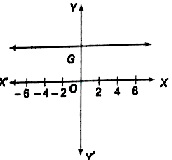
If G represents the name of the function in below graph, then G is a/an
A
identity function
B
constant function
C
modulus function
D
None of the above
Question 80Single Answer
Let X = {–1, 0, 1}, Y = {0, 2} and a function f: X → Y defined by y = 2x4, is
A
one-one onto
B
one-one into
C
many-one onto
D
many-one into
Question 81Single Answer
Let f : R→ R be a function defined by
A
one-one onto
B
one-one but not onto
C
onto but not one-one
D
None of the above
Question 82Single Answer
The mapping f: N→ N given by f(n) = 1 n2, n € N where, N is the set of natural numbers is
A
one-one and onto
B
onto but not one-one
C
one-one but not onto
D
neither one-one nor onto
Question 83Single Answer
A
B
C
[ 0 , 1 ]
D
None of the above
Question 84Single Answer
A relation R in a set A is called _______, if (a1, a2) ∈ R implies (a2, a1) ∈ R, for all a1, a2 ∈ A .
A
symmetric
B
transitive
C
equivalence
D
non-symmetric
Question 85Single Answer
A
f is one-one onto
B
f is one-one into
C
f is many-one onto
D
f is many-one into
Question 86Single Answer
Domain of f(x) = sin–1[2 – 4x2] ([.] denotes the greatest integer function) is
A
[–1, 1]
B
(–2, 2)
C
D
None of the above
Question 87Single Answer
A
B
C
D
Question 88Single Answer
If f(x) = [x2] – [x]2, where [.] denotes the greatest integer function and x € [0, 2] then the set of values of f(x) is
A
{–1, 0}
B
{–1, 0, 1}
C
{0}
D
{0, 1, 2}
Question 89Single Answer
A
B
C
D
None of these
Question 90Single Answer
If f: A → B and g: B → C be two functions, then the composition of functions f and g is given by
A
gof(x) = g(f(x))
B
gof(x) = g(x)f(x)
C
fog(x) = g(f(x))
D
None of the above
Question 91Single Answer
If the function gof is defined an onto, then
A
neither f nor g is onto
B
f and g both are necessarily onto
C
f must be onto
D
None of the above
Question 92Single Answer
If f(x) = 2x + 7 and g (x) = x2 + 7, x R, then which value of x will satisfy fog (x) = 25?
A
–1, 1
B
–2, 2
C
D
None of these
Question 93Single Answer
A
3
B
1
C
D
None of these
Question 94Single Answer
A
B
C
D
Question 95Single Answer
A
B
C
D
Question 96Single Answer
A
Zero
B
1
C
-1
D
Question 97Single Answer
a + ib > c + id can be explained only when
A
b = 0, c = 0
B
b = 0, d = 0
C
a = 0, c = 0
D
a = 0, d = 0
Question 98Single Answer
If 3x2 + 4x + 2 = 0, then equation has
A
real roots
B
imaginary roots
C
one real and one imaginary root
D
distinct real roots
Question 99Single Answer
A
B
C
D
Question 100Single Answer
A
B
C
D
Question 101Single Answer
A
B
C
D
Question 102Single Answer
If square root of –7 + 24i is x + iy, then x is equal to
A
±1
B
±2
C
±3
D
±4
Question 103Single Answer
A
B
C
D
Question 104Single Answer
A
B
C
D
Question 105Single Answer
A
B
C
D
Question 106Single Answer
A
B
C
D
Question 107Single Answer
A
i
B
C
1
D
Zero
Question 108Single Answer
A
B
1/2
C
n
D
Zero
Question 109Single Answer
A
B
C
-12 - 9i
D
-12 + 9i
Question 110Single Answer
The locus of the poins z which satisfy the condition
A
a straight line
B
a circle
C
a parabola
D
none of these
Question 111Single Answer
A
x = 1
B
x = –1
C
x = ±1
D
No real roots
Question 112Single Answer
If z is a complex number such that Re(z) = Im(z), then
A
Re(z2) = 0
B
Im(z2) =0
C
Re(z2) = Im(z2)
D
Re(z2) = –Im(z2)
Question 113Single Answer
If 2a = –1 – i and 2b = –1 + i then
5a4 + 5b4 + 7a–1b–1 is equal to
A
–1
B
–2
C
Zero
D
2
Question 114Single Answer
The real value of a for which the expression is purely real is, when n € N
A
B
C
D
None of these
Question 115Single Answer
A
B
C
D
Question 116Single Answer
A
1
B
–1
C
2
D
–2
Question 117Single Answer
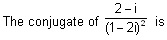
What is the conjugate of
A
B
C
D
Question 118Single Answer
If be the conjugate of the complex number z,then which of the following relations is false?
A
B
C
D
Question 119Single Answer
If z1, z2 and z3 be the three complex numbers such that |z1 + 1| < 1, |z2 + 2| < 2 and |z3 + 4| < 4, then the maximum value of |z1| + |z2| + |z3| is
A
7
B
10
C
12
D
14
Question 120Single Answer
A
B
C
D
Question 121Single Answer
A
Zero
B
C
D
Question 122Single Answer
A
B
C
D
Question 123Single Answer
A
B
C
D
Question 124Single Answer
Re(z2) = 1 is represented by
A
the circle x2 + y2 = 1
B
the hyperbola x2 – y2 = 1
C
parabola or a circle
D
all of the above
Question 125Single Answer
If the complex numbers iz, z and z + iz represent the three vertices of a triangle, then the area of the triangle is
A
B
C
D
Question 126Single Answer
If Z1, Z2, Z3 and z4 are the affixes of four points in the argand plane and z is the affix of a point, such that |z – z1| = |z – z2| = |z – z3| = |z – z4|, then z1, z2, z3 and z4 are
A
concyclic
B
vertices of parallelogram
C
vertices of a rhombus
D
in a straight line
Question 127Single Answer
Let z1 and z2 be the non-real roots of the equation + 3z2 + b = 0. If the origin together with the points represented by z1 and z2 form an equilateral triangle, then the value of b is
A
1
B
2
C
3
D
None of these
Question 128Single Answer
If the sum of a certain n number of terms of the AP, 25, 22, 19,....... is 116, then the last term is
A
4
B
3
C
2
D
–4
Question 129Single Answer
If a, 4, b are in Arithmetic Progression; a, 2, b are in Geometric Progression; then a, 1, b are in
A
A.P
B
G.P
C
H.P
D
None of these
Question 130Single Answer
What is the value of n sot that geometric mean between a and b ? where
A
B
C
n = 2
D
–2
Question 131Single Answer
If logax, logbx, logex be in HP, then a, b, c are in
A
AP
B
HP
C
GP
D
None of these
Question 132Single Answer
If A is the arithmetic mean and G1, G2 be two geometric means between any two numbers, then is equal to
A
2A
B
A
C
3A
D
None of these
Question 133Single Answer
A
B
C
D
Question 134Single Answer
A
B
C
D
Question 135Single Answer
A
B
loge2
C
D
loge2 + 1
Question 136Single Answer
A
B
C
D
Question 137Single Answer
The domain of a sequence can be subset of natural numbers of the type
A
{3, 4, 5,.....k}
B
{1, 2, 3, 4, 5,......k}
C
{0, 1, 2, 3, 4.,....k}
D
None of the above
Question 138Single Answer
A
4
B
6
C
8
D
10
Question 139Single Answer
The number which should be added to the numbers 2, 14, 62, so that the resulting numbers may be in GP, is
A
1
B
2
C
3
D
4
Question 140Single Answer
The sum of the geometric progression 0.15, 0.015, 0.0015, ..... 20 terms is
A
B
C
D
None of these
Question 141Single Answer
The value of 0.234 is
A
B
C
D
Question 142Single Answer
If log 2, log (2n – 1) and log (2n + 3) are in AP, then n is is equal to
A
B
log25
C
log35
D
Question 143Single Answer
In a cricket tournament 16 school terms participated. A sum of Rs,8000 is to be awarded among themselves as prize money. If the last placed team is awarded `Rs 275 in prize money and the award increases by the same amount for successive finishing places, amount will be first place team received is
A
Rs 720
B
Rs 725
C
Rs 735
D
Rs 780
Question 144Single Answer
A
909
B
75
C
750
D
900
Question 145Single Answer
The sum of integers from 1 to 100 that are divisible by 2 or 5 is
A
3000
B
3050
C
4050
D
None of these
Question 146Single Answer
If a2, b2, c2 are in AP, then which of the following is also in AP?
A
sinA, sinB, sinC
B
tanA, tanB, tanC
C
cotA, cotB, cotC
D
None of the above
Question 147Single Answer
A
20
B
30
C
40
D
None of the above
Question 148Single Answer
If a, b, c are in GP and loga – log 2b, log 2b – log 3c and log 3c – log a are in AP, then a, b, c are the length of the sides of a triangle which is
A
acute angled
B
obtuse angled
C
right angled
D
equilateral
Question 149Single Answer
A
AP
B
HP
C
GP
D
None of these
Question 150Single Answer
If x, 1, z are in AP and x, 2, z are in GP, then x, 4, z will be in
A
AP
B
GP
C
HP
D
None of these
Question 151Single Answer
A
AP
B
GP
C
HP
D
None of these
Question 152Single Answer
A
B
C
D
Question 153Single Answer
Let n > 1 be a positive integer, then the largest integer m such that (nm + 1) divides (1 + n + n2 + ..... n127), is
A
32
B
63
C
64
D
127
Question 154Single Answer
If b2, a2, c2 are in AP, then a + b, b + c, c + a, will be in
A
AP
B
GP
C
HP
D
None of these
Question 155Single Answer
A
(n – 1)(a1 – an)
B
na1an
C
(n – 1)a1an
D
n(a1 – an)
Question 156Single Answer
in
A
AP
B
GP
C
HP
D
None of these
Question 157Single Answer
A
B
C
D
Question 158Single Answer
Sum of n terms of the following series 13 + 33 + 53 + 73 + ..... is
A
n2(2n2 – 1)
B
n3(n – 1)
C
n3 + 8n + 3
D
2n4 + 3n2
Question 159Single Answer
A
e + 1
B
C
e – 1
D
None of these
Question 160Single Answer
A
2loge2 – 2
B
2 – loge2
C
2loge4
D
loge4
Question 161Single Answer
In how many ways can the number 7056 be resolved into two factors ?
A
20
B
21
C
23
D
22
Question 162Single Answer
The sum of the cubes of three consecutive intergers is divisible by
A
36
B
18
C
12
D
9
Question 163Single Answer
The number of integers less than 720 and prime to it
A
144
B
192
C
216
D
36
Question 164Single Answer
The number of ways in which N = 2,778,300 can be resolved into the two factors prime to each other
A
10
B
9
C
8
D
7
Question 165Single Answer
The sum of the divisors of 630 is
A
809
B
1439
C
1872
D
1579
Question 166Single Answer
The number of zeroes at the end, if 100! is fully expanded and written out is
A
23
B
26
C
25
D
24
Question 167Single Answer
What is the highest power of 3 contained in 100!?
A
49
B
48
C
47
D
46
Question 168Single Answer
The least positive integer having remainders 2, 3, 2 when divided by 3, 5, 7 respectively
is
A
27
B
25
C
24
D
23
Question 169Single Answer
If n is positive odd integer, then n3 – n is divisible by
A
32
B
24
C
18
D
15
Question 170Single Answer
n7 – n is divisible by
A
50
B
45
C
40
D
42
E
42
Question 171Single Answer
32n – 8n – 1 is divisible by
A
65
B
67
C
71
D
64
Question 172Single Answer
If n > 2, then n5 – 5n3 + 4n is divisible by
A
120
B
110
C
100
D
90
Question 173Single Answer
n(n + 1)(n + 5) is a multiple of
A
5
B
6
C
7
D
None of these
Question 174Single Answer
A
B
C
D
Question 175Single Answer
What is the largest number that divides 245 and 1029, leaving remainder 5 in each case?
A
15
B
16
C
9
D
5
Question 176Single Answer
What is the largest number that divides each one of 1152 and 1664 exactly?
A
32
B
64
C
128
D
256
Question 177Single Answer
A
B
2
C
D
Question 178Single Answer
The greatest number which on dividing 1657 and 2037 leaves remainders 6 and 5 respectively, is
A
1651
B
2032
C
127
D
None of these
Question 179Single Answer
If p is a prime, then 2(p – 3)! + 1 is a multiple of
A
p – 1
B
p
C
p + 1
D
None of the above
Question 180Single Answer
If (n, 7) = 1 i.e. if n is prime to 7, then n12 – 1 is divisible by
A
9
B
3
C
5
D
7
Question 181Single Answer
16! + 86 is divisible by
A
320
B
323
C
232
D
None of these
Question 182Single Answer
18! +1 is divisible by
A
19
B
23
C
both (a) and (b)
D
None of the above
Question 183Single Answer
The remainder when 21000 is divisible by 17 is
A
4
B
3
C
2
D
1
Question 184Single Answer
Remainder when 1! + 2! + 3! +..... + 50! is divided by
A
3
B
2
C
1
D
4
Question 185Single Answer
The remainder obtained by dividiing
1! + 2! + 3! + 4! + ...... + 100! by 12 is
A
7
B
8
C
9
D
10
Question 186Single Answer
22n,+ 1 where n is a positive integer greater than one, ends in
A
5
B
7
C
9
D
any number
Question 187Single Answer
If 2n – 1 is a prime, then sum of all the divisiors including 1 and itself of 2n – 1(2n – 1) is
A
2n(2n – 1)2
B
2n + 1(2n – 1)
C
2n(2n – 1)
D
2n – 1(2n – 1)
Question 188Single Answer
When 2n – 1 is a prime number, then the sum of the reciprocals of all the divisors of the number 2n(2n – 1) is
A
2
B
C
D
Question 189Single Answer
If m, n are primes, then mn – 1 + nm – 1 – 1 is a multiple of
A
m + n
B
m – n
C
D
mn
Question 190Single Answer
Let P(n) : n2 + n + 1(n € N) is an even integer. Therefore, P (n) is true.
A
for n > 1
B
for all n
C
for n > 2
D
None of these
Question 191Single Answer
A
1904
B
2000
C
2002
D
2006
Question 192Single Answer
A
an irrational number
B
a non-integer rational number
C
an odd number
D
an even number
Question 193Single Answer
A
B
C
D
Question 194Single Answer
If P(n) = 2 + 4 + 6 + ..... + 2n, n € N, then P(k) = k(k + 1) + 2 Þ P(k + 1) = (k + 1)(k + 2) + 2 for all k € N. Then, we can conclude that P(n) = n(n + 1) + 2 for






 B and A
 B, then
 R} is .....X.... set. Here, X refers to
 B
 A





 (A


 = 100, then n
 is equal to 300 provided n(X) is equal to


 N} and B = {x : x is a multiple of 6 and x
 N}, then A
 B consists of all multiples of

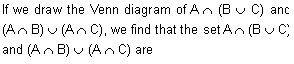

 B will be


 B)?







 (B × A)] is equal to
 B) × (A
 B) is equal to



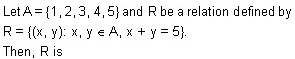
 N and x < 6}
 N and x < 6}
 N and x < 6}


 g{f(x)}
 0 is the inverse of itself, is

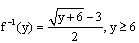
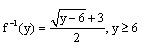



 N}. Then,
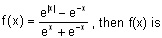
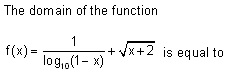


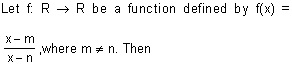
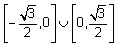
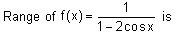


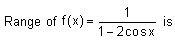


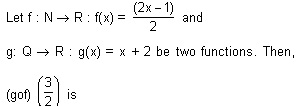
 R, then which value of x will satisfy fog (x) = 25?




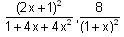
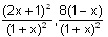
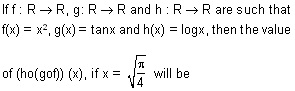




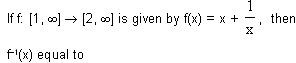






















 is purely real is, when n € N





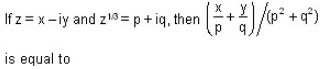
 What is the conjugate of


 be the conjugate of the complex number z,then which of the following relations is false?











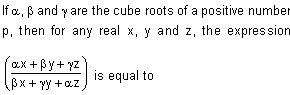


 geometric mean between a and b ? where


 is equal to
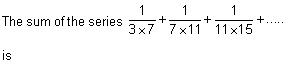








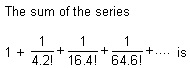





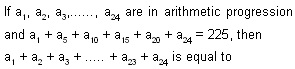
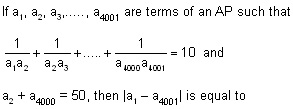
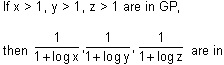





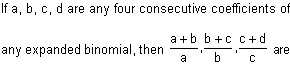 in