‘Economics is the study of mankind in the ordinary business of life’ was given by :
A
Adam Smith
B
Lord Robbins
C
Alfred Marshall
D
Samuelson
Question 2Single Answer
A study of how increase in the corporate income tax rate will affect the natural unemployment rate is an example of :
A
Macro Economics
B
Descriptive Economics
C
Micro Economics
D
Normative Economics
Question 3Single Answer
Under a free economy, prices are :
A
Regulated
B
Determined through free interplay of demand and supply
C
Partly regulated
D
None of these
Question 4Single Answer
In a free market economy, when consumers increase their purchase of a goods and the level of _______exceeds ______ then prices tend to rise :
A
Demand, Supply
B
Supply, Demand
C
Prices, Demand
D
Profits, Supply
Question 5Single Answer
Under Inductive method, the logic proceeds from:
A
General to particulars
B
Particular to general
C
Both (a) and (b)
D
None
Question 6Single Answer
Which of these would cause a rightward shift of the PPC curve?
A
Improvement in technology
B
Greater capital formation
C
Increase in population
D
All of these
Question 7Single Answer
Economics is the study of :
A
How society manages its unlimited resources
B
How to reduce our wants until we are satisfied
C
Who society manages its scarce resources
D
How to fully satisfy our unlimited wants.
Question 8Single Answer
Who defines Economics in terms of Dynamic Growth and Development?
A
Robbins
B
Paul A Samuelson
C
Adam Smith
D
None
Question 9Single Answer
Which one is not the characteristic of capitalistic economy?
A
Profit motive
B
Income inequality
C
Free employment
D
Collective ownership
Question 10Single Answer
Capitalistic Economy uses _____ as principal means of allocating resources.
A
Demand
B
Supply
C
Price
D
All of the above
Question 11Single Answer
Micro economics is also known as_______
A
Public economics.
B
Price theory.
C
Income theory.
D
Demand theory.
Question 12Single Answer
Which one in the following is not correct:
A
There are limited wants
B
Means are scarce
C
Resources have alternative uses
D
Economics is science.
Question 13Single Answer
Who gave the positive aspect of science?
A
Alfred Marshall
B
A.C. Pigou
C
Adam smith
D
Robbins.
Question 14Single Answer
In a capitalist economy the allocation of resources is performed by:
A
Producers
B
Government
C
Planners
D
Price mechanism
Question 15Single Answer
Which of the following are the features of a mixed economy?
A
Planned economy
B
Dual system of pricing exists
C
Balanced regional development
D
All of the above.
Question 16Single Answer
The elements of the set {x : x is an integer, x2 : 4} can be represent as .....Z..... . Here, Z refers to
A
{–2, 2}
B
{–1, 0, 1}
C
{–2, –1, 0, 1, 2}
D
{0, 1, 2}
Question 17Single Answer
A
B
C
D
None of these
Question 18Single Answer
If Y = {x : x is a positive factor of the number 2p – 1(2p – 1), where 2p – 1 is a prime number}, then Y can be represent in roster form as
A
{2}
B
{1, 2}
C
{1, 2, 22, ....., 2p – 1}
D
{1, 2, 22, 23,.... 2p – 1, (2p – 1)}
Question 19Single Answer
The set {x : x is a positive integer less than 6 and 3x – 1 is an even number} in roster form is
A
{1, 2, 3, 4, 5}
B
{1, 2, 3, 4, 5, 6}
C
{2, 4, 6}
D
{1, 3, 5}
Question 20Single Answer
If A B and A B, then
A
A is called a proper subset of B
B
A is called a super set of B
C
A is not a subset of B
D
B is a subset of A
Question 21Single Answer
The number of non-empty subsets of the set{1, 2, 3, 4} is
A
15
B
14
C
16
D
17
Question 22Single Answer
The number of elements of the power set of a set containing m elements is
A
2m – 1
B
m
C
m2
D
2m
Question 23Single Answer
If A = {x : x = n2, n = 1, 2, 3}, then number of proper subsets is
A
3
B
8
C
7
D
None of these
Question 24Single Answer
If A = {x : x = 4n + 1, 2 £ n £ 5},then number of subsets of A is
A
16
B
15
C
4
D
None of these
Question 25Single Answer
Let A and B be two non-empty subsets of a set X such that A is not a subset of B, then
A
A is always a subset of the complement of B
B
B is always a subset of A
C
A and B are always disjoint
D
A and the complement of B are always non-disjoint
Question 26Single Answer
Which of the following is/are empty set?
A = {x : x2 + x + 1 = 0 and x Î Z} B = {x : x is a prime number and 19 < x < 23}
A
A
B
B
C
Both A and B
D
None of the above
Question 27Single Answer
The set {x : x4 = 1 and x R} is .....X.... set. Here, X refers to
A
empty
B
finite
C
infinite
D
singleton
Question 28Single Answer
The universal set for the sets
A = {x : x2 – 5x + 6 = 0} and
B = {x : x2 – 3x + 2 = 0} having least number of elements is
A
{1, 2}
B
{1, 3}
C
{1, 2, 3}
D
{0, 1, 2, 3}
Question 29Single Answer
If A = {1, 2, 3}, B = {x € R : x2 – 2x + 1 = 0},
C = {1, 2, 2, 3} and
D = {x € R : x3 – 6x2 + 11x – 6 = 0}, then the equal sets are
A
A and B
B
A and C
C
A, B and C
D
A, C and D
Question 30Single Answer
If A = (–3, 5) and B = [–7, 9], then
A
A = B
B
A B
C
B A
D
None of these
Question 31Single Answer
Two finite sets have m and n elements, respectively. The total number of subsets of first set is 56 more than the total number of subsets of the second set. The value of m and n respectively are
A
7, 6
B
5, 1
C
6, 3
D
8, 7
Question 32Single Answer
Combine terms: 12a + 26b - 4b – 16a .
A
4a + 22b
B
-28a + 30b
C
-4a + 22b
D
28a + 30b
Question 33Single Answer
The average of first 50 natural numbers is ………… .
A
25.30
B
25.5
C
25.00
D
12.25
Question 34Single Answer
60 Times of 8 Equals to
A
480
B
300
C
250
D
400
Question 35Single Answer
Consider the sets
A = {x : x is a real number and x2 + 1 = 0}
B = {x : x is a real number and x2 – 16 = 0}
C = {x : x is a real number and x2 = x + 2}
Which of the following is are null set ?
A
A
B
A and B
C
A and C
D
A, B and C
Question 36Single Answer
If X = {4n – 3n – 1: n Î N} and Y = {9(n – 1): n Î N}; where N is the set of natural numbers, then X È Y is equal to
A
N
B
Y – X
C
X
D
Y
Question 37Single Answer
Which of the following is / are correct?
I. {2, 3, 4} {1, 2, 3, 4, 5}
II. {a, b, c} {b, c, d}
III. {x : x is an equilateral triangle in a plane} Ì {x : x is a triangle in the same plane}
IV. {x : x is an even natural number} {x : x is an integer}
A
I and III are correct
B
II and III are correct
C
Only IV is correct
D
All above are correct
Question 38Single Answer
A
B
C
D
Question 39Single Answer
Consider the following statements :
1. The set of all irrational numbers between √2 and √5 is an infinite set .
2. The set of all odd integers less than 100 is a finite set .
Which of the statements given above is/are correct ?
A
1 only
B
2 only
C
Both 1 and 2
D
Neither 1 nor 2
Question 40Single Answer
What is the Next Prime Number after 7 ?
A
13
B
12
C
14
D
11
Question 41Single Answer
If A and B are two given sets, then A (A B)C is equal to
A
A
B
B
C
D
Question 42Single Answer
121 Divided by 11 is
A
11
B
10
C
19
D
18
Question 43Single Answer
Let X be the universal set for sets A and B, if n(A) = 200, n(B) = 300 and n = 100, then n is equal to 300 provided n(X) is equal to
A
600
B
700
C
800
D
900
Question 44Single Answer
A
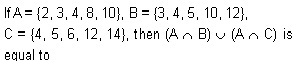
{3, 4, 10}
B
{2, 8, 10}
C
{4, 5, 6}
D
{3, 5, 14}
Question 45Single Answer
Let A = {x : x is a prime factor of 240} B = {x : x is the sum of any two prime factors of 240}, then
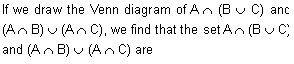
A
B
C
D
Question 46Single Answer
If A = {x : x is a multiple of 4 and x N} and B = {x : x is a multiple of 6 and x N}, then A B consists of all multiples of
A
16
B
12
C
8
D
4
Question 47Single Answer
A
A = B
B
B = C
C
A = C
D
None of these
Question 48Single Answer
A
equal
B
disjoint
C
either equal or disjoint
D
none of the above
Question 49Single Answer
A
{–i, i}
B
{–1, 1}
C
{–1, 1, i, –i}
D
None of these
Question 50Single Answer
If A = {x : f(x)= 0} and
B = {x : g(x) = 0}, then A B will be
A
[f(x)]2 + [g(x)]2 = 0
B
C
D
None of the above
Important Questions Package
TNPSC Block Health Statistician Exam Online Question Bank Package
Buy TNPSC Block Health Statistician Important Questions, MCQ, question answer in Hindi & English. It will help you to score high marks in TNPSC Block Health Statistician question bank 2026 in Online, PDF & Print study material.
+ Free Monthly Current Affairs, GK & more PDF Download
Sr.
Package Name
Amount
1.
TNPSC Block Health Statistician Exam Paper 1 - English
Description : 1000 Question with Answer
₹101[₹500]
2.
TNPSC Block Health Statistician Exam Paper 1 - English
Description : 2000 Question with Answer
₹151[₹500]
3.
TNPSC Block Health Statistician Exam Paper 1 - English
Description : 3000 Question with Answer
₹181[₹500]
4.
TNPSC Block Health Statistician Exam Paper 2 - English
Description : 1000 Question with Answer
₹101[₹500]
5.
TNPSC Block Health Statistician Exam Paper 2 - English
Description : 2000 Question with Answer
₹151[₹500]
6.
TNPSC Block Health Statistician Exam Paper 1 - English
Description : 1000 Question & Answer Download in PDF (Send by Email)
₹151[₹450]
7.
TNPSC Block Health Statistician Exam Paper 2 - English
Description : 1000 Question & Answer Download in PDF (Send by Email)
₹151[₹450]
8.
TNPSC Block Health Statistician Exam Paper 1 Question Bank Book - English
Description : 1000 Question with Answer (Printed Material)
₹390[₹600]
9.
TNPSC Block Health Statistician Exam Paper 2 Question Bank Book - English
Description : 1000 Question with Answer (Printed Material)
₹390[₹600]
Statistics, Mathematics and Economics
Question 51Single Answer
In a group of 400 people, 250 can speak Hindi and 200 can speak English. Then, people who can speak both Hindi and English are
A
60
B
80
C
50
D
45
Question 52Single Answer
20 teachers of a school either teach Mathematics or Physics. 12 of them teach Mathematics while 4 teach both the subjects. The number of teacher teaching Physics only, is
A
12
B
8
C
16
D
20
Question 53Single Answer
In a class of 100 students, 70 have taken Science, 60 have taken Mathematics, 40 have taken both Science and Mathematics. The number of students who have not taken Science or Mathematics or both Science and Mathematics, is equal to
A
90
B
10
C
30
D
20
Question 54Single Answer
A market research group conducted a survey of 1000 consumers and reported that 720 consumers like product A and 450 consumers like the product B, then least number that must have like both products, is
A
730
B
170
C
180
D
1270
Question 55Single Answer
If there are three athletic teams in a school, 21 are in the basketball team, 26 in hockey team and 29 in the football team. 14 play hockey and basketball, 15 play hockey and football, 12 play football and basketball and 8 play all the games. The total number of members is
A
42
B
43
C
45
D
None of these
Question 56Single Answer
What is the primary purpose of agriculture?
A
To produce energy
B
To cultivate crops and rear animals for food, fiber, and other products
C
To develop urban areas
D
To promote tourism
Question 57Single Answer
Which of the following is a major component of agriculture?
A
Manufacturing
B
Information technology
C
Horticulture
D
Real estate
Question 58Single Answer
Agriculture is often referred to as the backbone of which economy?
A
Industrial economy
B
Service economy
C
Rural economy
D
Urban economy
Question 59Single Answer
What is subsistence farming?
A
Farming for commercial purposes
B
Farming primarily for household consumption
C
Farming using advanced technology
D
Farming with a focus on exports
Question 60Single Answer
Which of the following is NOT a type of agriculture?
A
Organic farming
B
Aquaculture
C
Non-agricultural farming
D
Precision farming
Question 61Single Answer
What is the primary focus of microeconomics?
A
National income
B
Individual units and markets
C
Government policies
D
Economic growth
Question 62Single Answer
Who is considered the father of economics?
A
Adam Smith
B
Alfred Marshall
C
Lionel Robbins
D
John Maynard Keynes
Question 63Single Answer
Microeconomics is concerned with which of the following?
A
Aggregate demand and supply
B
Behavior of individual consumers and firms
C
Monetary policies
D
Fiscal policies
Question 64Single Answer
Which of the following is an example of a microeconomic issue?
A
Inflation rates
B
Consumer preferences for a product
C
Unemployment rate
D
National income accounting
Question 65Single Answer
Which of the following best defines microeconomics?
A
Study of the overall economy
B
Study of individual and business decisions
C
Study of economic development
D
Study of international trade
Question 66Single Answer
What does the term "economics" originally mean?
A
Study of wealth
B
Management of the household
C
Study of markets
D
Analysis of resources
Question 67Single Answer
The scope of microeconomics includes all the following except:
A
Theory of demand
B
Theory of production
C
National income determination
D
Market structure analysis
Question 68Single Answer
Which of the following is a normative statement?
A
The unemployment rate is 5%.
B
The government should reduce taxes to increase consumer spending.
C
There is a decrease in production.
D
The inflation rate has risen to 3%.
Question 69Single Answer
What does positive economics deal with?
A
Value judgments
B
Statements of facts
C
Economic predictions
D
Policy recommendations
Question 70Single Answer
Economics as a science is primarily based on:
A
Opinions
B
Experiments
C
Observations and deductions
D
Assumptions and beliefs
Question 71Single Answer
According to Alfred Marshall, economics is:
A
The study of scarcity
B
The study of human behavior
C
A science of wealth and welfare
D
The study of macroeconomic policies
Question 72Single Answer
Lionel Robbins defined economics as:
A
A science of wealth
B
A study of welfare
C
A science of scarcity and choice
D
A study of economic systems
Question 73Single Answer
What is the key criticism of Marshall's definition?
A
It ignored the concept of scarcity.
B
It neglected welfare aspects.
C
It focused too much on mathematical analysis.
D
It was considered too abstract.
Question 74Single Answer
Robbins' definition emphasized which aspect of economics?
A
Production
B
Welfare
C
Scarcity
D
Monetary policies
Question 75Single Answer
According to Robbins, economics is a science because it:
A
Studies wealth generation
B
Focuses on welfare improvement
C
Deals with scarce resources
D
Analyzes production systems
Question 76Single Answer
Which of the following theories explains inflation as a result of an increase in aggregate demand in the economy?
A
Cost-Push Inflation
B
Demand-Pull Inflation
C
Structural Inflation
D
Wage-Price Spiral
Question 77Single Answer
In the Philips Curve, what is the relationship between inflation and unemployment?
A
Positive correlation
B
Negative correlation
C
No correlation
D
None of the above
Question 78Single Answer
Which of the following is a characteristic of inflationary gap?
A
Unemployment is high
B
Actual output is greater than potential output
C
Actual output is less than potential output
D
Full employment
Question 79Single Answer
Which of the following factors does NOT contribute to demand-pull inflation?
A
Increase in government spending
B
Decrease in interest rates
C
Increase in aggregate demand
D
Decrease in the cost of production
Question 80Single Answer
According to the Philips Curve, which of the following happens when unemployment is reduced?
A
Inflation increases
B
Inflation decreases
C
Inflation remains unchanged
D
Unemployment increases
Question 81Single Answer
Which theory of inflation suggests that inflation occurs when the cost of production increases, causing producers to raise prices to maintain profits?
A
Demand-Pull Inflation
B
Cost-Push Inflation
C
Built-In Inflation
D
Structural Inflation
Question 82Single Answer
Which of the following is a possible effect of inflation?
A
Increased purchasing power
B
Decreased cost of living
C
Decreased cost of borrowing
D
Reduced real wages
Question 83Single Answer
Which of the following is NOT an anti-inflation policy?
A
Tight monetary policy
B
Higher interest rates
C
Reduced government spending
D
Expansionary fiscal policy
Question 84Single Answer
Which economic theory emphasizes the role of investment and capital accumulation in economic growth?
A
Hayek’s Theory of Growth
B
Hawtrey’s Theory of Growth
C
Schumpeter’s Theory of Growth
D
Samuelson’s Theory of Growth
Question 85Single Answer
According to Hayek, which of the following is the main cause of economic fluctuations?
A
Excessive government intervention
B
Changes in consumer preferences
C
Changes in money supply
D
Technological advancements
Question 86Single Answer
Who proposed the idea that economic growth is driven by creative destruction in the process of technological innovation?
A
Samuelson
B
Schumpeter
C
Hayek
D
Hicks
Question 87Single Answer
According to Samuelson, which of the following is a key factor in the long-run growth of the economy?
A
Consumption patterns
B
Government policies
C
Investment in technology and infrastructure
D
Stock market performance
Question 88Single Answer
Which of the following is a characteristic of Malthusian Theory of Population?
A
Population grows exponentially, while food production grows arithmetically
B
Population grows at a linear rate, and food production grows exponentially
C
Both population and food production grow at a constant rate
D
There is no relationship between population and food supply
Question 89Single Answer
The theory of optimum population suggests that an economy's population should be?
A
As large as possible to maximize resources
B
Below the level of full employment
C
Balanced with available resources to maximize per capita income
D
At the point where population growth exceeds the capacity of resources
Question 90Single Answer
According to the Malthusian theory, which of the following is a consequence of overpopulation?
A
Increased wealth and prosperity
B
Declining standards of living
C
Technological advancements
D
Decrease in disease and poverty
Question 91Single Answer
Which of the following is NOT a key indicator of economic growth?
A
GDP (Gross Domestic Product)
B
Inflation rate
C
Unemployment rate
D
Per capita income
Question 92Single Answer
What is inflation?
A
A sustained increase in the general price level of goods and services.
B
A decrease in the general price level of goods and services.
C
A period of economic recession.
D
An increase in unemployment.
Question 93Single Answer
Which of the following is a leading economic indicator?
A
Unemployment rate
B
Consumer Price Index (CPI)
C
Industrial production
D
Interest rates
Question 94Single Answer
What is the primary function of the Reserve Bank of India (RBI)?
A
To regulate the banking system in India.
B
To manage the fiscal deficit.
C
To implement government policies.
D
To provide social security benefits.
Question 95Single Answer
What is monetary policy?
A
Government spending and taxation policies.
B
Policies that control the money supply and interest rates.
C
Policies related to international trade.
D
Policies aimed at reducing poverty.
Question 96Single Answer
Which Five-Year Plan primarily focused on "Faster, Sustainable and More Inclusive Growth"?
A
9th Five-Year Plan
B
10th Five-Year Plan
C
11th Five-Year Plan
D
12th Five-Year Plan
Question 97Single Answer
During whose Prime Ministership was the concept of the "rolling plan" introduced?
A
Indira Gandhi
B
Rajiv Gandhi
C
Morarji Desai
D
Atal Bihari Vajpayee
Question 98Single Answer
Who chairs the National Development Council (NDC)?
A
The President of India
B
The Prime Minister of India
C
The Finance Minister of India
D
The Governor of the Reserve Bank of India
Question 99Single Answer
Which Five-Year Plan was primarily aimed at "Rapid Industrialization"?
A
First Five-Year Plan
B
Second Five-Year Plan
C
Third Five-Year Plan
D
Fourth Five-Year Plan
Question 100Single Answer
What replaced the Planning Commission of India?
A
Finance Commission
B
NITI Aayog
C
Reserve Bank of India
D
SEBI
Question 101Single Answer
What does the gradient of a scalar field represent?
A
Magnitude of the field
B
Direction of maximum increase
C
Rate of change in all directions
D
Zero vector
Question 102Single Answer
What is the gradient of a scalar function f(x, y, z) classified as?
A
Scalar
B
Vector
C
Tensor
D
Constant
Question 103Single Answer
If f(x, y, z) = x² + y² + z², what is ∇f?
A
2x + 2y + 2z
B
(2x, 2y, 2z)
C
x + y + z
D
(x, y, z)
Question 104Single Answer
What does a positive divergence of a vector field indicate?
A
Sink
B
Source
C
Rotation
D
Zero flux
Question 105Single Answer
What does the curl of a vector field measure?
A
Expansion
B
Rotation
C
Magnitude
D
Direction
Question 106Single Answer
For a vector field F = (y, -x, z), what is the curl ∇ × F?
A
(0, 0, -2)
B
(0, 0, 2)
C
(1, 1, 1)
D
(-1, 1, 0)
Question 107Single Answer
What is the directional derivative of a function f in the direction of a unit vector u?
A
∇f • u
B
∇f × u
C
|∇f| + |u|
D
∇f / u
Question 108Single Answer
If f(x, y) = xy and u = (1/√2, 1/√2), what is the directional derivative at (1, 1)?
A
1
B
2
C
√2
D
0
Question 109Single Answer
What is the unit normal to a surface defined by f(x, y, z) = c?
A
∇f
B
|∇f| / ∇f
C
∇f × |∇f|
D
∇f / |∇f|
Question 110Single Answer
For the surface x² + y² + z² = 9, what is the unit normal at (1, 2, 2)?
A
(1/3, 2/3, 2/3)
B
(2, 4, 4)
C
(1, 2, 2)
D
(1/9, 2/9, 2/9)
Question 111Single Answer
What is the physical interpretation of the gradient’s magnitude?
A
Rate of rotation
B
Maximum rate of change
C
Divergence strength
D
Surface area
Question 112Single Answer
If a vector field F is irrotational, what is # × F?
A
Zero
B
One
C
A constant vector
D
A scalar
Question 113Single Answer
What is the gradient of f(x, y) = sin(x) + cos(y)?
A
(cos(x), -sin(y))
B
(sin(x), cos(y))
C
(-sin(x), cos(y))
D
(cos(x), sin(y))
Question 114Single Answer
If F = (x², y², z²), what is the divergence # • F?
A
2x + 2y + 2z
B
x² + y² + z²
C
2(x + y + z)
D
0
Question 115Single Answer
What does a zero curl of a vector field imply?
A
The field is divergent
B
The field is irrotational
C
The field is constant
D
The field is zero
Question 116Single Answer
In which direction does the directional derivative achieve its maximum value?
A
Opposite to #f
B
Perpendicular to #f
C
Along #f
D
Along the zero vector
Question 117Single Answer
If f(x, y, z) = xyz, what is #f at (1, 1, 1)?
A
(1, 1, 1)
B
(yz, xz, xy)
C
(0, 0, 0)
D
(x, y, z)
Question 118Single Answer
What is the divergence of F = (x, y, z) at (2, 3, 4)?
A
3
B
9
C
0
D
1
Question 119Single Answer
For F = (z, x, y), what is # × F?
A
(1, 1, 1)
B
(y - x, z - y, x - z)
C
(0, 0, 0)
D
(1, -1, 1)
Question 120Single Answer
What is the directional derivative of f(x, y) = x² + y² in the direction (1, 0) at (1, 1)?
A
2
B
1
C
0
D
4
Question 121Single Answer
What is the primary purpose of statistics?
A
To predict future events
B
To create graphical designs
C
To collect, analyze, and interpret data
D
To perform algebraic calculations
Question 122Single Answer
What is a key use of statistics in economics?
A
Designing experiments
B
Forecasting economic trends
C
Drawing artistic charts
D
Solving quadratic equations
Question 123Single Answer
What is a limitation of statistics?
A
Handles large datasets easily
B
Simplifies complex problems
C
Always provides exact results
D
Cannot deal with qualitative data effectively
Question 124Single Answer
What does the scope of statistics include?
A
Only data collection
B
Data collection, analysis, and decision-making
C
Only graphical representation
D
Solving geometric problems
Question 125Single Answer
Why is statistics important in research?
A
To make informed decisions based on data
B
To draw artistic diagrams
C
To eliminate all errors
D
To avoid data collection
Question 126Single Answer
What is a common misuse of statistics?
A
Accurate data analysis
B
Misleading conclusions from biased data
C
Proper data collection
D
Clear graphical representation
Question 127Single Answer
What is the role of statistics in planning?
A
To help allocate resources efficiently
B
To ignore data patterns
C
To avoid data analysis
D
To focus on qualitative aspects
Question 128Single Answer
What is a major limitation of statistical methods?
A
They are always precise
B
They depend on the quality of data
C
They eliminate all uncertainties
D
They work without data
Question 129Single Answer
How does statistics assist in policy-making?
A
By ignoring trends
B
By focusing on diagrams only
C
By avoiding numerical data
D
By providing data-driven insights
Question 130Single Answer
What is a key challenge in applying statistics?
A
Handling large datasets
B
Ensuring data accuracy and reliability
C
Drawing perfect diagrams
D
Avoiding calculations
Question 131Single Answer
What is an example of a secondary data source?
A
Surveys
B
Experiments
C
Government reports
D
Observations
Question 132Single Answer
What does classification of data involve?
A
Drawing diagrams
B
Grouping data into categories
C
Calculating averages
D
Fitting curves
Question 133Single Answer
What is the purpose of tabulation?
A
To organize data in a systematic table
B
To confuse data presentation
C
To draw scatter diagrams
D
To compute correlations
Question 134Single Answer
What type of data is classified by attributes like gender or color?
A
Quantitative data
B
Qualitative data
C
Continuous data
D
Discrete data
Question 135Single Answer
What is a frequency distribution table used for?
A
To display the frequency of data values
B
To show relationships between variables
C
To fit quadratic equations
D
To draw pie charts
Question 136Single Answer
How is data collected through questionnaires classified?
A
Secondary data
B
Primary data
C
Tabulated data
D
Graphical data
Question 137Single Answer
What is a key advantage of tabulation?
A
Increases data complexity
B
Avoids classification
C
Eliminates data errors
D
Simplifies data for analysis
Question 138Single Answer
What does chronological classification of data refer to?
A
Grouping by size
B
Grouping by time
C
Grouping by location
D
Grouping by value
Question 139Single Answer
What is a common method for collecting sample data?
A
Random sampling
B
Complete enumeration
C
Graphical analysis
D
Equation fitting
Question 140Single Answer
What is the role of a tally mark in tabulation?
A
To draw graphs
B
To count frequencies
C
To calculate means
D
To fit lines
Question 141Single Answer
What is the definition of probability?
A
Certainty of an event
B
Measure of likelihood of an event
C
Frequency of data
D
Variance of outcomes
Question 142Single Answer
What does a probability of 0 indicate?
A
Event is certain
B
Event is impossible
C
Event is likely
D
Event is frequent
Question 143Single Answer
For mutually exclusive events, what is P(A or B)?
A
P(A) + P(B)
B
P(A) * P(B)
C
P(A) - P(B)
D
P(A) / P(B)
Question 144Single Answer
What is the formula for the addition rule for non-mutually exclusive events?
A
P(A or B) = P(A) + P(B)
B
P(A or B) = P(A) + P(B) - P(A and B)
C
P(A or B) = P(A) * P(B)
D
P(A or B) = P(A) / P(B)
Question 145Single Answer
If P(A) = 4, P(B) = 5, and P(A and B) = 2, what is P(A or B)?
A
7
B
9
C
6
D
2
Question 146Single Answer
What does the multiplication rule calculate?
A
Probability of at least one event
B
Probability of both events occurring
C
Probability of no events
D
Sum of probabilities
Question 147Single Answer
For independent events, what is P(A and B)?
A
P(A) + P(B)
B
P(A) * P(B)
C
P(A) - P(B)
D
P(A) / P(B)
Question 148Single Answer
If P(A) = 6 and P(B) = 3, and A and B are independent, what is P(A and B)?
A
9
B
18
C
3
D
6
Question 149Single Answer
What is conditional probability P(A|B)?
A
P(A) + P(B)
B
P(A and B) / P(B)
C
P(A) * P(B)
D
P(A) - P(B)
Question 150Single Answer
What is the formula for Bayes’ theorem?
A
P(A|B) = P(B|A) * P(A) / P(B)
B
P(A|B) = P(A) + P(B)
C
P(A|B) = P(A) * P(B)
D
P(A|B) = P(A) - P(B)
Question 151Single Answer
If P(B|A) = 8, P(A) = 3, and P(B) = 4, what is P(A|B)?
A
6
B
8
C
5
D
3
Question 152Single Answer
For mutually exclusive events A and B, what is P(A and B)?
A
0
B
1
C
P(A) + P(B)
D
P(A) * P(B)
Question 153Single Answer
If P(A) = 5, P(B) = 4, and P(A and B) = 1, what is P(A or B)?
A
5
B
8
C
9
D
6
Question 154Single Answer
If P(A) = 7 and P(B|A) = 6, what is P(A and B)?
A
42
B
6
C
7
D
1
Question 155Single Answer
What is a random variable?
A
A fixed value
B
A variable with random outcomes
C
A constant probability
D
A sample mean
Question 156Single Answer
What is a discrete random variable?
A
Takes continuous values
B
Takes countable values
C
Takes infinite values
D
Takes no values
Question 157Single Answer
What is a continuous random variable?
A
Takes countable values
B
Takes any value in an interval
C
Takes fixed values
D
Takes zero values
Question 158Single Answer
What does the expected value E(X) represent?
A
Variance of X
B
Average value of X
C
Probability of X
D
Maximum value of X
Question 159Single Answer
For a discrete random variable X with P(X = 1) = 4 and P(X = 2) = 6, what is E(X)?
A
6
B
14
C
10
D
4
Question 160Single Answer
What does the variance of a random variable measure?
A
Average value
B
Spread of values
C
Probability of values
D
Sum of values
Question 161Single Answer
What is a time series?
A
A set of random data points
B
A graphical representation of categories
C
Data collected at successive time intervals
D
A measure of central tendency
Question 162Single Answer
What are the main components of a time series?
A
Mean, median, mode
B
Trend, seasonal, cyclical, irregular
C
Variance, standard deviation
D
Index, weight, cost
Question 163Single Answer
What does the trend component of a time series represent?
A
Long-term movement or direction
B
Short-term fluctuations
C
Periodic changes
D
Random variations
Question 164Single Answer
What is the seasonal component in a time series?
A
Long-term growth
B
Regular, periodic fluctuations
C
Unpredictable changes
D
Cyclical patterns over decades
Question 165Single Answer
What does the cyclical component of a time series indicate?
A
Short-term random changes
B
Seasonal patterns
C
Long-term oscillations around the trend
D
Immediate fluctuations
Question 166Single Answer
What is the irregular component in a time series?
A
Predictable seasonal changes
B
Random, unpredictable variations
C
Long-term trend
D
Cyclical patterns
Question 167Single Answer
What is the purpose of time series analysis?
A
To calculate averages
B
To identify patterns and forecast future values
C
To compute index numbers
D
To create bar charts
Question 168Single Answer
What method is commonly used to determine the trend in a time series?
A
Scatter plot
B
Moving average
C
Pie chart
D
Histogram
Question 169Single Answer
What does a moving average smooth out in a time series?
A
Seasonal and irregular fluctuations
B
Long-term trends
C
Cyclical patterns
D
All components
Question 170Single Answer
How is a 3-period moving average calculated for a time series?
A
Sum of 3 consecutive values divided by 3
B
Sum of all values divided by 3
C
Difference of 3 consecutive values
D
Product of 3 consecutive values
Question 171Single Answer
For the data 10, 20, 30, 40, 50, what is the 3-period moving average for the third point?
A
20
B
30
C
40
D
50
Question 172Single Answer
What is a limitation of the moving average method?
A
Captures all components
B
Loses data at the ends of the series
C
Accounts for cyclical patterns
D
Predicts exact values
Question 173Single Answer
What does the least squares method minimize in a linear trend?
A
Sum of values
B
Sum of squared differences between observed and fitted values
C
Sum of seasonal components
D
Sum of irregular components
Question 174Single Answer
What is the general form of a linear trend equation?
A
Y = a + bX
B
Y = a + bX + cX²
C
Y = a * bX
D
Y = a / X
Question 175Single Answer
In the linear trend equation Y = a + bX, what does 'b' represent?
A
Intercept
B
Slope of the trend line
C
Seasonal component
D
Irregular variation
Question 176Single Answer
In the linear trend equation Y = a + bX, what does 'a' represent?
A
Slope
B
Cyclical component
C
Value of Y when X = 0
D
Random error
Question 177Single Answer
For time series data 5, 7, 9, 11, what is the slope of the linear trend by least squares?
A
1
B
2
C
3
D
4
Question 178Single Answer
What is a key advantage of the least squares method for trend estimation?
A
Ignores data points
B
Provides the best linear fit
C
Accounts for seasonal patterns
D
Eliminates all errors
Question 179Single Answer
For data 2, 4, 6, 8, what is the linear trend equation by least squares?
A
Y = 1 + 2X
B
Y = 2 + 2X
C
Y = 1 + X
D
Y = 2 + X
Question 180Single Answer
What is a limitation of the linear trend method?
A
Captures nonlinear patterns
B
Assumes a linear relationship
C
Accounts for irregular components
D
Predicts exact values
Question 181Single Answer
What is a barter system?
A
Exchange of goods without money
B
Use of digital currency
C
Trading with gold
D
Banking transactions
Question 182Single Answer
What determines the demand for money?
A
Interest rates and income levels
B
Government spending
C
Tax rates
D
Public debt
Question 183Single Answer
What is the supply of money controlled by?
A
Commercial banks only
B
Central bank and banking system
C
Government expenditure
D
Public savings
Question 184Single Answer
What is a primary function of money?
A
Taxation
B
Medium of exchange
C
Deficit financing
D
Public debt
Question 185Single Answer
What serves as a store of value?
A
Money
B
Taxes
C
Government bonds
D
Public expenditure
Question 186Single Answer
What is a function of money as a unit of account?
A
Facilitating barter
B
Measuring value of goods and services
C
Lending funds
D
Controlling inflation
Question 187Single Answer
What is the role of a central bank?
A
Collecting taxes
B
Regulating money supply
C
Issuing public debt
D
Managing public expenditure
Question 188Single Answer
What does a central bank do during inflation?
A
Increases money supply
B
Reduces money supply
C
Increases public spending
D
Lowers taxes
Question 189Single Answer
What is a key function of commercial banks?
A
Printing currency
B
Managing fiscal policy
C
Accepting deposits and granting loans
D
Issuing government bonds
Question 190Single Answer
What does the money multiplier measure?
A
Tax revenue growth
B
Increase in money supply from initial deposits
C
Public debt expansion
D
Government expenditure
Question 191Single Answer
What affects the money multiplier?
A
Reserve requirements
B
Public expenditure
C
Tax rates
D
Deficit financing
Question 192Single Answer
What is a monetary policy instrument?
A
Public debt
B
Cash Reserve Ratio (CRR)
C
Taxation
D
Budget deficit
Question 193Single Answer
What does SLR stand for in monetary policy?
A
Statutory Liquidity Ratio
B
Standard Loan Rate
C
Savings Liquidity Ratio
D
Securities Lending Rate
Question 194Single Answer
What is the purpose of SLR?
A
To increase public spending
B
To reduce taxes
C
To ensure banks maintain liquid assets
D
To finance deficits
Question 195Single Answer
What does CRR require banks to do?
A
Lend all deposits
B
Keep a portion of deposits with the central bank
C
Invest in government bonds
D
Pay taxes
Question 196Single Answer
What happens when CRR is increased?
A
Money supply increases
B
Money supply decreases
C
Public expenditure rises
D
Taxes are reduced
Question 197Single Answer
What does OMO stand for in monetary policy?
A
Open Market Operations
B
Official Monetary Order
C
Organised Market Options
D
Operational Money Output
Question 198Single Answer
What does a central bank do in Open Market Operations?






 B and A
 B, then
 R} is .....X.... set. Here, X refers to
 B
 A





 (A


 = 100, then n
 is equal to 300 provided n(X) is equal to


 N} and B = {x : x is a multiple of 6 and x
 N}, then A
 B consists of all multiples of


 B will be

