On-line teaching and face-to-face teaching both are effective
D
Face-to-face teaching is less effective than online teaching
Question 2Single Answer
In order to solve the problem of aimlessness in education, we should develop -
A
democratic citizenship
B
centralized education
C
education
D
reform the administrative set-up
Question 3Single Answer
If a student misbehaves with other students in the class, the teacher should -
A
report the matter to the parents
B
punish him at the time of the morning assembly in the school
C
deal with him with sympathetic understanding
D
treat him with sympathy and understanding
Question 4Single Answer
How can a failed student be encouraged to study sincerely in the same class?
A
by teacher’s counseling
B
by psychological counseling
C
by guardian’s counseling
D
by Students’ Association
Question 5Single Answer
Our examination system is -
A
defective
B
without any defect
C
in the interest of the students
D
well-planned
Question 6Single Answer
Which Article in the Constitution deals with elementary education ?
A
Article 45
B
Article 370
C
Article 19
D
Article 226
Question 7Single Answer
For physically handicapped student of the school, there should be
A
proper facility for entering the class-room and toilet
B
proper arrangement for his food and lodging
C
arrangement for his free education
D
an arrangement for necessary equipments
Question 8Single Answer
A naughty student in the class is
A
foolish and dull
B
active and intelligent
C
unadjusted and unappreciated
D
rich and careless
Question 9Single Answer
Why is syllabus necessary in school ?
A
It helps in the proper functioning of the school
B
It makes the classroom education under control
C
A teacher can rule every work outside the class in a proper manner
D
All of the above are possible
Question 10Single Answer
If a seminar or conference is being conducted in your city concerning education, what will you do ?
A
I will take part in it without the permission of the Principal
B
I shall seek the permission of the Principal
C
I shall take leave from the school
D
I shall take no interest in it
Question 11Single Answer
How will you evaluate a student on the basis of the question paper type ?
A
On the basis of objective type questions
B
Essay type questions
C
Short answer type questions
D
All of the above
Question 12Single Answer
In order to make teaching more effective in the class, what would be done?
A
After the teaching, same type of questions should be given to the students for practice
B
Home-work should be given frequently
C
Home-work should be given now and them
D
After school hours, same type of questions should be got solved from the students
Question 13Single Answer
Why did you adopt teaching profession ?
A
Your parents wanted it
B
At the advice of your friend
C
No member in your family is in this profession
D
You have interest in it
Question 14Single Answer
You will pay need to such persons who are
A
very intelligent
B
very weak in studies
C
your relatives
D
well - behaved
Question 15Single Answer
In order to become skillful in his job, a teacher
A
should study new books on his subject
B
should take part in the debates of the school
C
should write on his subject
D
All of the above
Question 16Single Answer
Why step will you take to make your students health ?
A
Make the parents aware of the importance of good health
B
Organise debate on the importance of good health
C
Give them training regarding health
D
Give examples of healthy students
Question 17Single Answer
Which of the following is/are the basic paradigms in classroom teaching?
A
Learning paradigm
B
Instructional paradigm
C
Both (a) and (b)
D
None of the above
Question 18Single Answer
The prime requirement to become a good teacher is to have
A
Genuine interest in teaching
B
Knowledge about controlling students
C
Subject knowledge
D
Good expression
Question 19Single Answer
Research is -
A
A purposeful, systematic activity
B
Conducted for purely academic purposes.
C
Conducted to answer questions about practical issues.
D
A random, unplanned process of discovery
Question 20Single Answer
The research is always
A
Verifying the old knowledge
B
Exploring new knowledge
C
Filling the gaps between the knowledge
D
All of the above
Question 21Single Answer
Find the missing number in the following series.
8, 24, 12, ?, 18, 54
A
26
B
24
C
36
D
32
Question 22Single Answer
Find the missing number in the following series.
28, 33, 31, 36, ?, 39
A
30
B
32
C
33
D
34
Question 23Single Answer
The main governing body at the tertiary level of education in India is -
A
NCERT
B
CBSE
C
AICTE
D
UGC
Question 24Single Answer
Government established the University Grants Commission by an act of Parliament in the year
A
1980
B
1948
C
1950
D
1956
Question 25Single Answer
The term ecosystem was coined by -
A
Arthur Tansley
B
Al Gore
C
Mobius
D
Mobius
Question 26Single Answer
Who first used and defined Ecology in 1866?
A
H. Reiter
B
Haeckel
C
Charles Elton
D
Odum
Question 27Single Answer
ICT stands for -
A
Information and communication technology
B
Information controlled technology
C
Information capable technology
D
None of the above
Question 28Single Answer
Which of the following is also termed as multimedia education?
A
ICT supported education
B
ICT enabled education
C
ICT education
D
None of the above
Question 29Single Answer
Passage :
Direction: Study the table given below and answer question (The table consists of marks obtained by candidates in different subject) Marks obtained in different subjects by various candidates
Subjects (maximum marks)
Students
Maths
Chemistry
Physics
Geography
History
Computer Science
(150)
(130)
(120)
(100)
(100)
(100)
Ayush
90
50
90
60
70
80
Aman
100
80
80
40
80
70
Sajal
90
60
70
70
90
70
Rohit
80
65
80
80
60
60
Muskan
80
65
85
95
50
90
Tanvi
70
75
65
85
40
60
Tarun
65
35
50
77
80
80
What is the average of marks obtained by Aman for all subjects?
A
72
B
75
C
80
D
85
Question 30Single Answer
Passage :
Direction: Study the table given below and answer question (The table consists of marks obtained by candidates in different subjects) Marks obtained in different subjects by various candidates
Subjects (maximum marks)
Students
Maths
Chemistry
Physics
Geography
History
Computer Science
(150)
(130)
(120)
(100)
(100)
(100)
Ayush
90
50
90
60
70
80
Aman
100
80
80
40
80
70
Sajal
90
60
70
70
90
70
Rohit
80
65
80
80
60
60
Muskan
80
65
85
95
50
90
Tanvi
70
75
65
85
40
60
Tarun
65
35
50
77
80
80
What is the approximate percentage of marks obtained by Ayush?
A
62.8
B
72.5
C
75
D
74
Question 31Single Answer
Which is the main objective of research?
A
To review the literature
B
To summarize what is already known
C
To get an academic degree
D
To discover new facts or to make fresh interpretation of known facts
Question 32Single Answer
Sampling error decreases with the
A
decrease in sample size
B
increase in sample size
C
process of randomization
D
process of analysis
Question 33Single Answer
The principles of fundamental research are used in
A
action research
B
applied research
C
philosophical research
D
historical research
Question 34Single Answer
Users who use media for their own ends are indentified as
A
Passive audience
B
Active audience
C
Positive audience
D
Negative audience
Question 35Single Answer
Classroom communication can be described as
A
Exploration
B
Institutionalisation
C
Unsignified narration
D
Discourse
Question 36Single Answer
Ideological codes shape our collective
A
Productions
B
Perceptions
C
Consumptions
D
Creations
Question 37Single Answer
Passage :
The rapid advancement of technology has profoundly altered the way we communicate. Social media platforms connect billions across the globe, fostering instant interaction and the sharing of information. However, this interconnectedness also presents challenges. The spread of misinformation can occur at an unprecedented rate, impacting public opinion and even real-world events. Critical thinking and media literacy are now more essential than ever to navigate this complex digital landscape and discern credible sources from falsehoods.
What is the main idea of this passage?
A
The benefits of social media for global communication
B
The challenges posed by the rapid advancement of technology on communication
C
The importance of social media platforms in connecting people
D
The necessity of critical thinking and media literacy in the digital age
Question 38Single Answer
Passage :
The rapid advancement of technology has profoundly altered the way we communicate. Social media platforms connect billions across the globe, fostering instant interaction and the sharing of information. However, this interconnectedness also presents challenges. The spread of misinformation can occur at an unprecedented rate, impacting public opinion and even real-world events. Critical thinking and media literacy are now more essential than ever to navigate this complex digital landscape and discern credible sources from falsehoods.
According to the passage, what is a challenge of increased technological interconnectedness?
A
Slower rates of communication
B
Difficulty in sharing information
C
The rapid spread of misinformation
D
A decrease in global interaction
Question 39Single Answer
Passage :
The rapid advancement of technology has profoundly altered the way we communicate. Social media platforms connect billions across the globe, fostering instant interaction and the sharing of information. However, this interconnectedness also presents challenges. The spread of misinformation can occur at an unprecedented rate, impacting public opinion and even real-world events. Critical thinking and media literacy are now more essential than ever to navigate this complex digital landscape and discern credible sources from falsehoods.
The word "discern" in the passage most closely means:
A
Ignore
B
Understand
C
Distribute
D
Create
Question 40Single Answer
Passage :
The rapid advancement of technology has profoundly altered the way we communicate. Social media platforms connect billions across the globe, fostering instant interaction and the sharing of information. However, this interconnectedness also presents challenges. The spread of misinformation can occur at an unprecedented rate, impacting public opinion and even real-world events. Critical thinking and media literacy are now more essential than ever to navigate this complex digital landscape and discern credible sources from falsehoods.
What can be inferred about the impact of misinformation?
A
It has no effect on public opinion
B
Its impact is limited to online discussions
C
It can influence public opinion and real-world events
D
It is easily controlled by social media platforms
Question 41Single Answer
Passage :
The rapid advancement of technology has profoundly altered the way we communicate. Social media platforms connect billions across the globe, fostering instant interaction and the sharing of information. However, this interconnectedness also presents challenges. The spread of misinformation can occur at an unprecedented rate, impacting public opinion and even real-world events. Critical thinking and media literacy are now more essential than ever to navigate this complex digital landscape and discern credible sources from falsehoods.
The author's tone in this passage can be best described as:
A
Optimistic
B
Neutral and informative
C
Highly critical
D
Humorous
Question 42Single Answer
Identify the fallacy in the following argument: "Alan is tall, dark and handsome and has blue eyes. Bill is also tall, dark and handsome".
A
Inconsistency
B
Weak analogy
C
Slippery slope
D
Hasty generalisation
Question 43Single Answer
Identify the number that occurs in the series 2, 10, 30, 68, 130, ....
(A)738
(B) 349
(C) 520
(D) 222
Choose the correct answer from the options given below:
A
A, B and C only
B
B, C and D only
C
A, C and D only
D
A, B and D only
Question 44Single Answer
Which of the following are essential requirements for the formation of photochemical SMOG?
(A) Carbon monooxide (CO)
(B) Nitrogen dioxide (NO2)
(C) Carbon dioxide (CO2)
(D) Volatile Organic Compounds (VOCs)
(E) Sunlight
Choose the most appropriate answer from the options given below:
A
A, B and D only
B
A, C and E only
C
B, C, D and E only
D
B, D and E only
Question 45Single Answer
Which of the following Indian universities were modelled on the lines of University of London?
(A) Calcutta
(B) Bombay
(C) Madras
(D) Andhra
(E) Mysore
Choose the correct answer from the options given below:
A
A, B & C only
B
B, C & D only
C
C, D & E only
D
A, B & D only
Question 46Single Answer
Given below are two statements:
Statement I: Internet is commonly used service on the World Wide Web
Statement II: HTTP is the protocol that web browsers and web servers use to communicate with each other over the Internet
In the light of the above statements, choose the correct answer from the options given below:
A
Both Statement I and Statement II are true
B
Both Statement I and Statement II are false
C
Statement I is true but Statement II is false
D
Statement I is false but Statement II is true
Question 47Single Answer
Given below are two statements, one is labelled as Assertion A and the other is labelled as Reason R
Assertion (A): Teachers must encourage students to ask questions.
Reason (R): Asking questions can create curiosity and develop passion for learning
In light of the above statements, choose the most appropriate answer from the options given below
Choose the correct answer from below:
A
Both (A) and (R) are correct, and (R) is the correct explanation of (A)
B
Both (A) and (R) are correct, but (R) is not the correct explanation of (A)
C
(A) is correct but (R) is not correct
D
(A) is not correct but (R) is correct
Question 48Single Answer
Given below are two statements:
Statement I: Exploration is particularly useful when researchers lack a clear idea of the problems they will meet during the study
Statement II: Through exploration, researchers develop concepts more clearly, establish priorities, develop operational definitions, and improve the final research design
In light of the above statements, choose the correct answer from the options given below:
A
Both Statement I and Statement II are false
B
Both Statement I and Statement II are true
C
Statement I is false but Statement II is true
D
Statement I is true but Statement II is false
Question 49Single Answer
Which of the given learner characteristics are associated with field dependent (holistic/visual) learning style?
(i) Focusing on facts and principles
(ii) Relating concepts to personal experience
(iii) Formal interaction with teacher related to tasks at hand
(iv) Preferring to compete rather than cooperate
(v) Preferring to cooperate rather than compete
(vi) Perceiving global aspects of concepts and materials
Choose the correct answer from the options given below:
A
(i), (ii) and (iii)
B
(ii), (iii) and (v)
C
(ii), (v) and (vi)
D
(iv), (v) and (vi)
Question 50Single Answer
Teaching is best defined as?
A
Transmission of knowledge only
B
Memorization of facts
C
A process of facilitating learning
D
Examination process
Important Questions Package
UGC NET Population Studies Exam Online Question Bank Package
Buy UGC NET Population Studies Important Questions, MCQ, question answer in Hindi & English. It will help you to score high marks in UGC NET Population Studies question bank 2026 in Online, PDF & Print study material.
+ Free Monthly Current Affairs, GK & more PDF Download
Sr.
Package Name
Amount
1.
UGC NET Population Studies Exam - Hindi
Description : 1000 Question with Answer
₹101[₹500]
2.
UGC NET Population Studies Exam - Hindi
Description : 2000 Question with Answer
₹151[₹500]
3.
UGC NET Population Studies Exam - Hindi
Description : 3000 Question with Answer
₹181[₹500]
4.
UGC NET Population Studies Exam - Hindi
Description : 4000 Question with Answer
₹201[₹500]
5.
UGC NET Population Studies Exam - Hindi
Description : 5000 Question with Answer
₹221[₹500]
6.
UGC NET Population Studies Exam - Hindi
Description : 6000 Question with Answer
₹241[₹500]
7.
UGC NET Population Studies Exam - English
Description : 1000 Question with Answer
₹101[₹500]
8.
UGC NET Population Studies Exam - English
Description : 2000 Question with Answer
₹151[₹500]
9.
UGC NET Population Studies Exam - English
Description : 3000 Question with Answer
₹181[₹500]
10.
UGC NET Population Studies Exam - English
Description : 4000 Question with Answer
₹201[₹500]
11.
UGC NET Population Studies Exam - English
Description : 5000 Question with Answer
₹221[₹500]
12.
UGC NET Population Studies Exam - English
Description : 6000 Question with Answer
₹241[₹500]
13.
UGC NET Population Studies Exam - Hindi
Description : 1000 Question & Answer Download in PDF (Send by Email)
₹151[₹450]
14.
UGC NET Population Studies Exam - English
Description : 1000 Question & Answer Download in PDF (Send by Email)
₹151[₹450]
15.
UGC NET Population Studies Exam Question Bank Book - Hindi
Description : 1000 Question with Answer (Printed Material)
₹450[₹800]
16.
UGC NET Population Studies Exam Question Bank Book - English
Description : 1000 Question with Answer (Printed Material)
₹390[₹600]
17.
UGC NET Population Studies Exam Paper 2 Question Bank Book - English (Old)
Description : 1000 Question with Answer (Printed Material)
₹390[₹600]
Domain knowledge (Population Studies)
Question 51Single Answer
Who among the following argued that multiple centres of nuclei were responsible for urban growth ?
A
Harris and Ullman
B
Homer Hoyt
C
Park and Burgess
D
Nelson
Question 52Single Answer
In which year, the National Sample Survey (NSS) was set up ?
A
1950
B
1960
C
1970
D
1980
Question 53Single Answer
According to 2011 census, which Union Territory of India has lowest literacy rate ?
A
Chandigarh
B
Puducherry
C
Andaman & Nicobar Islands
D
Dadra & Nagar Haveli
Question 54Single Answer
During which period, India entered into the fourth phase of high population growth ?
A
1891-1921
B
1921-1951
C
1951-1981
D
1981-2011
Question 55Single Answer
Which one of the following is used to calculate the rate of natural increase in human population ?
A
CBR - CDR
B
CDR + CBR
C
CDR - CBR
D
CBR + CMR
Question 56Single Answer
Which year is called the ‘demographic divide’ in India ?
A
1881
B
1901
C
1921
D
1951
Question 57Single Answer
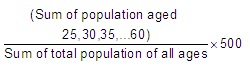
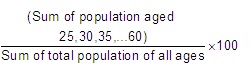
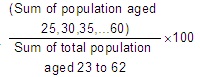
Which among the following is correct formula for Whipple’s Index ?
A
B
C
D
Question 58Single Answer
What is the annual permissible concentration of PM 2.5 in the air, according to World Health Organisation (WHO) ?
A
60 ug/m3
B
50 ug/m3
C
10 ug/m3
D
30 ug/m3
Question 59Single Answer
The growth rate of population in India during 2001-2011 was :
A
14.9 %
B
15.5 %
C
17.7 %
D
21.2 %
Question 60Single Answer
Which one of the following census can be considered the first modern census in the world ?
A
Swedish census
B
British census
C
Indian census
D
South African census
Question 61Single Answer
The density of population of India in Census 2011 is :
A
371
B
382
C
390
D
401
Question 62Single Answer
Who has introduced the hypothesis of intervening opportunities in migration studies ?
A
Wilbur Zelinski
B
K Zipf
C
Corrado Ginni
D
Samuel Stauffer
Question 63Single Answer
The estimated Whipple’s Index value 120 indicates that age data is :
A
Highly accurate
B
Moderate
C
Not accurate
D
Highly inaccurate
Question 64Single Answer
According to causes of death statistics, 2010-13, which one of the following is the leading (highest) cause of death among rural females population in India ?
A
Respiratory diseases
B
Cardiovascular diseases
C
Respiratory infections
D
Tuberculosis
Question 65Single Answer
Which among the following states in India, urbanisation percentage is the highest, according to 2011 census ?
A
Tamil Nadu
B
Maharashtra
C
Gujarat
D
Kerala
Question 66Single Answer
Which state has the highest percentage of Christians in India, as per 2011 census ?
A
Goa
B
Manipur
C
Meghalaya
D
Nagaland
Question 67Single Answer
Which one is not true when the base of population pyramid is shrinking ?
A
Increase of logetivity in population
B
High population growth
C
Decrease in dependency ratio
D
Declining fertility
Question 68Single Answer
Which was the Mascot of Indian Census 2011?
A
A teddy bear
B
A woman enumerator
C
A child and mother
D
A helping hand symbol
Question 69Single Answer
Which of the following are major principles of smart city growth?
(a) Uniform land uses
(b) Range of transport choices
(c) Preserve open space, farmland, natural beauty
(d) Compact building design
(e) Encourage community collaboration in decision-making
Choose the correct answer from the options given below :
A
(a), (b), (d) only
B
(a), (d), (e) only
C
(b), (c), (d), (e) only
D
(a), (b), (c), (d), (e) only
Question 70Single Answer
The tendency of population to grow after achieving the replacement level of fertility is known as :
A
Population explosion
B
Population momentum
C
Population structure
D
Population stabilization
Question 71Single Answer
Which of the following is one of the indicator used to compute ‘Human Development Index’?
A
Infant mortality rate
B
Morbidity rate
C
Life expectancy at birth
D
Death rate
Question 72Single Answer
A country with a constant growth rate of 2.36 per cent, approximately. How many years it will take to double its population?
A
27 years
B
30 years
C
33 years
D
36 years
Question 73Single Answer
What is straddling birth interval ?
A
The period between two live births
B
The period elapsed since the last live birth till survey date
C
The closed birth interval which includes the survey date and ends after this date in future
D
The period from the survey date to the date of next birth
Question 74Single Answer
What kind of settlement pattern will be developed when built up area is less compact ?
A
Clustered
B
Dispersed
C
Semi-clustered
D
Hamleted
Question 75Single Answer
Which is the state with highest population of scheduled tribes in India, as per 2011 Census ?
A
Gujarat
B
Madhya Pradesh
C
Maharashtra
D
Odisha
Question 76Single Answer
In which of the following year, Comprehensive National Nutrition Survey (CNNS) was conducted ?
A
2015-16
B
2016-17
C
2016-18
D
2017-19
Question 77Single Answer
Which of the following migration theory postulates that migration is a natural outgrowth of disruptions and dislocations that inevitably occur in the process of capitalist development ?
A
Dual Labour Market Theory
B
Neoclassical Economics Approach
C
World System Theory
D
Network Theory
Question 78Single Answer
Which one of the following is a cohort measure of fertility ?
A
Gross Reproduction Rate
B
Net Reproduction Rate
C
Children Ever Born
D
General Fertility Rate
Question 79Single Answer
Who among the following postulated the “Threshold Hypothesis” to explain fertility transition ?
A
Gosta Carlsson
B
Kingsley Davis
C
John Bongaarts
D
The United Nations
Question 80Single Answer
Which of the following state has negative population growth, as per 2011 census ?
A
Kerala
B
Nagaland
C
Goa
D
Tamil Nadu
Question 81Single Answer
Population Studies is primarily concerned with the?
A
Study of only biological traits
B
Study of physical geography only
C
Study of population size, structure and change
D
Study of economics only
Question 82Single Answer
Population Studies is most closely related to which discipline?
A
Astronomy
B
Social Sciences
C
Geology
D
Chemistry
Question 83Single Answer
Which of the following is a major social institution affecting population?
A
Bank
B
Industry
C
Market
D
Family
Question 84Single Answer
Marriage primarily influences population through?
A
Trade system
B
Climate change
C
Fertility regulation
D
Migration only
Question 85Single Answer
Kinship system mainly affects?
A
Weather pattern
B
Soil fertility
C
Ocean currents
D
Social organization and reproduction
Question 86Single Answer
Religion influences population mainly by affecting?
A
Genetic mutation
B
Plate tectonics
C
Fertility behavior and norms
D
Air pressure
Question 87Single Answer
Social change in India refers to?
A
Change in rainfall pattern
B
Change in social structure and institutions
C
Change in soil type
D
Change in river flow
Question 88Single Answer
Tribes in India are generally characterized by?
A
Urban lifestyle
B
Global trade systems
C
Industrial economy
D
Distinct culture and traditions
Question 89Single Answer
Social-psychological concepts in Population Studies help in understanding?
A
Chemical reactions
B
Astronomical events
C
Physical landforms
D
Human behavior affecting demographic change
Question 90Single Answer
Communication processes are important in Population Studies for?
A
Space exploration
B
Weather forecasting
C
Geological mapping
D
Dissemination of population policies
Question 91Single Answer
Population trend refers to?
A
Ocean currents
B
Direction of population change over time
C
Soil erosion
D
Air pressure changes
Question 92Single Answer
India’s population data is primarily collected through?
A
Space surveys
B
Census
C
Weather stations
D
Satellite only
Question 93Single Answer
A basic demographic concept is?
A
Gravity
B
Velocity
C
Fertility
D
Magnetism
Question 94Single Answer
Population change has how many main components?
A
1
B
3
C
2
D
4
Question 95Single Answer
The three components of population change are?
A
Rain, wind, snow
B
Birth, death, migration
C
Trade, transport, industry
D
Soil, water, air
Question 96Single Answer
Census is conducted in India every?
A
2 years
B
5 years
C
15 years
D
10 years
Question 97Single Answer
Indian Census is conducted by?
A
RBI
B
Office of Registrar General of India
C
NITI Aayog
D
ISRO
Question 98Single Answer
Census provides data mainly on?
A
Only economic activity
B
Population characteristics
C
Only weather
D
Only agriculture
Question 99Single Answer
One strength of census is?
A
Limited coverage
B
No accuracy
C
Random sampling
D
Complete coverage of population
Question 100Single Answer
One limitation of census is?
A
Frequent repetition
B
No structure
C
Lack of data
D
High cost and time consumption
Question 101Single Answer
Civil Registration System records?
A
Weather data
B
Soil data
C
Births and deaths
D
Trade data
Question 102Single Answer
SRS stands for?
A
Sample Rural Survey
B
Sample Registration System
C
Social Research Study
D
Statistical Rural Survey
Question 103Single Answer
SRS mainly provides data on?
A
Migration only
B
Industry
C
Agriculture
D
Fertility and mortality
Question 104Single Answer
One limitation of Civil Registration System in India is?
A
Over-coverage
B
Excess accuracy
C
Incomplete registration
D
Too much sampling
Question 105Single Answer
Population surveys are based on?
A
Sample data collection
B
Complete enumeration always
C
Satellite imaging only
D
Random guessing
Question 106Single Answer
NSS stands for?
A
National Sample Survey
B
National Social Survey
C
National System Survey
D
New Social Survey
Question 107Single Answer
DHS refers to?
A
District Health System
B
Death Health Survey
C
Data Handling System
D
Demographic and Health Surveys
Question 108Single Answer
NFHS is conducted in India for?
A
Forest data
B
Trade data
C
Geological data
D
Health and family welfare data
Question 109Single Answer
One major use of population surveys is?
A
Policy formulation
B
Space study
C
Astronomy
D
Engineering design
Question 110Single Answer
A limitation of surveys is?
A
Full accuracy always
B
Sampling errors
C
Infinite coverage
D
No data collection
Question 111Single Answer
Data appraisal means?
A
Collecting satellites
B
Weather forecasting
C
Building machines
D
Evaluating quality of population data
Question 112Single Answer
One type of error in population data is?
A
Coverage error
B
Arithmetic error only
C
Weather error
D
Chemical error
Question 113Single Answer
Whipple’s Index is used to measure?
A
Age heaping
B
Migration
C
Fertility
D
Mortality
Question 114Single Answer
Myer’s Index is used for?
A
Fertility estimation
B
Crop yield
C
Weather analysis
D
Age distribution accuracy
Question 115Single Answer
United Nations Age-Sex Accuracy Index evaluates?
A
Economic growth
B
Trade data
C
Rainfall data
D
Quality of age-sex data
Question 116Single Answer
Smoothing of age data is done to reduce?
A
Migration
B
Irregularities
C
Fertility
D
Census size
Question 117Single Answer
Chandrasekaran-Deming formula is used for?
A
Crop estimation
B
Dual system estimation
C
Weather prediction
D
Trade analysis
Question 118Single Answer
Completeness of vital registration refers to?
A
Missing census
B
Weather coverage
C
Extent of recorded vital events
D
Trade records
Question 119Single Answer
Population structure includes?
A
Age and sex composition
B
Roads
C
Rivers
D
Mountains
Question 120Single Answer
Global population variation refers to differences in?
A
Soil type
B
Ocean depth
C
Population size and growth
D
Air pressure
Question 121Single Answer
Historical population study in India includes analysis of?
A
Weather changes
B
Ocean currents
C
Past census trends
D
Volcanoes
Question 122Single Answer
Current population scenario refers to?
A
Future prediction only
B
Ancient history
C
Present demographic situation
D
Geological structure
Question 123Single Answer
Society and culture influence population through?
A
Climate only
B
Norms and behavior
C
Rocks and soil
D
Oceans
Question 124Single Answer
Social institutions regulate population mainly by influencing?
A
Fertility and mortality
B
Earth rotation
C
Rainfall
D
Temperature
Question 125Single Answer
Population Studies primarily uses data from?
A
Laboratory experiments
B
Chemical analysis
C
Space missions
D
Census and surveys
Question 126Single Answer
Communication in population studies helps in?
A
Data destruction
B
Geological mapping
C
Awareness and behavior change
D
Crop production only
Question 127Single Answer
Tribes in India are studied mainly for their?
A
Industrial output
B
Space travel
C
Cultural and demographic characteristics
D
Ocean systems
Question 128Single Answer
Basic demographic measures include?
A
Birth and death rates
B
Temperature
C
Wind speed
D
Soil quality
Question 129Single Answer
Migration is a component of?
A
Climate system
B
Soil system
C
Population change
D
Weather system
Question 130Single Answer
Population Studies nature is mainly?
A
Interdisciplinary social science
B
Physical science
C
Chemical science
D
Engineering science
Question 131Single Answer
Population Studies is best described as a?
A
Pure natural science
B
Engineering branch
C
Interdisciplinary social science
D
Medical science
Question 132Single Answer
The scope of Population Studies includes?
A
Only birth rates
B
Only migration laws
C
Only death rates
D
Population size, distribution, and composition
Question 133Single Answer
Social structure refers to?
A
Physical buildings
B
Weather systems
C
Organized pattern of social relationships
D
Economic graphs only
Question 134Single Answer
Racial groups are studied in population studies for understanding?
A
Climate variation
B
Ocean currents
C
Soil fertility
D
Population diversity
Question 135Single Answer
Society and culture influence population through?
A
Biological mutation
B
Norms and values
C
Earth rotation
D
Chemical reactions
Question 136Single Answer
Family is considered a basic social institution because it primarily affects?
A
Astronomy
B
Industrial growth only
C
Trade systems
D
Reproduction and socialization
Question 137Single Answer
Kinship systems determine?
A
Weather forecasting
B
Air pressure
C
Geological formation
D
Social relationships and inheritance patterns
Question 138Single Answer
Religion can influence population by affecting?
A
Plate movement
B
Soil erosion
C
River flow
D
Fertility preferences and mortality practices
Question 139Single Answer
Social change refers to changes in?
A
Rocks and minerals
B
Climate zones
C
Ocean salinity
D
Social institutions and behavior patterns
Question 140Single Answer
Communication in population studies is important for?
A
Satellite launching
B
Dissemination of demographic information
C
Geological surveys
D
Chemical testing
Question 141Single Answer
Population trend analysis helps in understanding?
A
Past climate only
B
Future population growth patterns
C
Soil type changes
D
Ocean depth
Question 142Single Answer
Global population variation mainly refers to differences in?